Best AI Agent Frameworks in 2026: LangGraph, CrewAI and More Compared
Compare the top AI agent frameworks by language, licence and best use case.
On this page
- Key takeaways
- What is an AI agent framework?
- The best AI agent frameworks compared
- 1. LangGraph
- 2. CrewAI
- 3. OpenAI Agents SDK
- 4. Google Agent Development Kit (ADK)
- 5. Microsoft Agent Framework
- 6. Claude Agent SDK
- 7. LlamaIndex Workflows
- 8. Mastra
- 9. Pydantic AI
- 10. smolagents
- No-code and low-code alternatives
- How to choose an agent framework
- Protocols that matter: MCP and A2A
- Production checklist for AI agents
- Illustrative example: an agency research agent
- Why agent frameworks matter for businesses
- How Digital Tatva can help
- Frequently asked questions
Last updated: 17 November 2026
Quick answer: The best AI agent frameworks in 2026 are LangGraph for controllable, stateful workflows; CrewAI for quick role-based multi-agent teams; the OpenAI Agents SDK for lightweight agents with handoffs and tracing; Google’s Agent Development Kit (ADK) for Google Cloud and Gemini; Microsoft Agent Framework, which merges AutoGen and Semantic Kernel, for .NET and Azure teams; the Claude Agent SDK for agents that use tools, files and code like Claude Code; LlamaIndex Workflows for document-heavy agents; Mastra for TypeScript developers; and Pydantic AI or smolagents for simple, typed Python agents. Choose based on your language, cloud, need for control and production requirements, and support MCP for tool connections.
Key takeaways
- Most frameworks are open source and free; you pay for model usage and hosting.
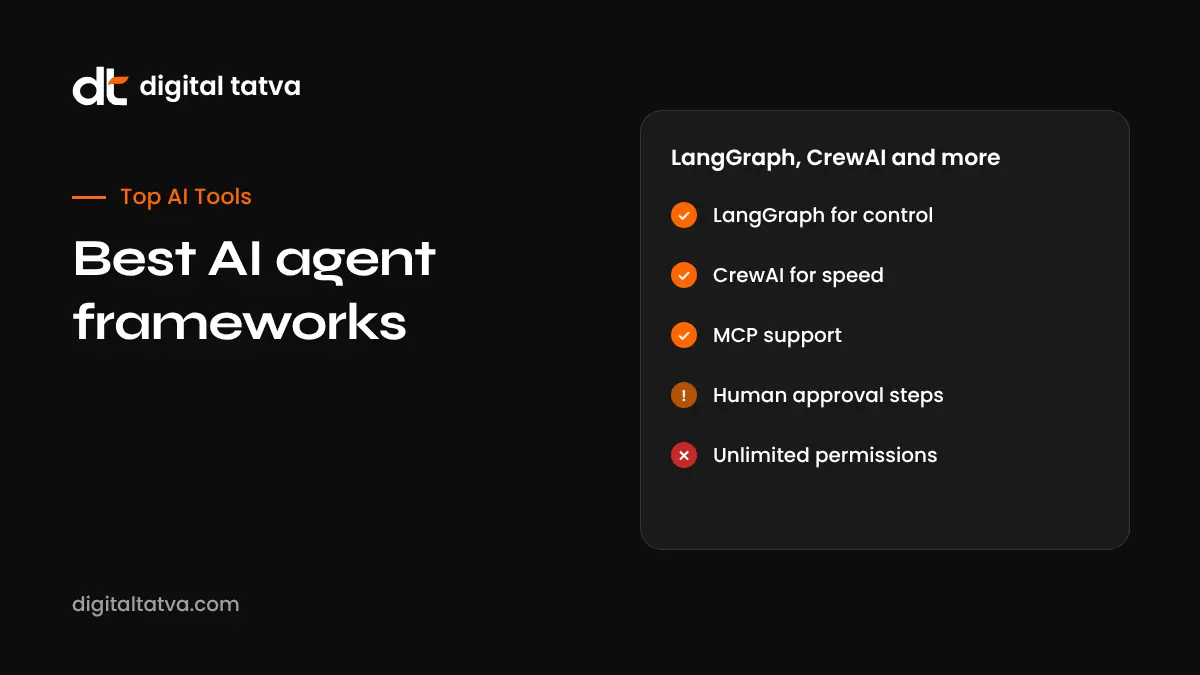
- LangGraph and Microsoft Agent Framework give the most control for complex, long-running workflows.
- CrewAI and the OpenAI Agents SDK are fastest to prototype.
- Model Context Protocol (MCP) support is now standard for connecting tools.
- Observability, evaluation and human approval steps matter more than the framework choice.
What is an AI agent framework?
An AI agent framework is a software library that helps developers build AI systems that plan, use tools, remember context and take actions, rather than just answer one prompt. Frameworks handle common needs: calling tools and APIs, managing state and memory, coordinating multiple agents, retrying failures, streaming output and tracing what happened. For background, read how to build an AI agent.
The best AI agent frameworks compared
| Framework | Language | Licence | Best for |
|---|---|---|---|
| LangGraph | Python, JavaScript | MIT | Stateful, controllable workflows with loops and human approval |
| CrewAI | Python | MIT | Role-based teams of agents, fast prototyping |
| OpenAI Agents SDK | Python, JavaScript | MIT | Lightweight agents with handoffs, guardrails and tracing |
| Google ADK | Python, Java and more | Apache 2.0 | Gemini and Google Cloud deployments |
| Microsoft Agent Framework | Python, .NET | MIT | Enterprise and Azure teams; successor to AutoGen and Semantic Kernel |
| Claude Agent SDK | Python, TypeScript | Anthropic’s terms | Agents that read files, run commands and use tools like Claude Code |
| LlamaIndex Workflows | Python | MIT | Agents over documents and data (RAG) |
| Mastra | TypeScript | Apache 2.0 core | Production agents for JavaScript developers |
| Pydantic AI | Python | MIT | Type-safe, structured outputs |
| smolagents | Python | Apache 2.0 | Minimal code-writing agents from Hugging Face |
Licence details from LangChain’s 2026 framework overview and project repositories; always check the current repository.
1. LangGraph
LangGraph, from the LangChain team, models agents as graphs of steps with shared state. It supports loops, branching, persistence, time travel debugging and human-in-the-loop approvals. It is lower level than some alternatives, which means more code but more control. LangSmith adds tracing and evaluation. Choose it for production workflows where reliability and auditability matter.
2. CrewAI
CrewAI lets you define agents with roles, goals and backstories, then assign tasks to a “crew”. It is intuitive and fast to prototype, supports local models and MCP, and has an enterprise platform. Choose it for content pipelines, research teams of agents or quick proofs of concept.
3. OpenAI Agents SDK
A minimal framework with agents, tools, handoffs between agents, guardrails and built-in tracing. It works best with OpenAI models and the Responses API but supports others through adapters. Choose it if you want simple code and you already use OpenAI.
4. Google Agent Development Kit (ADK)
ADK is Google’s open source framework with a built-in development UI, command line tools, session management and easy deployment to Vertex AI Agent Engine and Cloud Run. It supports the Agent2Agent (A2A) protocol for agents to talk to each other. Choose it for Gemini-based agents on Google Cloud.
5. Microsoft Agent Framework
Microsoft combined AutoGen’s multi-agent research and Semantic Kernel’s enterprise features into one SDK for Python and .NET, with graph-based workflows, OpenTelemetry observability and Azure AI Foundry integration. Choose it if your organisation runs on Microsoft and Azure.
6. Claude Agent SDK
Anthropic’s Agent SDK gives developers the same agent loop that powers Claude Code: reading and writing files, running commands, searching, using MCP tools, managing context and spawning subagents. Choose it for coding agents, research agents and automation that needs a computer-like environment.
7. LlamaIndex Workflows
Event-driven orchestration built for agents that search and reason over documents, PDFs and databases. Choose it for knowledge assistants and retrieval-heavy apps.
8. Mastra
A TypeScript framework with workflows, memory, evaluations and a local Studio. Choose it if your team builds in Next.js or Node.js.
9. Pydantic AI
From the Pydantic team, it emphasises type safety, validated structured outputs and dependency injection. Choose it for reliable Python agents that must return clean data.
10. smolagents
Hugging Face’s small library for agents that write and run code to solve tasks, working with open models. Choose it for experiments and open model projects. See Hugging Face explained.
No-code and low-code alternatives
Not every team needs code. Tools like n8n, Zapier Agents, Make, Microsoft Copilot Studio and OpenAI’s AgentKit and Agent Builder let you create agents visually. See our list of the best AI agents for ready-made options.
How to choose an agent framework
| Question | Suggested direction |
|---|---|
| Do you need fine control and audit trails? | LangGraph or Microsoft Agent Framework |
| Do you want the fastest prototype? | CrewAI or OpenAI Agents SDK |
| Are you on Google Cloud? | Google ADK |
| Are you a TypeScript team? | Mastra, or JavaScript versions of LangGraph or OpenAI Agents SDK |
| Does your agent need to work with files and run code? | Claude Agent SDK or smolagents |
| Is it mostly about documents? | LlamaIndex Workflows |
Protocols that matter: MCP and A2A
The Model Context Protocol, created by Anthropic and now widely adopted, standardises how agents connect to tools and data. Google’s Agent2Agent protocol focuses on communication between agents. Choosing frameworks that support these protocols reduces lock-in. Learn more in what is MCP.
Production checklist for AI agents
- Start with one clear, measurable task.
- Limit tools and permissions to what the agent needs.
- Add human approval for payments, emails or data changes.
- Log and trace every step for debugging.
- Build evaluation sets to test quality before release.
- Set cost limits and timeouts.
- Protect against prompt injection from web pages and documents.
- Plan for model changes and fallbacks.
Illustrative example: an agency research agent
This is an illustrative scenario, not a client story.
A digital agency wants an internal agent that researches a prospect’s website, checks how AI assistants describe the brand and drafts an audit outline. The developer prototypes with CrewAI using three roles: researcher, analyst and writer. For production, she rebuilds it in LangGraph to add retries, saved state and a human approval step before anything is sent to clients. MCP servers connect the agent to the CRM and a search tool, and LangSmith traces help the team fix errors. Every report is reviewed by a strategist before use.
Why agent frameworks matter for businesses
As more customers use AI agents to research and buy, those agents need clear, structured, accurate information about your products. Websites with clean data, schema and direct answers are easier for agents to use. Read how AI search engines work.
How Digital Tatva can help
Digital Tatva helps businesses prepare their websites and brand data for AI assistants and agents through answer engine optimisation. See our AEO services.
Is your website ready for AI agents? Request an AEO audit or try the free AI visibility checker.
Frequently asked questions
What is the best AI agent framework?
There is no single best. LangGraph is a common choice for control, CrewAI for speed, Google ADK for Google Cloud and Microsoft Agent Framework for Azure.
Is LangGraph better than CrewAI?
LangGraph offers more control and is often preferred for production. CrewAI is faster to start and easier for role-based teams.
Are AI agent frameworks free?
Most are open source and free. You pay for model API usage, hosting and optional commercial platforms.
What replaced AutoGen?
Microsoft Agent Framework combines AutoGen and Semantic Kernel into one SDK.
What is the OpenAI Agents SDK?
A lightweight open source framework from OpenAI for building agents with tools, handoffs, guardrails and tracing.
What is Google ADK?
Google’s open source Agent Development Kit for building and deploying agents, optimised for Gemini and Google Cloud.
Do I need a framework to build an agent?
No. Simple agents can be built directly with model APIs, but frameworks help with state, tools, tracing and multi-agent coordination.
What is MCP in AI agents?
The Model Context Protocol is an open standard for connecting AI agents to tools and data sources.
Which framework is best for TypeScript?
Mastra is popular, and LangGraph and the OpenAI Agents SDK also have JavaScript versions.
Can agent frameworks use open source models?
Yes. Most frameworks support open models through providers or local tools like Ollama.
Product details, prices and features are checked at the time of writing and can change. Sources are linked in the text so you can check them yourself.
How does your brand appear in AI answers?
We test the questions your buyers ask across the major AI assistants and search engines, then show you what to fix first.
Get an AI Visibility Audit