GPTZero vs ZeroGPT vs Turnitin: Which AI Detector Is Accurate in 2026?
An in-depth comparison of the two most visited AI detectors, with accuracy data and fair-use advice.
On this page
- Key takeaways
- Why AI detectors are so heavily searched
- How AI detectors work
- GPTZero vs ZeroGPT at a glance
- Accuracy: what tests actually show
- The false positive problem
- What about Turnitin?
- Other AI detectors worth knowing
- Which should you use?
- How to use AI detectors fairly: a guide for teachers
- Guide for students: protect yourself from false accusations
- For businesses and SEO teams
- Common myths
- Illustrative example: a college handling a flagged essay
- AI detector checklist
- Verdict
- How Digital Tatva can help
- Frequently asked questions
Last updated: 19 November 2026
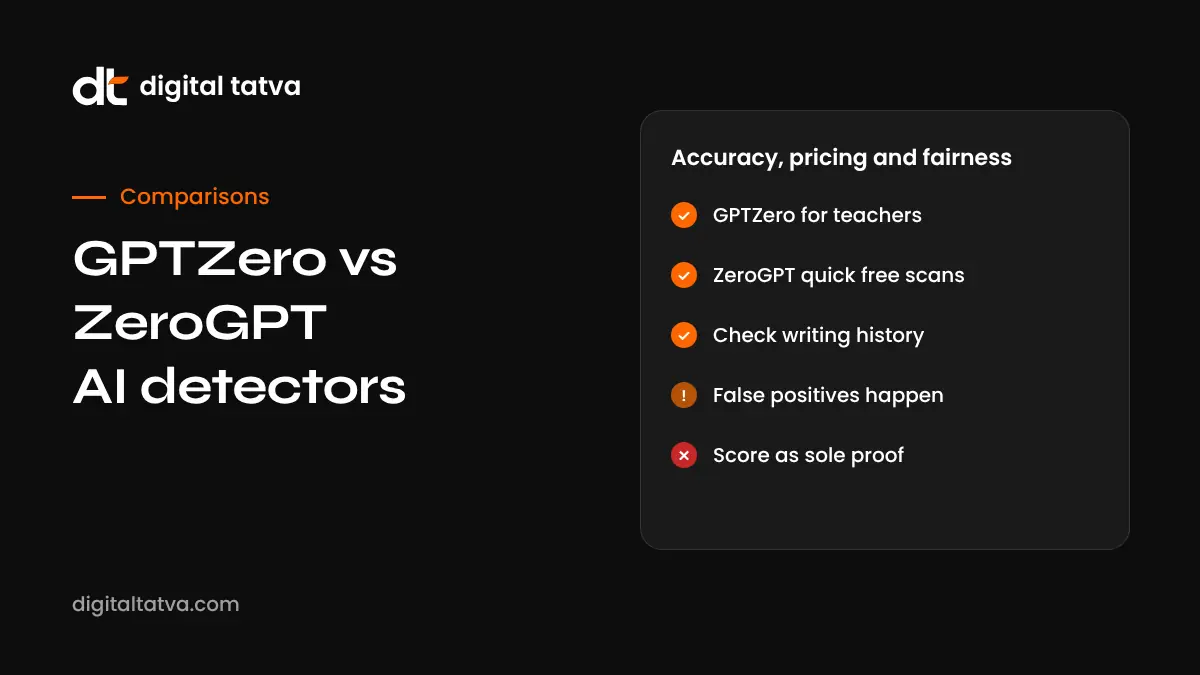
Quick answer: GPTZero is generally the more accurate and education-focused AI detector, with plagiarism checks, a writing-process view, Chrome and LMS integrations, and paid plans from about $8.33 to $23.99 per month. ZeroGPT is the easier free option with no sign-up and bigger per-check limits, but independent tests have found much higher false positive rates, in some studies flagging around a fifth to a quarter of human writing as AI. Turnitin’s AI detection is only available through institutions. No AI detector is reliable enough to prove that someone used AI, and all of them struggle with paraphrased text and with writing by non-native English speakers. Use detector scores as one signal, never as the only evidence.
Key takeaways
- ZeroGPT had about 41.9 million monthly visits and GPTZero about 24.1 million in October 2026, according to Semrush data reported by Exploding Topics; GPTZero grew about 82% in four months.
- GPTZero publishes strong benchmark scores, but independent real-world tests report lower accuracy, around 82% to 87%.
- ZeroGPT advertises over 98% accuracy, while independent tests reported around 74% accuracy and false positive rates above 20%.
- Both tools are weaker on humanized or paraphrased AI text.
- Non-native English writing is falsely flagged far more often, a problem first highlighted by a 2023 Stanford study.
Why AI detectors are so heavily searched
Since ChatGPT launched, students, teachers, editors, recruiters and SEO teams have wanted to know one thing: was this written by AI? AI detectors became some of the most visited AI tools on the web. In October 2026, ZeroGPT and GPTZero both ranked in the top 30 AI tools by traffic. Students check their own work before submitting, teachers screen assignments, and businesses check freelance content. Understanding what these tools can and cannot do protects everyone from bad decisions.
How AI detectors work
AI detectors are themselves AI models trained to recognise statistical patterns in text. Two common signals are:
- Perplexity: how predictable each word is. AI text tends to choose likely words, so it is often more predictable.
- Burstiness: how much sentence length and structure vary. Human writing usually mixes short and long sentences more unevenly.
Modern detectors combine these with classifiers trained on large sets of human and AI writing. The result is a probability, not proof. Simple, formulaic or very polished human writing can look “AI-like”, and AI text that has been edited or paraphrased can look human. That is why false positives and false negatives are unavoidable.
GPTZero vs ZeroGPT at a glance
| Feature | GPTZero | ZeroGPT |
|---|---|---|
| Company | GPTZero, founded by Edward Tian and Alex Cui | A separate company, unrelated to GPTZero |
| Free plan | About 10,000 words per month, account needed for most features | Up to about 15,000 characters per check, no account needed |
| Paid plans | Essential about $14.99 per month ($8.33 annually), Premium about $23.99 ($12.99 annually), Professional custom | Pro about $9.99 per month, Max about $26.99 per month, Enterprise custom |
| Sentence highlighting | Yes | Yes |
| Plagiarism checker | Yes, on paid plans | Yes, as a bundled tool |
| Writing process view | Yes, shows how a document was written in Google Docs | No |
| Integrations | Chrome extension, Canvas, Blackboard, Moodle, API | WhatsApp and Telegram on higher plans, API |
| Other tools | AI scan reports, source checks | Paraphraser, summariser, grammar checker, translator |
| Best for | Teachers, schools, publishers | Quick free checks |
Prices are from fast.io’s 2026 reviews of both tools and may vary by region and promotion. Check each website before buying.
Accuracy: what tests actually show
GPTZero
GPTZero reports very high accuracy on benchmarks, including a 99.5% score on a Chicago Booth benchmark cited in reviews. Independent real-world tests reported lower figures, around 82% to 87% overall. Detection rates varied by model, with one review reporting about 90% for GPT-4o text, 86.7% for Claude 3.5 and 84% for Gemini Pro. Accuracy fell to about 68% on paraphrased or “humanized” text. GPTZero says it added a de-biasing layer for non-native English writing and reported a false positive rate of about 1.1% on that dataset.
ZeroGPT
ZeroGPT advertises accuracy above 98%. Independent results cited in 2026 reviews were much lower: one 160-text benchmark found about 73.8% accuracy with a 20.5% false positive rate, and a study of 37,874 human-written essays found a 26.4% false positive rate. Paraphrased text from newer models was detected only about 22% of the time in one test. Technical writing produced some of the worst results.
| Measure | GPTZero (reported) | ZeroGPT (reported) |
|---|---|---|
| Vendor claim | Up to about 99% on benchmarks | Over 98% |
| Independent real-world accuracy | About 82% to 87% | About 74% |
| False positives on human text | Low in vendor tests; varies independently | About 20% to 26% in independent tests |
| Paraphrased AI text | About 68% detected | As low as about 22% detected |
Figures come from third-party reviews and studies compiled in 2026 and vary between tests. Treat them as indicators, not exact measures.
The false positive problem
A false positive means human writing is wrongly labelled as AI. This is the most harmful mistake, because it can lead to accusations against honest students or writers. Research has repeatedly found that:
- Non-native English writers are flagged far more often. A 2023 Stanford study found 61.3% of TOEFL essays by non-native speakers were misclassified as AI across several detectors.
- Formulaic writing, such as lab reports, legal text and short answers, looks “predictable” and gets flagged.
- Writing polished with grammar tools can be scored as AI.
- Short texts produce unreliable scores.
For Indian students and professionals who write in English as a second language, this matters a lot. Many universities have discouraged or stopped relying on AI detectors for disciplinary decisions for this reason.
What about Turnitin?
Turnitin, widely used by universities including in India, includes AI writing detection in its institutional licences. Individuals generally cannot buy it directly. Turnitin has said it aims to keep false positives low and shows an AI percentage with highlighted passages to instructors. Like all detectors, it is not proof, and Turnitin itself advises instructors to use the score as a starting point for a conversation.
Other AI detectors worth knowing
| Tool | Known for |
|---|---|
| Originality.ai | Content agencies and SEO teams; strong on paraphrased text in some tests |
| Pangram Labs | Newer detector with strong benchmark results |
| Copyleaks | Plagiarism plus AI detection for institutions |
| Google SynthID Detector | Checks for Google’s watermark in AI images, audio, video and text |
See our full list of the best AI detectors and our SynthID Detector guide.
Which should you use?
| You are | Recommendation |
|---|---|
| A teacher screening assignments | GPTZero, alongside conversations, drafts and writing history |
| A school or university | Institutional tools such as Turnitin or GPTZero with a clear policy |
| A student checking your own work | Either for a rough check, but focus on keeping drafts and notes as evidence of your process |
| A content manager checking freelancers | GPTZero or Originality.ai, plus editorial review for quality |
| Someone wanting a quick free scan | ZeroGPT, keeping its false positive rate in mind |
How to use AI detectors fairly: a guide for teachers
- Set a clear AI policy before assignments, explaining what AI use is allowed.
- Use the score as a signal, not a verdict.
- Check writing history, such as Google Docs version history or GPTZero’s writing process view.
- Compare with the student’s earlier work and in-class writing.
- Have a conversation and ask the student to explain their ideas and sources.
- Consider language background and the known bias against non-native writers.
- Document the process and follow your institution’s procedures.
- Design assessments with drafts, oral components and personal reflection that are harder to outsource.
Guide for students: protect yourself from false accusations
- Write in Google Docs or Word with version history turned on.
- Keep notes, outlines and research links.
- Follow your school’s AI rules and disclose permitted AI use.
- If flagged, calmly share your drafts and explain your process.
- Do not use “AI humanizer” tools to disguise AI text where AI is not allowed; that is still misconduct.
Read best AI tools for students and AI for kids for responsible use.
For businesses and SEO teams
Google does not penalise content simply because AI helped write it; it judges helpfulness and quality. An AI detector score therefore tells you little about whether a page will rank or be cited by AI assistants. Instead of chasing a “100% human” score, focus on accuracy, original insight, real examples and expert review. See does Google penalize AI content.
Common myths
| Myth | Reality |
|---|---|
| “99% accurate” means almost never wrong | Real-world accuracy is lower, and even 1% false positives affects many people at scale |
| A 0% AI score proves human writing | Edited or paraphrased AI text often passes |
| A high AI score proves cheating | Human writing can be flagged, especially from non-native writers |
| Detectors know which AI tool was used | They estimate patterns; source identification is unreliable |
| Google uses AI detectors to rank pages | Google focuses on quality and helpfulness, not AI detection scores |
Illustrative example: a college handling a flagged essay
This is an illustrative scenario, not a client story.
An engineering college in Pune runs final-year reports through its institutional detector. One student’s report is flagged at 64% AI. Instead of failing the student, the faculty member opens the Google Docs version history, which shows two weeks of gradual edits, and compares it with the student’s earlier assignments. In a short meeting, the student explains the methodology clearly. The flag is dismissed. The college later updates its policy so detector scores alone never trigger penalties.
AI detector checklist
- Know the tool’s limits and false positive risk.
- Use more than one signal: drafts, history, conversation.
- Avoid decisions based on short texts.
- Consider language background.
- Keep a fair, written AI policy.
- Focus on quality and learning outcomes, not just scores.
Verdict
GPTZero is the better choice for most teachers and organisations because of its accuracy record, writing process features and integrations. ZeroGPT is convenient for free, quick checks but has a higher risk of false positives. Whichever you use, remember the most important rule: an AI detector score is a clue, not a conviction.
How Digital Tatva can help
Digital Tatva helps businesses build AI-assisted content workflows that produce accurate, expert pages trusted by Google and AI assistants, without chasing detector scores. See our content optimization service.
Want content that ranks and gets cited by AI? Request an AEO audit or try the free AI visibility checker.
Related reading: How Do AI Detectors Work? Accuracy, False Positives and What to Do If You’re Flagged
Frequently asked questions
Is GPTZero better than ZeroGPT?
Independent tests generally show GPTZero with higher accuracy and fewer false positives. ZeroGPT is easier for free, quick checks.
Is ZeroGPT accurate?
ZeroGPT claims over 98% accuracy, but independent tests reported around 74% accuracy and false positive rates above 20%.
Is GPTZero free?
GPTZero has a free plan with a monthly word limit. Paid plans add higher limits, plagiarism checks and more features.
How much does GPTZero cost?
Reviews list Essential at about $14.99 per month or $8.33 per month annually, and Premium at about $23.99 per month or $12.99 per month annually.
Are GPTZero and ZeroGPT the same company?
No. They are separate companies with similar names.
Can AI detectors be wrong?
Yes. All AI detectors produce false positives and false negatives. Scores should never be the only evidence.
Why was my human-written essay flagged as AI?
Predictable phrasing, formulaic structure, heavy grammar-tool editing or non-native English patterns can trigger false positives.
Does Turnitin detect ChatGPT?
Turnitin includes AI writing detection for institutions. It gives instructors an AI percentage, which should be treated as a starting point, not proof.
Can AI detectors detect Claude and Gemini?
Reviews show detection rates vary by model and are lower for newer or edited text.
Does Google penalise content flagged by AI detectors?
No. Google evaluates helpfulness and quality, not detector scores.
Product details, prices and features are checked at the time of writing and can change. Sources are linked in the text so you can check them yourself.
How does your brand appear in AI answers?
We test the questions your buyers ask across the major AI assistants and search engines, then show you what to fix first.
Get an AI Visibility Audit