15 Biggest AI Launches of November 2026: Models, Money and Agents
The biggest AI models, products and business news of November 2026 in one place.
On this page
- Key takeaways
- November 2026 AI launches at a glance
- The biggest AI model launches
- The biggest AI business news
- The biggest AI product launches for work
- The biggest AI creative launches
- The biggest AI developer launches
- Other notable AI news from November 2026
- What November 2026 means for you
- How Digital Tatva can help
- Frequently asked questions
Last updated: 22 November 2026
Quick answer: The biggest AI launches and news of November 2026 so far are: Claude Fable 5.2 and Mythos 5.2 (9 November), GPT-6.2 Astra and Sol (17 November), the Gemini 4 Carbon, Neon and Hydrogen models, Alibaba’s Qwen4-Max (16 November), Moonshot’s open-weight Kimi K3.1 Pro, Anthropic’s record IPO (priced at $83 per share on 18 November and trading as ANT from 19 November), Jensen Huang stepping down as Nvidia CEO (12 November) followed by a record quarter, Microsoft Ignite 2026 (17 to 20 November), new Claude office tools, xAI’s Grok Bot 1.0, Meta’s Muse Ember, OpenAI Images 2.6, HeyGen Avatar 6, Google’s Antigravity swarm mode and a wave of open-weight releases. Google’s November 2026 core update and Pixel Drop also started rolling out on 10 November.
Key takeaways
- All three leading labs shipped new frontier models within about a week of each other.
- Artificial Analysis ranked Claude Fable 5.2 first and GPT-6.2 Astra second on its Intelligence Index after the launches.
- November was a month of money news as much as models: the largest IPO on record and a CEO change at Nvidia.
- Agents went to work: Microsoft, Anthropic, Google and xAI all launched team and office agents.
- Open weights kept coming, led by Kimi K3.1 Pro and several Apache-licensed models.
November 2026 AI launches at a glance
| # | Launch | Company | Date | Why it matters |
|---|---|---|---|---|
| 1 | Claude Fable 5.2 and Mythos 5.2 | Anthropic | 9 Nov | Top of the Artificial Analysis Intelligence Index |
| 2 | GPT-6.2 Astra and Sol | OpenAI | 17 Nov | Cheaper flagship and new everyday model |
| 3 | Gemini 4 Carbon, Neon and Hydrogen | November | Full Gemini 4 line-up for heavy, coding and fast work | |
| 4 | Qwen4-Max | Alibaba | 16 Nov | Low-cost flagship with 1M context |
| 5 | Kimi K3.1 Pro open weights | Moonshot AI | Early Nov | One of the largest open-weight models available |
| 6 | Anthropic IPO | Anthropic | 18 to 19 Nov | Largest IPO on record |
| 7 | Nvidia CEO change and record quarter | Nvidia | 12 and 17 Nov | Leadership shift at the key AI chip supplier |
| 8 | Microsoft Ignite 2026 | Microsoft | 17 to 20 Nov | Copilot Home, Office in Copilot, Autopilot agent |
| 9 | Claude Sheets, Whiteboards and Claude Data | Anthropic | November | Claude moves into office work |
| 10 | Grok Bot 1.0 | xAI | November | Shared AI teammate for Slack, Teams and meetings |
| 11 | Muse Ember | Meta | November | Low-cost model for agent workloads |
| 12 | Images 2.6 | OpenAI | Early Nov | Faster image models, GIF and SVG export |
| 13 | HeyGen Avatar 6 | HeyGen | 17 Nov | More realistic AI avatars from one photo |
| 14 | Antigravity swarm mode and Gemini Decisions API | November | Multi-agent coding and cheap classification | |
| 15 | Open-weight wave | MiniMax, Pika, Nous Research, others | November | More capable models you can run yourself |
The biggest AI model launches
1. Claude Fable 5.2 and Claude Mythos 5.2
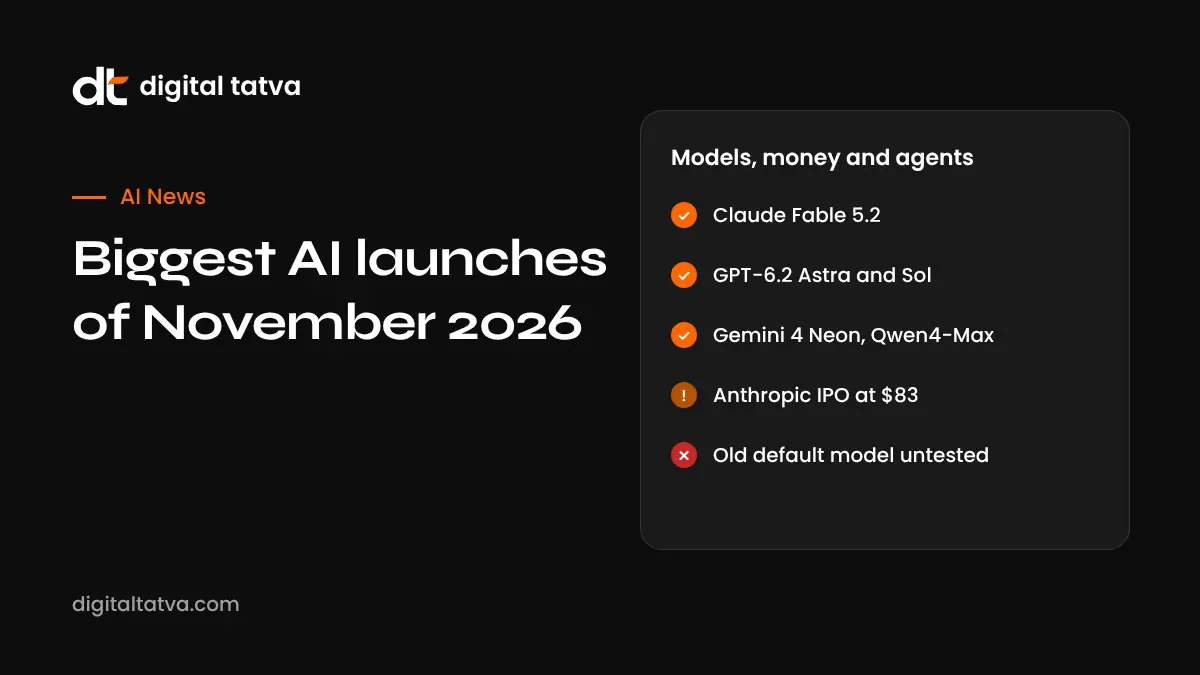
Anthropic released Claude Fable 5.2 and Mythos 5.2 on 9 November 2026. They share one underlying model at the top of Anthropic’s range. Fable 5.2 is the widely available version with extra safeguards for cybersecurity and biology, offered in Claude apps, the API, AWS, Google Cloud and Microsoft Azure. Mythos 5.2 is limited to vetted cybersecurity and life sciences organisations. API pricing is $8 per million input tokens and $40 per million output tokens, with an optional fast mode. After launch, Artificial Analysis placed Fable 5.2 first on its Intelligence Index with a score of 65. Anthropic still suggests Claude Opus 5.5 for most everyday work. Full details: Claude Fable 5.2 and Mythos 5.2.
2. GPT-6.2 Astra and GPT-6.2 Sol
OpenAI released GPT-6.2 Astra and Sol on 17 November 2026. Astra is the flagship for demanding professional work and costs $8 input and $40 output per million tokens, 20% less than GPT-6 Astra. Sol is the faster everyday model at $2 and $10. Both are in ChatGPT paid plans, ChatGPT Work and Codex. Artificial Analysis ranked Astra second, behind Fable 5.2. Some early power users found Astra harder to steer on long autonomous tasks, so test it on your own work. Full details: GPT-6.2 Astra and Sol explained.
3. Gemini 4 Carbon, Neon and Hydrogen
Google filled out its Gemini 4 family. Gemini 4 Carbon, the heavyweight model, became generally available with introductory API pricing that steps up after 30 November. Gemini 4 Neon targets complex coding and knowledge work at $3 input and $15 output per million tokens, with a 1 million token context window, and Google says it ranked first on the Artificial Analysis Coding Agent Index. Gemini 4 Hydrogen is the fast, low-cost tier. Read Gemini 4 Neon explained and Gemini 4 Carbon vs GPT-6.1 Sol.
4. Qwen4-Max
Alibaba launched Qwen4-Max on 16 November 2026 after a preview on 11 November. It has a 1 million token context window, accepts text, images and video, and costs $1.50 input and $4.50 output per million tokens on the Singapore endpoint. Artificial Analysis scored it 42.9, well up from its predecessor but behind the top Western models. Unlike many earlier Qwen releases, it has no open weights yet. See Qwen4-Max explained.
5. Kimi K3.1 Pro open weights
Moonshot AI released the weights of Kimi K3.1 Pro in early November: a mixture-of-experts model with about 2.8 trillion parameters, roughly 104 billion active, a 1 million token context and image input. Its modified licence asks large products to credit Kimi. It is one of the most capable models you can download, though running it needs serious hardware. See Kimi K3.1 Pro review.
The biggest AI business news
6. Anthropic’s record IPO
Anthropic priced its IPO at $83 per share on 18 November 2026, above its $70 to $78 range, and began trading on Nasdaq as ANT on 19 November. Reports put the raise at about $81 billion, the largest IPO on record, with a valuation of around $1.5 trillion. Shares opened at $111.50 and closed the first day at $87.17. Filings showed revenue of $33.24 billion for the first nine months of 2026. This is not investment advice; read the filings and speak to a licensed adviser before buying any stock. Background: Anthropic IPO explained.
7. Jensen Huang steps down, then Nvidia posts a record quarter
On 12 November Nvidia said co-founder Jensen Huang had stepped down as president, CEO and board member, effective immediately. CFO Colette Kress became interim CEO. Nvidia’s filing gave no reason, and news reports linked the move to reports about Huang’s personal relationships. Five days later Nvidia reported record third-quarter revenue of $115.8 billion, up 103% year on year. See Jensen Huang steps down as Nvidia CEO.
8. Microsoft Ignite 2026
Ignite (17 to 20 November) was all about agents: Copilot Home combining Chat and Cowork with a choice of OpenAI or Anthropic models, Office in Copilot reaching general availability, Autopilot as an always-on personal agent in early access, Copilot Code promised for December and Microsoft IQ to connect agents to work data. Many features were announced as previews, so check status before planning. See Microsoft Ignite 2026 announcements.
The biggest AI product launches for work
9. Claude Sheets, Whiteboards and Claude Data
Anthropic pushed Claude further into office work, with Sheets and Whiteboards in beta and Claude Data generally available with connectors to data platforms such as Snowflake, BigQuery and Databricks. See Claude Meetings, Sheets and Whiteboards.
10. Grok Bot 1.0
xAI launched Grok Bot 1.0, a shared team bot for Slack, Microsoft Teams and meeting calls. It is xAI’s first serious move into workplace collaboration. See Grok Bot 1.0.
11. Meta Muse Ember
Meta released Muse Ember, the smallest and cheapest model in its Muse family, aimed at high-volume agent workloads. It has closed weights. See Meta Muse Ember.
The biggest AI creative launches
12. OpenAI Images 2.6
OpenAI updated its image models with two API options: a fast model and a higher-quality model at the previous generation’s prices. OpenAI says generation is about 50% faster, and ChatGPT gained GIF and SVG export. See GPT Image 2.6.
13. HeyGen Avatar 6
HeyGen launched Avatar 6 on 17 November 2026. It creates video of a person from a single photo or short recording, with gestures that follow the script, native 2K output and a Turbo version. Use it only with clear consent from the person being shown. See HeyGen Avatar 6.
The biggest AI developer launches
14. Antigravity swarm mode and the Gemini Decisions API
Google added a swarm mode to Antigravity in which a coordinator sends parallel tasks to multiple agents that share a message board. It also introduced a Decisions API for yes-no, multiple-choice and scoring questions at very low cost, useful for classification and moderation at scale. See how to use Google Antigravity.
15. A wave of open-weight releases
Beyond Kimi, November brought several open models: MiniMax’s H3-Image for high-resolution images, Pika’s H3 Flex video model, Nous Research’s Apache-licensed Arete-27B and the Apache-licensed Ripple-65B preview. Benchmarks for these are mostly self-reported, so test before relying on them. See open source AI models and best Chinese AI models.
Other notable AI news from November 2026
- Google November 2026 core update: started rolling out on 10 November, with up to two weeks to complete. See what to do now.
- Pixel Drop: Gemini can complete multi-step tasks like ordering food and booking rides in more countries. See the November Pixel Drop.
- Siri App Intents preview: Apple opened Siri to App Intents from any app in iOS 27.3 developer betas.
- GPT-6 Cyber: OpenAI released a security-focused model for vetted defenders in its Daybreak programme.
- CrowdStrike: added an AI kill switch and agreed to buy AI security startups.
- Signal: began blocking screenshots by default on Android and iOS, citing risks from operating-system AI agents.
- OpenAI and AMD: OpenAI said its models helped improve AMD chip designs; AMD has not published its own figures.
- Cognition SWE-2 Flash: a cheaper, faster coding model for Devin users.
What November 2026 means for you
- Retest your default model. With Fable 5.2, GPT-6.2 and Gemini 4 all new, the best model for your tasks may have changed. Run your top five prompts through each.
- Review API costs. New cheaper tiers (Sol, Neon, Hydrogen, Qwen4-Max) can cut bills for routine work. See LLM API pricing comparison.
- Pilot one office agent. Copilot, Claude and Grok all launched team agents. Pick one process and test it with clear permissions.
- Check your search visibility after the core update. Compare a full week after completion with the week before.
- Update your AI policy. New avatar, voice and agent tools need consent and data rules.
Illustrative example: A content agency runs the same 20 client briefs through Claude Fable 5.2, GPT-6.2 Sol and Gemini 4 Neon in one afternoon. It keeps its main model for long-form writing, moves bulk product descriptions to a cheaper tier and documents the results so the team knows which model to use for which job. This is an illustrative scenario, not a client story.
Checklist: catching up on November 2026
- Top prompts retested on the new models.
- API model choices and budgets reviewed.
- One agent pilot chosen with an owner.
- Core update impact measured after rollout.
- Consent rules set for avatar and voice tools.
- Brand visibility rechecked in updated assistants.
How Digital Tatva can help
Every new model changes how AI assistants find and describe brands. Digital Tatva monitors your visibility across ChatGPT, Claude, Gemini, Perplexity and Google AI answers and fixes the gaps. See our AEO services.
Did the new models change how AI describes your brand? Request an AEO audit or try the free AI visibility checker.
Frequently asked questions
What was the biggest AI launch of November 2026?
On models, Claude Fable 5.2 and GPT-6.2 Astra were the biggest, with Fable 5.2 ranked first and Astra second on the Artificial Analysis Intelligence Index. On business news, Anthropic’s IPO was the largest on record.
When was GPT-6.2 released?
OpenAI released GPT-6.2 Astra and GPT-6.2 Sol on 17 November 2026.
When was Claude Fable 5.2 released?
Anthropic released Claude Fable 5.2 and Mythos 5.2 on 9 November 2026.
What price did the Anthropic IPO price at?
Anthropic priced its IPO at $83 per share on 18 November 2026, above its $70 to $78 range, and shares began trading on Nasdaq under ANT on 19 November.
Who is Nvidia’s CEO now?
After Jensen Huang stepped down on 12 November 2026, CFO Colette Kress became interim CEO while the board searches for a permanent replacement.
What did Microsoft announce at Ignite 2026?
Copilot Home, Office in Copilot, the Autopilot personal agent, Copilot Code, Microsoft IQ and new agent management and security tools. Many were previews.
Which open-weight models were released in November 2026?
Kimi K3.1 Pro, MiniMax H3-Image, Pika H3 Flex, Nous Research Arete-27B and the Ripple-65B preview were among the open-weight releases.
Is Qwen4-Max open source?
No. Qwen4-Max launched without open weights. Alibaba says smaller Qwen 4 models will be open sourced later.
When did the Google November 2026 core update start?
It began rolling out on 10 November 2026 and could take up to two weeks to complete.
Which new model should I use?
It depends on the task. Test your real prompts on Fable 5.2, GPT-6.2 and Gemini 4, and compare quality, speed and cost before switching.
Product details, prices and features are checked at the time of writing and can change. Sources are linked in the text so you can check them yourself.
How does your brand appear in AI answers?
We test the questions your buyers ask across the major AI assistants and search engines, then show you what to fix first.
Get an AI Visibility Audit