HeyGen Avatar 6: Features, Realism Tests, API and Consent Rules
What HeyGen Avatar 6 can do, how realistic it is and how to use it responsibly.
On this page
- Key takeaways
- What is new in Avatar 6?
- How realistic is it?
- Pricing and access
- Best uses for Avatar 6
- How to create an Avatar 6 video
- HeyGen vs Synthesia vs Runway avatars
- Consent, deepfakes and the law
- Illustrative example: an edtech company scaling lessons
- Checklist
- How Digital Tatva can help
- Frequently asked questions
Last updated: 19 November 2026
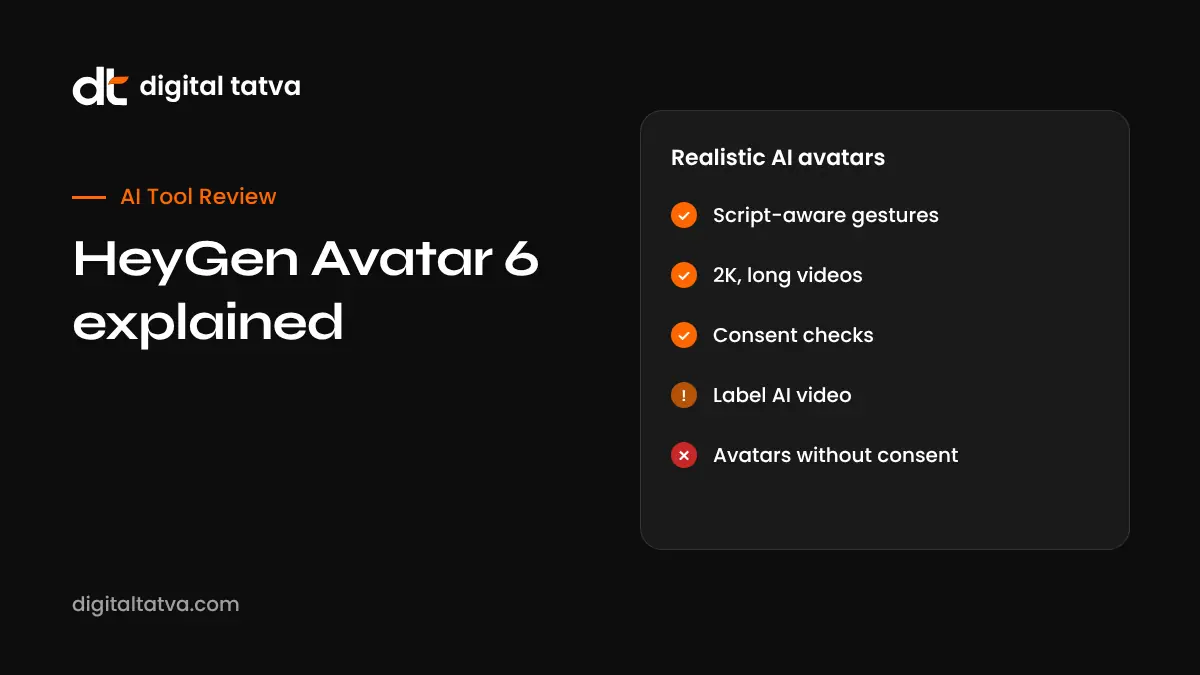
Quick answer: HeyGen Avatar 6, launched on 17 November 2026, is HeyGen’s most realistic AI avatar model. It creates video of a person from a single photo or a short identity recording, with gestures that follow the meaning of the script, such as pointing or counting at the right moment. It offers native 2K output (1080p by default in the API), no fixed duration limit, a Turbo version for faster generation and an editor that lets you replace words in recorded videos. HeyGen reports that viewers picked Avatar 6 as the real recording about as often as the real video, and it ranked first on the independent Avatar Arena. Footage-based avatars require recorded consent from the person.
Key takeaways
- Available in the HeyGen web app, mobile app and API.
- Script-aware gestures and motion prompts make videos feel less robotic.
- HeyGen’s headline “84.4%” figure is a doubled rate relative to a 50% chance baseline, not 84% of viewers being fooled.
- Consent verification is required for footage-based avatars.
- Label AI avatar videos where required and never impersonate real people without permission.
What is new in Avatar 6?
| Feature | What it does |
|---|---|
| Script-linked gestures | Places pointing, counting and directional movements based on script meaning |
| Motion prompts | Attach gestures or expressions to specific phrases |
| Single-photo avatars | Generate video from one photo, with optional short identity recording |
| 2K output | Native 2K, with 1080p default in the API |
| Long videos | No fixed duration limit; demos ran 25 to 28 minutes |
| Two speakers | Two people in one frame in demos |
| Recorded-video editor | Replace words or add gestures in real footage, regenerating only the edited part |
| Avatar 6 Turbo | Faster generation with lower latency |
Details from Unite.AI’s coverage of HeyGen’s technical report.
How realistic is it?
In HeyGen’s side-by-side test with external raters, Avatar 6 was picked as the real recording in 42.2% of answers. Because 50% would mean viewers could not tell the difference at all, HeyGen reports this as 84.4% of the chance level. In single-clip tests, 65.1% of answers judged Avatar 6 clips real, compared with 78.9% for genuine recordings. On the independent New Measure Avatar Arena, Avatar 6 ranked first for personal avatars and stock presenters, though tests used short scripts. Read claims carefully: avatars are very convincing, but not yet indistinguishable in every case.
Pricing and access
Avatar 6 is available on HeyGen’s web and mobile apps and through the API with model IDs heygen-avatar-6 and heygen-avatar-6-turbo. HeyGen’s developer platform, launched on 10 November, offers video from about $0.01 per second and free text-to-speech, according to launch coverage. Plan prices and credit costs vary, so check HeyGen’s pricing page. Some advanced features, such as realistic video references, are enterprise-only. For a walkthrough of the app, see how to use HeyGen.
Best uses for Avatar 6
- Training and onboarding videos that can be updated without reshoots.
- Product explainers and demos in multiple languages.
- Sales outreach with personalised intros, with consent and disclosure.
- Course content for educators and coaches.
- Internal communications from leadership, recorded once and updated easily.
How to create an Avatar 6 video
- Create or choose an avatar: upload a photo with permission, or record footage with the required consent statement.
- Write a clear script with short sentences.
- Add motion prompts for key moments, such as “point to the screen” or “count on fingers”.
- Choose a voice, ideally the person’s own voice with consent.
- Select Avatar 6 or Turbo and resolution.
- Preview, adjust gestures and regenerate small sections.
- Add captions and an AI disclosure where appropriate.
HeyGen vs Synthesia vs Runway avatars
| Tool | Strength |
|---|---|
| HeyGen Avatar 6 | Realism, script-aware gestures, long videos, API |
| Synthesia | Enterprise training workflows and compliance |
| Runway avatars | Fast generation and creative video tools |
See Synthesia vs HeyGen.
Consent, deepfakes and the law
Realistic avatars can be misused. HeyGen requires footage-based avatars to include a consent statement with a one-time code, and checks that the speaker matches the footage. Still, users must:
- Never create avatars of people without written consent.
- Label AI-generated video where platforms or laws require it. India’s IT Amendment Rules 2026 require labelling synthetic content; see AI rules in India.
- Avoid misleading customers about who is speaking.
- Teach staff and customers to spot deepfake scams; see how to spot deepfake scams.
Illustrative example: an edtech company scaling lessons
This is an illustrative scenario, not a client story.
An edtech startup in Jaipur has a popular maths teacher who can record only a few hours a week. With her written consent and a recorded consent statement, the team creates an Avatar 6 version. Lesson scripts are written and checked by the teacher, then turned into videos in Hindi and English with gestures that point to on-screen equations. Each video includes a short note that it uses an AI avatar of the teacher. When the syllabus changes, the team edits only the affected parts.
Checklist
- Written consent from anyone whose likeness is used.
- Scripts reviewed for accuracy.
- Gestures and tone checked in preview.
- AI disclosure added where required.
- Costs estimated per minute of video.
- Deepfake risk training for staff.
How Digital Tatva can help
Digital Tatva helps brands plan video and written content that AI assistants and search engines can understand and recommend. See our AEO services.
Is your content working in AI search? Request an AEO audit or try the free AI visibility checker.
Frequently asked questions
What is HeyGen Avatar 6?
HeyGen’s latest AI avatar model, launched on 17 November 2026, with script-aware gestures, 2K output and long video support.
Is Avatar 6 available on the free plan?
Availability by plan varies. Check HeyGen’s pricing page for which plans include Avatar 6.
What is Avatar 6 Turbo?
A faster version of Avatar 6 with lower latency.
Can Avatar 6 make a video from one photo?
Yes, with the person’s permission, optionally improved by a short identity recording.
How long can Avatar 6 videos be?
HeyGen says there is no fixed duration limit; demos ran 25 to 28 minutes.
Is Avatar 6 indistinguishable from real video?
It is very realistic, but HeyGen’s own tests show viewers still identified real recordings more often.
Does HeyGen require consent?
Yes. Footage-based avatars need a recorded consent statement with a one-time code.
Can I use Avatar 6 through an API?
Yes, using model IDs heygen-avatar-6 and heygen-avatar-6-turbo.
Do I need to label AI avatar videos?
Often yes, depending on platform rules and laws such as India’s 2026 IT rules on synthetic content.
Is HeyGen better than Synthesia?
HeyGen leads on realism and gestures; Synthesia is strong for enterprise training workflows.
Product details, prices and features are checked at the time of writing and can change. Sources are linked in the text so you can check them yourself.
How does your brand appear in AI answers?
We test the questions your buyers ask across the major AI assistants and search engines, then show you what to fix first.
Get an AI Visibility Audit