Banks Say You Are Liable for AI Agents: What Citi’s New Terms Mean
Why banks are shifting AI agent risk to customers and how to protect yourself.
On this page
- Key takeaways
- What changed
- What Citi’s terms say
- Why banks are doing this
- Types of AI money tools and their risk
- What this means in India
- How to use AI with your finances safely
- Advice for businesses
- What comes next
- Illustrative example: a freelancer choosing safe tools
- Checklist
- How Digital Tatva can help
- Frequently asked questions
Last updated: 19 November 2026
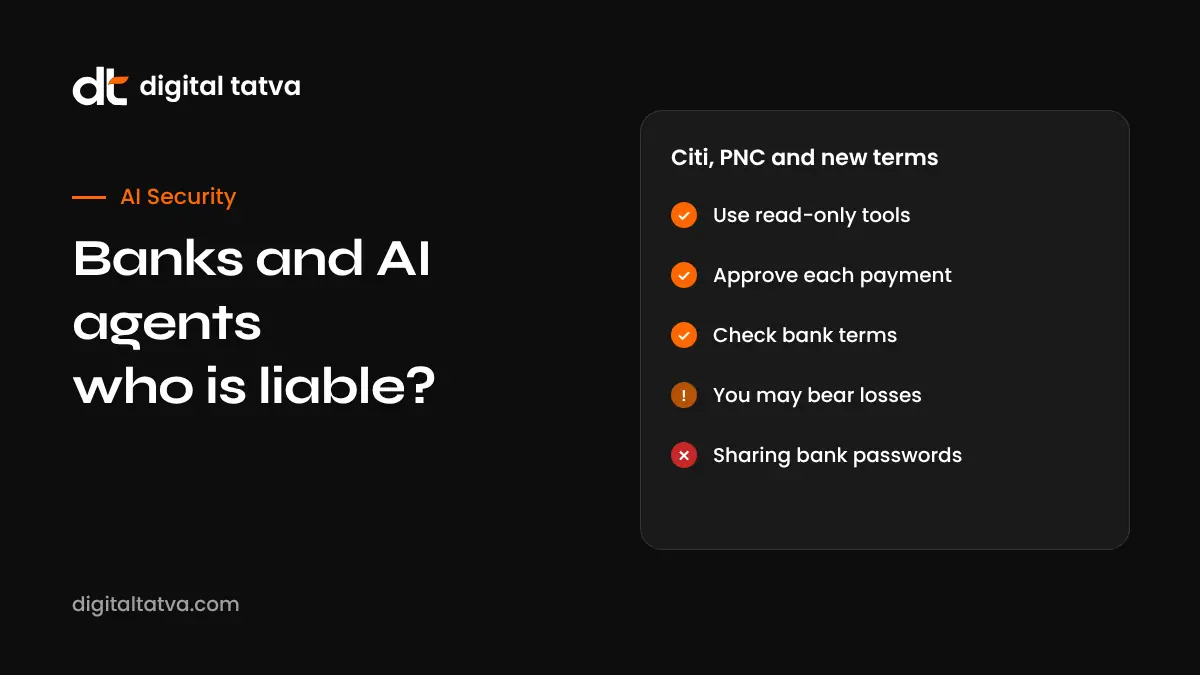
Quick answer: Several major US banks now say customers are responsible for what third-party AI agents do with their accounts, even if the agent makes a mistake or is hacked. Citi updated its Online User Agreement in November 2026, Citizens emailed customers with a similar warning, PNC changed its terms on 18 November, and JPMorgan and Bank of America announced similar positions in October. Citi’s terms treat agent actions as authorised by the customer and reserve the right to block agents at any time. The lesson for everyone, including in India: do not give AI agents your banking passwords, prefer read-only or tokenised tools with approvals, and check your bank’s terms first.
Key takeaways
- Under Citi’s new terms, the customer is responsible for an agent’s errors, unintended actions and actions beyond granted authority.
- If an agent leaks credentials or is hacked, Citi says the customer is responsible for what attackers do.
- Bank-built AI assistants carry no extra customer liability under Citi’s terms.
- Read-only tools such as Gemini with Google Wallet, and approval-based tools such as ChatGPT Wallet, reduce risk.
- Indian banks prohibit sharing passwords and OTPs; giving them to an AI agent can leave you unprotected.
What changed
| Bank | Change | When |
|---|---|---|
| Citi | New section in Online User Agreement: customers responsible for third-party AI agents’ activity | November 2026 |
| Citizens | Email warning customers they are responsible for their AI assistant’s actions | November 2026 |
| PNC | Updated terms | 18 November 2026 |
| JPMorgan and Bank of America | Similar policies; Bank of America asked customers not to share passwords with AI assistants | October 2026 |
Based on TechCrunch’s report of 18 November 2026 and Unite.AI’s summary of Citi’s terms.
What Citi’s terms say
- Citi cautions customers against using third-party agents to access accounts.
- Access and actions by an agent, and anyone it shares credentials with, are treated as authorised by the customer.
- Customers are responsible for agent errors, unintended actions and actions beyond the authority they granted, and for monitoring the agent.
- Citi can limit, suspend or block any third-party agent at any time without notice.
- Granting agent access lets Citi share data with that agent outside its usual privacy notice.
- Agent-initiated transfers are treated as directly authorised by the customer.
Why banks are doing this
- Reliability: banks see AI agents as unpredictable actors in their systems.
- Security: agents holding passwords create new attack paths, such as prompt injection and credential leaks. See AI agent security.
- Liability: banks want to avoid paying for losses they cannot control.
- Competition: TechCrunch noted that AI agents could help consumers avoid fees or move money to better accounts, threatening bank margins.
Types of AI money tools and their risk
| Type | Example | Risk |
|---|---|---|
| Read-only insights | Gemini with Google Wallet | Lower; cannot move money |
| Tokenised purchases with approval | ChatGPT Wallet with Face ID approval per purchase | Moderate; card details hidden and each purchase approved |
| Bank’s own AI assistant | In-app assistants | Covered by the bank’s normal terms |
| Third-party agent with your login | Browser agents using saved passwords | Highest; you may bear losses |
See Gemini and Google Wallet and ChatGPT Wallet explained.
What this means in India
Indian banks and the RBI have long warned customers never to share passwords, PINs or OTPs with anyone. Sharing them with an AI agent can be treated as a breach of your bank’s terms, weakening any claim if money is lost. UPI requires your own PIN for each payment, which limits what an agent can do on its own, but browser agents with saved net banking passwords can still be risky. Stick to official bank apps and read-only tools.
How to use AI with your finances safely
- Never share banking passwords, PINs or OTPs with an AI agent or chatbot.
- Prefer read-only tools for budgeting and insights.
- Use tokenised payment features with per-purchase approval and spending limits.
- Do not save banking passwords in browsers used by AI agents.
- Read your bank’s terms on third-party access.
- Turn on transaction alerts and review statements.
- Keep humans in the loop for transfers and large purchases.
Advice for businesses
- Do not let employees connect AI agents to company bank accounts without approval.
- Use corporate cards with limits for any agent purchases.
- Log agent actions and require approvals for payments.
- Check that finance tools such as ChatGPT for Accounting require human approval for entries.
- Update policies under India’s DPDP framework for any financial personal data; see AI rules in India.
What comes next
Expect more banks to publish terms on AI agents, and possibly to build approved agent connections with limited permissions. Payment networks are also building tokenised agent payments. Regulators may step in to define liability more clearly. Until then, assume you carry the risk if you hand over your credentials.
Illustrative example: a freelancer choosing safe tools
This is an illustrative scenario, not a client story.
A freelance designer in Bengaluru wants AI help with expenses. Instead of letting a browser agent log in to her net banking, she downloads her monthly statement, removes account numbers and asks an AI assistant to categorise spending and spot recurring charges. For online shopping, she uses a virtual card with a low limit. Her bank login stays only in the official app with biometric lock.
Checklist
- No passwords, PINs or OTPs shared with AI.
- Read-only tools for insights.
- Approval and limits for any purchases.
- Bank terms reviewed.
- Alerts on every transaction.
- Company policy for agent access to finances.
How Digital Tatva can help
Digital Tatva helps financial brands communicate clearly and accurately so AI assistants describe their products and safety policies correctly. See our AEO services.
How do AI assistants describe your financial brand? Request an AEO audit or try the free AI visibility checker.
Frequently asked questions
Are banks blocking AI agents?
Some banks reserve the right to block third-party AI agents and warn customers against using them for account access.
Who is liable if an AI agent misuses my bank account?
Under new terms at banks such as Citi, the customer is responsible, even if the agent is hacked.
Which banks changed their AI agent terms?
Citi, Citizens and PNC in November 2026, following JPMorgan and Bank of America in October, according to TechCrunch.
Is it safe to give ChatGPT my bank password?
No. Never share banking passwords, PINs or OTPs with any AI tool.
Is Gemini with Google Wallet safe?
It is read-only, so it cannot move money. Review privacy settings and connect only what you need.
How does ChatGPT Wallet protect payments?
It uses tokenised cards and requires approval, such as Face ID, for each purchase.
Do these rules apply in India?
These are US bank terms, but Indian banks already prohibit sharing credentials, so similar risks apply.
Can AI agents make UPI payments?
UPI payments need your PIN, so you should approve each payment yourself and never share the PIN.
Should businesses let AI agents pay bills?
Only with approvals, limits, logs and corporate cards, never with shared banking passwords.
Will banks offer approved AI agents?
Possibly. Banks may build their own assistants or approved connections with limited permissions.
Product details, prices and features are checked at the time of writing and can change. Sources are linked in the text so you can check them yourself.
How does your brand appear in AI answers?
We test the questions your buyers ask across the major AI assistants and search engines, then show you what to fix first.
Get an AI Visibility Audit