25 Best AI Startup Ideas for 2027: How to Pick, Validate and Launch
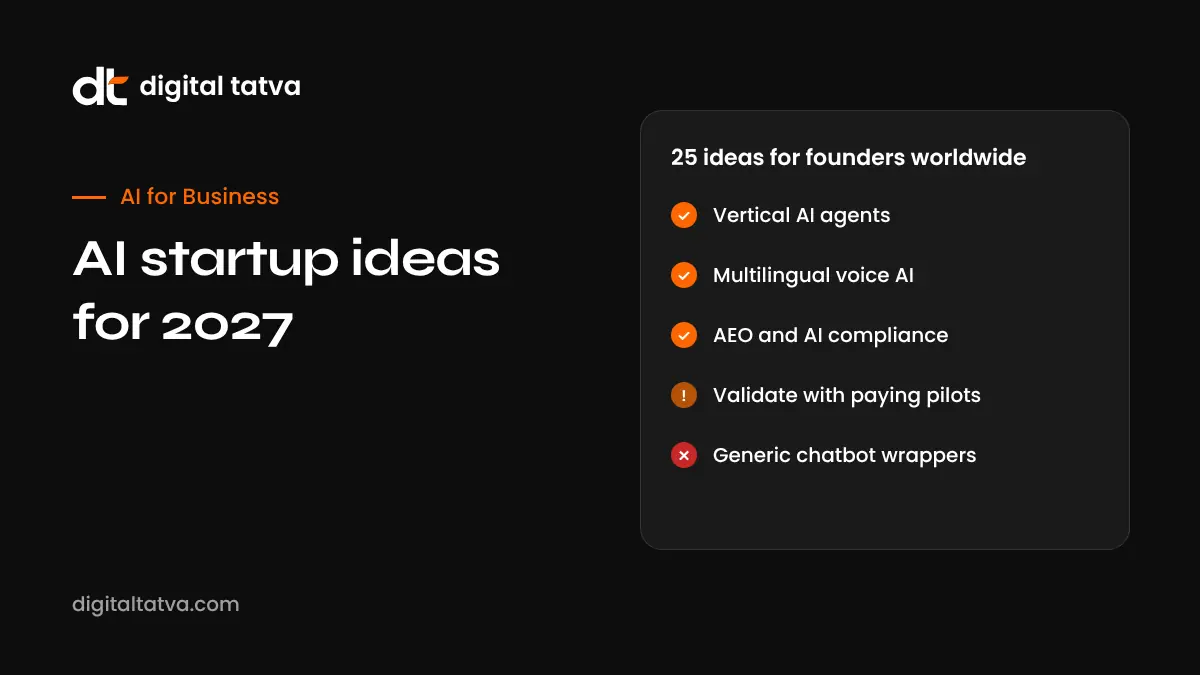
25 AI startup ideas for 2027 for founders worldwide, from vertical AI agents and multilingual voice AI to AEO, compliance and AI tutors, plus regional opportunities, validation steps and business models.
On this page
- Key takeaways
- What makes a good AI startup idea in 2027
- 25 AI startup ideas for 2027
- Comparing the ideas
- AI startup opportunities by region
- How to validate an AI startup idea
- A lean stack to build an AI startup
- Business models that work for AI startups
- Risks to plan for
- Common mistakes founders make
- Illustrative example: from service to SaaS
- AI startup idea checklist
- How Digital Tatva can help
- Frequently asked questions
Last updated: 20 November 2026
Quick answer: The best AI startup ideas for 2027 solve a narrow, expensive problem for a specific group of customers, rather than building another general chatbot. Strong areas include vertical AI agents for one industry (clinics, law firms, logistics, accounting), AI receptionists and voice agents in local languages, messaging-first AI for small businesses on WhatsApp and similar apps, AI search visibility (AEO) tools and services, AI compliance and governance tools, AI cost and model-routing tools, AI tutors for exam prep, AI for agriculture and rural services, AI dubbing and localisation, document automation, AI agent security, and AI-native services businesses that deliver outcomes using AI behind the scenes. Building has become cheaper thanks to AI coding tools and affordable models, so the real advantages now are distribution, proprietary data, deep domain knowledge and trust. Validate demand with paying customers before you build.
Key takeaways
- Pick a narrow customer and a painful, frequent, costly problem.
- Vertical and workflow-specific AI beats generic AI wrappers.
- Your edge is distribution, data, domain expertise and trust, not access to models.
- Mature markets such as the US and Europe reward compliance, integrations and enterprise trust; fast-growing markets in Asia, Africa, Latin America and the Middle East reward local-language, mobile-first and messaging-first products.
- Validate with paying pilots before writing much code, and track AI costs per customer from day one.
What makes a good AI startup idea in 2027
Large AI models are now widely available through APIs, and AI coding tools let small teams build products quickly. That means “we use GPT” or “we use Claude” is no longer a moat. Good ideas in 2027 share a few traits:
| Trait | Why it matters |
|---|---|
| Clear buyer with budget | Someone feels the pain and can pay to remove it |
| Frequent, repetitive work | AI is strongest where the same task happens again and again |
| Measurable outcome | Hours saved, leads won, errors avoided or revenue added |
| Proprietary data or workflow | Something that gets better with use and is hard to copy |
| Hard-to-reach distribution | Relationships, partnerships or communities that competitors lack |
| Trust and compliance needs | Regulated or sensitive areas reward careful, reliable products |
| Not on a big platform’s roadmap | Avoid features OpenAI, Google or Microsoft are likely to add for free |
25 AI startup ideas for 2027
AI agents and automation
- Vertical AI agents for one industry. Build an agent that handles a full workflow for one niche, such as insurance claims intake, freight booking, dental practice admin or real estate lead follow-up. Deep integration with that industry’s software is the moat. See what is agentic AI.
- AI back-office for small businesses. A done-for-you agent that handles invoices, reminders, bookkeeping prep and vendor follow-ups for SMBs, priced as a monthly service.
- AI agent security and monitoring. As businesses deploy agents that take actions, they need tools to set permissions, log actions, detect prompt injection and stop risky behaviour. See AI agent security.
- Agent testing and evaluation. Tools that automatically test AI agents and chatbots for wrong answers, policy breaches and regressions before release.
- Workflow automation agency with AI. A services business that builds Zapier, Make and n8n automations with AI steps for mid-size companies, then sells maintenance retainers. See Zapier vs Make vs n8n.
Voice, calls and customer communication
- Multilingual AI receptionists. Voice agents that answer calls for clinics, home services, law firms and local businesses, especially in underserved languages such as Spanish in the US, Arabic in the Gulf, Portuguese in Brazil or Hindi and regional languages in India. See AI receptionists in 2026.
- Messaging-first AI for SMBs. AI that handles enquiries, catalogue questions, orders, payment reminders and support on WhatsApp, Instagram, Messenger, LINE or Telegram, depending on the market. WhatsApp is the main business channel in much of Latin America, India, Southeast Asia, the Middle East, Africa and parts of Europe. See WhatsApp AI for business.
- AI call analytics for sales teams. Analyse sales and support calls for coaching, compliance and lost-deal reasons, especially for multilingual teams and calls that mix languages.
- AI collections assistant. Polite, compliant reminders and payment follow-ups for lenders, schools and subscription businesses, with careful attention to regulations.
Marketing, search and content
- AI search visibility (AEO) tools and services. Help brands track and improve how ChatGPT, Gemini, Perplexity and Google AI describe them. This includes tracking software, audits and white-label services for agencies. See what is AI search visibility and white label AEO.
- Product data optimisation for AI shopping. Clean and enrich product catalogues so AI shopping assistants can find, compare and recommend products accurately. See ChatGPT shopping optimization.
- AI localisation and dubbing studio. Translate and dub courses, YouTube channels, podcasts and ads into other languages so creators and brands can reach global audiences. See best AI dubbing tools.
- AI video production for SMB ads. A productised service that makes short ads and product videos with AI for a fixed monthly fee. See AI movie maker.
- Brand-safe AI content review. Tools that check AI-assisted content for factual errors, brand voice, compliance and disclosure requirements before publishing.
Education and careers
- AI tutors for competitive exams. Personalised practice, explanations and mock tests for exams such as the SAT, GRE, GMAT, IELTS, professional certifications or national entrance exams like JEE and NEET, in the learner’s language.
- AI teaching assistant for schools. Lesson planning, worksheet creation and feedback tools for teachers, with clear policies on student data. See AI for teachers.
- AI interview and skills coach. Mock interviews, communication practice and job-specific skill training for graduates. See AI tools for job search.
- Corporate AI training. Practical AI upskilling programmes for non-technical teams in sales, HR, finance and operations.
Healthcare, legal and finance
- Clinic admin AI. Appointment handling, reminders, documentation support and billing help for clinics, keeping clinical decisions with doctors and following health data rules.
- Legal document automation. Drafting, reviewing and summarising standard contracts and notices for small law firms and businesses, with lawyer oversight.
- AI for accountants and CAs. Automate tax and VAT or GST reconciliation prep, document collection and client reminders for accounting firms. See ChatGPT for accounting.
- AI compliance and governance tools. Help companies track AI use, policies, disclosures and risk under rules such as the EU AI Act, GDPR, emerging US state AI laws and India’s DPDP Act. See EU AI Act Article 50 and AI rules in India.
Infrastructure, cost and specialised AI
- AI cost optimisation and model routing. Tools that route requests to the cheapest model that can do the job, cache prompts and monitor AI spend per customer. See LLM API pricing comparison and AI tools to reduce business costs.
- AI for agriculture. Crop advice, disease detection from photos, weather and market price alerts for farmers in local languages, often through messaging apps or voice, with large needs across Africa, South and Southeast Asia and Latin America. See AI for farmers in India for one market example.
- Industry-specific small models. Fine-tuned or smaller models for one domain or language that are cheaper, faster or more private than general models, following the path of regional model builders such as Mistral in Europe and Sarvam AI in India.
Comparing the ideas
| Idea type | Startup cost | Technical difficulty | Speed to revenue |
|---|---|---|---|
| AI-powered services (automation agency, AEO, video, dubbing) | Low | Low to medium | Fast |
| Messaging and voice AI for SMBs | Low to medium | Medium | Medium |
| Vertical AI agents | Medium | Medium to high | Medium |
| Education and exam AI | Medium | Medium | Medium |
| Compliance, security and evaluation tools | Medium to high | High | Slower, larger contracts |
| Specialised models and infrastructure | High | High | Slow |
These ratings are general guidance, not forecasts. Your costs depend on scope, team and market.
AI startup opportunities by region
The same idea can be crowded in one market and wide open in another. Match your idea to the region’s buyers, channels and rules.
| Region | What buyers value | Promising AI startup areas |
|---|---|---|
| United States and Canada | ROI, integrations with existing software, security reviews | Vertical agents for healthcare admin, legal, insurance and home services; AI receptionists; agent security and evaluation; AEO tools |
| UK and Europe | Privacy, compliance and data residency | AI governance and EU AI Act compliance tools, multilingual support and localisation, privacy-first AI for regulated industries |
| Middle East | Arabic language quality, government and enterprise partnerships | Arabic voice and chat agents, AI for real estate, hospitality and government services, enterprise AI adoption services |
| India and South Asia | Low cost, local languages, WhatsApp and voice | Regional-language voice agents, WhatsApp AI for SMBs, exam prep tutors, accounting automation, agriculture AI |
| Southeast Asia | Mobile-first, messaging apps, many languages | Social and chat commerce assistants, multilingual support, AI for logistics and small merchants |
| Africa | Mobile money, low bandwidth, local languages | Voice and SMS-based AI, agriculture and health information services, AI for mobile financial services |
| Latin America | WhatsApp, Spanish and Portuguese, SMB affordability | WhatsApp sales and support agents, AI for SMB finance and collections, Spanish and Portuguese content and dubbing |
These are broad patterns, not guarantees. Validate demand in your target market before building.
Going global from day one
- Pick a beachhead market where you have customer access, then expand.
- Localise properly: language, currency, payment methods, tax and local examples, not just translation.
- Plan for data rules: GDPR in Europe, the DPDP Act in India, sector rules such as HIPAA in US healthcare, and data residency requests from enterprises.
- Price by region: purchasing power differs widely; regional pricing can unlock more customers.
- Get found globally: make sure Google and AI assistants can recommend you in each market and language. See what is AI search visibility.
How to validate an AI startup idea
- Talk to 20 potential customers. Ask about their current process, cost, tools and frustrations, not about your idea.
- Do the work manually first. Deliver the outcome by hand or with existing AI tools to prove value.
- Get paying pilots. Even small payments show real demand better than compliments.
- Measure the outcome. Hours saved, conversions, errors reduced or revenue added.
- Build a minimal product. Use no-code and AI coding tools to automate what customers already pay for. See how to use Replit Agent and how to use v0.
- Check unit economics. Calculate AI and infrastructure cost per customer against price. See how to estimate AI API costs.
A lean stack to build an AI startup
| Need | Options |
|---|---|
| Prototype apps | Replit Agent, v0, Lovable, Bolt, Cursor or Windsurf |
| AI models | OpenAI, Anthropic, Google, Mistral and open models through routers such as OpenRouter |
| Agents and workflows | Agent frameworks, n8n, Make, Zapier; see best AI agent frameworks |
| Voice and messaging | Voice AI platforms, WhatsApp Business API and other messaging app integrations |
| Payments and localisation | Global payment providers with local methods, multi-currency pricing and translation tools |
| Branding | AI business name generators and AI logo generators |
| Go-to-market | Website, AEO, LinkedIn, communities and partnerships |
For a full stage-by-stage list, see best AI tools for startups and compare editors in Windsurf vs Cursor.
Business models that work for AI startups
| Model | How it works | Watch out for |
|---|---|---|
| Subscription | Monthly or annual fee per seat or account | AI usage costs eating margins |
| Usage-based | Charge per call, minute, document or task | Unpredictable bills can scare customers |
| Outcome-based | Charge per booked appointment, resolved ticket or qualified lead | Clear definitions and tracking needed |
| Service plus software | Done-for-you service powered by your tools | Harder to scale without productising |
| White label | Agencies resell your product under their brand | Support and channel conflicts |
Risks to plan for
- Platform risk: a major AI company may add your feature for free. Build where depth and integrations matter.
- Model cost changes: price your product with buffers and monitor usage.
- Accuracy and liability: wrong AI answers can harm customers; keep humans in high-risk loops.
- Data privacy: collect only what you need and protect it.
- Regulation: AI rules are evolving in the EU, US, UK, India and elsewhere, and they differ by country.
- Hype cycles: focus on customers who pay for outcomes, not on trends.
Common mistakes founders make
- Building a generic chatbot with no clear customer.
- Spending months building before talking to buyers.
- Ignoring distribution until after launch.
- Underpricing and losing money on AI usage.
- Over-promising what AI can do.
- Expanding to many countries before winning one.
- Not planning for how customers find you in Google and AI search.
Illustrative example: from service to SaaS
This is an illustrative scenario, not a client story.
Two founders notice that small home services companies, such as plumbers and electricians, miss many calls while technicians are on jobs. They start by offering a managed service: setting up an AI voice agent and text follow-ups that answer questions, qualify jobs and book visits into the company’s scheduling software. After running it for a handful of paying customers, they learn which questions repeat, which integrations matter and what owners will pay. They then turn the setup into a self-serve product with industry templates, keep a premium managed tier, and later add Spanish support for bilingual markets. The same service-first playbook works elsewhere: for example, coaching institutes in India or real estate agencies in the Gulf that miss enquiries on WhatsApp and phone.
AI startup idea checklist
- Specific customer and painful problem defined.
- 20 customer conversations completed.
- Outcome delivered manually or with existing tools.
- Paying pilots secured.
- Unit economics, including AI costs, calculated.
- Moat identified: data, distribution, domain or trust.
- Target market, localisation and data rules considered.
- Go-to-market plan, including AI search visibility, ready.
How Digital Tatva can help
New startups need customers to find them. Digital Tatva helps founders in every market build websites and content that rank in Google and get recommended by ChatGPT, Gemini, Perplexity and Google AI. See our AEO services.
Launching an AI startup? Request an AEO audit or try the free AI visibility checker.
Frequently asked questions
What are the best AI startup ideas for 2027?
Vertical AI agents, multilingual AI receptionists, messaging-first AI for small businesses, AI search visibility tools, AI compliance and security tools, AI tutors and AI-powered services businesses are strong areas.
Is it too late to start an AI startup?
No, but generic tools are crowded. Opportunities remain in specific industries, languages, workflows and markets that big platforms do not serve deeply.
How much does it cost to start an AI startup?
AI-powered service businesses can start with very little capital using existing tools. Software products need more for development and AI usage, while building models requires significant funding.
Do I need to know coding to start an AI startup?
Not always. AI coding and no-code tools help non-technical founders build prototypes, though complex products usually need technical co-founders or developers.
What is an AI wrapper and is it a bad idea?
An AI wrapper is a thin product on top of an AI model. It can work if it solves a specific problem with good workflow, data and distribution, but simple wrappers are easy to copy.
Which markets have the best AI startup opportunities?
Every region has openings. The US and Europe reward vertical, compliant, well-integrated products, while India, Southeast Asia, Africa, Latin America and the Middle East reward local-language, mobile-first and messaging-first products at affordable prices.
How do AI startups make money?
Through subscriptions, usage-based pricing, outcome-based pricing, managed services and white-label partnerships.
How do I protect my AI startup from big tech competition?
Focus on a niche, integrate deeply with industry tools, build proprietary data and customer relationships and move fast on customer feedback.
Which AI tools help build a startup quickly?
AI app builders like Replit Agent and v0, coding editors like Cursor, automation tools like n8n and Make, and model routers like OpenRouter help small teams build fast.
How do I validate an AI startup idea?
Interview potential customers, deliver the outcome manually, secure paying pilots and measure results before building a full product.
Product details, prices and features are checked at the time of writing and can change. Sources are linked in the text so you can check them yourself.
How does your brand appear in AI answers?
We test the questions your buyers ask across the major AI assistants and search engines, then show you what to fix first.
Get an AI Visibility Audit