Best AI Tools to Reduce Business Operating Costs in 2027
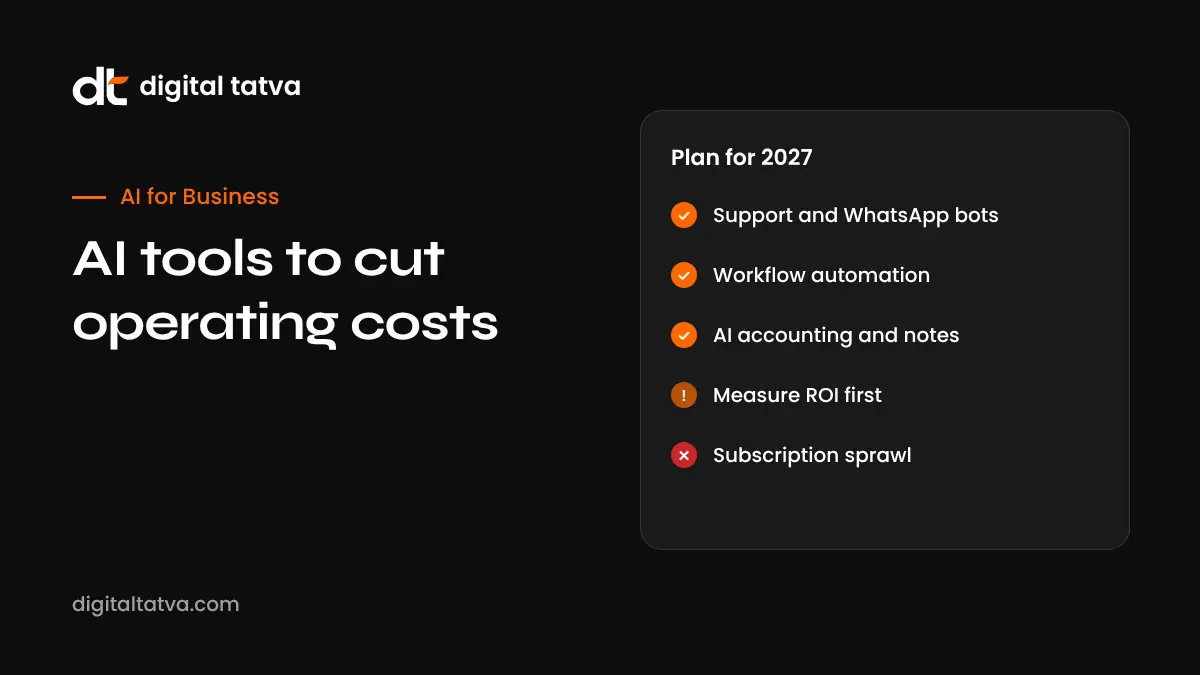
The AI tools that cut business operating costs in 2027: support bots, AI receptionists, automation, accounting, meeting notes, content and CRM AI, plus an ROI formula and a 90-day plan.
On this page
- Key takeaways
- Where AI actually reduces operating costs
- The best AI tools to reduce business operating costs
- 1. AI customer support: cut cost per ticket
- 2. AI receptionists: answer every call without extra hires
- 3. Workflow automation: stop copy-paste work
- 4. AI for accounting and finance
- 5. AI meeting assistants: reclaim hours every week
- 6. AI for content, design and marketing
- 7. AI in sales and CRM
- 8. AI in project management and internal operations
- 9. Lower your AI bills themselves
- How to calculate the ROI of an AI tool
- A 90-day plan to cut costs with AI
- AI cost-cutting for Indian businesses
- Risks and hidden costs
- Common mistakes
- What will change in 2027
- Illustrative example: a D2C skincare brand in Surat
- Checklist: cutting operating costs with AI
- How Digital Tatva can help
- Frequently asked questions
Last updated: 20 November 2026
Quick answer: The AI tools that cut business operating costs most reliably in 2027 are the ones that remove repeated manual work: AI customer support chatbots and WhatsApp bots (fewer tickets per agent), AI receptionists (no missed calls without extra staff), workflow automation tools such as Zapier, Make and n8n (no copy-paste between apps), AI accounting and invoice tools (faster bookkeeping and collections), AI meeting assistants (no manual notes), AI writing and design tools (less outsourcing for routine content), AI inside your CRM and project tools (less admin) and cheaper AI model choices for anything built on APIs. Savings come from time saved, work you no longer outsource and errors avoided, not from the software itself. Start with one or two high-volume processes, measure the hours they take today, and only keep tools that pay back within a few months.
Key takeaways
- Target high-volume, repetitive work first: support, calls, data entry, invoicing, meetings and routine content.
- Measure the cost of a process before buying a tool, then measure again after 30 to 60 days.
- AI subscriptions add up; audit seats and overlapping tools every quarter.
- Keep humans in charge of judgement, customers with problems, money decisions and anything regulated.
- For businesses in India, prioritise WhatsApp, Hindi and regional language support, GST-ready accounting and rupee pricing.
Where AI actually reduces operating costs
Operating costs are the money you spend running the business every month: salaries and freelancers, software, rent, utilities, marketing, support and admin. AI rarely cuts rent or electricity. It mainly reduces the cost of work by:
- Doing repetitive tasks faster so the same team handles more volume without hiring.
- Covering hours you could not staff, such as nights, weekends and peak periods.
- Replacing some outsourced work, like basic content, design variations, transcription and translation.
- Reducing errors and rework, such as data entry mistakes, missed follow-ups and late invoices.
- Consolidating software, when AI features inside tools you already pay for replace separate subscriptions.
The best AI investments in 2027 will be boring ones: they quietly remove hours of manual work every week.
The best AI tools to reduce business operating costs
| Cost area | Tool types | Example tools | Where savings come from |
|---|---|---|---|
| Customer support | AI chatbots, help desk AI, WhatsApp bots | Intercom Fin, Zendesk AI, Freshdesk Freddy, Tidio, WhatsApp Business platforms | Common questions answered instantly; agents focus on complex cases |
| Phone calls | AI receptionists and voice agents | Rosie, Smith.ai, Goodcall, Indian voice AI providers | No missed calls and fewer extra front desk hires |
| Admin and data entry | Workflow automation | Zapier, Make, n8n, Power Automate | Data moves between apps automatically |
| Finance and accounting | AI bookkeeping, invoice capture, collections | QuickBooks, Xero and Zoho Books AI features, ChatGPT accounting plugins | Faster reconciliation and fewer late payments |
| Meetings | AI note takers | Zoom AI Companion, Microsoft Copilot, Google Gemini in Meet, Otter, Fireflies | No manual notes; clear action items |
| Content and marketing | AI writing, design and video | ChatGPT, Claude, Gemini, Canva AI, CapCut | Less outsourcing for routine posts, emails and creatives |
| Sales | AI CRM and SDR tools | HubSpot Breeze, Salesforce Agentforce, Zoho Zia | Less manual logging, faster follow-ups |
| Projects and internal ops | AI in project and docs tools | ClickUp Brain, monday.com AI, Notion AI, Microsoft Copilot | Faster status updates, summaries and documentation |
| Hiring and HR | AI screening and HR assistants | ATS AI features, HR chatbots | Faster shortlisting and fewer repetitive HR questions |
| IT and development | AI coding assistants, cheaper model routing | GitHub Copilot, Cursor, Claude Code, OpenRouter | Faster development and lower API bills |
Tool names are examples, not endorsements. Features and prices change often, so compare current plans before buying.
1. AI customer support: cut cost per ticket
Support is often the biggest quick win. Many businesses find that a large share of questions repeat: order status, refunds, pricing, delivery times, account access and opening hours.
- What to automate: FAQs, order tracking, appointment changes, basic troubleshooting and lead capture.
- What to keep human: complaints, refunds above a limit, angry customers and complex technical issues.
- India tip: Customers often prefer WhatsApp. A WhatsApp AI bot with Hindi and English replies can handle routine questions around the clock. See WhatsApp AI for business.
Read AI customer support tools, best AI website chatbots and how to add an AI chatbot to your website.
2. AI receptionists: answer every call without extra hires
Missed calls are lost revenue for clinics, salons, real estate, home services and local businesses. AI receptionists answer calls, book appointments and transfer urgent calls to a person. Small business plans in 2026 commonly start between about $25 and $150 a month, and Indian providers often price per minute in rupees. Use them for overflow and after-hours first. Full guide: AI receptionists in 2026.
3. Workflow automation: stop copy-paste work
A surprising amount of admin is moving data from one app to another: form leads into a CRM, orders into a spreadsheet, invoices into accounting, and notifications into Slack or email. Automation tools connect your apps and add AI steps such as summarising, classifying or drafting replies.
| Tool | Best for | Cost note |
|---|---|---|
| Zapier | Non-technical teams, thousands of app connections | Pricing rises with tasks; can get expensive at high volume |
| Make | Visual, complex workflows at lower cost per operation | Often cheaper than Zapier for multi-step flows |
| n8n | Technical teams wanting self-hosting and control | Self-hosting can be very cost-effective at scale |
| Microsoft Power Automate | Businesses on Microsoft 365 | May be included or low-cost with existing licences |
Compare them in Zapier vs Make vs n8n and learn the basics in how to automate repetitive tasks with Zapier and AI. More options: best AI automation tools.
4. AI for accounting and finance
- Invoice and receipt capture: AI reads bills and receipts and creates entries.
- Bank reconciliation: suggested matches reduce manual work.
- Collections: automated, polite reminders reduce late payments.
- Reporting: ask questions in plain language about cash flow and expenses.
- India: choose tools that handle GST invoices and integrate with Indian banks and payment gateways.
Keep your accountant or CA in the loop for tax, compliance and final sign-off. See ChatGPT for accounting.
5. AI meeting assistants: reclaim hours every week
AI note takers join calls, transcribe, summarise and list action items. The saving is small per meeting but large across a team over a year. Many are already included in tools you pay for, such as Zoom, Microsoft 365 and Google Workspace. Compare options in best AI meeting assistants and Zoom AI Companion.
Tell participants when meetings are recorded and follow your privacy policies.
6. AI for content, design and marketing
AI can reduce the cost of routine marketing work such as first drafts, social posts, product descriptions, ad variations, image resizing and short videos.
- Use AI for drafts and variations; keep strategy, brand voice and final review with your team.
- Use Canva AI or similar for design variations instead of outsourcing every resize; see how to use Canva AI.
- Create product images and short videos in-house for routine needs; see AI product photography tools.
- Train AI on your brand voice; see how to train AI to write in your brand voice.
Do not cut quality to save money. Generic AI content rarely ranks or gets cited by AI search tools. Read what is AI search visibility.
7. AI in sales and CRM
Sales teams lose time logging calls, updating deals and writing follow-ups. CRM AI features summarise conversations, suggest next steps, draft emails and score leads.
- HubSpot Breeze AI
- Salesforce Agentforce
- Zoho Zia, popular with Indian SMBs
- Best AI CRM software and best AI SDR tools
8. AI in project management and internal operations
AI inside project and document tools writes status updates, summarises long threads, drafts SOPs and answers “where is that file?” questions. This reduces time spent in coordination.
- ClickUp Brain review
- monday.com AI review
- Best AI project management tools
- Claude Cowork and personal AI agents for delegating multi-step office work
9. Lower your AI bills themselves
As businesses use more AI, the AI tools become an operating cost of their own. Control it:
- Audit seats: remove unused licences every quarter.
- Avoid overlap: you may not need ChatGPT, Claude, Gemini and Copilot for every person.
- Use built-in AI: AI features in Microsoft 365, Google Workspace or your CRM may replace separate tools.
- Choose the right model: smaller, cheaper models handle many tasks well; see LLM API pricing comparison.
- Cut API costs: use prompt caching, shorter prompts and model routing; see prompt caching explained, how to reduce token usage and OpenRouter review.
- Use included credits: some plans now include API credits; see API credits in ChatGPT and Claude plans.
- Buy annually for tools you rely on and watch for promotions; see Black Friday 2026 AI deals.
How to calculate the ROI of an AI tool
Use a simple formula before you buy:
| Step | What to calculate |
|---|---|
| 1. Current cost | Hours per month spent on the task multiplied by the hourly cost of the people doing it, plus any outsourcing cost |
| 2. Expected time saved | Realistic share of those hours the tool removes, based on a trial, not vendor claims |
| 3. Monthly saving | Hours saved multiplied by hourly cost, plus outsourcing you can stop |
| 4. Total tool cost | Subscription, usage fees, setup time and training |
| 5. Net saving | Monthly saving minus monthly tool cost |
| 6. Payback period | Setup cost divided by net monthly saving |
Worked example (illustrative figures): a support team spends 120 hours a month answering repeat questions at an average cost of ₹400 an hour, which is ₹48,000 a month. A trial shows a chatbot handles enough questions to save about 40 hours, worth ₹16,000. If the chatbot costs ₹6,000 a month, the net saving is about ₹10,000 a month. If setup took ₹20,000 worth of time, payback is about two months. Your numbers will differ; measure your own.
A 90-day plan to cut costs with AI
- Weeks 1 and 2: map your costs. List the most time-consuming repetitive tasks by team and estimate hours per month.
- Weeks 3 and 4: pick two pilots. Choose high-volume, low-risk processes, such as FAQs and meeting notes.
- Weeks 5 to 8: run trials. Use free trials or entry plans, set rules and measure time saved and quality.
- Weeks 9 and 10: decide. Keep tools with clear net savings; cancel the rest.
- Weeks 11 and 12: scale and document. Train the team, write SOPs and plan the next two processes.
AI cost-cutting for Indian businesses
- WhatsApp first: automate enquiries, order updates and reminders on WhatsApp.
- Languages: choose tools with Hindi and regional language support for customers and staff.
- Rupee pricing and GST: compare local tools and factor in 18% GST on many foreign digital services.
- Local tools: Zoho, Indian voice AI providers and homegrown models such as Sarvam can be cost-effective; see Sarvam AI Indus review.
- Compliance: follow the DPDP Act and sector rules for customer data; see AI rules in India.
- Free and low-cost tiers: many small businesses can start with free plans; see free AI pro plans in India.
Risks and hidden costs
| Risk | How to manage it |
|---|---|
| Wrong answers to customers | Limit what the AI can say, review logs and keep a human handover |
| Data privacy and security | Check vendor terms, access controls and data storage; see AI agent security |
| Subscription sprawl | Central list of AI tools, owners and renewal dates |
| Usage-based bills spiking | Set spending limits and alerts |
| Staff resistance | Involve teams early and show how AI removes boring work |
| Quality drop in content | Human editing, fact-checking and brand review |
| Vendor lock-in | Prefer tools that export your data and use standard integrations |
Common mistakes
- Buying tools before mapping processes. Automation of a bad process just makes mistakes faster.
- Trusting vendor savings claims. Measure your own results.
- Trying to automate everything at once. Start with two pilots.
- Cutting people before the tool is proven. Run AI alongside your team first.
- Ignoring customer experience. Saving money by frustrating customers costs more later.
What will change in 2027
- More AI agents doing multi-step work across apps, not just answering questions. See what is agentic AI.
- AI built into software you already own, often with credit-based pricing, so watch usage limits.
- Cheaper capable models, making AI more affordable for small businesses.
- More regulation and disclosure requirements for AI in customer interactions.
- AI search shaping how customers find you, so accurate business information online matters more.
These are trends to plan for, not guarantees.
Illustrative example: a D2C skincare brand in Surat
This is an illustrative scenario, not a client story.
A 12-person D2C skincare brand spends most of its support time answering “where is my order?” and ingredient questions on WhatsApp and Instagram. It also pays a freelancer for weekly social posts and loses time copying orders into a spreadsheet. Over 90 days, it adds a WhatsApp AI bot connected to its order system with Hindi and English replies, uses Make to send new orders to its sheet and accounting tool automatically, turns on AI meeting notes in its existing video calls and drafts social captions with AI before a team member edits them. It measures hours spent on each task before and after, cancels one overlapping AI subscription and keeps the tools that showed clear net savings.
Checklist: cutting operating costs with AI
- Top 10 repetitive tasks listed with hours per month.
- Two pilot processes chosen.
- Current cost of each process calculated.
- Tools trialled with clear rules and human handover.
- Time saved and quality measured after 30 to 60 days.
- Net saving and payback calculated.
- Unused or overlapping AI subscriptions cancelled.
- Data privacy and security checked.
- Team trained and SOPs documented.
How Digital Tatva can help
Lower costs only help if customers can still find you. Digital Tatva helps businesses stay visible and accurately described in ChatGPT, Gemini, Perplexity and Google AI answers, so your marketing spend works harder. See our AEO services.
Is your business recommended when customers ask AI? Request an AEO audit or try the free AI visibility checker.
Related reading: 25 Best AI Startup Ideas for 2027
Frequently asked questions
Which AI tools reduce business costs the most?
Customer support chatbots, AI receptionists, workflow automation, AI accounting features and meeting assistants usually deliver the clearest savings because they remove high-volume repetitive work.
How much can AI save a small business?
It depends on how much repetitive work you have and how well the tools are set up. Measure hours spent before and after a trial rather than relying on vendor claims.
Is AI expensive for small businesses?
Many tools offer free or low-cost entry plans. Costs rise with seats and usage, so audit subscriptions regularly.
Can AI replace employees?
AI handles repetitive tasks well, but people are still needed for judgement, relationships, complex problems and quality control. Most businesses use AI to let the same team handle more work.
What is the cheapest way to start using AI in business?
Turn on AI features in tools you already pay for, use free tiers of chatbots and automation tools, and start with one process.
How do I measure AI ROI?
Calculate hours saved multiplied by hourly cost, add outsourcing you no longer need, subtract tool and setup costs and track the payback period.
Which AI tools are best for Indian small businesses?
WhatsApp AI bots, Zoho tools, GST-ready accounting software, AI receptionists with Hindi support and free AI plans are good starting points.
Are AI automation tools safe for customer data?
They can be with proper vendor checks, access controls and compliance with data protection laws such as the DPDP Act.
How can I reduce my AI subscription costs?
Remove unused seats, avoid overlapping tools, use built-in AI features, choose cheaper models for simple tasks and buy annual plans for tools you rely on.
What AI trends will affect business costs in 2027?
Expect more AI agents, AI built into existing software with credit-based pricing, cheaper models and more regulation of AI in customer interactions.
Product details, prices and features are checked at the time of writing and can change. Sources are linked in the text so you can check them yourself.
How does your brand appear in AI answers?
We test the questions your buyers ask across the major AI assistants and search engines, then show you what to fix first.
Get an AI Visibility Audit