OpenRouter Review 2026: Pricing, Free Models and How It Works
How OpenRouter works, what it costs and who should use it.
On this page
- Key takeaways
- What is OpenRouter?
- Why OpenRouter is trending
- OpenRouter pricing in 2026
- How OpenRouter works, step by step
- Key features
- Privacy and data: what to check
- OpenRouter vs going direct to providers
- OpenRouter alternatives
- Who should use OpenRouter?
- Tips to control OpenRouter costs
- Illustrative example: an agency building a content tool
- OpenRouter checklist
- Verdict
- How Digital Tatva can help
- Frequently asked questions
Last updated: 19 November 2026
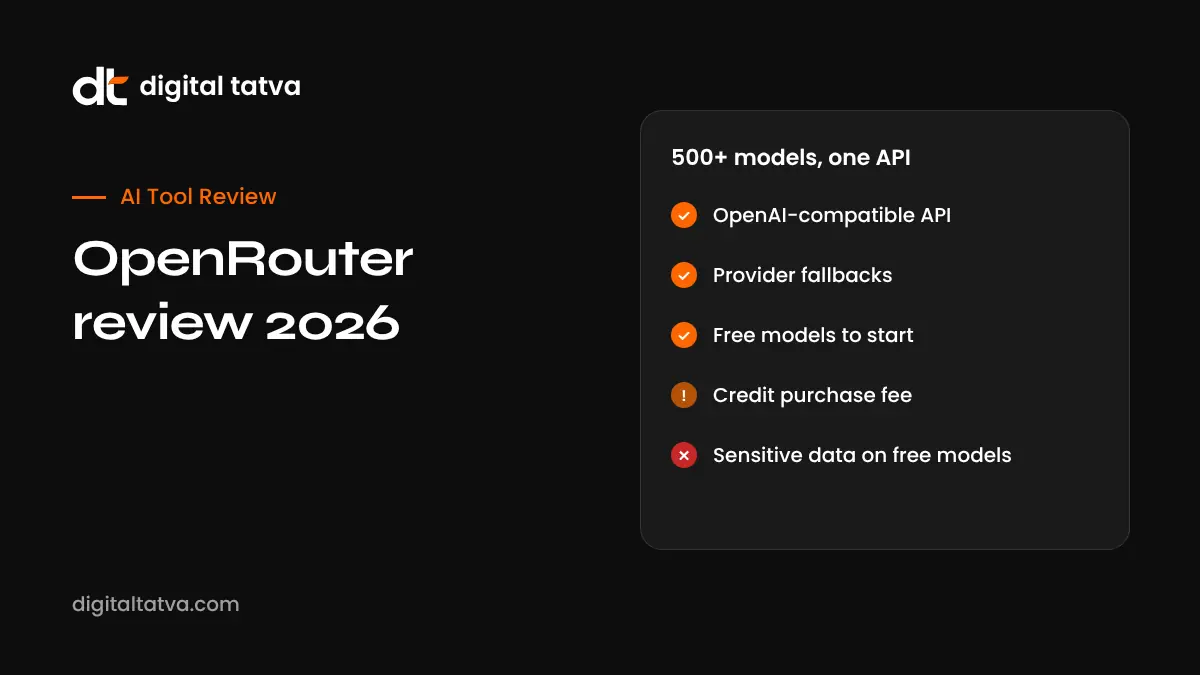
Quick answer: OpenRouter is a single API and chat interface that gives you access to 500 plus AI models from more than 80 providers, including OpenAI, Anthropic, Google, Meta, Mistral, DeepSeek, Qwen and many open models. You pay the provider’s list price for tokens with no markup, plus a fee when you buy credits (reported at 5.5% on the Standard plan, with an $0.80 minimum). A free tier offers 25 plus free models with limits of 20 requests per minute and 50 per day, rising to 1,000 per day after you buy at least $10 of credits. Its API is OpenAI-compatible, it can automatically fall back between providers, and it is popular with developers, AI app builders and coding tools. Check each model’s data policy before sending sensitive data.
Key takeaways
- OpenRouter had about 19.4 million monthly visits in October 2026, newly entering the top AI tools list reported by Exploding Topics.
- One API key and one bill for hundreds of models.
- Model tokens are billed at provider list price; fees apply when buying credits and above a free bring-your-own-key allowance.
- Automatic fallback and routing improve reliability when a provider is down.
- Privacy depends on which provider serves your request, so use OpenRouter’s data policy filters.
What is OpenRouter?
OpenRouter is an AI model marketplace and routing layer. Instead of signing up separately with OpenAI, Anthropic, Google, DeepSeek and others, managing several API keys and paying several bills, you use one OpenRouter account. Your app sends requests to OpenRouter in the same format as the OpenAI API, choosing a model like anthropic/claude-... or google/gemini-..., and OpenRouter forwards it to a provider that serves that model.
It also has a web chat where you can talk to many models side by side, which makes it popular for comparing models before choosing one for a project.
Why OpenRouter is trending
- Model explosion: new models launch every week, and developers want to test them without new accounts.
- Coding tools: many AI coding assistants and agents let users connect OpenRouter to choose any model.
- Cost control: teams route simple tasks to cheaper models and hard tasks to frontier models. See model routing explained.
- Free models: students and hobbyists can experiment at no cost.
- Usage rankings: OpenRouter publishes public leaderboards of which models are used most, widely shared on social media.
OpenRouter pricing in 2026
| Item | Free | Standard | Business | Enterprise |
|---|---|---|---|---|
| Models | 25 plus free models | 500 plus models, 80 plus providers | Same as Standard | Same, with contract terms |
| Token pricing | Free models only | Provider list price | Provider list price | Contract |
| Credit purchase fee | Not applicable | 5.5%, $0.80 minimum | 8% | Negotiated |
| Bring your own key | No | First $25,000 per month of list-price usage free, then 5% | Same | Custom |
| Free model limits | 20 per minute, 50 per day | 1,000 per day after $10 credit purchase | Higher | Custom |
| Payment | None | Cards, AliPay, USDC | Cards, AliPay, USDC | Invoicing |
Figures from Dupple’s guide, verified against OpenRouter’s pricing page and terms on 28 October 2026. Crypto payments may carry a separate fee, and prices exclude taxes such as GST. Check the live pricing page before budgeting.
How OpenRouter works, step by step
- Create an account at openrouter.ai with Google, GitHub or email.
- Try models in the chat to compare answers.
- Buy credits if you plan to use paid models, or start with free models.
- Create an API key and store it securely, never in public code.
- Point your app to OpenRouter’s API using the OpenAI-compatible endpoint.
- Choose a model ID, or use auto-routing to let OpenRouter pick.
- Set spending limits on keys to avoid surprise bills.
- Monitor the activity log for cost and usage per model.
Key features
Unified, OpenAI-compatible API
Most apps built for the OpenAI API can switch to OpenRouter by changing the base URL and key. This includes many SDKs, frameworks and no-code tools.
Provider routing and fallbacks
Popular open models are often served by several providers. OpenRouter can route to the cheapest, fastest or most reliable provider and fall back automatically if one fails. You can set preferences such as price or throughput.
Auto router
The openrouter/auto option chooses a model for your prompt. It is convenient for prototypes, but explicit model choice gives more predictable results in production.
Bring your own key (BYOK)
If you already have provider accounts or credits, you can add your own keys and still use OpenRouter’s routing and logs.
Prompt caching, tools and structured outputs
Where providers support them, OpenRouter passes through features like prompt caching, function calling, JSON output, images and web search plugins.
Rankings and model pages
Each model page shows pricing per million tokens, context length, providers, latency and uptime, which is useful for comparing options.
Privacy and data: what to check
When you use OpenRouter, your prompts pass through OpenRouter and the provider that serves the model. Policies differ: some providers may log or train on prompts, especially for free models, while others do not. OpenRouter offers account-level settings to restrict routing to providers that do not train on your data, and Business plans offer in-region routing options in the EU and US. Before sending client or personal data:
- Review OpenRouter’s privacy settings and each provider’s policy.
- Avoid free endpoints for confidential data.
- Consider going direct to a provider with an enterprise agreement for regulated workloads.
- In India, assess DPDP obligations for personal data; see AI data privacy for business.
OpenRouter vs going direct to providers
| Factor | OpenRouter | Direct provider APIs |
|---|---|---|
| Model choice | Hundreds of models, one key | One provider’s models per account |
| Cost | List price plus credit fee | List price, sometimes volume discounts |
| Reliability | Automatic fallback across providers | Depends on one provider |
| Latest features | Sometimes slightly delayed or partial | Immediate access |
| Data agreements | Varies by routed provider | Direct contract and enterprise terms |
| Billing | One bill | Many bills |
Compare direct pricing in our guides to OpenAI API pricing and the cheapest AI model for each task.
OpenRouter alternatives
| Tool | Type | Why consider it |
|---|---|---|
| LiteLLM | Open source proxy | Self-host your own gateway with your provider keys |
| Vercel AI Gateway | Managed gateway | Good for apps already on Vercel |
| Cloudflare AI Gateway | Managed gateway | Caching, logging and rate limits at the edge |
| Together AI, Groq, Fireworks | Inference providers | Fast hosting for open models |
| Amazon Bedrock, Google Vertex AI, Azure AI Foundry | Cloud platforms | Enterprise contracts and compliance |
Who should use OpenRouter?
- Developers and startups testing many models quickly.
- AI app builders who want fallbacks and one bill.
- Coding tool users who want to pick models in tools that support OpenRouter.
- Researchers and students experimenting with free and open models.
- Agencies running different models for different clients and tasks.
Large enterprises with strict compliance needs may prefer direct contracts or cloud platforms, possibly alongside OpenRouter for experimentation.
Tips to control OpenRouter costs
- Set a credit limit on each API key.
- Use smaller models for classification, extraction and summaries.
- Use prompt caching for repeated long instructions.
- Trim conversation history and documents sent with each request. See how to reduce token usage.
- Review the activity log weekly for unexpected spikes.
- Buy credits in larger amounts to reduce the impact of the minimum fee.
Illustrative example: an agency building a content tool
This is an illustrative scenario, not a client story.
A digital agency in Ahmedabad builds an internal tool that drafts product descriptions, classifies customer reviews and summarises competitor pages. Using OpenRouter, the developer tests six models in a day, picks a small open model for review classification, a mid-tier model for summaries and a frontier model for final drafts, and sets fallbacks. Each client project gets its own API key with a spending cap. For one healthcare client, the agency avoids routing through OpenRouter and uses a direct provider agreement because of data requirements.
OpenRouter checklist
- Decide which models you need to compare.
- Start with free models for prototypes.
- Set privacy and provider preferences before production.
- Create separate keys with spending limits.
- Configure fallbacks for critical features.
- Monitor cost and latency.
- Review terms for commercial and regulated use.
Verdict
OpenRouter is one of the most useful tools for anyone building with AI in 2026. It removes friction from testing and switching models, adds reliability through fallbacks and keeps billing simple. The trade-offs are a small credit fee, occasional feature lag compared with going direct, and the need to manage data policies carefully. For most developers and startups, the benefits outweigh the costs.
How Digital Tatva can help
Digital Tatva helps businesses understand the AI ecosystem and makes sure their brand is described accurately across the models customers use. See our AEO services.
How do different AI models describe your brand? Request an AEO audit or try the free AI visibility checker.
Frequently asked questions
What is OpenRouter?
OpenRouter is a unified API and chat platform that gives access to hundreds of AI models from many providers through one account and key.
Is OpenRouter free?
It has free models with daily limits. Paid models are billed at provider list prices plus a fee when buying credits.
How much does OpenRouter charge?
Reports from October 2026 list a 5.5% credit purchase fee on Standard with an $0.80 minimum, and 8% on Business, with no markup on model tokens.
What are OpenRouter’s free model limits?
About 20 requests per minute and 50 per day, rising to 1,000 per day after buying at least $10 in credits.
Is OpenRouter safe?
It is widely used, but your data passes through OpenRouter and the routed provider. Use privacy filters and avoid sending sensitive data to free endpoints.
Is OpenRouter cheaper than OpenAI directly?
Token prices match the provider’s list price, but the credit fee makes it slightly more expensive than paying direct. Convenience and fallbacks are the main benefits.
Can I use Claude through OpenRouter?
Yes, Anthropic’s Claude models are available alongside models from OpenAI, Google and others.
Is OpenRouter compatible with the OpenAI SDK?
Yes. Its API follows the OpenAI format, so many apps can switch by changing the base URL and key.
Can I pay for OpenRouter from India?
OpenRouter accepts cards and other methods listed on its site. Taxes may apply, and international card payments must be enabled.
What is bring your own key on OpenRouter?
You can add your own provider API keys and still use OpenRouter routing, with fees applying only above a monthly allowance.
Product details, prices and features are checked at the time of writing and can change. Sources are linked in the text so you can check them yourself.
How does your brand appear in AI answers?
We test the questions your buyers ask across the major AI assistants and search engines, then show you what to fix first.
Get an AI Visibility Audit