Meta Muse Ember: Pricing, Benchmarks and Best Uses for AI Agents
A guide to Meta's low-cost Muse Ember model for agent workloads.
On this page
- Key takeaways
- Where Muse Ember fits in Meta’s Muse family
- Muse Ember specs and pricing
- Benchmarks vs Claude Haiku 5.5 and GPT-6 Luna
- Best use cases
- When not to use Muse Ember
- Muse Ember vs other cheap models
- How to start with Muse Ember
- Safety
- Illustrative example: automating invoice data entry
- Checklist
- Building a planner and worker setup
- Estimating your costs
- How Digital Tatva can help
- Frequently asked questions
Last updated: 19 November 2026
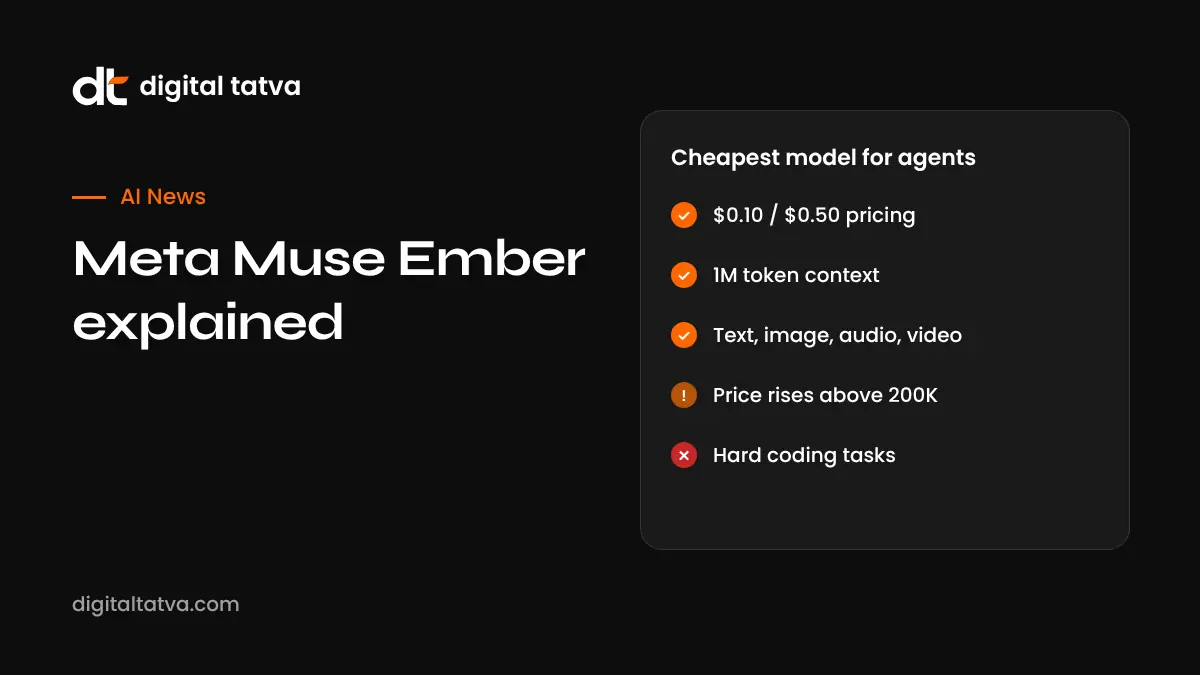
Quick answer: Muse Ember is Meta’s smallest and most efficient AI model, announced on 9 November 2026. It is built for the repetitive work AI agents do all day: tool calls, coding subtasks, routing, data extraction and long document parsing. It has a 1 million token context window, accepts text, images, audio and video, and costs $0.10 per million input tokens and $0.50 per million output tokens for prompts up to 200,000 tokens (higher above that). Meta says it matches Claude Haiku 5.5’s best Artificial Analysis score at about a third of the cost per task and beats GPT-6 Luna on intelligence per dollar, though Haiku still leads on the FrontierCode 2.0 coding benchmark. It is available through Muse Code, the Meta Model API, Google Cloud and Oracle Cloud.
Key takeaways
- About $0.14 per Artificial Analysis task, compared with $2.39 for Muse Spark 1.3 at a similar score.
- Pricing jumps to $0.30 input and $1.50 output per million tokens above 200K token prompts, the main “catch”.
- Strong on automation and agent benchmarks, weaker than Haiku on hard coding.
- Part of Meta’s Muse family alongside Muse Wonder and Muse Spark.
- Ideal as a worker model under a larger planner model.
Where Muse Ember fits in Meta’s Muse family
| Model | Role |
|---|---|
| Muse Wonder | Hardest problems and frontier reasoning |
| Muse Spark | Coding and agentic workflows |
| Muse Ember | Repeatable tasks at scale, lowest cost |
Meta says Ember is the first model trained using Muse Wonder Full. Read our guide to Meta Muse Wonder.
Muse Ember specs and pricing
| Item | Detail |
|---|---|
| Model ID | muse-ember-1.0 |
| Context window | 1 million tokens, up to 512K output |
| Inputs | Text, images, audio, video |
| Price up to 200K tokens | $0.10 input, $0.004 cached input, $0.50 output per million |
| Price above 200K tokens | $0.30 input, $0.012 cached input, $1.50 output per million |
| API | Supports the Responses API format |
Source: Meta’s Muse Ember announcement.
Benchmarks vs Claude Haiku 5.5 and GPT-6 Luna
| Benchmark | Muse Ember | Haiku 5.5 | GPT-6 Luna |
|---|---|---|---|
| AutomationBench-AA | 37.8% | 13.9% | 20.2% |
| Agents’ Last Exam | 61.6% | 57.0% | 57.1% |
| Terminal-Bench 4.0 | 40.9 | 39.2 | 16.4 |
| Coding Agent Index-AA | 46 | 37 | 31 |
| FrontierCode 2.0-AA | 27.2 | 34.9 | 25.2 |
| OSWorld 2.1 (partial) | 69.5 | 68.9 | 50.5 |
| Artificial Analysis Index | 36 | 36 | 28 |
Meta-reported results at maximum reasoning. Independent testing may differ.
Best use cases
- Agent worker tasks: calling tools, filling forms, moving data between apps.
- Extraction: pulling fields from invoices, contracts and reports.
- Routing and classification: sending requests to the right model or team. See model routing explained.
- Long document parsing: summarising and searching large files within the 200K price tier.
- Multimodal tagging: describing images, audio and video at low cost.
When not to use Muse Ember
- Complex software engineering, where Haiku 5.5 or larger models score higher.
- High-stakes reasoning in law, medicine or finance without a stronger reviewer model.
- Prompts consistently above 200K tokens, where the price triples.
Muse Ember vs other cheap models
| Model | Positioning |
|---|---|
| Meta Muse Ember | Cheapest per task for agent work in Meta’s benchmarks |
| Claude Haiku 5.5 | Strong coding and reliability |
| GPT-6 Luna | OpenAI’s smallest GPT-6 model |
| Gemini 4 Hydrogen | Google’s fast, efficient tier |
| Microsoft-Decision-1.1 | Low-cost routing and classification |
See the cheapest AI model for each task.
How to start with Muse Ember
- Get access through the Meta Model API, Google Cloud or Oracle Cloud.
- Pick one repetitive task, such as invoice extraction.
- Build a test set of 50 to 100 real examples.
- Compare Ember with your current model on accuracy and cost.
- Keep prompts under 200K tokens where possible.
- Use a stronger model to review low-confidence results.
Safety
Meta says Muse Ember was evaluated under its Superintelligence Scaling Framework and found below high-risk thresholds for chemical and biological, cybersecurity and loss-of-control risks. It was also tested for respecting user intent, resisting instructions hidden in content and asking for human input before high-impact actions. Still, apply your own controls when agents act on real systems; see AI agent security.
Illustrative example: automating invoice data entry
This is an illustrative scenario, not a client story.
An accounting outsourcing firm in Surat processes thousands of supplier invoices each month. It uses a larger model to design extraction rules, then runs Muse Ember to pull vendor names, GST numbers, amounts and dates from each PDF. Ember flags low-confidence fields for a human to check. The firm compares accuracy and cost against its previous model over a month before switching fully.
Checklist
- Choose high-volume, repeatable tasks.
- Test on real examples.
- Watch the 200K token price threshold.
- Use human or stronger-model review for errors.
- Monitor cost per task.
Building a planner and worker setup
A common pattern in 2026 is to pair a strong “planner” model with a cheap “worker” model. The planner breaks a job into steps and checks the results; the worker handles the many small steps. Muse Ember is designed for the worker role.
| Step | Model | Example |
|---|---|---|
| Plan the job | Large model (Claude, GPT-6.2, Gemini 4) | Decide which fields to extract from 1,000 contracts |
| Do repeated work | Muse Ember | Extract fields from each contract |
| Check edge cases | Large model or human | Review contracts where Ember was unsure |
| Summarise results | Either | Produce a report of key terms and risks |
This approach can cut costs dramatically while keeping quality high, because the expensive model only sees a small fraction of the work. Frameworks covered in our best AI agent frameworks guide make it easier to build.
Estimating your costs
As a rough example, processing 10,000 documents of about 5,000 tokens each with 500-token outputs would use about 50 million input tokens and 5 million output tokens. At Muse Ember’s under-200K pricing, that is about $5 for input and $2.50 for output, before any retries or reviews. The same job on a frontier model could cost many times more. Always test on real data, as token counts vary.
How Digital Tatva can help
Digital Tatva helps businesses understand the AI model landscape and keeps their brand accurately described across Meta AI, ChatGPT, Gemini and Claude. See our AEO services.
How does Meta AI describe your brand? Request an AEO audit or try the free AI visibility checker.
Frequently asked questions
What is Meta Muse Ember?
Meta’s smallest, most efficient AI model, launched on 9 November 2026 for repetitive agent tasks.
How much does Muse Ember cost?
$0.10 per million input tokens and $0.50 per million output tokens for prompts up to 200K tokens.
What is Muse Ember’s context window?
1 million tokens, with up to 512K output tokens.
Is Muse Ember better than Claude Haiku 5.5?
Meta reports similar overall intelligence at about a third of the cost, but Haiku scores higher on FrontierCode 2.0 coding.
Can Muse Ember process images and video?
Yes, it accepts text, images, audio and video.
Where can I use Muse Ember?
Through Muse Code, the Meta Model API, Google Cloud and Oracle Cloud.
Is Muse Ember open source?
Meta’s announcement describes API and cloud availability, not open weights.
What is the 200K token catch?
Prices roughly triple for prompts longer than 200,000 tokens.
What is Muse Ember best for?
Tool calls, coding subtasks, routing, data extraction and long document parsing.
Is Muse Ember safe?
Meta says it was below high-risk thresholds in its safety framework, but you should still add your own controls.
Product details, prices and features are checked at the time of writing and can change. Sources are linked in the text so you can check them yourself.
How does your brand appear in AI answers?
We test the questions your buyers ask across the major AI assistants and search engines, then show you what to fix first.
Get an AI Visibility Audit