10 Best Chinese AI Models in 2026: DeepSeek, Qwen, Kimi, GLM and More
DeepSeek, Qwen, Kimi, GLM and six more Chinese AI model families compared, with safe ways to use them.
On this page
Last updated: 22 November 2026
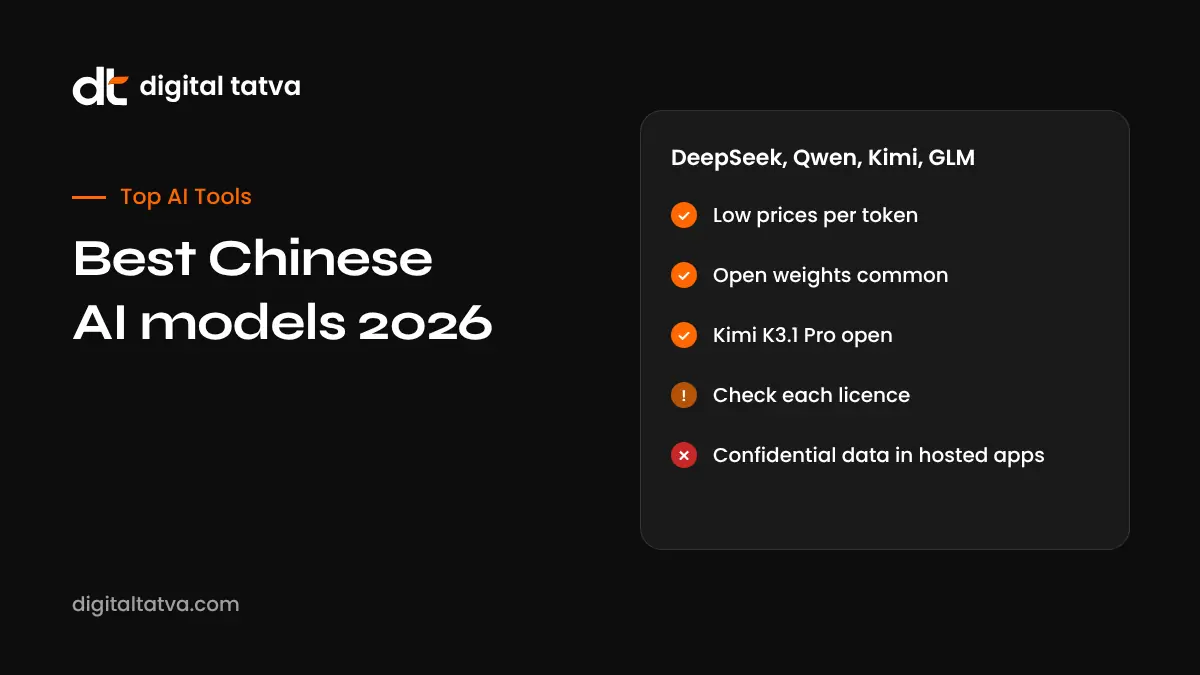
Quick answer: The best Chinese AI models in late 2026 are DeepSeek V4 (cheap, strong reasoning, open weights under the MIT licence), Alibaba’s Qwen family (Qwen4-Max as the new closed flagship, plus widely used open Qwen3.8 models), Moonshot’s Kimi K3.1 Pro (one of the largest open-weight models available), Zhipu’s GLM-5.3 (open weights, strong coding and security work at low prices), MiniMax (M3 for text and H3-Image for images), ByteDance’s Doubao (China’s most used assistant), Tencent’s Hy4 (vision and computer use), Xiaomi’s MiMo (efficient open models popular for coding), StepFun (on-device and multimodal) and Baidu’s ERNIE (Chinese-language strength). Their big advantages are price and open weights. The main caution is data: hosted apps and APIs generally process data in China, so many businesses use the open weights on their own or trusted infrastructure instead.
Key takeaways
- Chinese labs lead the world in open-weight releases, and their prices are often a fraction of US frontier models.
- The very top of benchmark tables is still held by US models such as Claude Fable 5.2 and GPT-6.2 Astra.
- Qwen4-Max broke the pattern by launching without open weights; Alibaba says smaller Qwen 4 models will be open later.
- For sensitive data, prefer self-hosting open weights or using them through providers outside China.
- Always check the licence: some “open” models add naming or usage conditions.
Why Chinese AI models matter in 2026
A few years ago, Chinese models were mostly used inside China. In 2026 they are part of almost every developer’s toolkit. DeepSeek is the fifth most visited AI tool in the world by web traffic, with about 296 million visits in October 2026, and Qwen Chat, Kimi and Z.ai (GLM) all draw millions of visits. Chinese open models are also among the most used on routers such as OpenRouter, and thousands of fine-tuned models on Hugging Face start from a Qwen or DeepSeek base.
Three things drive this: low prices, permissive open-weight releases and fast release cycles. For companies building AI products, that combination is hard to ignore, even when they ultimately choose a US model for their most sensitive work.
Best Chinese AI models compared
| # | Model family | Company | Open weights? | Best for |
|---|---|---|---|---|
| 1 | DeepSeek V4 (V4 Pro, V4.1 Flash) | DeepSeek | Yes, MIT licence for V4 | Cheap reasoning and coding |
| 2 | Qwen (Qwen4-Max, Qwen3.8 open models) | Alibaba | Qwen4-Max no; many Qwen3.8 models yes | All-round use and fine-tuning |
| 3 | Kimi K3.1 Pro | Moonshot AI | Yes, modified licence | Long context, front-end coding, agents |
| 4 | GLM-5.3 | Zhipu (Z.ai) | Yes, with tighter licence terms | Coding and security tasks at low cost |
| 5 | MiniMax M3 and H3-Image | MiniMax | H3-Image yes (licence under review) | Long memory, images and video |
| 6 | Doubao | ByteDance | No | Consumer assistant in China |
| 7 | Hy4 | Tencent | Weights promised | Vision and computer use, low price |
| 8 | MiMo | Xiaomi | Yes | Efficient coding |
| 9 | Step models | StepFun | Varies | On-device and multimodal AI |
| 10 | ERNIE | Baidu | Latest versions no | Chinese-language tasks |
Version names change quickly. The details below reflect public information as of November 2026.
The 10 best Chinese AI models in detail
1. DeepSeek V4
DeepSeek is still the best-known Chinese AI lab outside China. Its V4 family includes V4 Pro for harder work and the faster, cheaper V4.1 Flash, which was among the most used models on OpenRouter in 2026. V4 weights were released under the permissive MIT licence, so companies can run them on their own servers. The DeepSeek web app and app are free, and the API is one of the cheapest strong options available.
Strengths: reasoning, coding, price and open weights.
Watch out for: the hosted app stores data on servers in China, and several governments restrict its use on official devices. Read is DeepSeek safe, how to use DeepSeek and DeepSeek API pricing.
2. Qwen (Alibaba)
Qwen is the most widely used Chinese model family for building on. Alibaba has released many open Qwen models in different sizes and modalities, and they have been downloaded billions of times and turned into hundreds of thousands of derivatives. The newest flagship, Qwen4-Max, launched on 16 November 2026 with a 1 million token context, text, image and video input, and API pricing of $1.50 per million input tokens and $4.50 per million output tokens on Alibaba’s Singapore endpoint. Unlike many earlier Qwen releases, Qwen4-Max has no open weights yet.
Strengths: broad model range, strong multilingual support, huge ecosystem.
Watch out for: Qwen4-Max is slow per task according to independent testing. See Qwen4-Max explained and how to use Qwen.
3. Kimi K3.1 Pro (Moonshot AI)
Moonshot released the weights of Kimi K3.1 Pro in November 2026. It is a mixture-of-experts model with about 2.8 trillion total parameters and roughly 104 billion active per token, a 1 million token context window and image input. Kimi models are known for long-context work and building web interfaces. The licence is a modified open licence that requires large products to credit Kimi.
Strengths: very long context, front-end code, agent workflows.
Watch out for: running it yourself needs a lot of GPU memory, and Kimi’s own web traffic fell sharply in 2026 even as its models stayed popular through other platforms. See our Kimi K3.1 Pro review and how to use Kimi.
4. GLM-5.3 (Zhipu, Z.ai)
Zhipu, which sells internationally as Z.ai and became the first Chinese AI startup listed in Hong Kong, has kept releasing open GLM models. GLM-5.3 is reported to find software vulnerabilities at a level close to leading US models at a fraction of the price, roughly one-sixth according to reporting by TelQuel. Its licence terms have become stricter than earlier GLM releases, so read them before commercial use.
Strengths: coding, tool use, security analysis, enterprise focus.
Watch out for: licence changes between versions.
5. MiniMax M3 and H3-Image
MiniMax builds text, voice, image and video models. Its M3 language model claims strong coding and long memory, though independent evaluators placed it mid-pack among open models at launch. In November 2026 MiniMax released H3-Image with open weights, generating 4K images in about ten seconds with up to 16 reference images; its licence was still under review at release.
Strengths: multimodal range, especially images and video.
Watch out for: launch claims that are not yet independently verified.
6. Doubao (ByteDance)
Doubao is the most used AI assistant in China, with hundreds of millions of monthly users, and is built into ByteDance’s products. Its models are closed and mainly aimed at the Chinese market. International users meet ByteDance’s AI more often through tools like CapCut.
Strengths: consumer reach and product integration.
Watch out for: limited availability and documentation outside China.
7. Hy4 (Tencent)
Tencent’s Hy4 added vision and computer use to the Hy line in November 2026, with a 1 million token context. It is available through OpenRouter at low launch prices, and Tencent has promised weights later. Earlier Hy previews were released as open source.
Strengths: office and coding tasks at low cost, computer-use features.
Watch out for: weights not yet released for the newest version.
8. MiMo (Xiaomi)
Xiaomi’s MiMo models are open and designed for efficiency. They became one of the most used coding models on OpenRouter in mid-2026, a sign that developers value cheap, fast models for routine coding tasks.
Strengths: efficiency and coding.
Watch out for: smaller ecosystem than Qwen or DeepSeek.
9. StepFun
StepFun focuses on multimodal and on-device AI, and its models power devices from phone and car makers, reportedly tens of millions of them. It ranks near the top of several multimodal leaderboards.
Strengths: multimodal and embedded AI.
Watch out for: fewer English resources.
10. ERNIE (Baidu)
Baidu’s ERNIE models remain a benchmark for Chinese-language understanding and power Baidu Search and its assistant. The latest versions are closed, and ERNIE has lost consumer attention to Doubao, DeepSeek and Qwen.
Strengths: Chinese language and search-related tasks.
Watch out for: limited international access.
Chinese vs US AI models: how they compare
| Factor | Leading Chinese models | Leading US models |
|---|---|---|
| Top-end capability | Close behind on many tasks | Still lead overall indexes (Claude Fable 5.2, GPT-6.2 Astra, Gemini 4) |
| Price | Often much cheaper per token | Higher, with cheaper fast tiers |
| Open weights | Common, often permissive | Less common at the frontier |
| Data location for hosted apps | Usually China | Usually US or chosen region |
| Ecosystem and tooling | Strong for open models | Strong for agents and enterprise tools |
For a broader view, see open source AI models and LLM API pricing compared.
How to use Chinese AI models safely
- Separate data by sensitivity. Use hosted Chinese apps only for public or low-risk information.
- Prefer open weights for sensitive work. Run models on your own servers or through a cloud provider in your region. See how to run an LLM locally and best local LLM tools.
- Read the licence. Check commercial use, naming requirements and user limits.
- Check local rules. Some governments and companies restrict specific apps; follow your own organisation’s policy.
- Test for bias and refusals. Models trained under different rules can answer political or historical questions differently. Test on your own use cases.
- Benchmark on your tasks. Compare quality, speed and cost per task with your current model.
Illustrative example: A SaaS company wants to cut the cost of summarising support tickets. It runs an open DeepSeek or Qwen model on a cloud provider in its own region, keeps a US frontier model for customer-facing replies, and compares accuracy on 200 past tickets before switching. Customer data never touches a hosted app in another jurisdiction. This is an illustrative scenario, not a client story.
Checklist before using a Chinese AI model
- Data sensitivity classified.
- Hosting location decided (self-hosted, regional cloud or hosted app).
- Licence reviewed for commercial use.
- Company and government policies checked.
- Quality tested on real tasks.
- Cost per task compared with alternatives.
What Chinese AI models mean for brands
Millions of people now ask DeepSeek, Qwen, Kimi and Doubao for recommendations, especially in Asia. These models learn from the open web, so the same signals that help in ChatGPT and Gemini (clear facts, consistent entity information and trusted third-party mentions) also help here. See Grok and DeepSeek SEO and multilingual AEO.
How Digital Tatva can help
Digital Tatva helps brands understand and improve how they appear across AI assistants, including models popular in Asia. See our AEO services.
Does DeepSeek or Qwen know your brand? Request an AEO audit or try the free AI visibility checker.
Frequently asked questions
What is the best Chinese AI model?
It depends on the job. DeepSeek V4 is a strong low-cost all-rounder, Qwen has the widest open ecosystem, Kimi K3.1 Pro is the biggest open model for long-context work and GLM-5.3 is strong for coding at low cost.
Is DeepSeek better than ChatGPT?
DeepSeek is much cheaper and competitive on many reasoning and coding tasks, but ChatGPT’s top models still score higher overall and offer more features. See DeepSeek vs ChatGPT.
Are Chinese AI models safe to use?
Hosted apps usually process data in China, so avoid sharing confidential information there. Open-weight versions run on your own infrastructure avoid that data transfer.
Which Chinese AI models are open source?
DeepSeek V4, many Qwen3.8 models, Kimi K3.1 Pro, GLM models, MiMo and some MiniMax models have open weights, each under its own licence. Qwen4-Max and Doubao are closed.
Is Qwen4-Max open source?
No. It launched in November 2026 without open weights. Alibaba says smaller Qwen 4 models will be open sourced later.
Why are Chinese AI models so cheap?
Efficient model designs such as mixture of experts, competition between many labs and strategies focused on adoption and open ecosystems all keep prices low.
Can I use Chinese AI models for commercial products?
Often yes with open weights, but check each licence for conditions such as attribution or user limits, and check your own regulatory requirements.
Are Chinese AI models censored?
Models developed under Chinese rules may refuse or answer differently on politically sensitive topics. Test them on your use case, especially for news or public affairs content.
Which Chinese AI is most popular?
Doubao is the most used assistant inside China. Internationally, DeepSeek has the most web traffic of any Chinese AI tool.
How do I access Chinese AI models outside China?
Through the labs’ international websites and APIs, model routers such as OpenRouter, cloud providers that host open weights, or by downloading the weights from Hugging Face.
Product details, prices and features are checked at the time of writing and can change. Sources are linked in the text so you can check them yourself.
How does your brand appear in AI answers?
We test the questions your buyers ask across the major AI assistants and search engines, then show you what to fix first.
Get an AI Visibility Audit