10 Best AI World Models in 2026: Genie, Marble, Cosmos and More
What world models are, the ten that matter in 2026 and how they are used for games, film and robots.
On this page
Last updated: 22 November 2026
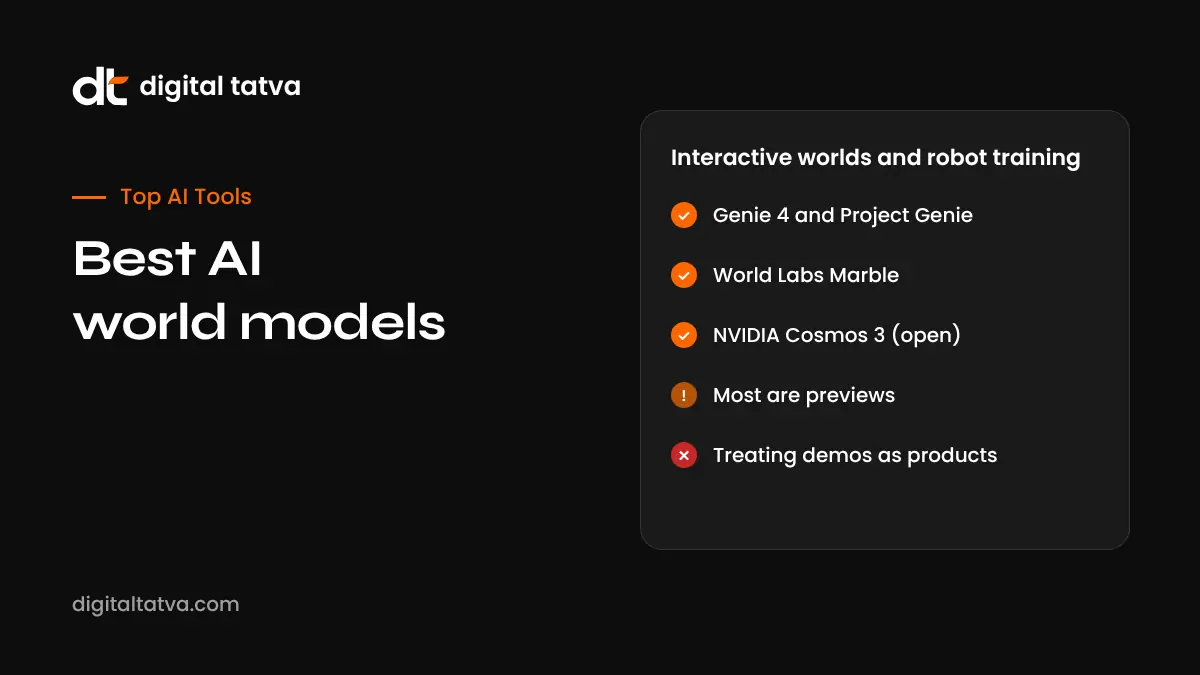
Quick answer: The best AI world models in late 2026 are Google DeepMind’s Genie 4 (the most advanced interactive worlds, announced 27 October 2026 as a research preview), Genie 3 through Project Genie (for Google AI Ultra subscribers), World Labs Marble (turns a single image into a persistent 3D environment you can export), NVIDIA Cosmos 3 (open models for robot and self-driving training data), Runway’s world models including GWM-1 and the newly announced Praxis-1 for robotics, Odyssey-2 (real-time interactive video with a developer API), Lightricks LTX-2.5 (open model for interactive video), Meta V-JEPA 2 (open model for robot planning), Tencent HunyuanWorld (open 3D world generation) and Microsoft’s Muse (game world generation research). Choose Genie or Marble for creative worlds, Cosmos or V-JEPA for robotics, and Odyssey or LTX for building interactive products.
Key takeaways
- A world model generates an environment that responds to actions, not just a fixed video.
- Uses include games, film previsualisation, training robots and self-driving cars, and testing AI agents.
- Most consumer-facing world models are still previews with short sessions.
- Open models such as NVIDIA Cosmos 3, LTX-2.5 and V-JEPA 2 let developers build their own systems.
- Expect world models to become a core tool for physical AI in 2027.
What is a world model?
A world model is an AI system that learns how a world looks and behaves, then generates it in real time as you act. Instead of producing a finished clip like a video generator, it predicts the next moment based on what you do: walk forward and the scene extends, push an object and it moves. Researchers see world models as a key step towards AI that understands physical reality, which matters for robots, self-driving cars and agents that act in the real world.
Interest in the field jumped in 2026 as Google released Genie 4, NVIDIA shipped Cosmos 3 and Runway announced a world model for robotics. RisingTrends data also shows strong growth in related searches such as “terrain diffusion” and “AI gaming”. For background on Google’s model, read Genie 4 explained.
Best AI world models compared
| # | World model | Company | Open or closed | Access | Best for |
|---|---|---|---|---|---|
| 1 | Genie 4 | Google DeepMind | Closed | Trusted testers, Ultra access planned | Most advanced interactive worlds |
| 2 | Genie 3 (Project Genie) | Google DeepMind | Closed | Google AI Ultra subscribers | Trying world models today |
| 3 | Marble | World Labs | Closed | Commercial product | Persistent, exportable 3D scenes |
| 4 | Cosmos 3 | NVIDIA | Open | Hugging Face | Robot and vehicle training data |
| 5 | GWM-1 and Praxis-1 | Runway | Mixed (Praxis-1 described as open-weight) | Runway platform and announced releases | Creative worlds and robotics research |
| 6 | Odyssey-2 | Odyssey | Closed | Developer API | Interactive streaming video in apps |
| 7 | LTX-2.5 | Lightricks | Open | Self-host or API | Building interactive video products |
| 8 | V-JEPA 2 | Meta | Open | GitHub | Robot planning research |
| 9 | HunyuanWorld | Tencent | Open | Hugging Face | Open 3D world generation |
| 10 | Muse | Microsoft | Research | Research releases | Game world generation |
This field moves monthly. Access and licence details reflect public information as of November 2026.
The 10 best world models in detail
1. Genie 4 (Google DeepMind)
Genie 4, announced on 27 October 2026, generates interactive environments in real time with native audio, lets users steer a scene mid-session with text prompts and runs experiences for about two minutes, roughly double Genie 3. Google pitches it for film previsualisation, game prototyping and training environments for robots and AI agents. It is a research preview for trusted testers, with access for Google AI Ultra subscribers described as coming.
Best for: seeing the state of the art.
Watch out for: limited access and short sessions. See Genie 4.
2. Genie 3 through Project Genie
Genie 3 generates navigable worlds from text at about 24 frames per second in 720p. Google AI Ultra subscribers can try it through Project Genie, which makes it one of the few frontier world models consumers can use today.
Best for: Ultra subscribers who want to experiment.
Watch out for: requires the top Google AI plan. See Gemini pricing.
3. World Labs Marble
Marble, from Fei-Fei Li’s World Labs, turns an image or prompt into a persistent 3D environment that you can explore and export as Gaussian splats or meshes for game engines and 3D tools. Unlike frame-by-frame world models, the world stays consistent.
Best for: game designers, architects and 3D artists.
Watch out for: commercial terms; check pricing on World Labs’ site. Related: best AI 3D model generators.
4. NVIDIA Cosmos 3
Cosmos 3, released in June 2026 in 16B and 64B sizes on Hugging Face, unifies text, image, video, audio and robot action generation. Its main job is producing physics-aware synthetic data to train robots and autonomous vehicles.
Best for: robotics and autonomous vehicle teams.
Watch out for: production use needs data center GPUs. See best GPU cloud providers.
5. Runway GWM-1 and Praxis-1
Runway has moved from video generation into world models. In November 2026 it described Praxis-1, which converts a 27-billion-parameter video model into an open-weight world model and uses a small “action expert” to control a real robot arm. Runway claimed a top open-source result on a robotics benchmark but had not yet published the score, download location or licence at the time.
Best for: creators using Runway and robotics researchers watching open releases.
Watch out for: treat claims as preliminary until weights and results are published. See Runway pricing.
6. Odyssey-2
Odyssey-2 streams interactive video, generating a new frame roughly every 50 milliseconds so users can influence what happens as it plays. A developer API, with a Pro tier, lets companies build interactive experiences on top.
Best for: developers building interactive media.
Watch out for: pricing on request.
7. Lightricks LTX-2.5
LTX-2.5 is an open world model aimed at real-time interactive systems, physical AI and production video. You can fine-tune the checkpoint and self-host it without per-generation fees.
Best for: teams that want control and no usage bills.
Watch out for: you need your own GPUs.
8. Meta V-JEPA 2
V-JEPA 2 takes a different approach: it predicts abstract representations of how a scene will change rather than generating pixels. Meta has shown it planning robot actions in new situations without task-specific training. Weights are available on GitHub, mostly under the MIT licence.
Best for: robotics research.
Watch out for: not a tool for generating visual worlds.
9. Tencent HunyuanWorld
Tencent’s HunyuanWorld models generate explorable 3D worlds from text or images and are released with open weights, giving developers an open alternative for 3D scene creation.
Best for: developers who want open 3D world generation.
Watch out for: check the licence for your region and use. See best Chinese AI models.
10. Microsoft Muse
Microsoft Research’s Muse (not to be confused with Meta’s Muse language models) is a generative model trained on gameplay that can generate game visuals and controller actions, pointing to AI-assisted game design and preservation of older games.
Best for: game studios following research.
Watch out for: research rather than a commercial product.
World models vs video generators
| Factor | Video generator | World model |
|---|---|---|
| Output | Fixed clip | Interactive environment |
| User control | Prompt before generation | Actions during generation |
| Consistency | Within the clip | Must stay consistent as you move |
| Main uses | Ads, films, social video | Games, simulation, robot training |
| Examples | Veo, Kling, Runway Gen models | Genie, Marble, Cosmos, Odyssey |
If you need finished videos, see best AI video generators and AI movie maker.
What world models are used for
- Robot training: generating endless realistic scenarios to train and test robots safely. See best humanoid robots.
- Self-driving cars: simulating rare and dangerous road situations.
- Game prototyping: testing level ideas before building them.
- Film previsualisation: exploring shots and sets before production.
- Training AI agents: giving agents environments to practise tasks.
- Architecture and retail: walking through spaces generated from sketches or photos.
How to start experimenting
- Define your goal. Creative exploration, 3D assets or robotics data.
- Pick the access route. Consumer previews (Project Genie), commercial tools (Marble) or open models (Cosmos, LTX, V-JEPA).
- Start small. Test with one scene or task.
- Check rights. Review licences and ownership of generated assets.
- Plan compute. Open models need capable GPUs.
Illustrative example: An indie game studio uses Marble to turn concept art into explorable 3D spaces, exports them to its game engine as a starting point and has artists refine the results. Prototyping a level takes days instead of weeks, while final assets are still hand-crafted. This is an illustrative scenario, not a client story.
Checklist: evaluating a world model
- Clear use case defined.
- Access and licence confirmed.
- Session length and consistency tested.
- Export formats checked.
- Compute costs estimated.
How Digital Tatva can help
As AI moves into 3D, video and physical products, Digital Tatva helps technology companies explain what they do clearly enough for AI assistants to recommend them. See AEO for SaaS and our AEO services.
Building in AI or 3D? Request an AEO audit or try the free AI visibility checker.
Frequently asked questions
What is an AI world model?
An AI system that generates an environment which responds to your actions in real time, rather than a fixed video.
What is the best AI world model?
Google DeepMind’s Genie 4 is the most advanced publicly shown, but access is limited. Marble is the most practical commercial tool, and Cosmos 3 leads among open models for robotics.
Can I try Genie 4?
Genie 4 launched as a research preview for trusted testers, with access for Google AI Ultra subscribers described as coming. Ultra subscribers can already try Genie 3 through Project Genie.
Are there open-source world models?
Yes. NVIDIA Cosmos 3, Lightricks LTX-2.5, Meta V-JEPA 2 and Tencent HunyuanWorld have open weights under their own licences.
How are world models different from video generators?
Video generators produce a finished clip from a prompt. World models keep generating as you act, so you can explore and change the scene.
What are world models used for?
Robot and self-driving training, game prototyping, film previsualisation, training AI agents and exploring architectural spaces.
Will world models replace game engines?
Not soon. They are useful for prototyping and ideas, but game engines still provide the control, consistency and performance games need.
Why do world models matter for robots?
They let robots practise in simulated worlds that look and behave like reality, which is cheaper and safer than real-world training.
How long can world model sessions last?
Most consumer previews run for a few minutes. Genie 4 runs for about two minutes per experience, roughly double Genie 3.
What do I need to run an open world model?
Typically powerful data center GPUs. Smaller versions may run on high-end workstations, but production use needs serious compute.
Product details, prices and features are checked at the time of writing and can change. Sources are linked in the text so you can check them yourself.
How does your brand appear in AI answers?
We test the questions your buyers ask across the major AI assistants and search engines, then show you what to fix first.
Get an AI Visibility Audit