10 Best Humanoid Robots of 2026: Who Is Actually Working in the Real World
Ten humanoid robots compared on what they are actually doing in factories, warehouses and homes.
On this page
- Key takeaways
- Why humanoid robots are a top trend
- Best humanoid robots compared
- The 10 humanoid robots in detail
- How humanoid robots learn their jobs
- Humanoid robots by region
- What humanoid robots can and cannot do in 2026
- How businesses should evaluate humanoid robots
- Humanoids, jobs and the future
- How Digital Tatva can help
- Frequently asked questions
Last updated: 22 November 2026
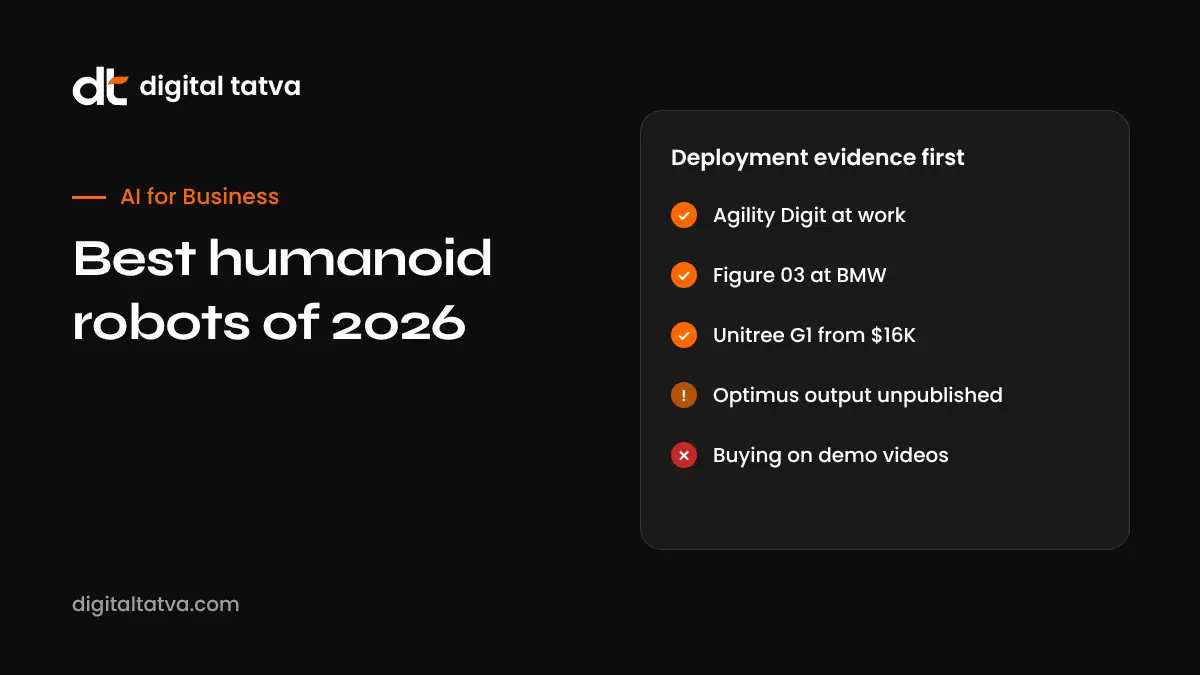
Quick answer: The most important humanoid robots in late 2026 are Agility Robotics’ Digit (the most proven in paid commercial work, with 65,000+ operating hours across customer sites), Figure 03 (working in logistics at BMW’s Spartanburg plant after Figure 02’s 11-month pilot), Unitree’s G1 and H-series (the best-selling humanoids, with about 5,500 shipped in 2025 and the G1 starting around $16,000), Tesla Optimus (high ambitions but no published production numbers, with public sales expected by the end of 2027), Apptronik Apollo (backed by Google DeepMind models), Boston Dynamics’ electric Atlas (with Hyundai), 1X NEO (a home humanoid sold to consumers), UBTech Walker S (factory deployments in China), Foundation Phantom (industrial and defence uses) and Fourier GR-series (research and rehabilitation). Factories and warehouses are where humanoids are working today; home robots remain early.
Key takeaways
- Most real humanoid work in 2026 is in warehouses and factories: moving totes, loading parts and sequencing.
- Agility and Figure have the strongest published deployment evidence.
- Chinese makers, led by Unitree, ship the most units and sell at the lowest prices.
- Tesla’s Optimus plans are large, but output figures have not been published.
- AI models for robots, including world models, are improving fast and will drive the next wave.
Why humanoid robots are a top trend
Humanoid robots moved from viral demos to early commercial work in 2025 and 2026. Better AI models let robots learn tasks from demonstrations and simulation, and falling hardware costs, especially from Chinese manufacturers, made pilots affordable. Search interest in robotics topics rose with it, and big tech companies now build AI models specifically for robots, such as NVIDIA Cosmos and Google DeepMind’s robotics models. See best AI world models for the AI side.
Claims in this field are often promotional. In this guide we separate published deployment evidence from announcements, based on industry reporting such as Humanoid Guide’s 2026 deployment review.
Best humanoid robots compared
| # | Robot | Company | Status (late 2026) | Main use |
|---|---|---|---|---|
| 1 | Digit | Agility Robotics | Commercial operation at multiple customers | Warehouse tote handling |
| 2 | Figure 03 | Figure AI | Working at BMW Spartanburg | Automotive logistics |
| 3 | G1 and H-series | Unitree | Shipping in volume | Research, education, development |
| 4 | Optimus | Tesla | Internal development, no published output | Tesla factories, future consumer use |
| 5 | Apollo | Apptronik | Data collection and pilots | Logistics and manufacturing |
| 6 | Atlas (electric) | Boston Dynamics | Industrial pilots with Hyundai | Automotive manufacturing |
| 7 | NEO | 1X | Offered to consumers; check delivery status in your country | Household help |
| 8 | Walker S series | UBTech | Factory deployments in China | Automotive and electronics plants |
| 9 | Phantom MKII | Foundation | Newly unveiled | Industrial and defence |
| 10 | GR series | Fourier | Sold for research and healthcare | Research and rehabilitation |
The 10 humanoid robots in detail
1. Agility Robotics Digit
Digit is the humanoid with the strongest record of paid work. According to Humanoid Guide, it has logged more than 65,000 operating hours across nine customer facilities, with customers including GXO, Schaeffler, Toyota Motor Manufacturing Canada and Mercado Libre. Agility’s RoboFab factory in Oregon is designed to build up to 10,000 robots a year.
Why it stands out: focused on one valuable job, moving totes, and doing it reliably.
2. Figure 03
Figure AI’s earlier Figure 02 completed an 11-month pilot at BMW’s Spartanburg plant, with Figure reporting more than 1,250 operating hours, over 90,000 sheet metal parts loaded and placement accuracy above 99%. Figure 03 has since moved into logistics sequencing at the same plant. Figure’s in-house AI system controls the robot’s movements and decisions.
Why it stands out: one of the clearest published results from a car factory.
3. Unitree G1 and H-series
Unitree ships more humanoids than anyone else, about 5,500 units in 2025 with targets of 10,000 to 20,000 in 2026. The G1 starts at around $16,000, making it the default choice for universities, labs and developers. The company’s profits came under pressure in 2026 as competition grew.
Why it stands out: price and availability.
4. Tesla Optimus
Tesla has set large goals for Optimus, but as of mid-2026 it had not published production numbers, and Elon Musk said Optimus was not yet in material use in Tesla factories. Tesla has said it expects public sales by the end of 2027.
Why it stands out: potential scale, if Tesla delivers on its plans. Treat timelines with caution.
5. Apptronik Apollo
Apptronik’s Apollo is designed for logistics and manufacturing, and the company works with Google DeepMind on AI models for its next generation. It opened a large facility in Austin for collecting robot task data in 2026.
Why it stands out: strong AI partnership and industrial focus.
6. Boston Dynamics Atlas
Boston Dynamics replaced its famous hydraulic Atlas with an all-electric version aimed at real industrial work, with Hyundai, its owner, as the first major customer for automotive manufacturing.
Why it stands out: decades of robotics experience and a large industrial owner.
7. 1X NEO
1X sells NEO as a home humanoid for household tasks, with some tasks supported by remote human operators while its AI learns. It is one of the few humanoids offered directly to consumers.
Why it stands out: a real attempt at home robots. Consider: privacy, since remote operation can involve people viewing your home.
8. UBTech Walker S series
UBTech has placed Walker S robots in Chinese car and electronics factories for tasks such as inspection and material handling, and reports growing orders.
Why it stands out: one of China’s leading industrial humanoid programmes.
9. Foundation Phantom MKII
Foundation unveiled Phantom MKII in November 2026, targeting industrial and defence markets with a reported carrying capacity of around 200 pounds.
Why it stands out: heavy-duty focus. Very new, so deployment evidence is limited.
10. Fourier GR series
Fourier, which started in rehabilitation robotics, sells GR humanoids to research institutions and healthcare settings.
Why it stands out: healthcare and research focus.
How humanoid robots learn their jobs
The big change behind the humanoid boom is in software, not just motors. Modern humanoids increasingly use AI models that connect what the robot sees, what it is told and how it moves. Common approaches include:
- Learning from demonstration: people perform a task, often through teleoperation, and the robot learns to imitate it. This is why several companies run large data collection sites.
- Vision-language-action models: models that take camera images and instructions and output movements, similar to how chat models output text.
- Simulation and world models: robots practise millions of variations in simulated worlds before trying a task in reality. See best AI world models.
- Reinforcement learning: robots improve balance and movement through trial and error, mostly in simulation.
- Remote assistance: some companies use human operators to help robots with tricky situations and to collect more training data.
This software-first approach is why AI labs and chipmakers now invest heavily in robotics, and why progress can be fast once a robot has enough data for a specific job.
Humanoid robots by region
| Region | Leading companies | Strengths |
|---|---|---|
| United States | Agility, Figure, Tesla, Apptronik, Boston Dynamics, 1X (US and Norway), Foundation | AI models, published industrial pilots, funding |
| China | Unitree, UBTech, Fourier and many others | Low-cost hardware, volume production, supply chains |
| Europe and others | A growing group of startups and research labs | Research, safety standards, industrial automation expertise |
What humanoid robots can and cannot do in 2026
| Can do reliably in pilots | Still difficult |
|---|---|
| Moving totes and boxes between fixed points | Handling any object in a messy home |
| Loading parts into fixtures | Delicate tasks needing fine touch |
| Repetitive logistics sequencing | Working safely among crowds of people |
| Inspection walks in factories | Long shifts without supervision or charging |
| Research and demonstrations | Matching human speed on varied tasks |
How businesses should evaluate humanoid robots
- Start with the task, not the robot. Many jobs are better served by wheeled robots, arms or conveyors.
- Ask for operating data. Hours worked, uptime, error rates and interventions per shift.
- Visit a live deployment. Demos are not deployments.
- Check safety standards. Ensure compliance with workplace and machinery safety rules.
- Plan the business case. Include integration, maintenance, charging and supervision costs.
- Pilot with clear exit criteria. Define success before you start.
Illustrative example: A third-party logistics company runs a six-month pilot with a humanoid moving empty totes between conveyors on a night shift. It tracks interventions per hour, uptime and safety incidents, and compares cost per tote with a simple conveyor extension before deciding whether to expand. This is an illustrative scenario, not a client story.
Checklist before a humanoid pilot
- Specific task and success metrics defined.
- Alternatives such as conveyors or arms compared.
- Vendor operating data reviewed.
- Safety assessment completed.
- Integration and support costs budgeted.
- Worker consultation and training planned.
Humanoids, jobs and the future
Humanoids will take on some repetitive, physically demanding work first, while creating demand for technicians, robot supervisors and integration specialists. See AI jobs in demand for 2027 and jobs AI will replace. For the wider picture, read AI trends for 2027.
How Digital Tatva can help
Robotics and manufacturing buyers increasingly research suppliers with AI assistants. Digital Tatva helps industrial and B2B companies get cited accurately. See AEO for manufacturers and our AEO services.
Does AI recommend your industrial business? Request an AEO audit or try the free AI visibility checker.
Frequently asked questions
What is the best humanoid robot in 2026?
For proven commercial work, Agility’s Digit and Figure’s robots at BMW have the strongest published evidence. For price and availability, Unitree’s G1 leads.
Can I buy a humanoid robot?
Yes. Unitree sells to researchers and developers, and 1X sells NEO for homes. Industrial humanoids are usually sold or leased to businesses.
How much does a humanoid robot cost?
Unitree’s G1 starts at around $16,000. Industrial humanoids are typically priced through custom contracts or robot-as-a-service leases.
Is Tesla Optimus available?
Not to the public. Tesla has said it expects public sales by the end of 2027 but has not published production figures.
Are humanoid robots working in factories?
Yes, in pilots and early commercial deployments, such as Digit in logistics and Figure at BMW.
Will humanoid robots replace workers?
They will take on some repetitive and physically demanding tasks, but deployments are still small, and they create new roles in maintenance and supervision.
Which country leads in humanoid robots?
China leads in units shipped and low prices; US companies lead in many published commercial deployments and AI models.
Are home robots like 1X NEO safe?
Review safety features and privacy terms carefully, especially if remote operators can control the robot in your home.
What AI powers humanoid robots?
Vision-language-action models, reinforcement learning and simulation, often using world models to generate training scenarios.
When will humanoid robots be common?
Expect steady growth in factories and warehouses through 2027 and beyond. Everyday home use is likely years away for most people.
Product details, prices and features are checked at the time of writing and can change. Sources are linked in the text so you can check them yourself.
How does your brand appear in AI answers?
We test the questions your buyers ask across the major AI assistants and search engines, then show you what to fix first.
Get an AI Visibility Audit