15 AI Jobs in Demand for 2027: Roles, Skills and How to Get Hired
Fifteen AI roles employers need going into 2027, the skills behind them and how to move into one.
On this page
Last updated: 22 November 2026
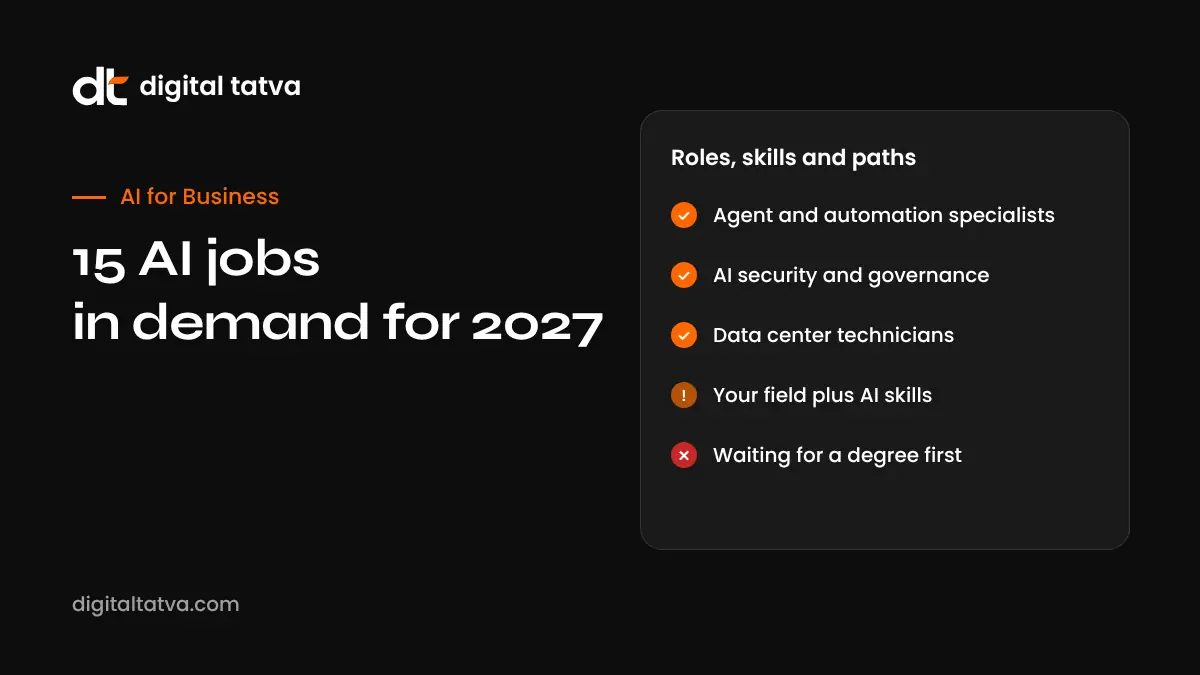
Quick answer: The AI jobs most in demand going into 2027 are AI and machine learning engineers, AI agent and automation specialists, data engineers, inference and MLOps engineers, AI security specialists, AI governance and compliance officers, AI product managers, data center technicians and electricians, AI visibility (AEO) specialists, AI trainers and domain experts who evaluate models, AI solutions and sales engineers, AI content editors, robotics technicians, AI educators and trainers, and AI-savvy managers in every function. You do not need a computer science degree for many of them: domain expertise plus strong AI skills is often the winning combination.
Key takeaways
- Demand is shifting from building models to deploying, securing and governing AI.
- Physical infrastructure jobs are booming: “data center jobs” searches grew about 606% in a year.
- Agents create demand for people who design, supervise and check automated work.
- Regulation creates compliance and governance roles, especially with EU deadlines in 2027.
- Every job is becoming an AI job: knowing how to use AI well is a baseline skill.
What is driving AI hiring in 2027
Several forces are shaping the AI job market going into 2027. Companies are moving AI agents from pilots into real work. Data center construction is creating demand for electricians, technicians and engineers. Regulations such as the EU AI Act add compliance work, with high-risk system obligations now due from December 2027. And AI search is changing marketing roles. RisingTrends data shows searches for “data center jobs” up about 606% year on year and “inference engineering” up roughly 29 times.
At the same time, AI funding has slowed through 2026, so hiring is becoming more selective. Practical skills that save money or reduce risk are the safest bets. For the bigger picture, read AI trends for 2027.
15 AI jobs in demand at a glance
| # | Job | What you do | Background that helps |
|---|---|---|---|
| 1 | AI or machine learning engineer | Build and integrate AI into products | Software engineering, ML |
| 2 | AI agent and automation specialist | Design and run agent workflows | Operations, no-code tools, scripting |
| 3 | Data engineer | Prepare and manage data for AI | SQL, data pipelines |
| 4 | Inference and MLOps engineer | Run models fast and cheaply in production | DevOps, GPUs, cloud |
| 5 | AI security specialist | Protect AI systems and agents | Cybersecurity |
| 6 | AI governance and compliance officer | Manage AI risk and regulation | Legal, risk, compliance |
| 7 | AI product manager | Define and ship AI features | Product management |
| 8 | AI visibility (AEO) specialist | Get brands cited in AI answers | SEO, content, PR |
| 9 | AI solutions or sales engineer | Help customers adopt AI products | Technical sales, consulting |
| 10 | AI-skilled manager | Redesign team workflows with AI | Any management role |
| 11 | Data center technician or electrician | Build and maintain AI infrastructure | Electrical, mechanical trades |
| 12 | AI trainer and model evaluator | Test and improve model outputs | Domain expertise |
| 13 | AI content editor | Turn AI drafts into quality content | Writing, editing |
| 14 | Robotics technician | Deploy and maintain robots | Mechatronics, maintenance |
| 15 | AI educator and trainer | Teach teams to use AI | Training, teaching |
Technical AI jobs
1. AI or machine learning engineer
These engineers integrate models into products: building retrieval systems, agents, evaluations and user features. Most companies now use existing models through APIs rather than training their own, so practical skills in prompt design, retrieval, evaluation and cost control matter as much as theory.
Skills to build: Python or TypeScript, LLM APIs, retrieval (see what is RAG), evaluation, agent frameworks. See best AI agent frameworks.
2. AI agent and automation specialist
As agents move into real work, companies need people who map processes, build automations with tools like n8n, Zapier and agent platforms, set permissions and monitor results. Many come from operations rather than engineering.
Skills to build: process mapping, automation tools, basic scripting, testing. See how to build an n8n AI workflow.
3. Data engineer
AI is only as good as the data it can access. Data engineers build the pipelines, warehouses and access controls that feed AI systems, and their work grows as tools like Claude Data and Microsoft IQ connect agents to company data.
Skills to build: SQL, data modelling, cloud data platforms, data quality.
4. Inference and MLOps engineer
Running AI at scale is expensive. Inference engineers make models faster and cheaper with batching, caching, model routing and the right hardware. Searches for “inference engineering” grew roughly 29 times in a year.
Skills to build: GPU serving tools such as vLLM, cloud infrastructure, monitoring. See best GPU cloud providers and model routing explained.
5. AI security specialist
Agents can be tricked by prompt injection, leak data or take harmful actions. Security teams need people who understand AI-specific risks, red-team models and set controls for agents.
Skills to build: security fundamentals, prompt injection, identity and access management for agents. See AI agent security.
Business and governance AI jobs
6. AI governance and compliance officer
With EU AI Act transparency duties in force since August 2026 and high-risk obligations due from December 2027, plus new laws in US states and other countries, companies need people who inventory AI systems, assess risk and keep documentation. See AI laws to know for 2027.
Skills to build: regulation, risk frameworks, policy writing, vendor assessment.
7. AI product manager
AI product managers decide what AI features to build, how to measure quality and how to handle failures. They need enough technical understanding to judge trade-offs between models, cost and user experience.
Skills to build: evaluation design, user research, AI pricing and cost awareness.
8. AI visibility (AEO) specialist
As customers ask AI assistants for recommendations, companies need specialists who measure and improve how often their brand is mentioned and cited. This role combines SEO, content strategy, digital PR and entity optimisation. See how to become an AEO specialist.
Skills to build: SEO, content, structured data, AI visibility tools.
9. AI solutions or sales engineer
AI vendors need people who can explain products, run pilots and connect AI to customer systems. These roles suit people with technical knowledge and strong communication skills.
10. AI-skilled manager
Every department needs leaders who can redesign workflows with AI, set quality standards and help teams adapt. This may be the largest category of all, even if it rarely has “AI” in the job title.
Hands-on and creative AI jobs
11. Data center technician or electrician
AI data centers need enormous amounts of power and cooling. Electricians, HVAC specialists, technicians and construction managers are in high demand where new facilities are built, although local opposition and power limits affect where projects go ahead.
Skills to build: electrical and mechanical trades, safety certifications.
12. AI trainer and model evaluator
AI labs and companies pay experts in law, medicine, finance, coding and other fields to write examples, rate answers and find mistakes. Domain expertise is the main qualification.
13. AI content editor
AI drafts are cheap; good content is not. Editors who fact-check, add expertise and remove generic filler are valuable, especially as audiences reject “AI slop”. See how to spot AI slop.
14. Robotics technician
As humanoid and industrial robots move into warehouses and factories, technicians are needed to install, maintain and supervise them. See best humanoid robots.
15. AI educator and trainer
Companies, schools and governments need people who can teach practical AI skills. Trainers with real workplace experience are especially valued.
How to move into an AI job
- Start from your current expertise. The fastest path is usually “your field plus AI”.
- Learn the fundamentals. How LLMs work, their limits, prompting and evaluation. See how to learn AI.
- Build a portfolio. Automate a real process, document the time saved and share it.
- Take a recognised course. See free AI courses with certificates.
- Use AI in your job search. See best AI tools for job search.
- Stay current. Follow a few good sources; see best AI newsletters.
Illustrative example: An accounts payable specialist learns an automation tool, builds a workflow that extracts invoice data and flags mismatches for review, and documents that it saves her team several hours a week. She uses that project to move into an internal automation specialist role. This is an illustrative scenario, not a client story.
Checklist: preparing for an AI career in 2027
- Target role chosen based on your background.
- Core AI concepts learned.
- One or two portfolio projects with measurable results.
- Relevant certification or course completed.
- Profile updated with AI skills and examples.
- Regular learning routine in place.
Skills that matter in every AI job
- Clear writing and instructions, because that is how you direct AI.
- Critical thinking to check AI output.
- Data literacy.
- Understanding privacy, security and ethics.
- Comfort with constant change.
See AI skills to learn and jobs AI will replace.
How Digital Tatva can help
Digital Tatva works at the intersection of AI and marketing, helping brands become visible in AI answers. If you are building an AEO capability in-house, we can help with strategy and training. See our AEO services.
Building AI visibility skills in your team? Request an AEO audit or try the free AI visibility checker.
Frequently asked questions
What AI jobs are most in demand for 2027?
AI engineers, agent and automation specialists, data and inference engineers, AI security and governance roles, data center technicians and AI visibility specialists are among the most in demand.
Can I get an AI job without a computer science degree?
Yes. Roles such as automation specialist, AI trainer, AI content editor, AEO specialist, AI educator and governance officer value domain expertise and practical skills.
Which AI job pays the most?
Specialist engineering and research roles at AI labs typically pay the most, but pay varies widely by country, company and experience.
Are data center jobs related to AI?
Yes. The AI boom is driving data center construction, creating demand for electricians, technicians and engineers.
What is an AI agent specialist?
Someone who designs, builds and supervises AI agents that carry out multi-step work, including permissions, testing and monitoring.
What is an AEO specialist?
A marketer who helps brands get mentioned and cited in AI answers from tools such as ChatGPT, Gemini and Perplexity.
Will AI create more jobs than it destroys?
Nobody knows for certain. AI is clearly creating new roles while changing or reducing others; the balance will differ by industry and country.
How long does it take to move into an AI job?
For people adding AI to existing expertise, a few months of focused learning and a portfolio project can be enough. Deep technical roles take longer.
Which AI skills should I learn first?
How LLMs work and fail, writing clear instructions, using AI tools in your field, basic data skills and AI privacy and security basics.
Are AI jobs safe from AI?
No job is fully safe, but roles that combine judgement, accountability, domain expertise and AI skills are the most resilient.
Product details, prices and features are checked at the time of writing and can change. Sources are linked in the text so you can check them yourself.
How does your brand appear in AI answers?
We test the questions your buyers ask across the major AI assistants and search engines, then show you what to fix first.
Get an AI Visibility Audit