15 AI Marketing Trends for 2027: What Marketers Should Plan for Now
Fifteen AI marketing trends backed by late 2026 data, with a practical plan for 2027.
On this page
Last updated: 22 November 2026
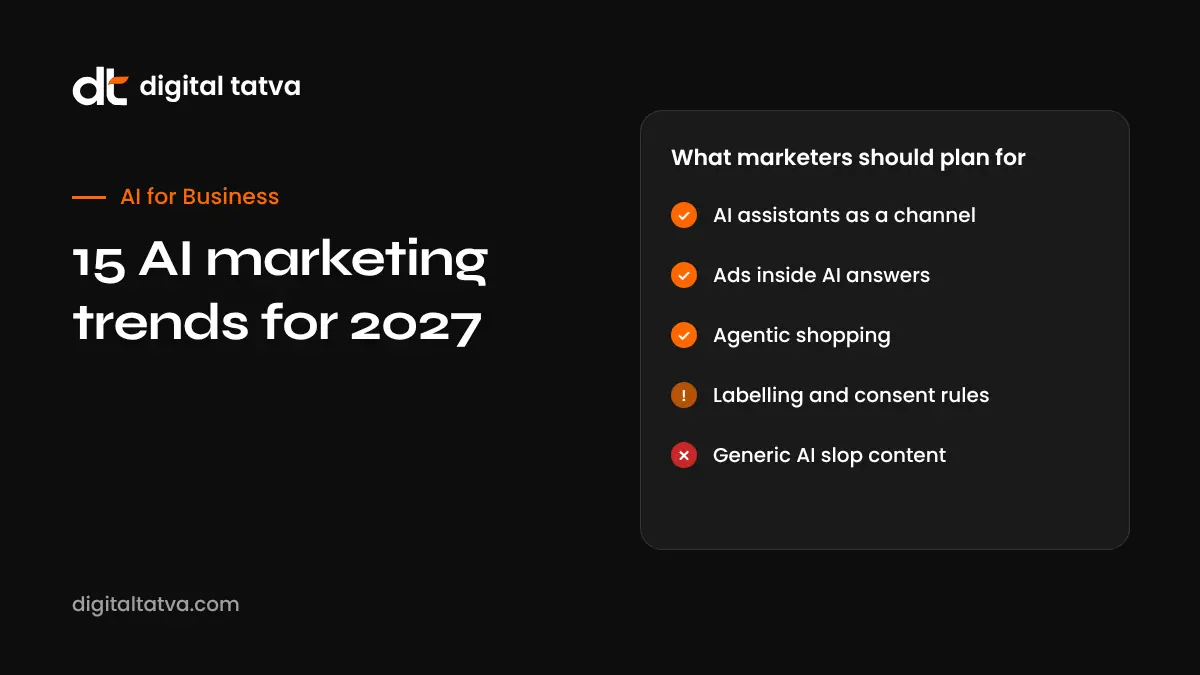
Quick answer: The AI marketing trends that will shape 2027 are: AI assistants becoming a main discovery channel, ads inside AI answers, AI agents that run campaigns, AI-generated video at scale, an authenticity backlash against “AI slop”, agentic shopping where AI buys on the customer’s behalf, conversational marketing in messaging apps, AI avatars and voice with strict consent, mandatory labelling of AI content in some markets, measurement of AI referrals and AI visibility, first-party data as the fuel for AI targeting, hyper-personalised email and websites, AI-powered creative testing, smaller teams with AI operations roles, and marketing to AI agents as well as people. The common thread: marketers must be visible and trusted inside AI systems, not just on search results pages and social feeds.
Key takeaways
- Customers increasingly ask ChatGPT, Gemini, Claude and Google AI Mode before they visit your website.
- Paid and organic visibility in AI answers need to be planned together.
- AI makes content cheap, so originality, proof and trust become the differentiators.
- Agents will compare and buy on behalf of customers, so product data quality becomes marketing.
- Regulation and consent rules for AI content, avatars and voices are tightening.
The data behind these trends
We built this list from late 2026 signals: AI tool traffic, search demand and product launches. ChatGPT drew about 5 billion web visits in October 2026, and Claude grew about 55% in four months. Searches for Google AI Mode grew about 587% in a year, “agent advertisement” and “ad agents” about 152%, “Meta ads” about 72% and “AI slop” about 178%, according to RisingTrends. For broader context, read our 20 AI trends for 2027 and SEO and AI search trends for 2027.
15 AI marketing trends for 2027 at a glance
| # | Trend | What to do in 2027 |
|---|---|---|
| 1 | AI assistants as a discovery channel | Track and improve AI visibility |
| 2 | Ads inside AI answers | Test AI placements, plan with organic |
| 3 | AI agents running campaigns | Set goals, guardrails and review |
| 4 | AI video at scale | Build a fast video testing workflow |
| 5 | Authenticity backlash | Invest in original proof and people |
| 6 | Agentic shopping | Clean product feeds and policies |
| 7 | Messaging-first marketing | AI on WhatsApp, iMessage and chat |
| 8 | Avatars and synthetic voice | Written consent and disclosure |
| 9 | AI content labelling | Labelling policy and records |
| 10 | Measuring AI referrals and visibility | New KPIs and dashboards |
| 11 | First-party data as AI fuel | Consent-based data collection |
| 12 | Hyper-personalised email and web | Modular content and testing |
| 13 | AI creative testing | More variants, clear hypotheses |
| 14 | Smaller teams, new AI roles | Train and redesign workflows |
| 15 | Marketing to AI agents | Agent-ready websites |
Trends in discovery and media
1. AI assistants become a main discovery channel
For many product and service questions, the first answer people see in 2027 will come from an AI assistant. That answer often names a shortlist of brands and links a few sources. If your brand is missing or described incorrectly, you lose demand before it reaches your analytics. Treat AI visibility like a channel: measure mentions and citations across ChatGPT, Gemini, Claude, Perplexity and Google AI Mode. Start with what is AI search visibility and how to track brand mentions in ChatGPT.
2. Ads inside AI answers
Ads now appear in and around AI answers, including Google AI Mode and AI Overviews and ChatGPT. Early formats are limited and evolving, but in 2027 paid placements will sit next to organic AI recommendations. Plan both together so your paid and organic messages match. See ads in AI Mode and AI Overviews and ChatGPT ads.
3. AI agents running campaigns
Ad platforms already automate targeting, bidding and creative through tools like Meta Advantage+ and Google AI Max. In 2027 more of campaign set-up, optimisation and reporting will be handled by AI agents, and searches for “ad agents” are rising fast. Marketers’ jobs shift to setting goals, feeding good data and creative, and checking results. See Meta Advantage+ and Google Ads AI Max.
4. AI video at scale
AI video tools are among the fastest growing AI products. Higgsfield more than doubled its web traffic between June and October 2026, and tools like Google Flow, Kling and HeyGen Avatar 6 make production cheaper. Expect brands to test far more video variants on short-form platforms. See best AI UGC video generators and AI movie maker.
5. The authenticity backlash
As AI content floods feeds, audiences tune out generic material. “AI slop” became a mainstream term, and searches for “no AI slop” appeared. In 2027, original research, real customers, named experts and behind-the-scenes content will stand out precisely because they cannot be generated. See how to spot AI slop and original research for AEO.
Trends in commerce and conversation
6. Agentic shopping
AI assistants can research products, compare offers and, in some cases, complete checkout. Google’s agentic checkout protocol, wallet features in ChatGPT and Gemini, and shopping research modes all expanded in 2026. When an agent shops for a customer, your product data, reviews, return policy and stock information do the selling. See Google UCP and agentic checkout and ChatGPT shopping optimization.
7. Messaging-first marketing
More AI assistants work through WhatsApp, iMessage and SMS to book, buy and schedule. For local services, travel and retail, a conversation thread may replace the app or website for many tasks. See WhatsApp AI for business and AI receptionists.
8. Avatars and synthetic voice with consent
AI avatars are now realistic enough that viewers struggle to tell them from real recordings, according to vendor tests for tools like HeyGen Avatar 6. That makes consent, disclosure and contracts essential. Use only people who have agreed in writing, and label synthetic content where rules or platform policies require it. See HeyGen Avatar 6.
9. Mandatory labelling of AI content
The EU AI Act’s transparency duties, including labelling certain AI-generated or manipulated content, apply from August 2026, and other countries are adding similar rules. Marketing teams need a simple policy: what gets labelled, how, and who approves. See EU AI Act Article 50 for marketers and AI laws to know for 2027.
Trends in data and measurement
10. Measuring AI referrals and AI visibility
Traditional rank tracking misses AI answers. In 2027, marketing dashboards will include AI referral traffic, share of voice in AI answers and citation counts. Tools for tracking AI Overviews and AI Mode matured quickly in 2026. See how to track AI traffic in GA4, AI Overview tracking tools and AI share of voice.
11. First-party data as AI fuel
AI targeting and personalisation are only as good as the data behind them. With privacy rules tightening, consented first-party data (email lists, purchase history, preferences) becomes the most valuable marketing asset.
12. Hyper-personalised email and websites
AI makes it practical to tailor emails, landing pages and offers to segments or even individuals. The challenge in 2027 is quality control, so build modular content blocks and test carefully. See AI email marketing.
13. AI-powered creative testing
Generating dozens of ad variants is now easy. The winners will be teams that test with clear hypotheses and learn which messages work, rather than flooding platforms with random variations. See best AI ad generators.
Trends in teams and websites
14. Smaller teams and new AI roles
Marketing teams will do more with fewer people, while new roles appear: AI operations, AI visibility specialists, prompt and workflow designers and AI content editors. See AI jobs in demand for 2027 and how to become an AEO specialist.
15. Marketing to AI agents
Some visitors to your website will be AI agents researching on behalf of a person. Clear structure, fast pages, machine-readable product and pricing information and verified bot access help agents understand and recommend you. See agent-ready website, Web Bot Auth and Microsoft Clarity agent analytics.
Your 2027 AI marketing plan
- Benchmark AI visibility. List your 20 most important buying questions and record how AI assistants answer them.
- Fix your facts. Make company, product and pricing information consistent across your site, listings and profiles.
- Build proof assets. Publish original data, case studies with permission and expert content.
- Set up AI measurement. Track AI referrals and visibility alongside SEO and paid metrics.
- Pilot AI campaign agents. Start with one channel, clear goals and human review.
- Write an AI content policy. Cover labelling, consent for avatars and voices, and approvals.
Illustrative example: A mid-sized skincare brand checks how ChatGPT, Gemini and Google AI Mode answer its 20 top buying questions and finds it is missing from most answers about sensitive skin. It publishes an ingredient study with its own testing data, fixes inconsistent product details across retailers and tracks AI mentions monthly. This is an illustrative scenario, not a client story.
Checklist: AI marketing readiness for 2027
- AI visibility baseline recorded.
- Product and company facts consistent everywhere.
- Original proof content planned each quarter.
- AI referral and visibility KPIs in dashboards.
- AI content labelling and consent policy approved.
- One AI campaign agent pilot with clear goals.
- Website tested for AI agent access and clarity.
How Digital Tatva can help
Digital Tatva specialises in the first and biggest trend on this list: getting brands found, cited and recommended inside AI assistants. We audit your AI visibility, fix entity and content gaps and track progress over time. See our AEO services and AI for marketing agencies.
Is your marketing ready for AI-first discovery? Request an AEO audit or try the free AI visibility checker.
Frequently asked questions
What is the biggest AI marketing trend for 2027?
AI assistants becoming a main discovery channel. Being mentioned and cited in AI answers will matter as much as ranking in classic search.
Will AI replace marketers in 2027?
No, but it will change the job. Marketers will spend more time on strategy, data, creative direction and checking AI output, and less on manual production.
Are there ads in ChatGPT and Google AI Mode?
Yes. Ads have started appearing in and around AI answers, with formats still evolving. See our guides to ChatGPT ads and ads in AI Mode.
Do I need to label AI-generated marketing content?
In some markets and cases, yes. The EU AI Act includes transparency duties for certain AI-generated content, and platforms have their own rules. Check what applies to you.
How do I measure AI marketing results?
Track AI referral traffic in analytics, AI share of voice and citations with AI visibility tools, and the usual conversion and revenue metrics.
What is agentic shopping?
When an AI assistant researches and sometimes completes purchases for a customer. Clean product data, clear policies and good reviews help agents choose your products.
Is AI-generated content bad for marketing?
Not if it is accurate, useful and reviewed. Generic, low-effort content performs poorly with audiences and AI assistants alike.
Which AI marketing tools should I use in 2027?
Start with one main assistant, the AI features in your ad platforms, an AI visibility tracker and a video tool. See best AI marketing tools.
How do small businesses keep up with AI marketing trends?
Focus on basics: consistent business information, reviews, helpful content, a simple AI visibility check every quarter and one or two AI tools that save time.
What skills do marketers need for 2027?
AI visibility and AEO, data analysis, prompt and workflow design, creative direction and understanding AI regulation and consent.
Product details, prices and features are checked at the time of writing and can change. Sources are linked in the text so you can check them yourself.
How does your brand appear in AI answers?
We test the questions your buyers ask across the major AI assistants and search engines, then show you what to fix first.
Get an AI Visibility Audit