How to Spot AI Slop: 15 Signs of Low-Quality AI Content
Fifteen signs of AI slop across text, images, video and websites, plus a quick check you can run in a minute.
On this page
- Key takeaways
- What is AI slop?
- 15 signs of AI slop at a glance
- Signs of AI slop in text
- Signs of AI slop in images and video
- Signs of AI slop in websites and feeds
- Tools that help you check content
- A 60-second slop check
- How brands can use AI without making slop
- How Digital Tatva can help
- Frequently asked questions
Last updated: 22 November 2026
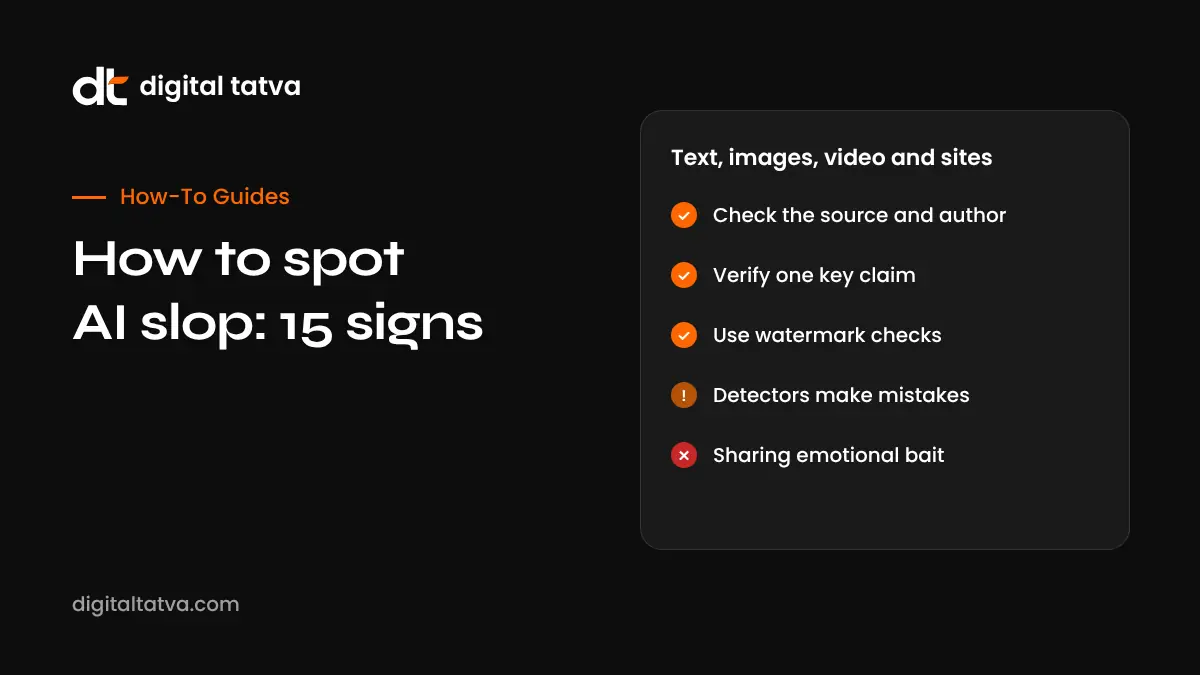
Quick answer: “AI slop” is low-effort, mass-produced AI content made to grab clicks, views or search traffic rather than to inform or entertain. You can usually spot it by 15 signs: vague text that says little, repeated stock phrases, confident but wrong facts, fake or missing sources, no named author or real experience, identical articles across many sites, images with odd hands, text or physics, glossy faces with no real context, videos with mismatched audio and lip movement, pages stuffed with ads, accounts posting at impossible volume, emotional bait with no source, AI “recipes” or “guides” that do not work, fake reviews, and missing content credentials or watermarks where you would expect them. No single sign proves something is AI slop, so check sources and creators before you trust or share it.
Key takeaways
- Searches for “AI slop” grew about 178% in a year, and even “no AI slop” became a search term.
- AI slop is about low effort and low value, not just the use of AI.
- Look at the source, the creator and the evidence, not only at visual glitches.
- Watermark and content credential checks help, but they are not complete.
- Brands that use AI well add real expertise, data and editing; that is the opposite of slop.
What is AI slop?
AI slop is the flood of cheap AI-generated text, images and video posted to farm attention: clickbait articles, fake inspirational images, recycled “news” videos and spammy product pages. The term spread widely in 2025 and 2026 as feeds, search results and marketplaces filled with it. RisingTrends data shows about 110,000 monthly searches for “AI slop”, up around 178% year on year.
Not all AI content is slop. A carefully edited article where AI helped with a first draft, or a clearly labelled AI illustration, can be genuinely useful. Slop is defined by intent and quality: it exists to get clicks, not to help anyone.
15 signs of AI slop at a glance
| # | Sign | Where you see it |
|---|---|---|
| 1 | Lots of words, little substance | Articles, posts |
| 2 | Repeated stock phrases and structure | Articles, comments |
| 3 | Confident but wrong facts | Articles, videos |
| 4 | Missing or fake sources | Articles, posts |
| 5 | No real author or experience | Websites, reviews |
| 6 | Near-identical content across sites | Search results |
| 7 | Visual errors in hands, text and physics | Images |
| 8 | Too-perfect faces with no context | Images, profiles |
| 9 | Audio and lip movement out of sync | Video |
| 10 | Pages buried in ads | Websites |
| 11 | Impossible posting volume | Social accounts, channels |
| 12 | Emotional bait with no source | Social feeds |
| 13 | Instructions that do not work | Recipes, how-tos, products |
| 14 | Fake or generic reviews | Marketplaces, app stores |
| 15 | No provenance where you would expect it | News images and video |
Signs of AI slop in text
1. Lots of words, little substance
Slop articles circle a topic without answering the question. They restate the title, add generic advice and end with a summary of nothing. Ask yourself: what did I learn that I could not have guessed?
2. Repeated stock phrases and structure
Watch for the same patterns again and again: dramatic openings about a “fast-paced world”, every section ending in a tidy one-line moral, lists of exactly three adjectives and an obligatory “in conclusion”. One pattern alone means little; many together suggest an unedited AI draft.
3. Confident but wrong facts
AI can invent statistics, dates, product features and quotes. Slop publishers do not check them. If a surprising number has no source, or a product feature sounds too good, verify it elsewhere.
4. Missing or fake sources
Real reporting links to evidence. Slop either cites nothing or cites studies and experts that do not exist. Click the links and search the names.
5. No real author or experience
Slop sites often have no named authors, or authors with AI-generated photos and no footprint elsewhere. Reviews claim hands-on testing but contain no details only a real user would know. See E-E-A-T for AI search.
6. Near-identical content across many sites
Search a distinctive sentence in quotes. If dozens of sites publish almost the same article, you are looking at mass-produced content.
Signs of AI slop in images and video
7. Visual errors in hands, text and physics
Image models have improved a lot, but slop still shows mistakes: extra fingers, melted jewellery, garbled signs, shadows going the wrong way and objects merging into each other.
8. Too-perfect faces with no context
Glossy, airbrushed people in emotional scenes, such as a child with a handmade sculpture asking for likes, are a classic slop format. Look for the original source of the photo and whether the people exist.
9. Audio and lip movement out of sync
AI videos and voice clones can have slightly off lip-sync, flat emotion, odd pauses or backgrounds that shift between shots. Be especially careful with videos of public figures saying surprising things. See how to spot deepfake scams.
Signs of AI slop in websites and feeds
10. Pages buried in ads
Many slop sites exist to show ads. If you scroll past more ads than paragraphs, the content was probably made cheaply to fill space.
11. Impossible posting volume
A channel posting dozens of videos a day, or a site publishing hundreds of articles a week on unrelated topics, is almost certainly automated.
12. Emotional bait with no source
Outrage, heartbreak and miracle stories spread fast. Slop uses them deliberately. Before sharing, check whether any reputable outlet reported the story.
13. Instructions that do not work
AI-generated recipes with impossible quantities, how-to guides that skip steps, or travel guides recommending closed places are common forms of slop that can waste money or even be unsafe. Be particularly careful with health, foraging and safety advice.
14. Fake or generic reviews
Reviews that sound the same, praise vague benefits and appear in sudden bursts may be AI-generated. Look for detailed reviews with photos and verified purchase labels.
15. No provenance where you would expect it
Major news organisations and camera makers increasingly attach content credentials (C2PA) to images, and AI companies such as Google mark AI output with watermarks like SynthID. Missing credentials do not prove anything, but tools that read them can help. See our SynthID detector guide.
Tools that help you check content
| Tool type | What it does | Limits |
|---|---|---|
| Reverse image search | Finds where an image first appeared | New images may have no history |
| Watermark checkers (such as SynthID detection) | Detects certain AI watermarks | Only works for tools that add them |
| Content credential viewers | Shows C2PA provenance data | Many images lack credentials |
| AI text detectors | Estimates whether text is AI-written | False positives and negatives |
| Fact-checking sites | Verify viral claims | Cannot cover everything |
AI text detectors are not reliable enough to accuse anyone on their own. Read how AI detectors work and best AI detectors before relying on them.
A 60-second slop check
- Who made it? Find the creator or publisher and check they are real and credible.
- What is the source? Look for links, named experts and original data.
- Does it check out? Search one key claim elsewhere.
- Is it consistent? Look for visual glitches, odd phrasing or contradictions.
- Why does it exist? Ask whether it is trying to inform you or just to get a click or a share.
How brands can use AI without making slop
AI slop is also a business risk. Google’s spam policies target scaled content made to manipulate rankings, and AI assistants tend to cite sources with clear expertise and original information. If your brand uses AI to produce content, build in quality:
- Start from real expertise, data, customer questions or first-hand testing.
- Use AI for drafts, structure and editing, not as the final author.
- Fact-check every number, name and claim.
- Add named authors with real credentials.
- Publish less, but make each piece genuinely useful.
- Label AI-generated images and synthetic media where rules or audiences expect it.
See does Google penalize AI content, Google spam policies and original research for AEO.
Illustrative example: A travel company that had published hundreds of quick AI-written destination pages pauses new content and audits the old pages. It removes thin pages, merges duplicates and adds local tips from its own guides, real photos and named authors to the best ones. The site ends up smaller but far more useful. This is an illustrative scenario, not a client story.
Checklist: avoiding AI slop in your own content
- Every piece starts from real expertise or data.
- Facts and sources checked by a person.
- Named author with relevant experience.
- No near-duplicate pages at scale.
- AI images and media labelled where appropriate.
- Regular audits to improve or remove thin content.
How Digital Tatva can help
AI assistants prefer clear, trustworthy, original sources. Digital Tatva helps brands build that kind of content and the signals that make AI cite it. See our AEO services.
Is your content being cited, or ignored as noise? Request an AEO audit or try the free AI visibility checker.
Frequently asked questions
What does AI slop mean?
Low-quality, mass-produced AI content made to get clicks, views or search traffic rather than to inform or help.
Is all AI content slop?
No. AI-assisted content that is accurate, edited and genuinely useful is not slop. Slop is about low effort and low value.
How can I tell if an article was written by AI?
Look for vague content, repeated phrases, missing sources, no real author and claims you cannot verify. Detectors can help but are not reliable on their own.
How can I tell if an image is AI-generated?
Check for visual errors, use reverse image search, and look for watermarks or content credentials. Still, the best images can be hard to spot.
Why is there so much AI slop online?
AI makes content almost free to produce, and ad revenue and engagement reward volume. Platforms are trying to reduce it, but the incentives remain.
Does Google penalise AI slop?
Google’s spam policies target scaled, low-value content made to manipulate rankings, whether or not AI wrote it. Helpful content can rank regardless of how it was made.
Can AI detectors spot AI slop?
Sometimes, but they make mistakes. Use them as one signal alongside source checks and common sense.
How do I stop seeing AI slop in my feed?
Do not engage with it, mute or block accounts that post it, follow trusted creators and use platform controls where available.
Is AI slop dangerous?
It can be when it spreads false information, fake health or safety advice, scams or deepfakes. Verify anything important before acting on it.
How can businesses avoid creating AI slop?
Start from real expertise, use AI as an assistant rather than the author, check facts, name authors and publish fewer, better pieces.
Product details, prices and features are checked at the time of writing and can change. Sources are linked in the text so you can check them yourself.
How does your brand appear in AI answers?
We test the questions your buyers ask across the major AI assistants and search engines, then show you what to fix first.
Get an AI Visibility Audit