15 AI Laws to Know for 2027: EU AI Act, US States, Asia and India
The AI rules and deadlines that matter for businesses in 2027, in plain English. General information, not legal advice.
On this page
Last updated: 22 November 2026
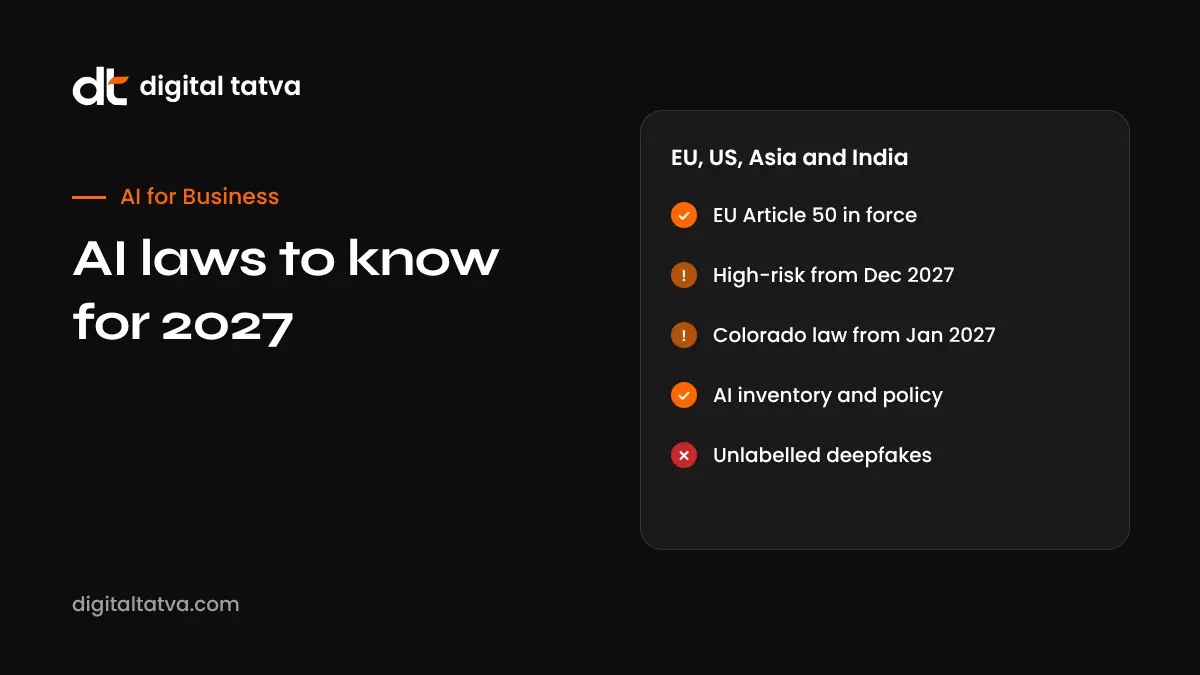
Quick answer: The AI laws and rules businesses should know going into 2027 are: the EU AI Act (transparency duties under Article 50 since 2 August 2026, a watermarking deadline of 2 December 2026 for generative AI already on the market, and high-risk obligations now due from 2 December 2027 for Annex III systems and 2 August 2028 for product-related systems after the AI Omnibus), the EU GDPR as it applies to AI, Colorado’s revised AI law (from 1 January 2027), California’s SB 53 for frontier developers (in force since 1 January 2026), Texas TRAIGA (since 1 January 2026), Illinois rules on AI in employment (since 1 January 2026), New York City’s bias audit law for hiring tools, the US federal push for a single national standard, South Korea’s AI Basic Act, China’s AI content labelling rules, Japan’s AI Promotion Act, India’s IT Amendment Rules 2026 and DPDP rules, and the UK’s sector-based approach. This is general information, not legal advice.
Key takeaways
- The EU AI Act is the most important law for most international businesses, and its deadlines moved in 2026.
- In the US, AI rules come mainly from states, with a federal push to limit state laws.
- Labelling AI-generated content is becoming a common requirement in the EU, China and India.
- Hiring and employment are the most regulated everyday uses of AI.
- An AI inventory, a policy and vendor checks prepare you for most of these laws.
Why AI regulation matters more in 2027
For years, AI rules were mostly principles and proposals. In 2026 several came into force, and 2027 brings more deadlines. At the same time, governments are adjusting: the EU passed an AI Omnibus in July 2026 that delayed some high-risk obligations, Colorado replaced its original AI Act with a lighter version, and the US federal government has pushed for a single national standard. Businesses that use AI for content, customer service, hiring or decisions about people need to know which rules apply to them. This guide summarises the main ones; always confirm details with a qualified lawyer.
AI laws to know for 2027 at a glance
| # | Law or rule | Where | Key date | Who it affects most |
|---|---|---|---|---|
| 1 | EU AI Act: transparency (Article 50) | EU, including non-EU firms reaching EU users | Since 2 August 2026 | Chatbots, deepfakes, AI content publishers |
| 2 | EU AI Act: watermarking for existing generative AI | EU | 2 December 2026 | Generative AI providers |
| 3 | EU AI Act: high-risk systems (Annex III) | EU | 2 December 2027 | AI in hiring, education, credit, biometrics |
| 4 | EU AI Act: high-risk product components (Annex I) | EU | 2 August 2028 | Medical devices, machinery and similar products |
| 5 | GDPR as applied to AI | EU and UK equivalents | In force | Anyone processing personal data with AI |
| 6 | Colorado SB 26-189 | Colorado, US | 1 January 2027 | Developers and users of consequential AI decisions |
| 7 | California SB 53 | California, US | Since 1 January 2026 | Large frontier model developers |
| 8 | Texas TRAIGA | Texas, US | Since 1 January 2026 | AI developers and deployers |
| 9 | Illinois HB 3773 | Illinois, US | Since 1 January 2026 | Employers using AI in hiring |
| 10 | NYC Local Law 144 | New York City, US | In force | Employers using automated hiring tools |
| 11 | US federal approach | United States | Ongoing | Everyone tracking state law preemption |
| 12 | South Korea AI Basic Act | South Korea | 2026 onward | High-impact and generative AI providers |
| 13 | China AI content labelling measures | China | Since September 2025 | Platforms and AI content providers |
| 14 | Japan AI Promotion Act | Japan | In force | Mainly government and large AI firms |
| 15 | India IT Amendment Rules 2026 and DPDP | India | IT Rules since 20 February 2026; DPDP phased | Platforms, publishers, data processors |
European Union
1. EU AI Act transparency rules (Article 50)
Since 2 August 2026, Article 50 requires that people are told when they interact with an AI system unless it is obvious, that deepfakes are clearly disclosed, and that AI-generated text published to inform the public on matters of public interest is labelled unless a person has reviewed it and someone takes editorial responsibility. AI providers must mark outputs in a machine-readable way. These rules apply to non-EU businesses that reach EU audiences. See EU AI Act Article 50 for marketers.
2. Watermarking deadline for existing generative AI
Under the AI Omnibus, which entered into force on 27 July 2026, generative AI systems placed on the market before 2 August 2026 have until 2 December 2026 to comply with the watermarking obligation. Systems launched on or after 2 August 2026 had to comply from launch.
3. High-risk AI systems (Annex III), now from December 2027
The AI Omnibus moved the main high-risk obligations for stand-alone Annex III systems, such as AI used in employment, education, credit scoring, critical infrastructure and biometrics, to 2 December 2027. Providers and deployers of these systems face requirements on risk management, data quality, documentation, human oversight and accuracy. 2027 is the year to prepare.
4. High-risk product components (Annex I), from August 2028
AI that is a safety component of regulated products, such as medical devices or machinery, now has until 2 August 2028.
5. GDPR and AI
Data protection law already applies to AI that processes personal data: you need a lawful basis, transparency, data minimisation and, for significant automated decisions, safeguards such as human review. European regulators have actively examined AI training and chatbots under GDPR. See AI data privacy for business.
United States
6. Colorado SB 26-189 (from 1 January 2027)
Colorado replaced its original AI Act (SB 24-205) with SB 26-189, signed on 14 May 2026 and effective from 1 January 2027. According to an October 2026 summary from Anaconda, the new law adds a 60-day cure period and drops the original requirements for a risk management programme and impact assessments. Businesses using AI for consequential decisions about Colorado residents should review the final text.
7. California SB 53
The Transparency in Frontier Artificial Intelligence Act, in force since 1 January 2026, requires large frontier model developers to publish safety frameworks and transparency reports and to report critical safety incidents. It mainly affects big AI labs, but it shapes the documentation their business customers can expect.
8. Texas TRAIGA
The Texas Responsible AI Governance Act, in force since 1 January 2026, sets rules for certain AI uses and offers defences for companies that find problems through testing or substantially follow frameworks such as NIST’s Generative AI Profile.
9. Illinois HB 3773
Since 1 January 2026, Illinois treats discriminatory use of AI in employment decisions as a civil rights violation and requires employers to notify workers and applicants when AI is used in those decisions. See AI for HR.
10. NYC Local Law 144
New York City requires bias audits and notices for automated employment decision tools used on candidates or employees in the city.
11. The US federal approach
The US still has no comprehensive federal AI law. A December 2025 executive order called for a single national standard and challenged state AI laws, but as of autumn 2026 Congress had not passed preemption legislation. Expect continued tension between federal and state approaches in 2027.
Asia and other regions
12. South Korea AI Basic Act
South Korea’s framework act on AI, which took effect in 2026, sets duties for high-impact AI and generative AI, including transparency and labelling obligations and requirements for some foreign providers to appoint a local representative. Check implementing decrees for details.
13. China’s AI content labelling rules
Since September 2025, China requires explicit and implicit labels on AI-generated content, alongside earlier rules on generative AI services and deep synthesis. Businesses offering AI content to users in China must follow them.
14. Japan AI Promotion Act
Japan chose a light-touch law focused on promoting AI development and coordination, with government guidance rather than heavy penalties.
15. India: IT Amendment Rules 2026 and DPDP
India has no single AI act. The IT Amendment Rules 2026, in force since 20 February 2026, require clear labelling of AI-generated content and fast removal of harmful deepfakes, while the Digital Personal Data Protection Act and DPDP Rules phase in obligations on personal data. See AI rules in India explained.
United Kingdom: the UK has no AI-specific act and regulates AI through existing regulators and laws such as data protection and consumer protection, though proposals for frontier AI legislation continue to be discussed.
What these laws mean for common business uses
| Use of AI | Main rules to check | Practical step |
|---|---|---|
| Customer service chatbots | EU Article 50, consumer law | Tell users they are talking to AI |
| AI images, video and voices | EU Article 50, China and India labelling | Label synthetic media, get consent |
| Hiring and HR | EU high-risk (2027), Illinois, NYC, Colorado | Audits, notices, human review |
| Credit and insurance decisions | EU high-risk, Colorado, sector regulators | Document decisions and allow appeals |
| Marketing content | EU Article 50, platform rules | Editorial review and labelling policy |
| Personal data in AI tools | GDPR, DPDP and similar laws | Vendor checks and data minimisation |
How to prepare for AI regulation in 2027
- Build an AI inventory. List every AI tool and system, what it does, who owns it and what data it uses.
- Classify risk. Flag uses in hiring, credit, education, health or biometrics as potentially high-risk.
- Write an AI policy. Cover approved tools, data rules, labelling and human review. See our AI usage policy template.
- Check vendors. Ask AI suppliers for documentation, data terms and compliance plans.
- Label and disclose. Set clear rules for AI chatbots, synthetic media and AI-written public content.
- Train staff. Make sure teams know the rules for their area.
- Review regularly. Laws and deadlines are still changing; check quarterly.
Illustrative example: A recruitment agency with clients in the EU and the US lists every AI tool it uses and finds that its CV screening tool could count as high-risk under the EU AI Act from December 2027. It asks the vendor for documentation, adds human review of every rejection, updates its candidate notices for Illinois and New York City and schedules a legal review. This is an illustrative scenario, not a client story.
Checklist: AI compliance basics
- AI inventory complete and owned.
- High-risk uses identified.
- AI policy published internally.
- Vendor documentation collected.
- Labelling and disclosure rules in place.
- Staff training completed.
- Legal review scheduled for high-risk uses.
How Digital Tatva can help
Digital Tatva is not a law firm, but we help brands publish accurate, well-labelled content that AI assistants can trust and cite, within the rules that apply to AI-generated content. See our AEO services.
Want trustworthy AI visibility? Request an AEO audit or try the free AI visibility checker.
Frequently asked questions
Was the EU AI Act delayed?
Partly. The AI Omnibus, in force since 27 July 2026, moved high-risk obligations to 2 December 2027 for Annex III systems and 2 August 2028 for product-related systems. Transparency rules under Article 50 still apply from 2 August 2026.
Does the EU AI Act apply to companies outside the EU?
Yes, if they place AI systems on the EU market or their AI outputs are used in the EU.
Do I have to label AI-generated content?
In many cases. The EU requires disclosure of deepfakes and some AI-written public interest text, and China and India have labelling rules. Platforms also have their own policies.
Is there a federal AI law in the US?
No comprehensive one. AI is regulated through state laws, sector rules and existing laws, while the federal government has pushed for a national standard.
When does the Colorado AI law take effect?
The revised law, SB 26-189, takes effect on 1 January 2027 and replaces the original Colorado AI Act.
Is using AI in hiring regulated?
Yes, increasingly. Illinois, New York City and Colorado have rules, and the EU treats many hiring tools as high-risk from December 2027.
What are the penalties under the EU AI Act?
Fines vary by violation and can reach a percentage of worldwide turnover; transparency breaches can reach up to 15 million euros or 3% of turnover.
Does India have an AI law?
No single AI act. AI is covered by the IT Act and IT Amendment Rules 2026, the DPDP Act and Rules, and sector regulations.
Does GDPR apply to AI tools?
Yes, whenever personal data is processed, including in prompts, training data and outputs.
What should small businesses do about AI laws?
Keep a simple list of AI tools, avoid putting sensitive personal data into them without proper terms, disclose chatbots and label synthetic media. Get legal advice for high-risk uses.
Product details, prices and features are checked at the time of writing and can change. Sources are linked in the text so you can check them yourself.
How does your brand appear in AI answers?
We test the questions your buyers ask across the major AI assistants and search engines, then show you what to fix first.
Get an AI Visibility Audit