12 Best GPU Cloud Providers in 2026: Neoclouds, Hyperscalers and Marketplaces
Where to rent GPUs for AI training and inference in 2026, and how to choose safely.
On this page
Last updated: 22 November 2026
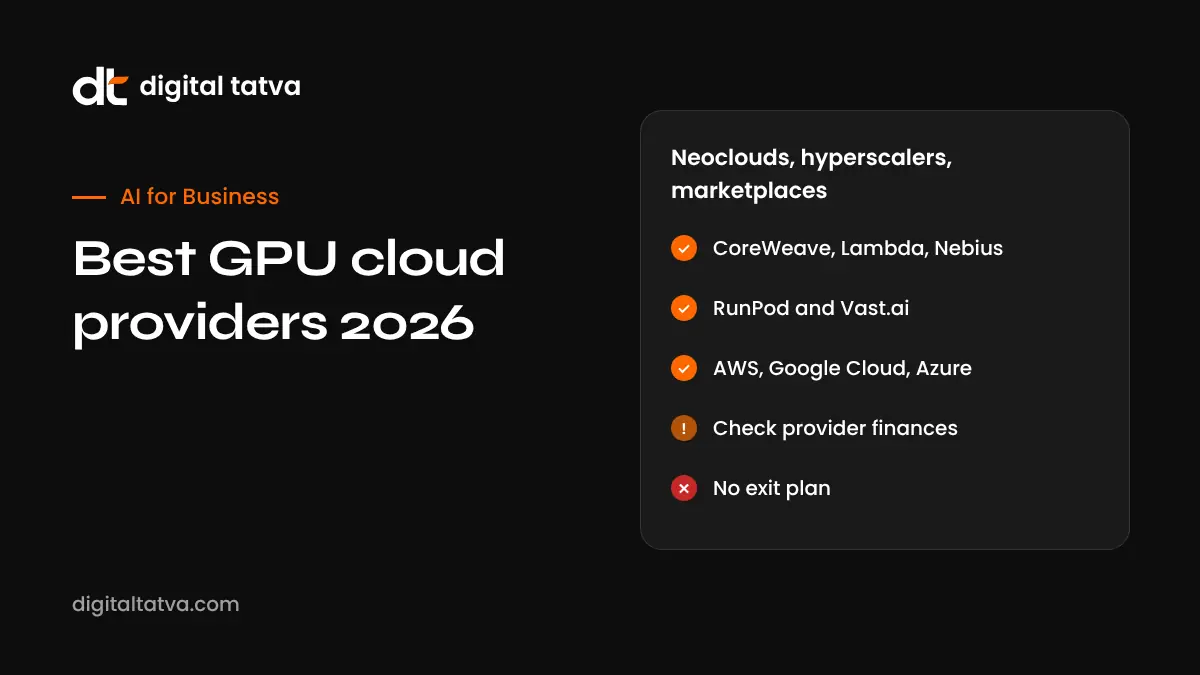
Quick answer: The best GPU cloud providers in 2026 fall into three groups. Neoclouds built for AI: CoreWeave (largest, enterprise and lab scale), Lambda (developer-friendly training and inference), Nebius (full-stack AI cloud in Europe and the US), Crusoe (energy-focused AI data centers) and Together AI (GPU clusters plus hosted open models). On-demand marketplaces for smaller budgets: RunPod, Vast.ai, Vultr and DigitalOcean (Paperspace). Hyperscalers for enterprise integration: AWS, Google Cloud, Microsoft Azure and Oracle Cloud. Serverless platforms such as Modal suit teams that want to run code without managing machines. Choose based on the GPUs you need, cluster size, contract length, data location and the provider’s financial strength.
Key takeaways
- “Neocloud” searches grew about 819% in a year as specialist GPU clouds became mainstream.
- Neoclouds often offer newer GPUs and simpler pricing than hyperscalers, but some carry heavy debt.
- Marketplaces are cheapest for experiments; reserved clusters are cheaper per hour for long training runs.
- Data residency, security certifications and support matter as much as hourly price.
- Avoid locking critical workloads into a single provider without an exit plan.
What is a neocloud?
A neocloud is a cloud provider that specialises in GPUs for AI training and inference, rather than offering hundreds of general services like AWS or Azure. Neoclouds grew quickly because AI labs and startups needed large numbers of the newest Nvidia chips faster than hyperscalers could supply them. Search interest reflects this: “neo cloud” draws about 110,000 searches a month, up roughly 819% year on year in RisingTrends data.
The sector is growing fast and also under financial scrutiny. CoreWeave reported third-quarter 2026 revenue of $3.66 billion, up 168% year on year, while Fortune reported that its 2031 bond yield passed 16% in October, a level often associated with credit stress. If you are renting compute for important workloads, a provider’s financial health is part of due diligence. See AI bubble signals to watch.
Best GPU cloud providers compared
| # | Provider | Type | Best for | Scale |
|---|---|---|---|---|
| 1 | CoreWeave | Neocloud | AI labs and enterprises needing large clusters | Very large |
| 2 | Lambda | Neocloud | Developers and research teams | Small to large |
| 3 | Nebius | Neocloud | Full-stack AI cloud with European presence | Medium to large |
| 4 | Crusoe | Neocloud | Energy-conscious AI infrastructure | Medium to very large |
| 5 | Together AI | AI cloud and inference | Open-model inference and training | Small to large |
| 6 | RunPod | On-demand GPU cloud | Startups, hobbyists, serverless inference | Single GPU to clusters |
| 7 | Vast.ai | GPU marketplace | Lowest-cost experiments | Single GPU to small clusters |
| 8 | Vultr | Global cloud with GPUs | Regional coverage at fair prices | Small to medium |
| 9 | DigitalOcean (Paperspace) | Developer cloud | Simple GPU droplets and notebooks | Small to medium |
| 10 | Modal | Serverless compute | Running AI code without managing servers | Bursty workloads |
| 11 | AWS, Google Cloud, Azure | Hyperscalers | Enterprises integrating AI with existing cloud | Very large |
| 12 | Oracle Cloud | Hyperscaler | Large AI training clusters | Very large |
We do not list hourly prices because they change frequently and depend on GPU model, region, availability and commitment length. Always request quotes for reserved capacity.
The best GPU clouds in detail
1. CoreWeave
CoreWeave is the largest neocloud, serving major AI labs and enterprises with large clusters of the latest Nvidia GPUs. In November 2026 it reported strong third-quarter growth, announced a multi-year training deal with self-driving company Wayve and brought new capacity online in Copenhagen with heat reuse for district heating. It also expanded a security partnership with CrowdStrike.
Best for: very large training and inference contracts.
Watch out for: enterprise-focused sales process; review contract terms and the company’s financial position.
2. Lambda
Lambda has long been a favourite with researchers and developers, offering on-demand GPU instances, reserved clusters and pre-configured machine learning software.
Best for: teams that want straightforward GPU access without hyperscaler complexity.
Watch out for: popular GPU types can sell out at busy times.
3. Nebius
Nebius runs a full-stack AI cloud with data centers in Europe and the US, offering GPU clusters, managed Kubernetes, storage and inference services.
Best for: European teams with data residency needs and companies wanting more than raw GPUs.
Watch out for: compare regional availability for the GPUs you need.
4. Crusoe
Crusoe builds AI data centers with a focus on energy sourcing, including sites designed around stranded or renewable power, and rents GPU capacity on top.
Best for: large workloads where energy and sustainability reporting matter.
Watch out for: best suited to larger commitments.
5. Together AI
Together AI combines GPU clusters for training with a hosted platform for running and fine-tuning open models through an API.
Best for: teams building on open models who want both inference and training in one place.
Watch out for: compare per-token inference prices with alternatives such as OpenRouter.
6. RunPod
RunPod offers on-demand GPU pods, community and secure cloud options, and serverless endpoints for inference. It is popular with startups and individual developers.
Best for: experiments, fine-tuning and small production inference.
Watch out for: community cloud machines vary in reliability; use secure cloud for sensitive work.
7. Vast.ai
Vast.ai is a marketplace where hosts rent out GPUs, often at the lowest prices available.
Best for: budget experiments and non-sensitive workloads.
Watch out for: security and reliability vary by host; not ideal for confidential data.
8. Vultr
Vultr offers cloud GPUs across many regions alongside regular compute, which helps teams that need capacity close to users.
Best for: regional inference and smaller clusters.
Watch out for: check which GPU models each region offers.
9. DigitalOcean (Paperspace)
DigitalOcean brought Paperspace’s GPU machines and notebooks into its developer-friendly cloud.
Best for: small teams already on DigitalOcean.
Watch out for: limited options for very large training jobs.
10. Modal
Modal lets developers run Python functions on GPUs in the cloud without managing servers, scaling up and down automatically.
Best for: bursty inference, batch jobs and prototypes.
Watch out for: per-second pricing adds up for always-on workloads.
11. AWS, Google Cloud and Microsoft Azure
The hyperscalers offer GPUs and their own AI chips, deep integration with data, security and compliance tools, and managed AI platforms such as Bedrock, Vertex AI and Azure AI Foundry.
Best for: enterprises with existing cloud commitments and compliance needs.
Watch out for: complex pricing and quotas for the newest GPUs.
12. Oracle Cloud
Oracle has built very large GPU clusters for AI training and is a major infrastructure partner for leading AI labs.
Best for: large training workloads and Oracle customers.
Watch out for: enterprise contracting and minimum commitments.
Neocloud vs hyperscaler vs marketplace
| Factor | Neocloud | Hyperscaler | Marketplace |
|---|---|---|---|
| GPU availability | Often first with new GPUs | Good, with quotas | Varies by host |
| Price | Competitive, especially reserved | Usually higher on demand | Often lowest |
| Extra services | Focused on AI | Hundreds of services | Minimal |
| Compliance | Growing certifications | Most mature | Limited |
| Best for | Training and inference at scale | Enterprise integration | Experiments |
How to choose a GPU cloud
- Define the workload. Training, fine-tuning or inference, and for how long.
- Pick the GPU. Match memory and interconnect to your model size; bigger is not always cheaper per task.
- Check data rules. Region, certifications and who can access your data.
- Compare total cost. Include storage, data transfer, idle time and support, not just hourly rates.
- Test before committing. Run a benchmark on two providers.
- Plan an exit. Use containers and portable tooling so you can move if prices or providers change.
Do you even need a GPU cloud?
Many businesses do not. If you only call models such as Claude, GPT or Gemini, you pay per token through their APIs and never touch a GPU. GPU clouds make sense when you train or fine-tune models, host open models at high volume, or need full control over data and infrastructure. For smaller private workloads, a single powerful workstation can be enough; see best local LLM tools. To compare per-token costs, see LLM API pricing compared.
Illustrative example: A startup fine-tunes an open model for customer support. It experiments on a marketplace GPU for a week, moves the final training run to a reserved cluster at a neocloud, and serves the model on a serverless platform so it pays only when customers are using it. Its containers run the same way on each provider, so it can switch if costs change. This is an illustrative scenario, not a client story.
Checklist before signing a GPU contract
- Workload and GPU type defined.
- Total cost modelled, including storage and transfer.
- Data location and certifications confirmed.
- Provider financial health and support reviewed.
- Benchmark completed on real workloads.
- Portability and exit terms in place.
How Digital Tatva can help
If you sell AI infrastructure or developer services, buyers increasingly shortlist vendors by asking AI assistants. Digital Tatva helps B2B tech companies get mentioned accurately in ChatGPT, Gemini, Claude and Perplexity. See AEO for B2B and our AEO services.
Is your company on AI’s shortlist? Request an AEO audit or try the free AI visibility checker.
Frequently asked questions
What is the best GPU cloud provider?
For large clusters, CoreWeave, Nebius, Crusoe, Lambda and the hyperscalers. For experiments on a budget, RunPod and Vast.ai. For serverless inference, Modal and RunPod.
What is a neocloud?
A cloud provider specialising in GPUs for AI, such as CoreWeave, Lambda, Nebius or Crusoe.
What is the cheapest GPU cloud?
Marketplaces such as Vast.ai and community options on RunPod are often cheapest per hour, with trade-offs in reliability and security.
Is CoreWeave safe to use?
It is a major provider used by leading AI labs. As with any vendor, review contracts, security certifications and financial position for critical workloads.
Should I use AWS or a neocloud for AI?
Use a hyperscaler if you need deep integration with existing cloud services and compliance tools. Use a neocloud if you mainly need GPU capacity at competitive prices.
How much does it cost to rent a GPU?
From well under a dollar an hour for older consumer GPUs on marketplaces to several dollars an hour or more per high-end data center GPU. Reserved contracts lower the hourly rate.
Do I need a GPU cloud to use AI?
No. If you use AI through APIs or apps, the provider runs the GPUs. GPU clouds are for training, fine-tuning or hosting your own models.
Which GPU is best for AI training?
The newest Nvidia data center GPUs lead for large training runs, but older or smaller GPUs can be more cost-effective for fine-tuning and inference.
Can I keep data in Europe with a GPU cloud?
Yes. Several providers, including Nebius and the hyperscalers, offer European regions. Confirm data residency in your contract.
Are neoclouds risky?
Some carry significant debt, and credit markets have priced in risk. Spread critical workloads, keep them portable and review provider health regularly.
Product details, prices and features are checked at the time of writing and can change. Sources are linked in the text so you can check them yourself.
How does your brand appear in AI answers?
We test the questions your buyers ask across the major AI assistants and search engines, then show you what to fix first.
Get an AI Visibility Audit