14 Best AI Newsletters to Follow in 2026 (Daily, Practical and Technical)
Fourteen AI newsletters worth your inbox, with the right three to pick for your role.
On this page
- Key takeaways
- Why AI newsletters are booming
- Best AI newsletters compared
- Best daily AI newsletters
- Best practical and business AI newsletters
- Best technical and research AI newsletters
- Best AI newsletter stack by role
- What makes a good AI newsletter?
- Newsletters vs other ways to follow AI
- How to get the most from AI newsletters
- Want audio instead?
- Newsletters and AI visibility
- How Digital Tatva can help
- Frequently asked questions
Last updated: 22 November 2026
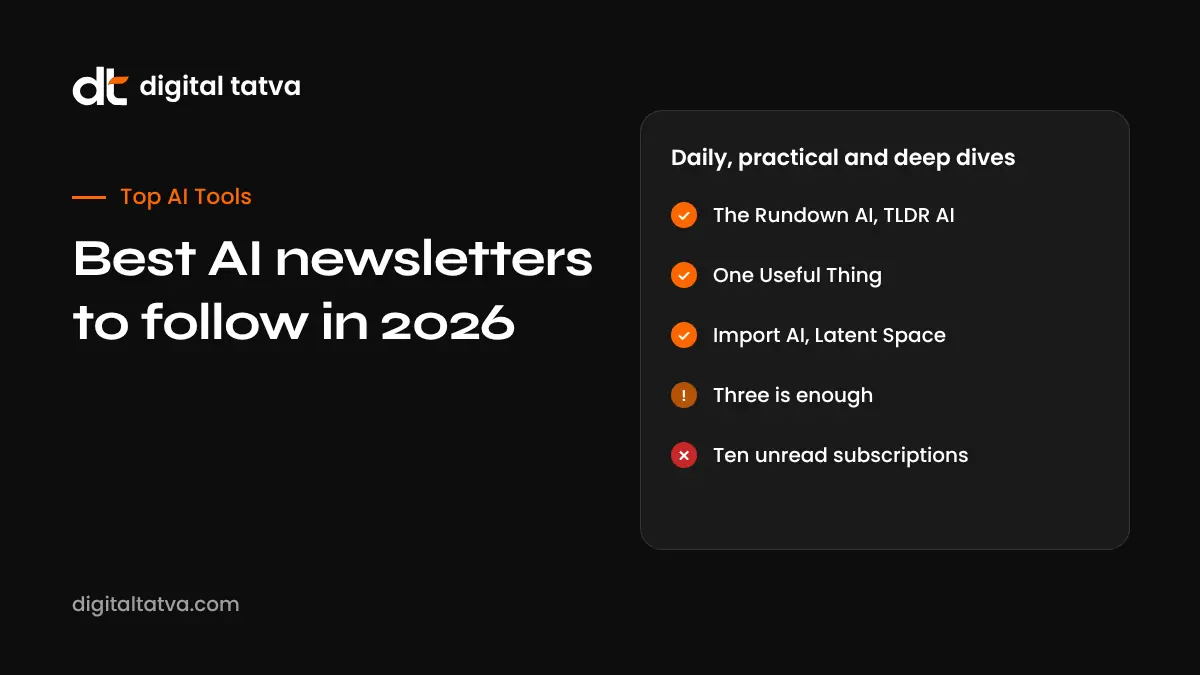
Quick answer: The best AI newsletters to follow in 2026 are The Rundown AI and Superhuman AI (fast daily news for busy professionals), TLDR AI (short daily links for technical readers), The Neuron (friendly daily explainer), Ben’s Bites (builders and new tools), One Useful Thing by Ethan Mollick (practical AI at work), The Batch from DeepLearning.AI (weekly news with Andrew Ng’s perspective), Import AI by Jack Clark (research and policy), Latent Space (AI engineering), Interconnects by Nathan Lambert (open models and training), Simon Willison’s newsletter (hands-on LLM use), Exponential View by Azeem Azhar (strategy and economics), MIT Technology Review’s The Algorithm (balanced reporting) and Last Week in AI (weekly round-up). Pick one daily news letter, one practical letter and one deep-dive letter, and unsubscribe from the rest.
Key takeaways
- AI news moves too fast to follow on social media alone; good newsletters filter it for you.
- Searches for “AI newsletter” grew about 77% in a year, to roughly 165,000 a month.
- Daily letters keep you current; weekly letters help you understand what matters.
- Choose newsletters that match your role: business, marketing, engineering or research.
- Three well-chosen newsletters beat ten you never open.
Why AI newsletters are booming
In November 2026 alone, Anthropic, OpenAI and Google all released new frontier models, Anthropic completed the largest IPO on record and Nvidia changed CEOs. Keeping up by scrolling social feeds means seeing the same story twenty times and missing what matters. Newsletters solve that by curating and explaining. RisingTrends data shows “AI newsletter” searches at about 165,000 a month, up roughly 77% year on year.
For a one-page summary of the month, see our biggest AI launches of November 2026.
Best AI newsletters compared
| # | Newsletter | Frequency | Best for | Style |
|---|---|---|---|---|
| 1 | The Rundown AI | Daily | Busy professionals | Quick news with practical tips |
| 2 | Superhuman AI | Daily | Productivity-focused readers | News plus tools and tutorials |
| 3 | TLDR AI | Daily | Engineers and technical readers | Short summaries and links |
| 4 | The Neuron | Daily | Non-technical readers | Friendly, explanatory |
| 5 | Ben’s Bites | Several a week | Builders and founders | New tools and how people use them |
| 6 | One Useful Thing | Weekly or less | Managers, educators, knowledge workers | Thoughtful essays on AI at work |
| 7 | The Batch | Weekly | Learners and practitioners | News with expert commentary |
| 8 | Import AI | Weekly | Research and policy watchers | Research summaries and analysis |
| 9 | Latent Space | Weekly | AI engineers | Deep technical essays and interviews |
| 10 | Interconnects | Weekly | Model and open-source watchers | Training, open models, analysis |
| 11 | Simon Willison’s newsletter | Regular | Developers using LLMs | Hands-on experiments and notes |
| 12 | Exponential View | Weekly | Leaders and strategists | Economics and big-picture trends |
| 13 | The Algorithm (MIT Technology Review) | Weekly | General readers wanting balance | Journalism and context |
| 14 | Last Week in AI | Weekly | Anyone wanting one weekly round-up | Comprehensive summary |
Most of these have free editions; some offer paid tiers with extra content. Frequencies and pricing change, so check each sign-up page.
Best daily AI newsletters
1. The Rundown AI
The Rundown is one of the largest AI newsletters, built for people who want the day’s most important AI news in about five minutes, plus a practical tip or tool they can use the same day.
Read it if: you want a single daily briefing that respects your time.
2. Superhuman AI
Superhuman AI focuses on using AI to get more done, mixing daily headlines with tool recommendations and short how-to guides.
Read it if: productivity matters more to you than industry gossip.
3. TLDR AI
TLDR AI, from the TLDR newsletter family, gives short summaries of research papers, launches and engineering posts with links to the originals.
Read it if: you are technical and want a fast scan of what is new.
4. The Neuron
The Neuron explains AI news in plain language with a light tone, which makes it a good starting point for people new to the topic.
Read it if: you want to understand AI without jargon.
5. Ben’s Bites
Ben’s Bites covers new AI tools, products and what builders are doing with them, with a strong startup and maker community around it.
Read it if: you build products or like trying new tools early.
Best practical and business AI newsletters
6. One Useful Thing (Ethan Mollick)
Wharton professor Ethan Mollick writes some of the most useful essays on how AI changes work, teaching and management, often with experiments you can repeat yourself.
Read it if: you lead a team or teach and want evidence-based thinking about AI at work.
7. The Batch (DeepLearning.AI)
The Batch summarises the week’s key AI developments with a letter from Andrew Ng, balancing technical depth and accessibility.
Read it if: you are learning AI or want a steady weekly view.
8. Exponential View (Azeem Azhar)
Exponential View connects AI to economics, energy and geopolitics, useful for anyone thinking about strategy and investment cycles, including the AI bubble debate.
Read it if: you make strategic decisions and want context.
9. The Algorithm (MIT Technology Review)
MIT Technology Review’s AI newsletter offers reported journalism with a critical eye on hype, ethics and policy.
Read it if: you want balanced coverage with less excitement and more scrutiny.
Best technical and research AI newsletters
10. Import AI (Jack Clark)
Import AI, written by Anthropic co-founder Jack Clark, summarises notable research papers and adds commentary on safety and policy implications.
Read it if: you follow AI research and governance.
11. Latent Space
Latent Space, from swyx and Alessio Fanelli, covers AI engineering: agents, evaluation, infrastructure and interviews with builders. It also has a popular podcast.
Read it if: you build with LLMs professionally.
12. Interconnects (Nathan Lambert)
Interconnects goes deep on how models are trained, post-training methods and the open model ecosystem.
Read it if: you care about open models and how frontier labs work.
13. Simon Willison’s newsletter
Developer Simon Willison shares hands-on experiments with new models and tools, clear notes on prompt injection and practical tips for using LLMs safely.
Read it if: you want honest, tested takes rather than launch hype.
14. Last Week in AI
Last Week in AI publishes a comprehensive weekly summary of news and research, with a companion podcast.
Read it if: you only want to check in once a week.
Best AI newsletter stack by role
| Role | Daily | Practical | Deep dive |
|---|---|---|---|
| Business owner | The Rundown AI | One Useful Thing | Exponential View |
| Marketer | The Neuron | Superhuman AI | The Algorithm |
| Developer | TLDR AI | Simon Willison | Latent Space |
| Researcher | TLDR AI | The Batch | Import AI and Interconnects |
| Founder | Ben’s Bites | One Useful Thing | Exponential View |
| Student | The Neuron | The Batch | Last Week in AI |
What makes a good AI newsletter?
Hundreds of AI newsletters launched in 2025 and 2026, and many simply repackage the same press releases. Before you subscribe, check for these qualities:
- Original insight: the writer adds analysis, testing or context, not just links.
- Accuracy: claims are sourced, and corrections are made when something is wrong.
- Clear sponsorship: sponsored tools and paid placements are labelled.
- Relevance to you: the examples match your role, industry or skill level.
- Consistency: it arrives on a predictable schedule and keeps a consistent quality bar.
- Respect for your time: you can get the main points in a few minutes.
A quick test: after reading three issues, can you name one decision or action each issue helped with? If not, unsubscribe.
Newsletters vs other ways to follow AI
| Source | Strength | Weakness |
|---|---|---|
| Newsletters | Curated, arrives on schedule, easy to skim | Can pile up unread |
| Podcasts | Deep conversations, good for commutes | Time-consuming |
| Social media | Fastest for breaking news | Noisy, repetitive, prone to hype |
| Company blogs | Official details and documentation | One-sided |
| Research papers | Primary evidence | Technical and slow to read |
How to get the most from AI newsletters
- Limit yourself to three. One daily, one practical, one deep dive.
- Use a separate inbox or folder. Read them in one sitting instead of all day.
- Try one tool a week. Turn reading into skills by testing one recommendation.
- Use AI to summarise. Paste long issues into your assistant and ask what matters for your job. See best AI summarizers.
- Review every quarter. Unsubscribe from anything you skip.
Illustrative example: A marketing manager replaces an hour of daily social scrolling with three newsletters read over coffee. Each Friday she picks one tool or idea to test with her team, and after a quarter the team has adopted two new workflows that save time every week. This is an illustrative scenario, not a client story.
Checklist: your AI reading routine
- Three newsletters chosen for your role.
- A folder or filter set up.
- A fixed reading time each day or week.
- One experiment per week.
- Quarterly clean-up of subscriptions.
Want audio instead?
If you prefer listening on a commute, see our list of the best AI podcasts, and for learning paths see how to learn AI and free AI courses with certificates.
Newsletters and AI visibility
Newsletters are also a source AI assistants learn from. Being mentioned in respected newsletters builds the third-party signals that help ChatGPT, Gemini and Perplexity recommend your brand. See brand mentions for AEO and digital PR tools.
How Digital Tatva can help
Digital Tatva helps brands earn the mentions and citations that AI assistants rely on. See our AEO services.
Is your brand part of the AI conversation? Request an AEO audit or try the free AI visibility checker.
Frequently asked questions
What is the best AI newsletter?
For most busy professionals, The Rundown AI or Superhuman AI for daily news, plus One Useful Thing for practical insight. Developers should add TLDR AI and Latent Space.
What is the best free AI newsletter?
Most newsletters on this list are free, including The Rundown AI, TLDR AI, The Neuron, The Batch and Import AI.
What is the best AI newsletter for beginners?
The Neuron and The Rundown AI explain news in plain language and include practical tips.
What is the best AI newsletter for developers?
TLDR AI for daily scanning, Latent Space for AI engineering and Simon Willison’s newsletter for hands-on testing.
What is the best AI newsletter for business leaders?
One Useful Thing for AI at work and Exponential View for strategy and economics.
Which AI newsletter covers research best?
Import AI and Interconnects cover research in depth, and TLDR AI links to new papers daily.
How many AI newsletters should I subscribe to?
Three is enough for most people: one daily, one practical and one deep dive.
Are paid AI newsletters worth it?
Only if the extra content directly helps your work. Start with free editions and upgrade if you find yourself wanting more.
Is there an AI newsletter for marketers?
Superhuman AI and The Neuron work well for marketers. Pair them with our AI marketing trends for 2027.
How do I avoid AI information overload?
Limit subscriptions, read at a fixed time, use AI to summarise long issues and focus on news that affects your work.
Product details, prices and features are checked at the time of writing and can change. Sources are linked in the text so you can check them yourself.
How does your brand appear in AI answers?
We test the questions your buyers ask across the major AI assistants and search engines, then show you what to fix first.
Get an AI Visibility Audit