Is AI a Bubble? 12 Signals to Watch Going Into 2027
A balanced look at the evidence for and against an AI bubble, and how businesses can prepare.
On this page
- Key takeaways
- What people mean by an “AI bubble”
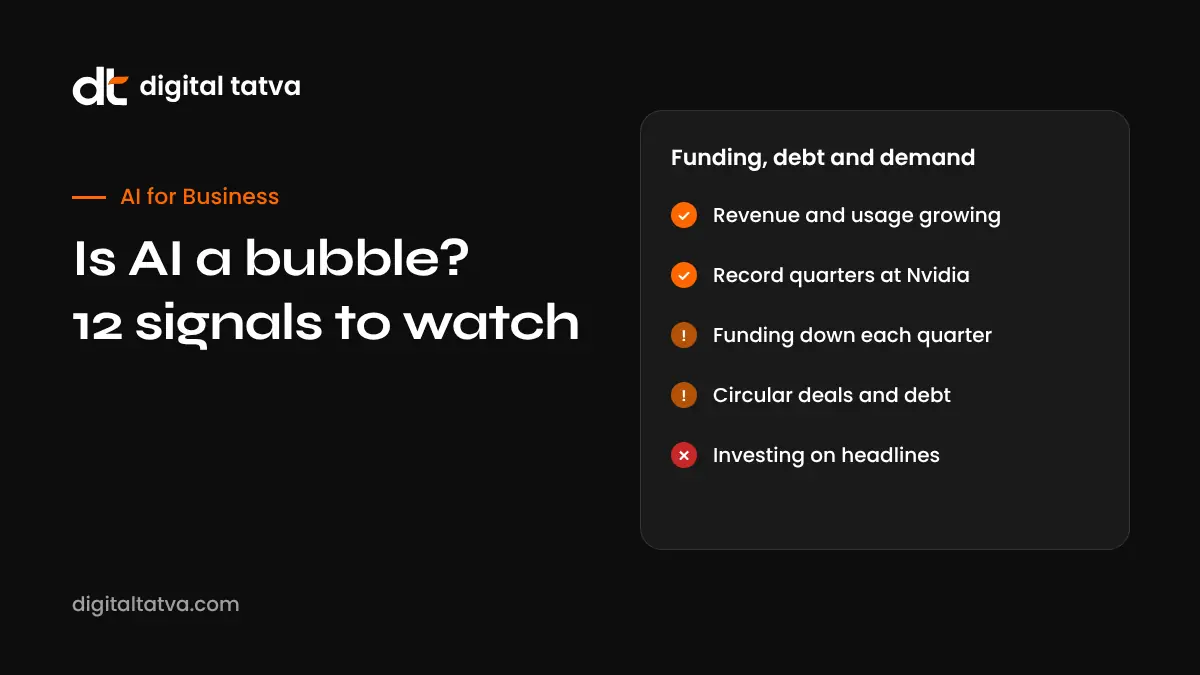
- 12 AI bubble signals at a glance
- Signals that point towards a bubble
- Signals that point against a bubble
- Signals that could go either way
- What a correction would and would not mean
- How businesses can prepare
- How Digital Tatva can help
- Frequently asked questions
Last updated: 22 November 2026
Quick answer: Whether AI is a bubble is one of the most debated questions of late 2026. The case for a bubble rests on falling AI funding (from about $239 billion in Q1 2026 to $103 billion in Q3), circular deals where chipmakers and clouds fund their own customers, record AI debt issuance, distressed-looking bond yields at some data center operators, a sharp drop in Nvidia’s market value since October and growing local opposition to data centers. The case against rests on real and fast-growing revenue and usage: Nvidia reported record quarterly revenue of $115.8 billion, Anthropic reported $33.24 billion of revenue in nine months, and ChatGPT and Claude web traffic kept rising. The 12 signals below help you judge which way things are heading. This article is information, not investment advice.
Key takeaways
- Technology adoption and financial valuations are two different questions. AI can be useful and still be overvalued.
- The main stress is in financing: debt, circular deals and data center leases, not in whether people use AI.
- Watch credit markets and data center projects more closely than model benchmarks.
- For businesses, a correction would mostly mean vendor consolidation, price changes and slower infrastructure growth.
- Do not make investment decisions from articles like this one. Speak to a licensed adviser.
What people mean by an “AI bubble”
A bubble is when the prices of assets rise far above what their future cash flows can justify, usually because investors expect someone else to pay more later. The dot-com era is the usual comparison: the internet was real and transformative, but many companies and investors still lost most of their money when expectations ran ahead of revenue.
Today’s debate is similar. Very few people argue that AI is useless. The argument is about whether the hundreds of billions spent on chips, data centers and model training will earn enough to pay back the debt and justify valuations in the trillions. Search interest reflects the anxiety: “AI bubble” draws about 165,000 searches a month, up around 22% year on year, according to RisingTrends.
12 AI bubble signals at a glance
| # | Signal | Late 2026 reading | Direction |
|---|---|---|---|
| 1 | AI venture funding | Q1 $239.1B, Q2 $153.1B, Q3 $103.3B | Cooling |
| 2 | Circular financing | BIS: more than half of investment into AI firms comes from other AI firms | Warning |
| 3 | AI debt issuance | Morgan Stanley projects nearly $570B in 2026 | Warning |
| 4 | Neocloud credit | CoreWeave 2031 bond yield above 16% in October | Warning |
| 5 | Nvidia’s value vs revenue | Nearly $2T of value lost since 6 October; record $115.8B quarter | Mixed |
| 6 | IPO reception | Anthropic priced above range; first-day gain narrowed | Mixed |
| 7 | Model company revenue | Anthropic: $33.24B in nine months of 2026 | Healthy |
| 8 | User demand | ChatGPT web visits up about 20%, Claude about 55% (June to October) | Healthy |
| 9 | Power and local approval | Voters rejected 40 of 41 local data center measures | Warning |
| 10 | Stock market stress | Nasdaq one-day fall of 5.5% in early November | Warning |
| 11 | Interest rates and policy | Possible further rate rises; tariff threats on offshore data centers | Uncertain |
| 12 | Business return on AI | Buyers consolidating tools and demanding proof | Mixed |
Signals that point towards a bubble
1. AI funding is falling quarter by quarter
Figures cited by Fortune show global AI funding of $239.1 billion in Q1 2026, $153.1 billion in Q2 and $103.3 billion in Q3. That is still a very large amount of money, but the direction matters. When new money slows, companies that depend on raising again at higher valuations come under pressure.
What to watch: Q4 funding totals and how many late-stage rounds are flat or down rounds.
2. Circular financing
Many AI deals loop money back to the investor. Chipmakers invest in AI companies that buy their chips, cloud providers invest in model labs that commit to spending on their cloud, and lenders finance data centers against those commitments. Research from the Bank for International Settlements, as reported by Daily Maverick, found almost 29% of AI companies’ investments flow into other AI businesses, and more than half of the investment entering AI firms comes from other AI firms. Fortune also reported that Nvidia guaranteed up to $105 billion of lease obligations on an Ohio data center campus built for OpenAI, one of its own customers.
Why it matters: circular deals make demand look stronger than independent demand may be, and they link the health of several companies together.
3. Record AI debt
Morgan Stanley projects nearly $570 billion of global AI-related debt issuance in 2026, more than double 2025, with about $236 billion issued by the end of May. Debt is cheaper than equity when things go well and painful when revenue disappoints, because interest is due either way.
What to watch: new bond pricing and covenant terms for AI infrastructure deals.
4. Stress in neocloud credit
Neoclouds are specialist GPU cloud providers such as CoreWeave. Fortune reported that CoreWeave’s 2031 bond yield passed 16% in October, a level that usually signals distress, and cited a Reuters estimate of a high probability of default within five years. At the same time, CoreWeave reported Q3 revenue of $3.66 billion, up 168% year on year. Strong growth with expensive debt is exactly the mix that makes this sector the one to watch. See best GPU cloud providers.
5. Market stress
Daily Maverick reported that the Nasdaq fell 5.5% in a single day in early November and entered correction territory, and that Japan’s Nikkei was in a bear market. Fortune reported Nvidia lost nearly $2 trillion of market value in under six weeks from its 6 October record. Fast, repeated sell-offs show how sensitive prices have become to AI news.
6. Data centers facing power and politics
AI needs power on a scale utilities were not planning for. In the US midterms, voters rejected 40 of 41 local ballot measures on data center developments, according to Daily Maverick. Meta said it is re-evaluating its 2030 net-zero goal after a sharp rise in emissions, and President Trump threatened a large tax on US companies building data centers abroad. Projects that cannot get power or approval cannot earn the revenue their financing assumes.
Signals that point against a bubble
7. Revenue is real and growing fast
Unlike many dot-com companies, the leading AI firms have large and fast-growing revenue. Anthropic’s filings showed $33.24 billion of revenue in the first nine months of 2026, compared with $4.59 billion for all of 2025. Nvidia reported record third-quarter revenue of $115.8 billion, up 103% year on year. See Anthropic IPO explained and Nvidia’s record quarter.
8. People keep using AI more
ChatGPT’s web visits grew about 20% between June and October 2026, to roughly 5 billion a month, and Claude’s grew about 55%, to 1.15 billion. AI features are also built into phones, office software and search. Usage this broad is hard to reverse. See the most popular AI tools.
9. Public market investors still showed up
Anthropic priced its IPO at $83 per share, above its $70 to $78 range, raising about $81 billion according to reports. Shares opened at $111.50 and closed the first day at $87.17. Demand was strong, but the gap between the open and the close also shows that investors are price-sensitive.
10. Falling prices widen the market
New model tiers such as GPT-6.2 Sol, Gemini 4 Hydrogen and Qwen4-Max make AI much cheaper per task. Lower prices can squeeze margins, but they also open up uses that were not affordable before, which supports long-term demand.
Signals that could go either way
11. Interest rates and policy
The AI build-out relies on borrowing. Daily Maverick noted the risk of further US rate rises, while policy threats such as tariffs on offshore data centers, energy rules and AI regulation could change project economics. Watch central bank decisions and energy policy as closely as product launches.
12. Whether businesses earn a return
The final test is whether companies that buy AI get measurable value. Early adopters report time savings, but many are now cutting overlapping subscriptions and asking for proof. If enterprise budgets keep growing in 2027, the infrastructure spending is easier to justify. See how to measure AI ROI.
What a correction would and would not mean
| Area | Likely effect of a correction | Unlikely effect |
|---|---|---|
| AI tools you use | Price changes, fewer free tiers, some startups closing or being acquired | Major assistants disappearing |
| Infrastructure | Delayed or cancelled data centers, cheaper spare GPU capacity | AI usage reversing |
| Jobs | Slower hiring at AI startups | An end to AI skills demand |
| Investors | Large losses on overvalued assets | Every AI company failing |
| Marketing and search | Little change; AI search keeps growing | A return to search without AI |
The dot-com crash wiped out many companies, but internet use kept growing and the survivors became some of the largest companies in the world. Many analysts expect something similar if AI corrects: pain for investors and weaker companies, continued adoption for users.
How businesses can prepare
- Avoid single-vendor dependence. Keep prompts, data and workflows portable between model providers.
- Check vendor health. For critical tools, ask about funding, profitability and data export options.
- Prefer flexible contracts. Monthly or usage-based terms protect you if prices or vendors change.
- Focus AI on measurable work. Projects that save clear hours or drive revenue survive budget cuts.
- Keep building visibility in AI search. Customers will keep asking AI assistants for recommendations whatever happens to valuations.
Illustrative example: A retail company relies on one small AI startup for product descriptions. Worried about the funding climate, it exports its prompts and brand guidelines, tests the same workflow on two larger model providers and keeps a fallback ready. If the startup is acquired or raises prices, the switch takes a day instead of a month. This is an illustrative scenario, not a client story.
Checklist: AI bubble readiness
- Critical AI vendors listed with a backup for each.
- Data and prompts exportable.
- Contracts reviewed for price change and exit terms.
- AI projects tied to measurable outcomes.
- Quarterly review of AI spend.
- Investment decisions discussed with a licensed adviser, not based on headlines.
How Digital Tatva can help
Whatever happens to AI valuations, AI assistants are becoming a main way people find products and services. Digital Tatva helps brands get mentioned and described accurately in ChatGPT, Gemini, Claude, Perplexity and Google AI answers. See our AEO services.
Make sure AI assistants recommend you in any market. Request an AEO audit or try the free AI visibility checker.
Frequently asked questions
Is AI a bubble?
There is no consensus. Valuations, debt and circular financing look stretched to many analysts, while revenue and usage are growing fast. AI can be a lasting technology and still have overvalued parts.
When will the AI bubble burst?
Nobody can predict timing reliably. Watch funding totals, credit spreads, data center cancellations and AI company earnings for signs of stress.
What are circular deals in AI?
Deals where an investor puts money into a company that then spends it on the investor’s products, such as a chipmaker funding a customer that buys its chips.
How much has AI funding fallen in 2026?
Figures cited by Fortune show global AI funding falling from $239.1 billion in Q1 2026 to $153.1 billion in Q2 and $103.3 billion in Q3.
Is Nvidia in a bubble?
Nvidia lost nearly $2 trillion of market value from its October peak, but it also reported record revenue of $115.8 billion for its latest quarter. Whether its valuation is justified is a judgement for investors and their advisers.
What is a neocloud?
A cloud provider that specialises in renting GPUs for AI, such as CoreWeave. Many neoclouds use significant debt, which makes them sensitive to credit conditions.
How would an AI crash affect ordinary users?
Mostly through price changes, fewer free tiers and some smaller tools closing. Major assistants are likely to keep running.
Is the AI bubble like the dot-com bubble?
There are similarities, such as heavy infrastructure spending ahead of revenue. A key difference is that leading AI companies already have large and growing revenue.
Should I sell AI stocks?
We cannot give investment advice. Speak to a licensed financial adviser who knows your situation.
Should my business stop investing in AI?
Not necessarily. Focus on projects with measurable returns, avoid lock-in and keep contracts flexible so you are protected if the market changes.
Product details, prices and features are checked at the time of writing and can change. Sources are linked in the text so you can check them yourself.
How does your brand appear in AI answers?
We test the questions your buyers ask across the major AI assistants and search engines, then show you what to fix first.
Get an AI Visibility Audit