30 Most Popular AI Tools Right Now (November 2026 Traffic Ranking)
The 30 most visited AI tools in the world right now, ranked by October 2026 traffic, with what each one is best for.
On this page
- Key takeaways
- How this ranking works
- The 30 most popular AI tools: full table
- The top 10, tool by tool
- Ranks 11 to 30 at a glance
- Most popular AI tools by category
- What the ranking says about AI in late 2026
- How to choose from the most popular AI tools
- What popularity means for brands
- How Digital Tatva can help
- Frequently asked questions
Last updated: 22 November 2026
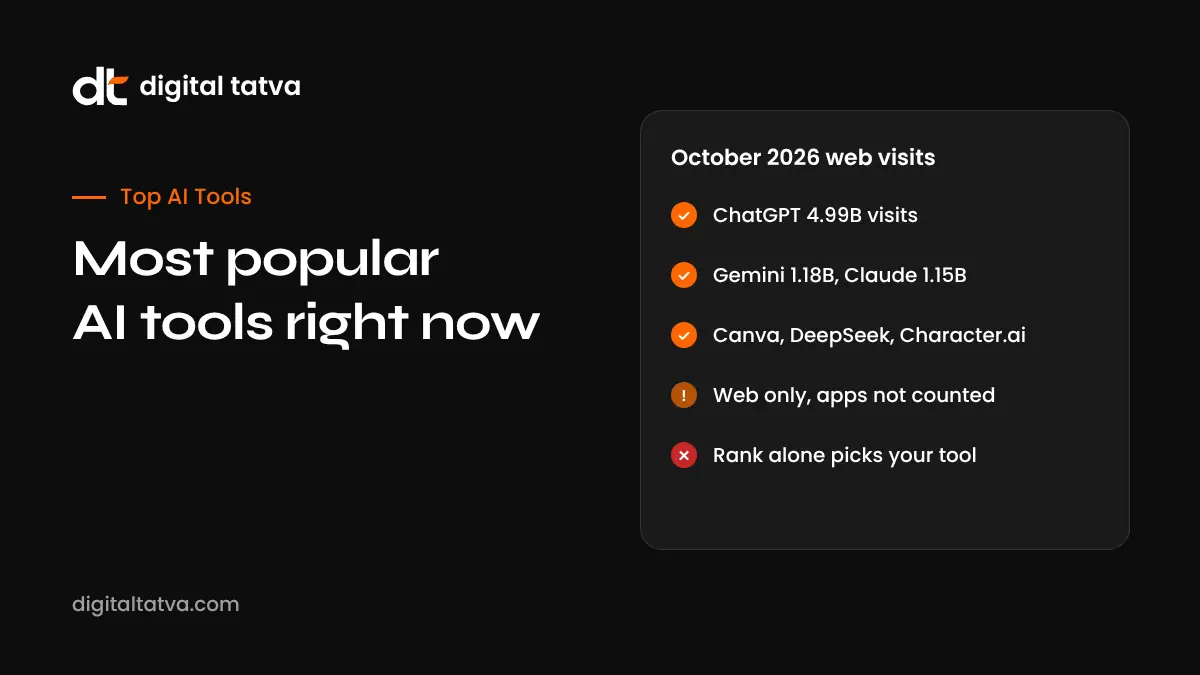
Quick answer: The most popular AI tools in the world right now, ranked by October 2026 website visits, are ChatGPT (about 4.99 billion visits), Gemini (1.18 billion), Claude (1.15 billion), Canva (867 million), DeepSeek (296 million), Character.ai (286 million), Grok (166 million), DeepL (158 million), CapCut (108 million) and Perplexity (98 million). The rest of the top 30 includes Microsoft Copilot, Gemini Notebook (formerly NotebookLM), Grammarly, Remove.bg, Suno, Google AI Studio, ElevenLabs, Higgsfield, Wayground, QuillBot, Hugging Face, Meta AI, ZeroGPT, Lovable, Cursor, Manus, Photoroom, GPTZero, Gamma and SeaArt. These figures are third-party traffic estimates for websites only, so they leave out app usage and AI built into other products.
Key takeaways
- ChatGPT still gets more web visits than the next nine tools on the list combined.
- Claude passed 1 billion monthly visits and is now almost level with Gemini on the web.
- Creative tools (Canva, CapCut, Suno, Higgsfield, ElevenLabs) make up a large share of the top 20, not just chatbots.
- Education and writing checks are big: Wayground, QuillBot, ZeroGPT and GPTZero all pass 24 million visits.
- Website visits measure reach, not quality. Choose tools by the job you need done, not by rank alone.
How this ranking works
This list uses the November 2026 update of Exploding Topics’ ranking of the most popular AI tools, which is based on Semrush traffic estimates for October 2026. Each tool is ranked by total monthly website visits on desktop and mobile web to the domain that hosts it. A few points matter when you read it:
- It measures websites, not apps. ChatGPT, Gemini, Meta AI and Copilot all have huge mobile app audiences that this data does not capture. Meta AI, for example, is used mostly inside WhatsApp, Instagram and Facebook, so its web number badly understates its reach.
- It is an estimate. Traffic tools model visits from panels and clickstream data. Treat the numbers as directional, and compare them month to month from the same source rather than across sources.
- Built-in AI is missing. Google AI Overviews and AI Mode, Copilot inside Microsoft 365, and AI features in Photoshop, Notion or Excel do not show up as separate websites.
- Visits are not users. One heavy user can generate dozens of visits a month.
With those limits in mind, the ranking is still the best public snapshot of which AI products people actively open in a browser.
The 30 most popular AI tools: full table
| Rank | Tool | October 2026 visits | What it is used for |
|---|---|---|---|
| 1 | ChatGPT | 4.99 billion | General AI assistant, search, writing, coding, images |
| 2 | Gemini | 1.18 billion | Google’s assistant, research, Workspace tasks, images and video |
| 3 | Claude | 1.15 billion | Writing, analysis, coding and long documents |
| 4 | Canva | 867.0 million | Design with built-in AI (Magic Studio) |
| 5 | DeepSeek | 295.9 million | Low-cost chat and reasoning models |
| 6 | Character.ai | 286.1 million | Character chat and role-play |
| 7 | Grok | 165.5 million | xAI assistant linked to X |
| 8 | DeepL | 157.7 million | Translation and writing |
| 9 | CapCut | 108.4 million | Video editing with AI features |
| 10 | Perplexity | 97.9 million | AI answer engine with citations |
| 11 | Microsoft Copilot | 91.5 million | Microsoft’s consumer and work assistant |
| 12 | Gemini Notebook (formerly NotebookLM) | 77.7 million | Research notebooks and audio overviews from your sources |
| 13 | Grammarly | 77.5 million | Writing assistance and grammar |
| 14 | Remove.bg | 76.5 million | Background removal |
| 15 | Suno | 75.1 million | AI music generation |
| 16 | Google AI Studio | 63.2 million | Testing Gemini models and building apps |
| 17 | ElevenLabs | 61.1 million | AI voice, dubbing and voice agents |
| 18 | Higgsfield | 57.5 million | AI video and image generation for creators |
| 19 | Wayground (formerly Quizizz) | 56.0 million | Classroom quizzes and AI lesson resources |
| 20 | QuillBot | 53.2 million | Paraphrasing, grammar and summaries |
| 21 | Hugging Face | 48.1 million | Open models, datasets and demos |
| 22 | Meta AI | 43.3 million | Meta’s assistant on the web |
| 23 | ZeroGPT | 41.9 million | AI text detection |
| 24 | Lovable | 33.3 million | Building apps by describing them |
| 25 | Cursor | 29.4 million | AI code editor and coding agent |
| 26 | Manus | 24.5 million | General-purpose AI agent |
| 27 | Photoroom | 24.2 million | Product photos and image editing |
| 28 | GPTZero | 24.1 million | AI text detection |
| 29 | Gamma | 21.8 million | AI presentations, documents and sites |
| 30 | SeaArt | 21.7 million | AI image generation and community models |
Just outside the top 30 are Kling (19.7 million), OpenRouter (19.4 million), DeepAI (18.2 million), OpenArt (18.1 million), Qwen Chat (17.6 million), HeyGen (13.6 million), Replit (12.1 million), Tripo (12.0 million), Gauth (11.3 million) and Kimi (11.0 million).
The top 10, tool by tool
1. ChatGPT
ChatGPT remains the default AI assistant for most people, with close to 5 billion web visits in October 2026 and roughly 20% growth since June. It covers chat, search, file analysis, image generation, agents and shopping in one place. Free users get a capable model with limits, and paid plans unlock higher limits and the newest models. Read our ChatGPT review and ChatGPT pricing guide.
Best for: everyday questions, writing, research and anyone who wants one tool that does most things.
2. Gemini
Gemini sits at about 1.18 billion visits. Its web number is only part of the story, because Gemini also runs inside Android, Chrome, Gmail, Docs and Google Search. The Gemini 4 family brought stronger coding and long output, and Google offers generous free access plus AI plans bundled with storage. See our Gemini review.
Best for: Google Workspace users, Android users and anyone who wants AI tied to Google services.
3. Claude
Claude is the biggest mover among the leaders. It grew about 55% between June and October 2026 to roughly 1.15 billion visits, putting it within touching distance of Gemini on the web. Claude is popular for long documents, careful writing, coding and agent work through Claude Code and Cowork. Read our Claude review.
Best for: writers, analysts, developers and teams handling long or complex documents.
4. Canva
Canva is the only design tool in the top five. Its AI features (Magic Studio, Magic Design, Canva Code and image generation) sit inside a tool hundreds of millions of people already use for social posts, presentations and print. See our Canva AI guide.
Best for: small businesses, marketers, teachers and anyone who designs without a designer.
5. DeepSeek
DeepSeek holds fifth place with about 296 million visits. It is known for strong reasoning at low prices and openly released model weights. Businesses handling sensitive data should review where data is processed before using the hosted app. Read is DeepSeek safe.
Best for: cost-conscious users and developers who want capable models cheaply.
6. Character.ai
Character.ai shows how big entertainment AI has become, with about 286 million visits. People use it for role-play, practice conversations and fun. Parents should note the platform’s age rules and safety settings. See our Character.ai alternatives.
Best for: creative role-play and casual conversation.
7. Grok
Grok from xAI has about 166 million web visits, plus usage inside X. It is popular for real-time takes on posts and news trending on X. See how to use Grok.
Best for: X users who want AI with live social context.
8. DeepL
DeepL is the most visited dedicated translation tool, with about 158 million visits, though it slipped slightly since June. Professionals choose it for natural-sounding translations of documents and emails. Read our DeepL review.
Best for: business translation and multilingual teams.
9. CapCut
CapCut climbed into the top 10 with about 108 million visits and roughly 24% growth. Auto captions, AI effects and templates make it the go-to editor for short-form video. See how to use CapCut AI.
Best for: Reels, Shorts and TikTok creators.
10. Perplexity
Perplexity is still in the top 10 at about 98 million visits, but it fell around 15% between June and October 2026 as ChatGPT, Gemini and Google AI Mode all improved their own search answers. It remains a strong choice for cited research. Read our Perplexity review.
Best for: research with sources you can check.
Ranks 11 to 30 at a glance
- Microsoft Copilot (11): dropped out of the top 10 on the web, though most Copilot use happens inside Windows and Microsoft 365. See our Copilot review.
- Gemini Notebook (12): the renamed NotebookLM, used to study and research from your own sources. See how to use NotebookLM.
- Grammarly (13) and QuillBot (20): writing help remains one of the biggest everyday uses of AI. See our Grammarly review and QuillBot review.
- Remove.bg (14) and Photoroom (27): quick image clean-up for sellers and social media. See best background removers.
- Suno (15): the leading AI music app. See how to make a song with Suno.
- Google AI Studio (16): developers and power users testing Gemini models for free. See our AI Studio guide.
- ElevenLabs (17): voice generation, dubbing and voice agents. See our ElevenLabs review.
- Higgsfield (18): one of the fastest risers of 2026 for AI video. See how to use Higgsfield.
- Wayground (19): Quizizz under its new name, more than doubling since June. See our Wayground guide.
- Hugging Face (21): the home of open models. See Hugging Face explained.
- Meta AI (22): web visits up about 71%, but most usage is inside Meta’s apps. See how to use Meta AI.
- ZeroGPT (23) and GPTZero (28): AI detection is a mass-market need for students and teachers. See GPTZero vs ZeroGPT.
- Lovable (24) and Cursor (25): the two biggest names in AI building. See our Lovable review and Cursor review.
- Manus (26): an autonomous agent for research and multi-step tasks. See how to use Manus.
- Gamma (29): AI presentations and documents. See our Gamma review.
- SeaArt (30): image generation with community models and styles.
Most popular AI tools by category
| Category | Most visited | Runners-up |
|---|---|---|
| General assistants | ChatGPT | Gemini, Claude, DeepSeek, Grok, Copilot |
| Design and images | Canva | Remove.bg, Photoroom, SeaArt, OpenArt |
| Video | CapCut | Higgsfield, Kling, HeyGen |
| Writing | Grammarly | QuillBot, DeepL |
| Search and research | Perplexity | Gemini Notebook |
| Audio and music | Suno | ElevenLabs |
| Building and coding | Google AI Studio | Hugging Face, Lovable, Cursor, OpenRouter, Replit |
| Education | Wayground | Gauth |
| AI detection | ZeroGPT | GPTZero |
| Agents | Manus | ChatGPT agent mode, Claude Cowork |
What the ranking says about AI in late 2026
The big three are pulling away
ChatGPT, Gemini and Claude together account for well over 7 billion monthly web visits. The fourth biggest assistant, DeepSeek, is under 300 million. Most people now pick one of three general assistants and add specialist tools on top.
Claude is the growth story
Claude’s 55% jump in four months is the largest gain among tools above 100 million visits. A separate estimate from First Page Sage puts Claude at about 11.2% of US chatbot usage in October 2026, up 0.6 points in a month, behind ChatGPT (52.3%) and Gemini (26.3%).
Answer engines face pressure
Perplexity’s drop shows how hard it is to compete as a standalone AI search engine when Google, OpenAI and Anthropic all build search into their assistants. For brands, this means visibility has to be earned across several assistants, not one.
Creators drive a big share of AI traffic
Canva, CapCut, Suno, Higgsfield, ElevenLabs, Remove.bg and Photoroom together pass 1.2 billion visits. Content creation, not just chat, is a mass-market AI use.
Education is huge and contested
Students use QuillBot, Gauth and chat assistants, while teachers use Wayground and AI detectors. Detection tools have real limits, so they should never be the only evidence of misconduct. See how AI detectors work.
How to choose from the most popular AI tools
- Start with one general assistant. ChatGPT, Gemini or Claude covers most tasks. Pick the one that fits the apps you already use.
- Add specialists only for jobs you repeat. A design tool, a video editor or a writing checker is worth it if you use it weekly.
- Test on your own work. Run the same three real tasks through two tools and compare results.
- Check privacy settings. Look at training opt-outs, data retention and where data is stored, especially for client or company information.
- Watch total cost. Several 20 dollar subscriptions add up quickly. See how to save on AI subscriptions.
Illustrative example: A five-person marketing team uses ChatGPT for drafts, Canva for visuals and CapCut for short videos. Before adding a fourth paid tool, they list the tasks each person repeats every week and find that Gemini Notebook’s free tier covers their research needs. They skip a paid research tool and save the budget. This is an illustrative scenario, not a client story.
What popularity means for brands
When billions of visits flow through AI assistants each month, more buying research starts with a question to ChatGPT, Gemini, Claude or Perplexity. If those assistants do not know your brand, or describe it wrongly, you lose demand you never see in analytics. Track how often you are mentioned and cited across the most-used assistants, not only in Google. Our guide to AI search visibility explains how to measure it.
Checklist: making the most of the top AI tools
- One main assistant chosen for your team.
- Specialist tools linked to weekly tasks only.
- Privacy and training settings reviewed.
- Subscriptions audited every quarter.
- Brand visibility checked in ChatGPT, Gemini, Claude and Perplexity.
- Monthly look at new and fast-growing tools in your category.
How Digital Tatva can help
The tools at the top of this list are where your customers ask for recommendations. Digital Tatva helps brands show up accurately in ChatGPT, Gemini, Claude, Perplexity and Google AI answers through answer engine optimization. See our AEO services.
Do the most popular AI assistants recommend your brand? Request an AEO audit or try the free AI visibility checker.
Frequently asked questions
What is the most popular AI tool in the world?
ChatGPT, with about 4.99 billion website visits in October 2026 according to Semrush estimates published by Exploding Topics. That is more than four times Gemini’s web traffic.
Is Gemini or Claude more popular?
On the web they are close: Gemini had about 1.18 billion visits and Claude about 1.15 billion in October 2026. Gemini has far more usage inside Android and Google apps, which web data does not capture.
Which AI tool is growing fastest?
Among tools with more than 10 million visits, Wayground (formerly Quizizz) and Higgsfield both grew about 110% between June and October 2026. Claude grew fastest among the largest assistants at about 55%.
Is Perplexity losing users?
Its web visits fell about 15.5% between June and October 2026, to roughly 98 million. It still ranks in the top 10 AI tools.
How accurate are these traffic numbers?
They are third-party estimates based on modelled data. They are useful for comparing tools and spotting trends, but they are not exact counts.
Why is Meta AI ranked so low?
Most people use Meta AI inside WhatsApp, Instagram, Facebook and Messenger. This ranking only counts visits to its website.
What is the most popular free AI tool?
ChatGPT, Gemini and Claude all have free tiers and are the three most visited tools. Canva, CapCut and Gemini Notebook also offer strong free plans.
What is the most popular AI tool for coding?
Among dedicated coding tools on this list, Cursor has the most web visits, followed by Replit. Lovable leads for building apps without code. Many developers also use Claude Code, Codex and GitHub Copilot, which are not measured as websites here.
What is the most popular AI image or video tool?
Canva leads for design. For video, CapCut is the most visited editor and Higgsfield is the most visited dedicated generator, ahead of Kling and HeyGen.
How often does this ranking change?
Monthly. Positions near the top are stable, but tools ranked 10 to 40 can move several places in a single update. We refresh this page as new data is published.
Product details, prices and features are checked at the time of writing and can change. Sources are linked in the text so you can check them yourself.
How does your brand appear in AI answers?
We test the questions your buyers ask across the major AI assistants and search engines, then show you what to fix first.
Get an AI Visibility Audit