15 Fastest Growing AI Tools of 2026 (Traffic and Search Data)
Which AI tools grew fastest in 2026, which ones lost traffic, and what the growth means for you.
On this page
- Key takeaways
- How we measured growth
- Fastest growing AI tools by website visits (June to October 2026)
- Fastest growing AI tools by search demand
- AI tools that lost traffic in 2026
- Patterns behind the fastest growing AI tools
- How to use fast-growing tools without wasting money
- What fast-growing AI tools mean for your brand
- How Digital Tatva can help
- Frequently asked questions
Last updated: 22 November 2026
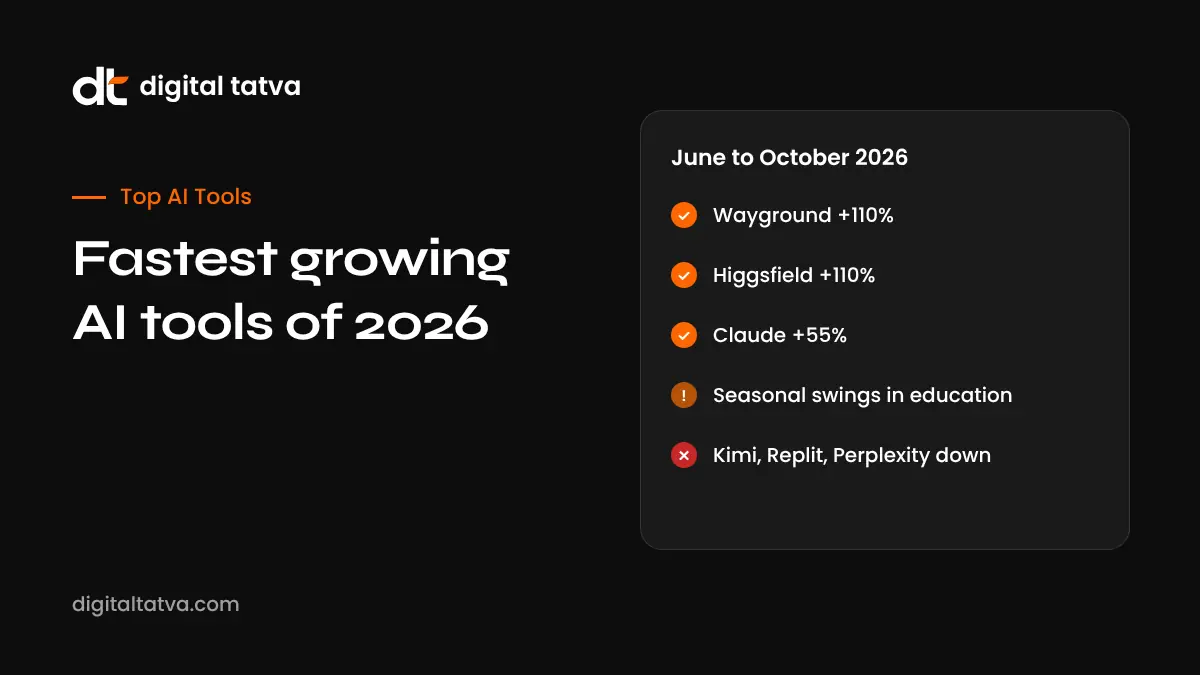
Quick answer: The fastest growing AI tools of 2026, based on website visits between June and October 2026, are Wayground (formerly Quizizz, up about 110%), Higgsfield (up about 110%), GPTZero (up about 82%), Meta AI (up about 71%) and Claude (up about 55%). CapCut, ChatGPT, DeepSeek, Canva and Cursor also grew by double digits. On search demand, Google AI Mode (up about 587% year on year), Google Flow, Meshy, Granola and OpenCode are rising fastest. Tools losing ground over the same period include Kimi, Replit and Perplexity.
Key takeaways
- Two very different tools lead growth: a classroom platform (Wayground) and a creator video tool (Higgsfield).
- Claude added roughly 400 million monthly visits in four months, the largest absolute gain on the list after ChatGPT.
- AI detection keeps growing as schools set AI policies, with GPTZero up about 82%.
- Search interest shows the next wave: Google AI Mode, AI filmmaking (Flow), 3D generation (Meshy), meeting notes (Granola) and open-source coding agents (OpenCode).
- Fast growth is a reason to test a tool, not a reason to switch your whole workflow.
How we measured growth
We used two public data sets so you can see both actual usage and rising interest:
- Website visits: Semrush traffic estimates published by Exploding Topics in its November 2026 update, comparing June 2026 with October 2026 for tools above 10 million monthly visits.
- Search demand: RisingTrends’ AI trends data (updated 19 November 2026), which shows monthly searches and year-on-year growth for AI products and topics.
Traffic estimates are modelled, not exact, and they leave out mobile apps. A tool can grow fast from a small base, so we show visit numbers next to every percentage.
Fastest growing AI tools by website visits (June to October 2026)
| Rank | Tool | June 2026 | October 2026 | Change |
|---|---|---|---|---|
| 1 | Wayground (formerly Quizizz) | 26.6 million | 56.0 million | +110.5% |
| 2 | Higgsfield | 27.4 million | 57.5 million | +110.3% |
| 3 | GPTZero | 13.2 million | 24.1 million | +82.1% |
| 4 | Meta AI | 25.3 million | 43.3 million | +71.0% |
| 5 | Claude | 741.8 million | 1.15 billion | +55.2% |
| 6 | CapCut | n/a | 108.4 million | +24.4% |
| 7 | ChatGPT | n/a | 4.99 billion | +20.3% |
| 8 | DeepSeek | n/a | 295.9 million | +15.7% |
| 9 | Canva | n/a | 867.0 million | +15.5% |
| 10 | Cursor | n/a | 29.4 million | +11.7% |
Character.ai (+15.3%), Grok (+8.1%) and Gemini (+5.8%) also grew over the period. June figures are shown where the source published them.
1. Wayground (formerly Quizizz)
Wayground more than doubled its web traffic in four months, from about 26.6 million to 56 million visits. The timing fits the school calendar: June is a quiet month in many countries and October is peak term time. The rebrand from Quizizz also widened the product from quizzes to AI-assisted lessons, practice and assessments. See our Wayground guide.
Why it is growing: teachers want ready-made, AI-generated practice that they can still control and review.
2. Higgsfield
Higgsfield also grew about 110%, to 57.5 million visits, making it the most visited dedicated AI video generator on the web. It packages many video and image models with camera presets and effects that make cinematic clips quick to produce. See how to use Higgsfield.
Why it is growing: creators want one place to try the latest video models without juggling subscriptions.
3. GPTZero
GPTZero rose about 82%, to 24.1 million visits. Demand for AI detection follows the academic year and new institutional AI policies. Detectors can produce false positives, so results should be one signal among several. Compare options in GPTZero vs ZeroGPT and learn the limits in how AI detectors work.
Why it is growing: schools and publishers need a documented process for checking AI use.
4. Meta AI
Meta AI’s website grew about 71%, to 43.3 million visits. That is small next to its in-app use across WhatsApp, Instagram and Facebook, but the web growth shows more people using it as a standalone assistant. See how to use Meta AI.
Why it is likely growing: Meta’s newer Muse models and its push to make Meta AI useful outside its social apps.
5. Claude
Claude grew about 55%, from roughly 742 million to 1.15 billion visits. No other tool of that size grew as fast. Claude’s agent features (Claude Code, Cowork, Claude Data, and Sheets and Whiteboards in beta) pulled in professional users, and newer models such as Claude Fable 5.2 kept it at the top of benchmark tables. Read our Claude review.
Why it is growing: strong coding and agent work, plus word of mouth among professionals.
6. CapCut
CapCut grew about 24%, to 108 million visits, and moved into the top 10 AI tools on the web. Auto captions, AI effects and templates keep it the default editor for short-form video. See how to use CapCut AI.
7. ChatGPT
Growing 20% at ChatGPT’s size means adding close to 850 million monthly visits. Shopping research, agents, group features and cheaper plans keep pulling people in. See our ChatGPT review.
8. DeepSeek
DeepSeek grew about 16%, to 296 million visits, helped by low prices and new coding features. Check data handling before using it for sensitive work: is DeepSeek safe.
9. Canva
Canva grew about 15.5%, to 867 million visits, as AI features became part of everyday design work. See how to use Canva AI.
10. Cursor
Cursor grew about 12%, to 29.4 million visits, despite strong competition from Claude Code, Codex and Google Antigravity. Read our Cursor review.
Fastest growing AI tools by search demand
Search growth often shows what people are about to try. These tools and features have the steepest year-on-year rise in monthly searches in RisingTrends’ November 2026 data.
| Rank | Tool or feature | Monthly searches | Year-on-year growth |
|---|---|---|---|
| 11 | Google AI Mode | 673,000 | +587% |
| 12 | Google Flow (searched as “Flow AI”) | 110,000 | +437% |
| 13 | Meshy AI | 74,000 | +173% |
| 14 | Granola | 201,000 | +61% |
| 15 | OpenCode | 165,000 | About 12x |
11. Google AI Mode
Searches for Google AI Mode grew almost sevenfold in a year. AI Mode is Google’s conversational search experience, now rolled out widely, and it changes how people research products and services. See how to use Google AI Mode and, if you run a business, Google AI Mode SEO.
12. Google Flow
Flow is Google’s AI filmmaking tool built on Veo video models. Rising searches reflect the boom in AI short films and ads. See how to use Google Flow and our AI movie maker guide.
13. Meshy
Meshy turns text and images into 3D models for games, 3D printing and product mockups. Interest grew about 173%. Compare it with Tripo and others in best AI 3D model generators.
14. Granola
Granola is an AI notepad for meetings that records on your device without a bot joining the call. Searches grew about 61%. See best AI note-taking apps and AI note taker privacy and consent.
15. OpenCode
OpenCode is an open-source coding agent that runs in the terminal and works with many model providers. Searches grew about twelvefold as developers looked for alternatives to closed coding agents. See best AI coding assistants.
AI tools that lost traffic in 2026
| Tool | October 2026 visits | Change since June | Likely reason |
|---|---|---|---|
| Kimi | 11.0 million | -45.9% | Strong competition in China and abroad; much use moved to API and open weights |
| Replit | 12.1 million | -16.4% | Competition from Lovable, Base44, Claude and coding agents |
| Perplexity | 97.9 million | -15.5% | Search built into ChatGPT, Gemini, Claude and Google AI Mode |
| DeepL | 157.7 million | -3.9% | General assistants now translate well |
The reasons column is our interpretation, not data from the source. A traffic dip does not mean a tool is worse; Kimi’s open-weight models, for example, are widely used through other platforms.
Patterns behind the fastest growing AI tools
- Education swings with the calendar. Wayground, GPTZero and homework tools rise sharply when terms start. Compare like-for-like months before reading too much into it.
- Video is the hottest creative category. Higgsfield, CapCut and Flow are all growing as AI video gets good enough for ads and social content.
- Assistants are consolidating. Claude and ChatGPT grow while standalone search and smaller chatbots lose share.
- Agents move from demos to work. Coding agents and office agents drive professional sign-ups.
- Privacy-friendly tools win niches. Bot-free note takers like Granola and open-source agents like OpenCode grow on trust and control.
How to use fast-growing tools without wasting money
- Use free tiers first. Most tools on this list have free plans or trials.
- Test against your current tool. Run the same task in both and judge the output, not the hype.
- Check data and pricing terms. Fast-growing startups change plans and credit systems often.
- Avoid lock-in. Keep your files and prompts exportable.
- Review every quarter. Growth leaders change from one update to the next.
Illustrative example: An e-commerce brand notices Higgsfield trending and tests it for two weeks on product ad clips, while keeping CapCut for editing. It compares cost per usable clip against its freelance videographer and keeps both: AI for quick variations, the freelancer for hero content. This is an illustrative scenario, not a client story.
Checklist before adopting a trending AI tool
- Clear task it will improve.
- Free trial completed on real work.
- Output quality compared with your current tool.
- Privacy, data use and commercial rights checked.
- Monthly cost and credit limits understood.
- Exit plan if the tool changes or shuts down.
What fast-growing AI tools mean for your brand
As new assistants and AI search features grow, the number of places where customers can ask about your product grows too. A brand that is visible in ChatGPT may still be missing from Claude, Meta AI or Google AI Mode. Track your presence across all of them. Our most popular AI tools ranking shows where the biggest audiences are today.
How Digital Tatva can help
Digital Tatva tracks how AI assistants describe and recommend brands, and builds the content, entity and citation signals that help you appear in answers as new platforms grow. See our AEO services.
Are you visible in the AI tools your customers are switching to? Request an AEO audit or try the free AI visibility checker.
Frequently asked questions
What is the fastest growing AI tool in 2026?
Among tools with more than 10 million monthly visits, Wayground (formerly Quizizz) grew fastest at about 110.5% between June and October 2026, just ahead of Higgsfield at about 110.3%.
Which AI chatbot is growing fastest?
Meta AI’s website grew about 71% and Claude about 55% over the same period. Claude’s growth is the most significant because it started from more than 700 million visits.
Is ChatGPT still growing?
Yes. ChatGPT’s web visits grew about 20% between June and October 2026, to roughly 4.99 billion.
Which AI tools are declining?
Kimi (about -46%), Replit (about -16%), Perplexity (about -15.5%) and DeepL (about -4%) lost web traffic between June and October 2026.
Why is Higgsfield growing so fast?
It bundles many popular video and image models with creator-friendly presets, so people can test the newest models in one place.
Why did Wayground grow so much?
School terms and the rebrand from Quizizz to a wider AI teaching platform both pushed traffic up between the summer break and October.
What is OpenCode?
An open-source AI coding agent that runs in the terminal and connects to different model providers. Searches for it grew about twelvefold in a year.
How reliable is this growth data?
It comes from third-party estimates of web traffic and search volume. It is good for spotting direction and scale, but it is not exact and leaves out app usage.
Should I switch to a fast-growing AI tool?
Test it first on real tasks. Switch only if it clearly beats your current tool on quality, cost or time saved.
How often do the fastest growing AI tools change?
Often. Seasonal effects, new model launches and pricing changes can move a tool up or down within a few months, so check updated data each quarter.
Product details, prices and features are checked at the time of writing and can change. Sources are linked in the text so you can check them yourself.
How does your brand appear in AI answers?
We test the questions your buyers ask across the major AI assistants and search engines, then show you what to fix first.
Get an AI Visibility Audit