Jensen Huang Steps Down as Nvidia CEO: What It Means for AI and Nvidia’s Record Quarter
Nvidia's leadership change, its record third quarter and what it means for the AI industry.
On this page
- Key takeaways
- What happened
- Who is Colette Kress?
- Nvidia’s record Q3 fiscal 2027 results
- Why Nvidia matters to everyday AI
- What changes and what does not
- What it means for India
- How businesses should read AI industry news
- Illustrative example: an IT services firm planning GPU spend
- Checklist: staying calm about AI industry shocks
- How Digital Tatva can help
- Frequently asked questions
Last updated: 18 November 2026
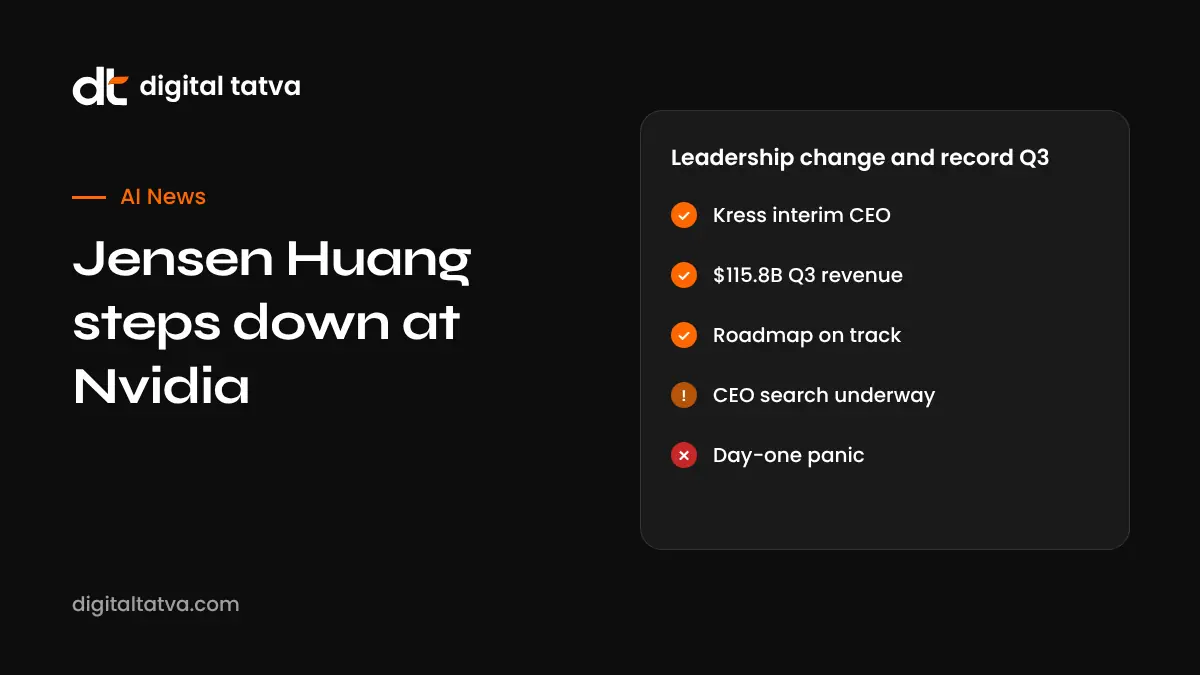
Quick answer: On 12 November 2026, Nvidia announced that co-founder Jensen Huang had stepped down as president, chief executive and board member, effective immediately. CFO Colette Kress became interim CEO while keeping her CFO role, and former Synopsys chief Harvey C. Jones became Nvidia’s first board chair. Nvidia’s filing did not state a reason; news reports linked the move to reports about Huang’s personal relationships. Five days later, on 17 November, Nvidia reported record third-quarter revenue of $115.8 billion, up 103% year on year, driven by its Vera Rubin data centre chips. For AI users and businesses, the near-term impact is small: Nvidia’s roadmap, supply deals and the wider AI build-out continue.
Key takeaways
- Huang led Nvidia for 33 years after co-founding it in 1993.
- The board has started a search for a permanent CEO, considering internal and external candidates.
- Q3 fiscal 2027 data centre revenue was $107.6 billion, up 110% year on year.
- Nvidia guided fourth-quarter revenue to about $130 billion, plus or minus 3%.
- Nvidia’s pending acquisition of Hugging Face and its AI partnerships remain in place, according to its results release.
What happened
Nvidia filed a report with the US Securities and Exchange Commission on 12 November 2026 announcing a CEO transition. The filing said Jensen Huang resigned as president, CEO and director with immediate effect. It named Colette Kress, executive vice president and CFO, as interim CEO, and Harvey C. Jones as the board’s first-ever chair. The filing did not give a reason for the resignation. Several outlets reported that it followed media reports about Huang’s personal relationships, and that some US lawmakers had asked questions. Nvidia shares fell about 4% that day, according to reports.
Quotes from the filing:
- Harvey C. Jones: “The Board has full confidence in Colette and the leadership team.”
- Colette Kress: “Our focus remains on serving our customers, partners, developers and shareholders.”
Who is Colette Kress?
Colette Kress has been Nvidia’s CFO since 2013 and has led its financial strategy through the AI boom. Before Nvidia she held senior finance roles at Cisco and Microsoft. As interim CEO she will also remain CFO until a permanent chief executive is appointed.
Nvidia’s record Q3 fiscal 2027 results
| Metric | Q3 fiscal 2027 (quarter ended 25 October 2026) |
|---|---|
| Revenue | $115.8 billion, up 103% year on year and 20% quarter on quarter |
| Data centre revenue | $107.6 billion, up 110% year on year |
| Edge computing revenue | $8.2 billion, up 42% year on year |
| GAAP gross margin | 74.8% |
| GAAP net income | $65.3 billion |
| Shareholder returns | $28.1 billion in buybacks and dividends |
| Q4 outlook | About $130 billion revenue, plus or minus 3%, excluding China data centre compute |
Source: Nvidia’s third-quarter fiscal 2027 results release. Kress said, “Vera Rubin is off to an explosive start, our roadmap is on track and our ambition has never been greater.”
Why Nvidia matters to everyday AI
Almost every major AI product you use, from ChatGPT and Gemini to Claude and Meta AI, is trained or served at least partly on Nvidia hardware or competes with it. Nvidia’s Vera Rubin systems are the latest generation powering large data centres. Nvidia also invests in AI companies, including a reported $10 billion commitment in the Anthropic IPO private placement, and agreed to buy Hugging Face, the hub for open AI models. See Hugging Face explained.
What changes and what does not
| Area | Expected effect |
|---|---|
| Product roadmap | Nvidia says it is on track; chips are planned years ahead |
| Customer supply | Existing orders and partnerships continue |
| Leadership and culture | The biggest open question; Huang was closely identified with Nvidia’s strategy |
| Governance | A separate board chair is a structural change for the company |
| AI prices for users | No direct short-term effect; compute supply and competition matter more |
| Stock volatility | Likely to stay high around leadership news; this is not investment advice |
What it means for India
Indian cloud providers, data centre builders and the IndiaAI Mission’s GPU programme rely heavily on Nvidia chips. Contracts and deliveries are not expected to change because of a leadership change, but buyers will watch for any shift in strategy on sovereign AI partnerships, which Huang championed during visits to India. Read our overview of AI in India statistics.
How businesses should read AI industry news
- Separate headlines from operations. Leadership news rarely changes the tools you use next month.
- Watch pricing and capacity. Chip supply affects AI tool pricing and rate limits over time.
- Avoid single-vendor dependence. Keep options across AI providers. See model routing explained.
- Focus on your visibility. Whatever happens to chip makers, customers keep asking AI assistants for recommendations.
Illustrative example: an IT services firm planning GPU spend
This is an illustrative scenario, not a client story.
An IT services company in Bengaluru was planning to rent GPU capacity for a client’s AI project. After the Nvidia news, the client asks whether to pause. The firm’s CTO reviews the facts: supply contracts are unchanged, results are strong and the cloud provider has confirmed availability. The project continues, but the team designs it to run on more than one provider and model family, which reduces risk from any single vendor’s news.
Checklist: staying calm about AI industry shocks
- Read the official filing or company release first.
- Check whether your vendors have announced any changes.
- Avoid making long-term decisions on day-one headlines.
- Keep your AI stack flexible across providers.
- Keep investing in content and brand signals that AI assistants rely on.
How Digital Tatva can help
Digital Tatva helps businesses stay visible across AI assistants regardless of which models or chips power them. See our AEO services.
Is your brand visible in AI answers? Request an AEO audit or try the free AI visibility checker.
Frequently asked questions
Did Jensen Huang resign from Nvidia?
Yes. Nvidia announced on 12 November 2026 that he stepped down as president, CEO and board member, effective immediately.
Why did Jensen Huang step down?
Nvidia’s filing did not state a reason. News reports linked the resignation to media reports about his personal relationships.
Who is Nvidia’s CEO now?
CFO Colette Kress is interim CEO while the board searches for a permanent chief executive.
Who is Nvidia’s board chair?
Harvey C. Jones, former CEO and executive chairman of Synopsys, became Nvidia’s first board chair.
What were Nvidia’s Q3 fiscal 2027 results?
Revenue was $115.8 billion, up 103% year on year, with data centre revenue of $107.6 billion.
What is Nvidia’s outlook for next quarter?
About $130 billion in revenue, plus or minus 3%, excluding China data centre compute revenue.
Does this affect ChatGPT, Gemini or Claude?
Not directly in the short term. These services depend on chip supply and data centres, which continue.
Is Nvidia still buying Hugging Face?
Nvidia’s results release still lists the agreement to acquire Hugging Face.
How long did Jensen Huang lead Nvidia?
About 33 years, since co-founding the company in 1993.
Should I buy or sell Nvidia shares?
We do not give investment advice. Consult a qualified financial adviser.
Product details, prices and features are checked at the time of writing and can change. Sources are linked in the text so you can check them yourself.
How does your brand appear in AI answers?
We test the questions your buyers ask across the major AI assistants and search engines, then show you what to fix first.
Get an AI Visibility Audit