Claude Fable 5.2 and Mythos 5.2: What Is New, Pricing and Who Should Use Them
Anthropic released Claude Fable 5.2 and Mythos 5.2 on 9 November 2026. Here is what changed, API pricing including fast mode, benchmark claims, availability and when to pick Fable over Opus 5.5.
On this page
- Key takeaways
- What are Claude Fable 5.2 and Mythos 5.2?
- What is new in Fable 5.2
- Claude Fable 5.2 pricing
- Where you can use Fable 5.2
- Fable 5.2 vs Opus 5.5: which should you use?
- Effort levels explained
- How Fable 5.2 compares with other frontier models
- Safety and the Mythos tier
- What Fable 5.2 means for businesses
- How to start using Fable 5.2
- Frequently asked questions
Last updated: 12 November 2026
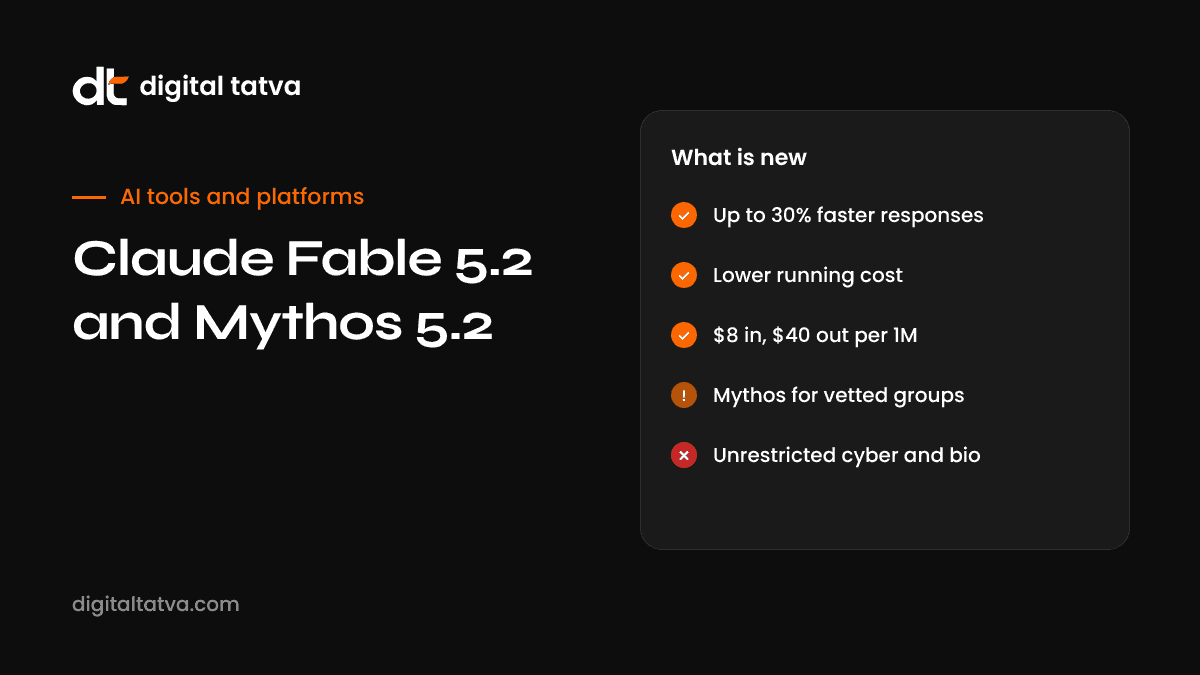
Quick answer: Anthropic released Claude Fable 5.2 and Claude Mythos 5.2 on 9 November 2026. They share one underlying model at the top of Anthropic’s range. Fable 5.2 is the broadly available version, with extra safeguards for cybersecurity and biology, and is offered in Claude apps, the Claude API (as claude-fable-5-2), AWS, Google Cloud and Microsoft Azure. Mythos 5.2 is restricted to vetted cybersecurity and life sciences organisations. API pricing is $8 per million input tokens and $40 per million output tokens, with an optional fast mode at $16 and $80 that Anthropic says runs up to 2.5 times faster. Anthropic still recommends Claude Opus 5.5 for most everyday work and Fable for the hardest problems.
Key takeaways
- Fable 5.2 and Mythos 5.2 are the same model. Fable adds safeguards and is widely available. Mythos is for approved organisations only.
- Standard API pricing is $8 input and $40 output per million tokens. Fast mode doubles the price for up to 2.5 times the speed.
- Anthropic says both generate output up to 30% faster than the 5.1 versions.
- Launch results focus on difficult coding, scientific research, hardware engineering and robotics.
- For most business tasks, Opus 5.5 remains the better value starting point. Fable earns its cost on long, ambiguous, high-stakes work.
What are Claude Fable 5.2 and Mythos 5.2?
Anthropic organises its Claude models into tiers. Haiku is the fastest and cheapest, Sonnet is the balanced workhorse, Opus is the flagship for demanding work, and above Opus sits the Mythos tier for the most capable models. The Mythos tier first appeared publicly with Claude Fable 5 and Mythos 5 in June 2026.
Fable and Mythos are two releases of the same model. The difference is access and safeguards:
- Claude Fable 5.2 is available to everyone on supported plans and platforms. It applies additional safeguards for cybersecurity and biology topics.
- Claude Mythos 5.2 is available only to vetted organisations in cybersecurity and life sciences, which apply through Anthropic’s verification programmes. It is designed for legitimate defensive security and scientific research where those safeguards would get in the way.
The 5.2 release replaces the 5.1 versions as the top of the range.
What is new in Fable 5.2
Faster output
Anthropic says Fable 5.2 and Mythos 5.2 generate output up to 30% faster than Fable and Mythos 5.1. For long agentic tasks that produce a lot of code or text, that adds up to meaningful time savings.
Optional fast mode
A new fast mode raises generation speed by up to 2.5 times, at double the standard token price. It is aimed at interactive work where waiting is the bottleneck, such as live coding sessions or customer-facing agents.
Stronger coding on hard problems
Anthropic reports that Fable 5.2 scored 49.1% on the FrontierCode 2.0 benchmark at its highest effort setting. In early testing, Fable 5.2 at High effort roughly matched Opus 5.5 at Max effort on FrontierCode 2.0, at about half the cost per task. Early users including Vercel, Shopify and Datadog described it as especially capable on ambiguous engineering work.
Fewer unnecessary refusals
Anthropic says Fable’s safeguards produced about 55% fewer blocks than Fable 5.1 in early testing. If earlier versions sometimes declined legitimate security or science questions, this should reduce that friction.
Research and engineering results
Anthropic shared several research examples at launch. These are Anthropic’s own reported results, not independent tests:
- Fable 5.2 solved two open problems in black-hole physics.
- It coordinated about 1,000 agents to formalise Fermat’s Last Theorem in 30 hours.
- It designed three working electronic devices whose circuit boards needed no electrical modifications.
- It scored 64.9% on the RoboDojo Sim robotics test.
- Mythos 5.2 reached 89.6% on Anthropic’s CVE Rediscovery evaluation and accurately modelled 28 of 34 attempted AAV capsids.
On the Artificial Analysis Intelligence Index v5, Fable 5.2 was reported at 65 at maximum effort, ahead of Gemini 4 Carbon and Claude Opus 5.5.
Claude Fable 5.2 pricing
| Mode | Input (per million tokens) | Output (per million tokens) | Speed |
|---|---|---|---|
| Standard | $8 | $40 | Up to 30% faster than 5.1 |
| Fast mode | $16 | $80 | Up to 2.5x faster than standard |
These are list prices on the Claude API at launch. Cloud providers may list their own prices, and features such as prompt caching and batch processing can reduce costs further. Always check the current pricing page before budgeting. Our Claude API pricing guide explains how token costs work, and the LLM API pricing comparison shows how Claude compares with other providers.
What a task might cost
To make the numbers concrete, here is a simple illustration using standard pricing. It is arithmetic, not a measured result:
| Example task | Input tokens | Output tokens | Approximate cost |
|---|---|---|---|
| Review a long contract and summarise risks | 100,000 | 4,000 | $0.80 + $0.16 = $0.96 |
| Refactor a medium code module | 50,000 | 20,000 | $0.40 + $0.80 = $1.20 |
| Long agentic coding session | 2,000,000 | 200,000 | $16 + $8 = $24 |
Agentic sessions consume far more tokens than single prompts because the model reads files, runs tools and revises its work many times. That is where model choice has the biggest impact on cost.
Where you can use Fable 5.2
| Platform | Fable 5.2 | Mythos 5.2 |
|---|---|---|
| Claude apps (web, desktop, mobile) | Yes, on supported plans | No |
| Claude Code | Yes | No |
| Claude API | Yes, claude-fable-5-2 |
Vetted organisations only |
| Amazon Web Services | Yes | Vetted organisations only |
| Google Cloud | Yes | Vetted organisations only |
| Microsoft Azure | Yes | Vetted organisations only |
Plan availability and usage limits in the Claude apps can change, so check your plan’s details. Our Claude pricing guide covers the consumer and team plans.
Fable 5.2 vs Opus 5.5: which should you use?
This is the practical question for most teams, and Anthropic’s own guidance is clear: start with Opus 5.5 for most daily coding and knowledge work, use Fable or Mythos for the hardest projects, and use Sonnet or Haiku for lighter tasks.
| Use case | Recommended model | Why |
|---|---|---|
| Writing, research summaries, everyday analysis | Opus 5.5 | Strong quality at lower cost |
| Routine coding and bug fixes | Opus 5.5 or Sonnet | Fable’s extra capability is rarely needed |
| Ambiguous, multi-day engineering projects | Fable 5.2 | Handles unclear requirements and long chains of work better |
| Complex scientific or mathematical reasoning | Fable 5.2 | Launch results show strength on open research problems |
| Orchestrating many smaller agents | Fable 5.2 as planner, smaller models as workers | Anthropic says Fable can advise or orchestrate smaller models |
| High-volume classification or extraction | Haiku or Sonnet | Speed and cost matter more than peak intelligence |
| Defensive security research at a vetted organisation | Mythos 5.2 | Built for this with fewer restrictions |
The FrontierCode 2.0 result is worth noting: if Fable at High effort matches Opus at Max effort at about half the cost per task, then for the hardest coding tasks Fable can actually be cheaper. That makes effort settings as important as model choice. For a deeper look at the Opus tier, read our Claude Opus 5.5 guide.
Effort levels explained
Claude models let you choose how much reasoning effort the model spends, from low to maximum. Higher effort usually means better results on hard problems but more tokens and more time. Anthropic says Medium is the default effort level in Claude apps and Claude Code.
A sensible approach:
- Start with the default effort for a new kind of task.
- Raise effort only when results fall short on genuinely hard problems.
- Compare cost per successful task, not cost per prompt, when choosing between models and effort levels.
How Fable 5.2 compares with other frontier models
November 2026 is a crowded month for frontier models. Google has rolled out Gemini 4 Carbon to AI Ultra subscribers in AI Mode, and OpenAI, Moonshot and Mistral have recent flagship releases. Benchmark claims at launch come from the companies themselves, so the best test is your own workload.
If you are comparing options, these guides may help:
Safety and the Mythos tier
The split between Fable and Mythos reflects a deliberate safety design. The same model can help a security team find vulnerabilities or help a lab model proteins, but those abilities could also be misused. Fable keeps safeguards on for general users, and Mythos removes some of them for organisations Anthropic has verified.
Anthropic says predeployment testing found a low risk of high-stakes misalignment for the 5.2 models. Fable’s reduced block rate suggests the safeguards have become more precise rather than weaker.
A short history for context: Anthropic first released Fable 5 and Mythos 5 on 9 June 2026, suspended access on 12 June to comply with US Department of Commerce export controls, and restored access on 1 July 2026 after the controls were lifted.
What Fable 5.2 means for businesses
- Engineering teams can hand off larger, less clearly specified projects, with humans reviewing outcomes rather than writing every step. Anthropic says over 90% of changes merged into its own core codebase are now written by Claude with human guidance.
- Research and product teams can use Fable for deep analysis where accuracy matters more than speed.
- Operations teams can use Fable as a planner that directs cheaper models, keeping overall cost under control.
- Budget owners should set usage policies so the most expensive model is used where it pays off, not by default for every prompt. Our guide to API credits and AI subscriptions explains how to manage this.
How to start using Fable 5.2
- In the Claude apps, choose Fable 5.2 from the model selector if your plan includes it.
- In Claude Code, select the model in your settings or session.
- On the API, use the model ID
claude-fable-5-2. - On AWS, Google Cloud or Azure, enable the model in your provider’s model catalogue.
- Test on a small set of real tasks, record cost and quality, and compare with Opus 5.5 before switching workloads.
Frequently asked questions
When was Claude Fable 5.2 released?
Anthropic released Claude Fable 5.2 and Claude Mythos 5.2 on 9 November 2026.
What is the difference between Fable 5.2 and Mythos 5.2?
They share the same underlying model. Fable 5.2 is broadly available with extra safeguards for cybersecurity and biology. Mythos 5.2 is restricted to vetted cybersecurity and life sciences organisations.
How much does Claude Fable 5.2 cost?
On the Claude API, standard pricing is $8 per million input tokens and $40 per million output tokens. Fast mode costs $16 and $80 per million tokens.
What is Fable 5.2 fast mode?
An optional mode that increases generation speed by up to 2.5 times at double the standard price. It suits interactive work where response time matters.
Is Fable 5.2 better than Opus 5.5?
Fable 5.2 is more capable on the hardest tasks, but Anthropic recommends Opus 5.5 as the starting point for most everyday work because it offers strong results at lower cost.
Can I use Fable 5.2 in Claude Code?
Yes. Fable 5.2 is available in Claude Code, where Medium is the default effort level.
How do I get access to Mythos 5.2?
Cybersecurity and life sciences organisations can apply through Anthropic’s verification programmes. It is not available to the general public.
Is Fable 5.2 available on AWS, Google Cloud and Azure?
Yes. Anthropic says Fable 5.2 is available on Amazon Web Services, Google Cloud and Microsoft Azure, as well as Claude’s own platforms.
Product details, prices and features are checked at the time of writing and can change. Sources are linked in the text so you can check them yourself.
How does your brand appear in AI answers?
We test the questions your buyers ask across the major AI assistants and search engines, then show you what to fix first.
Get an AI Visibility Audit