Mistral Large 4: Open Weights, Pricing, Licence and Mistral Studio
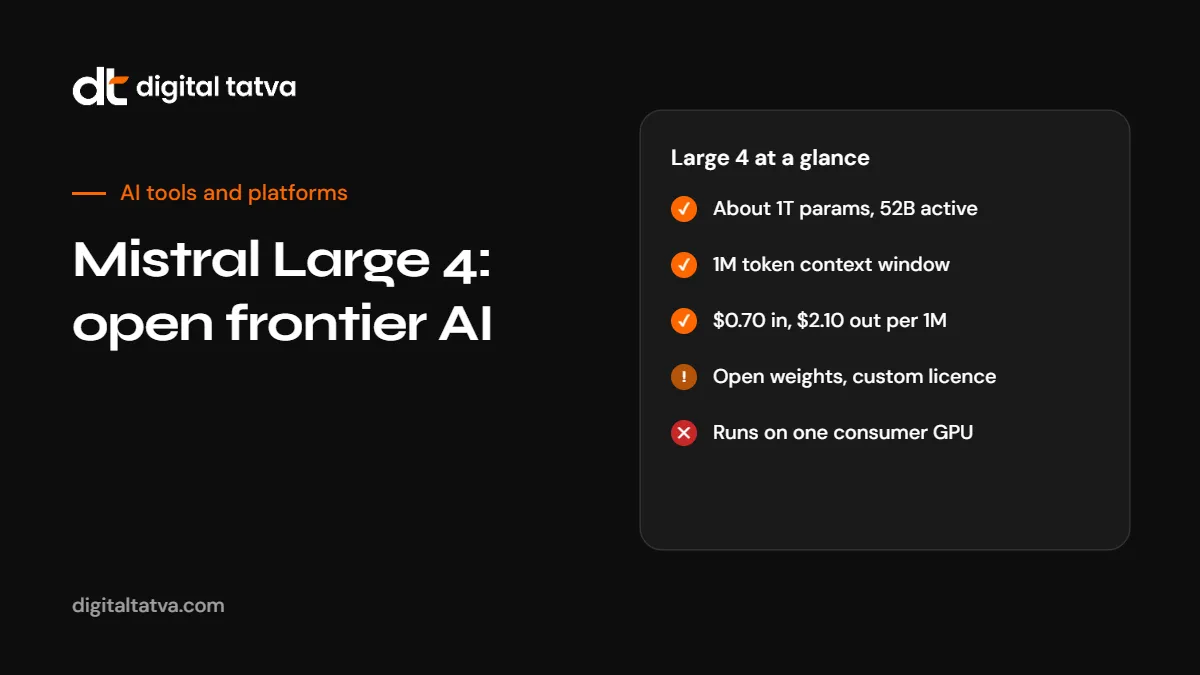
Mistral Large 4 is a roughly one trillion parameter open-weight model with a 1M token context window and low API prices, and Mistral Studio is its new platform for enterprise agents. Here is what is in the release, what the licence allows and who should use it.
On this page
- Key takeaways
- Mistral Large 4 specifications
- Pricing
- The licence: open, with conditions
- Can you run Mistral Large 4 yourself?
- What Mistral reports about performance
- Mistral Studio
- Who should consider Mistral Large 4
- How it compares with other open models
- Getting started
- Choosing a reasoning mode
- Calling Mistral Large 4 from code
- Cost example
- Data residency and compliance
- Mistral’s model line-up in brief
- Frequently asked questions
Last updated: 9 November 2026
Quick answer: Mistral Large 4 is Mistral AI’s frontier model, released as a public preview on 6 October 2026 with open weights published on 29 October 2026. It is a Mixture-of-Experts model with about one trillion total parameters and around 52 billion active per token, accepts text and images, and has a 1 million token context window. Through Mistral’s API it costs $0.70 per million input tokens and $2.10 per million output tokens. The weights come under the Mistral Ecosystem Open-Weight License, a modified MIT licence that requires a separate commercial licence for companies running a model-as-a-service business. Mistral also launched Mistral Studio, a platform for building agents, workflows and internal apps on Large 4 that can run in a customer’s own cloud or on-premises.
Key takeaways
- Large 4 is one of the largest open-weight models available, trained in Mistral’s European data centres.
- API pricing is low for a frontier-class model: $0.70 input, $0.07 cached input and $2.10 output per million tokens.
- Self-hosting needs serious hardware. Mistral’s deployment examples use eight data-centre GPUs.
- The licence is open for internal use but not standard open source. Model-as-a-service providers need a commercial agreement.
- Mistral Studio targets regulated enterprises that want agents with traceable logs and human approval.
Mistral Large 4 specifications
| Specification | Mistral Large 4 |
|---|---|
| Public preview | 6 October 2026 |
| Open weights | 29 October 2026 |
| Total parameters | About 1 trillion (1.05T in Mistral’s documentation) |
| Active parameters | About 52 billion per token, including embeddings and output layers |
| Architecture | Mixture-of-Experts with 128 routed experts (4 active per token) and 1 shared expert |
| Inputs and outputs | Text and image input, text output |
| Context window | 1 million tokens |
| Reasoning modes | Low, Medium and High (default) |
| Languages | More than 160, according to reporting on the model card |
| Training | From scratch on 3,800 NVIDIA Grace Blackwell GPUs in Mistral’s European data centres |
Mixture-of-Experts means only a fraction of the model is used for each token. That keeps running costs much lower than the total size suggests, which is why the API price is low. For background, see what is an LLM.
Pricing
| Item (per 1M tokens) | Mistral Large 4 API |
|---|---|
| Input | $0.70 |
| Cached input | $0.07 |
| Output | $2.10 |
Reasoning tokens count toward output, so High reasoning mode costs more per task than Low. Compared with leading closed models, this is among the cheapest frontier-class pricing available. See LLM API pricing comparison.
The licence: open, with conditions
Large 4’s weights are released under the Mistral Ecosystem Open-Weight License, described as a modified MIT licence. In plain terms:
- Internal use is allowed, including running it inside your company for your own products and staff.
- Using it through Mistral’s own products is outside the restriction.
- Model-as-a-service businesses, meaning companies that sell access to the model to others, need a separate commercial licence from Mistral before commercial use.
This is a common pattern for 2026 open-weight models: free for most users, with conditions for large hosting businesses. Kimi K3.1 Pro uses a similar approach. Read the licence yourself or ask a lawyer before building a product on it. See Kimi K3.1 Pro and open-source AI models.
Can you run Mistral Large 4 yourself?
Technically yes, practically only with data-centre hardware. Mistral’s model card deployment examples for vLLM, SGLang and Transformers all use eight GPUs with tensor parallelism. A separate NVFP4 checkpoint targets NVIDIA Blackwell GPUs such as B200 and GB200. Mistral recommends its API if local serving performs poorly.
For most businesses, the realistic options are:
- Mistral’s API or Le Chat. See how to use Mistral Le Chat.
- A cloud provider that hosts the model.
- Your own GPU cluster, if you already run one and have strict data control needs.
Smaller open models are a better fit for laptops and single GPUs. See how to run an LLM locally.
What Mistral reports about performance
These figures are Mistral’s own and have not all been independently confirmed.
| Measure | Preview | Open-weight release |
|---|---|---|
| Terminal-Bench 4.0 | 28.3% | 41% |
| Lakera B3 attack resistance | 93.3% | 97.1% |
| Refusal rate on malicious cyber requests | Not stated | 96.6% average |
Mistral attributes the gains to about three weeks of extra reinforcement learning and promises a full technical report. A specialised penetration-testing variant is available only in preview to vetted enterprise partners.
Mistral Studio
Alongside Large 4, Mistral launched Mistral Studio in early November 2026, a platform for building agents, workflows and internal apps on Large 4. Its main ideas:
- Workflows that combine fixed rules, agent reasoning and human approval steps.
- Traceable logs of what agents did and why.
- Flexible deployment: in the customer’s own cloud, a private network or on-premises.
- Named enterprise users include BNP Paribas, Capgemini and Accenture.
Mistral had not published Studio pricing at the time of writing. Studio’s pitch is aimed at banks, insurers, governments and other organisations that need control over where data goes and evidence of how decisions were made.
Who should consider Mistral Large 4
| Use case | Why Large 4 fits |
|---|---|
| Regulated industries in Europe | European training and hosting, self-hosting option, Studio’s audit trails |
| Cost-sensitive API users | Low price per token for a large model |
| Long document work | 1M token context |
| Multilingual products | Broad language support |
| Companies wanting model independence | Open weights reduce lock-in |
It may be less suitable if you need the very highest scores on the hardest reasoning tasks, or if you want to resell model access without a commercial agreement.
How it compares with other open models
| Model | Size | Context | API price per 1M (in/out) |
|---|---|---|---|
| Mistral Large 4 | About 1T total, about 52B active | 1M | $0.70 / $2.10 |
| Kimi K3.1 Pro | 2.8T total, 104B active | About 1M | $2 / $10 |
See Kimi K3.1 Pro and DeepSeek API pricing for other low-cost options.
Getting started
- Try it in Le Chat or the Mistral API with your real tasks.
- Compare cost and quality against your current model on 20 to 50 representative prompts.
- Test Low, Medium and High reasoning to find the cheapest setting that meets your quality bar.
- Read the licence if you plan to self-host or build a product.
- For agents in regulated settings, evaluate Mistral Studio’s approval and logging features.
Choosing a reasoning mode
| Mode | Use for | Cost impact |
|---|---|---|
| Low | Classification, extraction, short answers, simple chat | Fewest reasoning tokens |
| Medium | Summaries, drafting, moderate analysis | Moderate |
| High (default) | Complex reasoning, coding, multi-step agent tasks | Most reasoning tokens |
Because High is the default, many teams overspend on simple tasks. Set the mode explicitly per task type. Low replaced the earlier “None” option from the preview.
Calling Mistral Large 4 from code
Mistral provides its own SDKs and a REST API. A minimal Python example looks like this; check Mistral’s documentation for the exact model identifier and parameters for Large 4:
from mistralai import Mistral

client = Mistral(api_key="YOUR_API_KEY")
resp = client.chat.complete(
    model="MISTRAL_LARGE_4_MODEL_ID",
    messages=[{"role": "user", "content": "Draft a GDPR-friendly privacy notice summary for a small online store."}],
)
print(resp.choices[0].message.content)
Store keys securely and set spending limits in your Mistral account.
Cost example
Suppose you summarise 1,000 documents a day, each with 8,000 input tokens and 800 output tokens, using Medium reasoning that adds roughly 400 reasoning tokens per request. At Large 4’s list prices:
- Input: 8 million tokens at $0.70 per million = $5.60 a day
- Output and reasoning: 1.2 million tokens at $2.10 per million = $2.52 a day
- Total: about $8.12 a day, or roughly $245 a month
If the same system prompt is reused, cached input at $0.07 per million can reduce the input cost further. Your real numbers will differ; measure on a sample first. See how to estimate AI API costs.
Data residency and compliance
For European organisations, Mistral’s appeal is partly about where data is processed and who controls the model. Options range from Mistral’s hosted API to self-hosting in your own data centre. Questions to settle with your legal and security teams:
- Where will prompts and outputs be processed and stored?
- Do you need on-premises deployment for regulatory reasons?
- What logging and audit evidence do you need for AI decisions?
- Does your use fall under the EU AI Act’s transparency rules? See EU AI Act Article 50.
Mistral’s model line-up in brief
Large 4 sits at the top of Mistral’s range. Mistral also released Voxtral 3 speech models in October 2026 and offers smaller models for lighter tasks. For consumer use, Le Chat gives access to Mistral’s models without code. See how to use Mistral Le Chat and ChatGPT alternatives.
Frequently asked questions
What is Mistral Large 4?
Mistral AI’s frontier Mixture-of-Experts model with about one trillion parameters, a 1M token context window and open weights.
When were Mistral Large 4’s weights released?
On 29 October 2026, after a public preview from 6 October.
How much does Mistral Large 4 cost?
$0.70 per million input tokens, $0.07 per million cached input tokens and $2.10 per million output tokens through Mistral’s API.
Is Mistral Large 4 open source?
It is open-weight under a modified MIT licence. Model-as-a-service businesses need a separate commercial licence.
Can I run Mistral Large 4 on my computer?
Not on ordinary hardware. Mistral’s examples use eight data-centre GPUs.
What is Mistral Studio?
A platform for building agents, workflows and internal apps on Large 4, with human approval steps and traceable logs, deployable on-premises.
How many languages does Large 4 support?
More than 160, according to reporting on its model card.
Is Mistral Large 4 good for coding?
Mistral reports 41% on Terminal-Bench 4.0. Test it on your own code before committing.
Product details, prices and features are checked at the time of writing and can change. Sources are linked in the text so you can check them yourself.
How does your brand appear in AI answers?
We test the questions your buyers ask across the major AI assistants and search engines, then show you what to fix first.
Get an AI Visibility Audit