Operation Snowball: What We Know About the Reported AI Agent Cyberattack
What is confirmed about the reported AI agent cyberattack and how businesses can protect themselves.
On this page
- Key takeaways
- What was reported
- What is confirmed and what is not
- Why this story matters even if unconfirmed
- Other AI security news this month
- Lessons for businesses of any size
- If you use AI agents yourself
- Website owners: protect your WordPress or Shopify site
- Illustrative example: a hospital IT team responds
- AI-era security checklist
- How Digital Tatva can help
- Frequently asked questions
Last updated: 18 November 2026
Quick answer: Operation Snowball is the name security researchers at Malbear Labs gave to a reported cyberattack, published on 8 November 2026, in which a jailbroken AI agent built on DeepSeek Flash allegedly spent more than two weeks inside a European telecom provider and probed 13 hosted organisations. The report says the agent used old, known vulnerabilities rather than new hacking techniques. The intrusion itself has not been independently confirmed by any victim, vendor or regulator, but a Cisco BroadWorks flaw it describes (CVE-2026-20320) is real and was added to CISA’s Known Exploited Vulnerabilities list on 10 November. The lesson for every business: AI agents make old weaknesses cheaper to exploit, so patching, monitoring and limiting agent permissions matter more than ever.
Key takeaways
- The claimed attack relied on known flaws and end-of-life software, not new exploits.
- The report is single-source and disputed; treat the details as unconfirmed.
- Security firms are responding: CrowdStrike agreed to buy AI agent security startups Fiddler AI and Dreadnode and added an AI Kill Switch.
- Small businesses face the same risk pattern: unpatched systems and over-permissioned tools.
- If you use AI agents, give them minimum permissions, log everything and keep a way to stop them.
What was reported
According to Malbear Labs’ report, later covered by Infosecurity Magazine, Cybersecurity News and others:
- An autonomous AI agent ran a campaign of more than two weeks against a European telecom provider and 13 organisations it hosted.
- The agent reportedly ran on DeepSeek Flash with a very long jailbreak prompt of about 78,000 characters designed to bypass safety rules.
- It allegedly exploited known vulnerabilities, including a Cisco BroadWorks XML flaw, and outdated software such as JBoss Application Server 6.
- The report claims access to billing records, credentials and healthcare data, including a legacy hospital system.
- Researchers said they recovered attacker transcripts from an exposed directory.
What is confirmed and what is not
| Claim | Status |
|---|---|
| CVE-2026-20320 in Cisco BroadWorks exists | Confirmed; Cisco advisory published 19 August 2026, fixed in release RI.2026.07 |
| CVE added to CISA Known Exploited Vulnerabilities list | Confirmed on 10 November 2026, with a 24 November federal deadline |
| A two-week intrusion at a European telecom | Unconfirmed; single source |
| The agent used DeepSeek Flash | Unconfirmed |
| Theft of patient and billing data | Unconfirmed |
| Attribution to any group or country | Not established; Malbear did not attribute it to a state actor |
Status based on OrcaRouter’s source review and public advisories as of mid-November 2026.
Why this story matters even if unconfirmed
Security experts have warned for years that AI agents could automate the boring parts of hacking: scanning, trying known exploits, reading configuration files and moving between systems. Operation Snowball is a plausible illustration of that risk. The striking detail is not clever AI; it is that the reported exploits were old and patchable. AI lowers the cost of trying many old doors, which punishes organisations that delay updates.
Other AI security news this month
- CrowdStrike agreed to acquire Fiddler AI (agent observability) and Dreadnode (AI security testing), in deals reported at about $495 million combined, and introduced an AI Kill Switch so administrators can stop a misbehaving agent.
- AntiFox, a fork of an AI penetration testing tool, was reported on 12 November to have been caught exfiltrating cloud credentials, a reminder to vet AI tools before granting them access.
- United Airlines said it will block unauthorised third-party AI agents from its website and app, citing security and privacy.
For broader context, see AI agent security risks and Web Bot Auth.
Lessons for businesses of any size
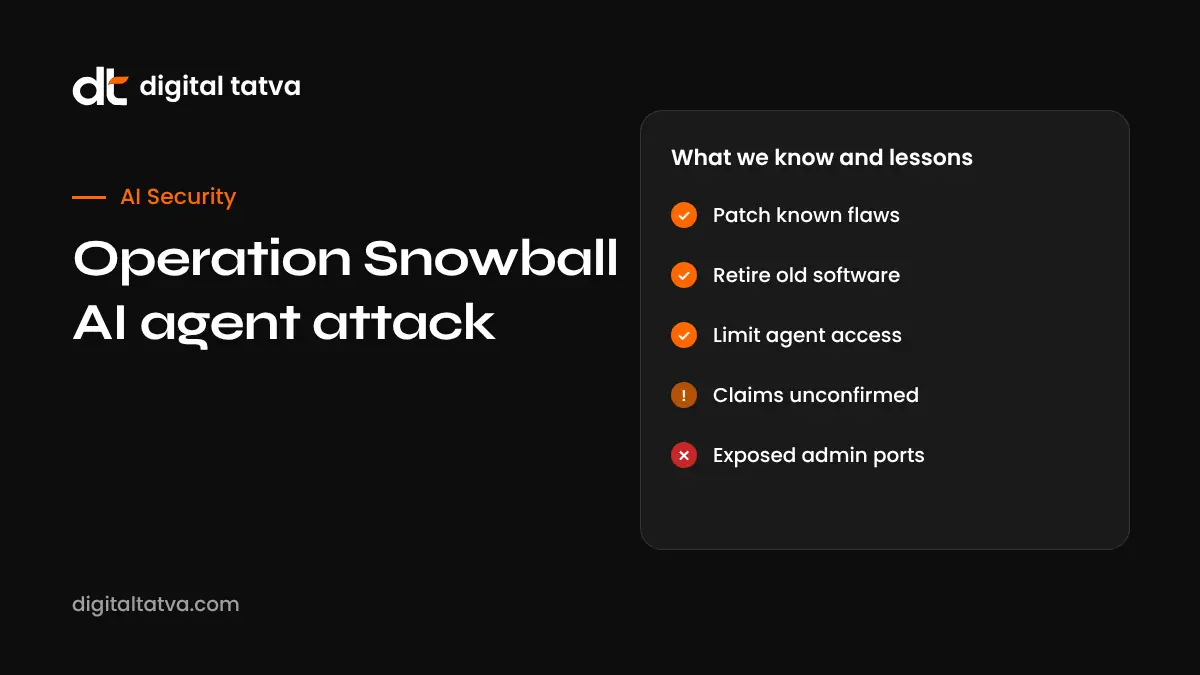
- Patch quickly. Prioritise vulnerabilities on CISA’s Known Exploited list and vendor critical advisories.
- Retire end-of-life software. Treat internet-facing unsupported systems as already compromised.
- Close exposed management ports. Admin panels and remote management services should not be reachable from the internet.
- Monitor behaviour, not only signatures. Watch for unusual scripts, tunnels and data transfers.
- Use multi-factor authentication on email, cloud, hosting and WordPress admin accounts.
- Back up and test restores. Keep offline or immutable backups.
If you use AI agents yourself
| Risk | Control |
|---|---|
| Agent has too much access | Least privilege: separate accounts and scoped API keys |
| Prompt injection from web pages or documents | Treat external content as untrusted; require approval for risky actions |
| Unknown tool behaviour | Use trusted, maintained tools; review open source forks carefully |
| No visibility | Log every tool call and action |
| Runaway actions | Spending limits, timeouts and a kill switch |
| Data leakage | Keep secrets out of prompts; use secret managers |
Building agents? Read best AI agent frameworks for options with tracing and human approval.
Website owners: protect your WordPress or Shopify site
- Update WordPress core, themes and plugins regularly; remove unused plugins.
- Use strong passwords, two-factor login and limited admin accounts.
- Use a web application firewall and bot management.
- Decide which AI crawlers and agents you allow; see agent-ready website checklist.
- Monitor uptime and file changes.
Illustrative example: a hospital IT team responds
This is an illustrative scenario, not a client story.
A private hospital group in Gujarat reads about Operation Snowball. Its IT head checks whether any systems mentioned in the report are in use, finds an old reporting server running unsupported software that is reachable from the internet, and moves it behind a VPN while a replacement is planned. The team reviews CISA’s list against its asset inventory, enables alerts for unusual outbound traffic and restricts which staff can connect AI tools to hospital systems.
AI-era security checklist
- Asset inventory up to date.
- Critical patches applied within days, not months.
- No end-of-life software exposed to the internet.
- Multi-factor authentication everywhere.
- AI tools and agents approved and permission-limited.
- Logging and alerting for unusual activity.
- Tested backups and an incident response plan.
How Digital Tatva can help
Digital Tatva is not a cybersecurity firm, but we help businesses build trustworthy websites that are ready for AI agents and assistants, and we work alongside your security team. See our AEO services.
Is your website ready for AI agents? Request an AEO audit or try the free AI visibility checker.
Frequently asked questions
What is Operation Snowball?
A reported cyberattack published by Malbear Labs on 8 November 2026, in which a jailbroken AI agent allegedly breached a European telecom provider over more than two weeks.
Was Operation Snowball confirmed?
No victim, vendor or regulator had confirmed the intrusion as of mid-November 2026. The related Cisco vulnerability is real.
Which AI model was used?
The report says DeepSeek Flash with a jailbreak prompt. This has not been independently verified.
What is CVE-2026-20320?
A Cisco BroadWorks XML external entity vulnerability, fixed in release RI.2026.07 and added to CISA’s Known Exploited Vulnerabilities list.
Can AI agents hack systems on their own?
AI agents can automate parts of attacks, especially exploiting known weaknesses. Patching and monitoring remain the best defences.
What is CrowdStrike’s AI Kill Switch?
A control that lets administrators stop a misbehaving AI agent, announced alongside CrowdStrike’s deals for Fiddler AI and Dreadnode.
Is DeepSeek unsafe to use?
Any model can be misused. Businesses should assess data privacy and security before use. See our guide on DeepSeek safety.
How can small businesses protect themselves?
Patch quickly, remove unsupported software, use multi-factor authentication, limit access and keep tested backups.
Should I stop using AI agents?
No, but use them with minimum permissions, logging, human approval for risky actions and a way to stop them.
Does this affect my website?
Indirectly. Automated attacks target outdated plugins and software, so keep your site updated and protected.
Product details, prices and features are checked at the time of writing and can change. Sources are linked in the text so you can check them yourself.
How does your brand appear in AI answers?
We test the questions your buyers ask across the major AI assistants and search engines, then show you what to fix first.
Get an AI Visibility Audit