State of AI Tool Pricing 2026: 155 Tools and 21 Models Analyzed
Original research on 155 AI tools and 21 AI models: median prices by category, free plans, credits vs seats, annual discounts, API costs and India vs US pricing in 2026.

On this page
- Key takeaways
- Key findings at a glance
- How did we build this dataset?
- How much does an AI tool cost in 2026?
- Why do so many AI tools cost $20 a month?
- Which AI tool categories are the most expensive?
- What does each AI category cost?
- How many AI tools have a free plan?
- Credits, seats or flat fees: how are AI tools priced?
- Is annual billing worth it for AI tools?
- How expensive do top AI plans get?
- How much do AI APIs cost per million tokens?
- How can you lower AI API costs?
- How do AI prices in India compare with US prices?
- What changed in AI pricing in 2026?
- What do these findings mean for buyers?
- What are the limitations of this research?
- How to cite this report
- Frequently asked questions
- Sources
Last updated: 23 October 2026
Quick answer: We analyzed the pricing of 155 AI tools across 17 categories and 21 AI models in October 2026. The median AI tool costs $19 a month for its cheapest paid plan, 69% have a free plan, 39% charge by credits, and paying yearly saves a median 20%. API prices for comparable tasks vary 100x, from $0.50 to $50 per million output tokens.
AI pricing has become one of the most confusing parts of buying software. Some tools charge a flat monthly fee, others sell credits that disappear at different rates, some bill per seat, and a growing number now charge per task an AI agent completes. Prices also change often: in 2026 alone we tracked repricings, new cheap tiers, discontinued products and the arrival of outcome-based billing in customer support and sales.
To bring some order to this, Digital Tatva built an original dataset of public pricing for 155 AI tools and 21 AI models, collected and checked in October 2026. This report shares what the data shows: what a typical AI tool costs, which categories are most expensive, how common free plans really are, how much annual billing saves, how API prices compare across providers, and how Indian rupee prices compare with US dollar prices.
Every number in this report comes from our dataset and is reproducible. Where a price came from a third-party source rather than the vendor’s own pricing page, we say so. Use the findings to plan budgets, compare tools and spot pricing traps before you subscribe.
Key takeaways
- The median entry price for a paid AI tool is $19 a month; the average is $28 because a few expensive SEO and sales tools pull it up.
- 53% of tools with a listed price start under $20 a month, and 81% start under $30.
- 26 of 148 priced tools (18%) sit right on the $20 anchor, between $19 and $20.99 a month.
- 69% of tools offer a permanent free plan, 16% offer only a trial, and 15% have no free option.
- Credits are now the most common pricing model (39% of tools), ahead of flat plans (30%) and per-seat pricing (16%).
- Annual billing saves a median 20.4% across 84 tools that list both prices, and 38 of them save 25% or more.
- SEO and AI visibility tools have the highest median entry price ($95); productivity and note-taking tools have the lowest ($9).
- Frontier AI models cost a median $20 per million output tokens, mid-tier models $9 and budget models $1.20.
- India-specific plans are often 15% to 70% cheaper than US prices at market exchange rates, while flagship $20 plans cost about the same once GST is included.
Key findings at a glance
The table below summarizes the headline statistics from our analysis of 155 AI tools and 21 AI models. Each finding is explained in detail in the sections that follow.
| Metric | Result (October 2026) |
|---|---|
| Tools analyzed | 155 AI tools in 17 categories |
| AI models analyzed | 21 API models from 6 providers |
| Prices from official pages | 115 of 155 tools (74%) |
| Median entry price | $19 per month (148 tools with a listed price) |
| Average entry price | $28.10 per month |
| Tools at the $20 anchor | 26 tools (18%) priced $19 to $20.99 |
| Free plan available | 107 tools (69%) |
| Trial only | 25 tools (16%) |
| No free option | 23 tools (15%) |
| Most common pricing model | Credits, used by 61 tools (39%) |
| Median annual billing discount | 20.4% (84 tools) |
| Median top self-serve plan | $84 per month |
| Top plan vs entry plan | Median 3.2x the entry price |
| Most expensive category | SEO and AI visibility, median $95 |
| Cheapest category | Productivity and notes, median $9 |
| API output price range | $0.50 to $50 per million tokens (100x) |
| Typical output to input ratio | Output costs 5x input (median) |
How did we build this dataset?
We built the dataset by recording the public, self-serve pricing of 155 AI tools and 21 AI models between August and October 2026, then checking each entry against the vendor’s pricing page or a dated third-party source in October 2026. We only counted prices anyone can pay online without talking to sales.
For each tool we recorded the following fields:
- Category: one of 17 categories, such as chat assistants, image generation, coding or sales and CRM.
- Free option: a permanent free plan (Y), a time-limited trial only (T), or no free option (N).
- Entry price: the cheapest paid self-serve plan in US dollars per month when billed monthly. If a tool only shows a yearly price, we used the yearly price divided by 12 and noted it.
- Annual price: the same plan’s monthly equivalent when billed yearly, where listed.
- Top self-serve plan: the most expensive plan you can buy online per month, excluding custom enterprise deals.
- Pricing model: flat subscription, credits, per seat, usage-based, outcome-based, one-time purchase, or free.
- Source type: official vendor page (O) or third-party source (T).
- India price: the rupee price where a tool publishes one.
For AI models we recorded the standard API price per million input tokens, output tokens and cached input tokens, plus the context window, from each provider’s official API pricing page where available.
A few rules kept the comparison fair. Prices exclude taxes unless the vendor only shows tax-inclusive prices, which is common for Indian rupee plans. Euro prices were converted at 1.16 US dollars per euro. Rupee comparisons use a rate of 94.5 rupees per US dollar, close to the mid-market rate of 94.54 on 21 October 2026. Introductory prices that only apply to long prepaid terms are flagged in the data. Enterprise and “contact sales” plans are excluded because they are not public.
Note: AI prices change often. Every figure here reflects October 2026. Always confirm the current price on the vendor’s own pricing page before you buy, and read our guide on how to save money on AI subscriptions.
How much does an AI tool cost in 2026?
A typical paid AI tool costs $19 a month for its cheapest plan, based on the median entry price of the 148 tools in our dataset that list a paid price. The average is higher, $28.10, because a small number of professional tools with entry prices of $100 or more pull the mean upward.
The median is the better guide for most buyers. It tells you that half of all AI tools start below $19 a month and half start above it. The cheapest paid entry in our data is $1 a month (Goodnotes Essential, billed yearly) and the most expensive is $300 a month (the starter plan of an AI visibility platform aimed at brands).
Here is how entry prices are distributed:
| Entry price per month | Number of tools | Share of priced tools |
|---|---|---|
| Under $10 | 27 | 18% |
| $10 to $19.99 | 52 | 35% |
| $20 to $29.99 | 41 | 28% |
| $30 to $49.99 | 14 | 9% |
| $50 to $99.99 | 7 | 5% |
| $100 and above | 7 | 5% |
Two patterns stand out. First, the market is concentrated between $10 and $30: 93 of 148 tools (63%) start in that band. Second, very few consumer tools start above $50. The seven tools starting at $100 or more are almost all business tools for SEO, sales prospecting, developer automation or ad creation, where buyers expect to earn the cost back.
The practical takeaway is that a stack of three or four paid AI tools will usually cost $60 to $100 a month for one person. If you are weighing which ones deserve a place in your budget, see our analysis of AI subscriptions worth paying for.
Why do so many AI tools cost $20 a month?
Many AI tools cost $20 a month because ChatGPT Plus set that price in 2023 and it became the reference point buyers use to judge every other AI subscription. In our data, 26 of 148 priced tools (18%) charge between $19 and $20.99 a month, far more than any other single price point.
The $20 cluster includes Claude Pro, Perplexity Pro, Kimi, Manus, QuillBot Premium ($19.95), Notion AI on the Business plan, Ideogram Plus, Magnific, Submagic, WellSaid, Fathom, Read AI, Cursor Pro, Devin Desktop (formerly Windsurf), Replit Core, Ollama Pro, Base44, Activepieces, Freshdesk, Zoho CRM, Klaviyo, Pangram, Planner 5D, Collov AI, scite and Consensus. Google’s Gemini AI Pro sits just below at $19.99, and ChatGPT Plus remains at $20.
The anchor matters because it shapes how vendors design their plan ladders. In 2026 the biggest assistants built cheaper tiers below $20 to reach price-sensitive users, especially outside the United States:
| Assistant | Cheapest paid tier | $20 tier | Power tier |
|---|---|---|---|
| ChatGPT | Go, $8 | Plus, $20 | Pro, $100 to $500 |
| Gemini | AI Plus, $4.99 | AI Pro, $19.99 | Ultra, up to $199.99 |
| Claude | Pro, $20 ($17 yearly) | Pro, $20 | Max, $100 or $200 |
| Microsoft Copilot | Microsoft 365 Personal, $9.99 | Premium, $19.99 | Premium, $19.99 |
| Grok | SuperGrok Lite, $10 | n/a | Heavy, $300 |
| Perplexity | Pro, $20 | Pro, $20 | Max, $200 |
The result is a three-level structure that most assistants now follow: a low-cost tier for casual users, the familiar $20 tier for regular users, and a $100 to $300 tier for heavy users who want more usage and the newest models first. For a closer look at the assistant plans, read our guides to ChatGPT pricing, Claude pricing, Gemini pricing and Perplexity pricing.
Which AI tool categories are the most expensive?
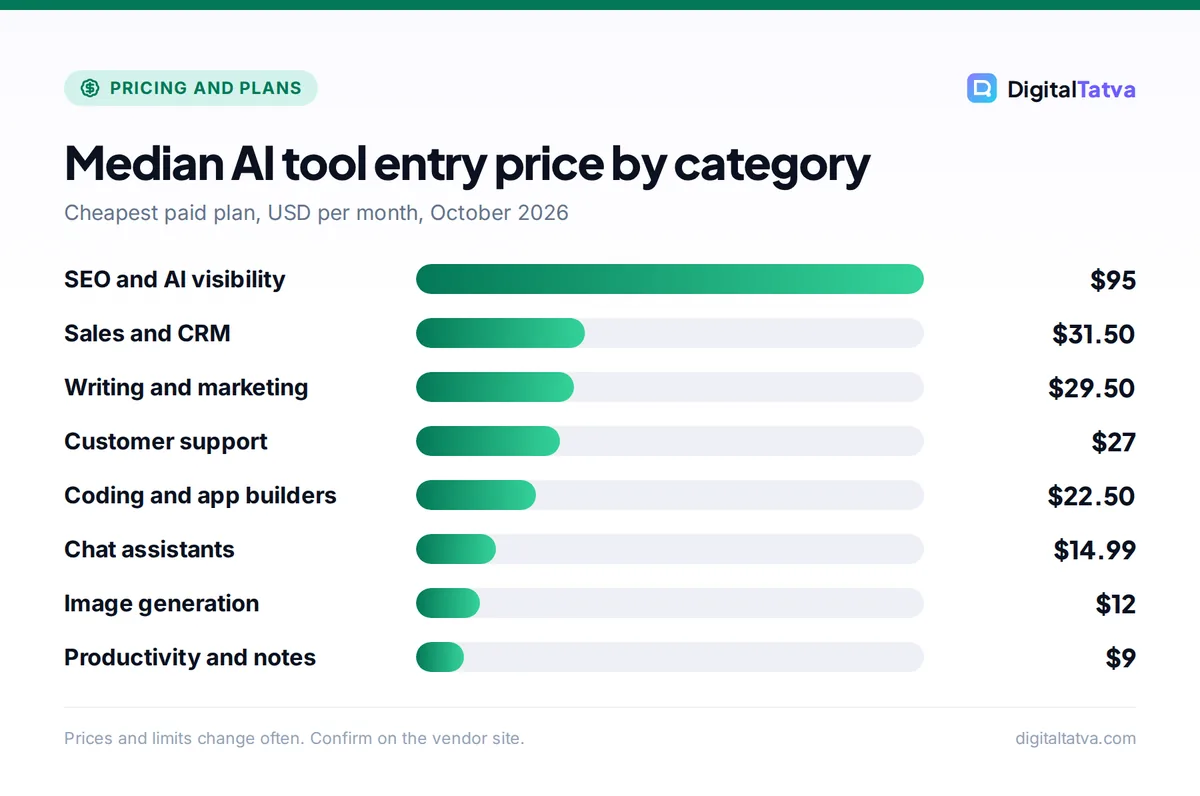
SEO and AI visibility tools are the most expensive AI category, with a median entry price of $95 a month, followed by sales and CRM ($31.50) and writing and marketing tools ($29.50). The cheapest categories are productivity and notes ($9), research and study tools ($11.25) and image generation and design ($12).
The table below ranks all 17 categories by median entry price. “Free plan” shows the share of tools in each category with a permanent free plan, and “Highest top plan” shows the most expensive self-serve plan in that category.
| Category | Tools | Median entry | Entry range | Free plan | Highest top plan |
|---|---|---|---|---|---|
| SEO and AI visibility | 9 | $95 | $29 to $300 | 22% | $549 |
| Sales and CRM | 15 | $31.50 | $6 to $185 | 60% | $999 |
| Writing and marketing | 4 | $29.50 | $19.95 to $69 | 50% | $69 |
| Customer support | 6 | $27 | $19 to $55 | 33% | $500 |
| Automation and agents | 10 | $23.50 | $2.99 to $99 | 70% | $200 |
| Coding and app builders | 12 | $22.50 | $10 to $59 | 100% | $2,250 |
| Email assistants | 5 | $18 | $9.46 to $30 | 40% | $120 |
| Meetings and transcription | 9 | $18 | $10 to $29.99 | 89% | $89 |
| Video and avatars | 15 | $17 | $9.99 to $110 | 80% | $279.99 |
| AI detectors | 5 | $16.99 | $14.95 to $20 | 60% | $179 |
| Website builders | 7 | $15 | $2.99 to $39 | 43% | $399 |
| Chat assistants | 11 | $14.99 | $4.99 to $20 | 100% | $500 |
| Voice and audio | 8 | $13 | $6 to $29 | 62% | $199 |
| Image generation and design | 23 | $12 | $2.49 to $35 | 61% | $199.99 |
| Research and study | 6 | $11.25 | $4 to $20 | 83% | $65 |
| Productivity and notes | 8 | $9 | $1 to $20 | 100% | $199.99 |
| Translation | 2 | $8.70 | $8.70 (one priced plan) | 100% | $58 |
The ranking follows a clear logic: categories sold to businesses that can measure a return (search rankings, pipeline, closed deals, resolved tickets) charge the most, while categories aimed at individuals and students charge the least. Small categories such as translation and writing have few tools in our sample, so treat their medians as indicative rather than definitive.
What does each AI category cost?
Each AI category has its own pricing habits, from flat fees in SEO to credits in image and video and per-seat billing in meetings and CRM. This section summarizes what we found in each category, with links to our detailed pricing guides.
Chat assistants
All 11 chat assistants in our dataset have a free plan, and every paid entry tier costs $20 or less, with a median of $14.99. DeepSeek and Meta AI are free in their consumer apps, with DeepSeek charging only for API use. The cheapest paid tier is Gemini AI Plus at $4.99, followed by ChatGPT Go at $8 and Microsoft 365 Personal at $9.99. The spread appears at the top: ChatGPT Pro reaches $500 a month at its highest level, Grok Heavy costs $300, and Claude Max, Perplexity Max, Manus and Kimi Ultra sit around $200. If you are deciding between tiers, compare ChatGPT Plus vs Pro and Claude Pro vs Max.
Writing, productivity and email tools
Writing tools are relatively expensive at a median of $29.50, mainly because marketing platforms such as Jasper ($69 per seat, trial only) and Copy.ai ($29) target teams. Consumer writing tools are cheaper, and Grammarly and QuillBot both cut their price by more than half for yearly billing. Productivity and note-taking tools are the cheapest category of all, with a median of $9 and a free plan in every case. Notion is a notable exception to the low-cost pattern: full Notion AI now comes with the $20 Business plan rather than as a cheap add-on (see our Notion AI pricing guide). Email assistants cost a median $18, ranging from SaneBox at under $10 to Superhuman Mail at $30 per seat.
Image generation and design
Image generation is the largest category in our data with 23 tools, and it is one of the cheapest, with a median entry price of $12. It is also the category most dominated by credits: 17 of 23 tools (74%) give you a monthly allowance of generations or credits rather than unlimited use. Pixlr starts at just $2.49, Canva Pro works out to $12 a month on yearly billing, and Midjourney’s Basic plan costs $10. Professional upscalers and editors cost more, such as Topaz Labs at $29 and Krea at $35. Some image tools still sell one-time licenses, such as Luminar at $129 to $199. See our guides to Midjourney pricing and Canva pricing for plan details.
Video and avatars
Video tools start at a median $17, but the real cost depends on how many seconds or minutes your credits buy. Twelve of 15 video tools (80%) use credits. Entry plans from Pika ($10), Kling ($10) and Runway ($15) are affordable for testing, while avatar platforms such as Synthesia and HeyGen start at $29. AI ad video platforms are the most expensive: Arcads starts at $110 a month for a small number of videos. Two things changed the video market in 2026. OpenAI discontinued Sora, closing the app on 26 April 2026 with API access ending on 24 September 2026, and several lower tiers restrict commercial use, so always check the license. Compare options in best AI video generators and Runway pricing.
Voice, music and audio
Voice and audio tools have a median entry price of $13. ElevenLabs is one of the cheapest ways in at $6 a month for its Starter plan, while Murf starts at $29 (see ElevenLabs pricing). Music generators Suno and Udio both start at $10, but their terms changed in 2026: Suno introduced download caps from 3 September 2026, and Udio has disabled downloads. If you plan to use AI music in commercial projects, the license and download rules matter as much as the price.
Meetings and transcription
Meeting assistants are among the most generous categories: 89% offer a free plan, and the median entry price is $18 per user. This is the category where per-seat pricing dominates, with 7 of 9 tools billing per user. Otter.ai, Fireflies.ai and Fathom all start between $16.99 and $20 a month and drop to around $8 to $16 on yearly billing. TurboScribe stands out with unlimited transcription for a flat $10 a month. Business tiers top out at $29 to $39.75 per user, so a team of ten will spend roughly $200 to $400 a month.
Coding assistants and app builders
Every coding tool in our dataset has a free tier, and the median entry price is $22.50. The big shift is in how they bill. Eleven of 12 coding tools now meter usage through credits or usage-based pricing rather than a fixed allowance of requests. GitHub Copilot moved to usage-based AI Credits on 1 June 2026, and Cursor and Devin Desktop charge $20 for Pro with included usage and pay-as-you-go beyond it. App builders use credits that are consumed by each AI edit, which explains the huge range at the top: Lovable’s highest self-serve plan reaches $2,250 a month, the most expensive self-serve plan in our entire dataset. Read our guides to Cursor pricing and GitHub Copilot pricing, or compare tools in best AI coding assistants.
Automation and AI agents
Automation platforms have a median entry price of $23.50, but entry prices range from IFTTT at $2.99 to Pipedream at $99. Pricing is almost entirely metered: most tools charge by tasks, operations, executions or credits. Zapier Professional costs $29.99 monthly or $19.99 yearly, Make starts at $12, and n8n’s cloud Starter plan works out to about $27 monthly when converted from euros. Agent platforms such as Lindy and Gumloop start around $30 to $37. Because each automation step can use AI credits, real costs rise with volume. See Zapier vs Make vs n8n and best AI agents.
SEO and AI visibility
SEO and AI visibility tools are the most expensive category, with a median entry price of $95 and only 22% offering a free plan. Ahrefs has the cheapest established entry at $29 with its Starter plan, while Semrush starts at $139 a month for its SEO toolkit. A new subcategory of AI visibility trackers, which measure how often a brand appears in ChatGPT, Perplexity and Google’s AI answers, has entered at a wide range of prices: Otterly.AI starts at $29, Peec AI at about $95, Ahrefs Brand Radar at $199 as an add-on, and Scrunch AI at $300. Almost all SEO tools still use flat plans (8 of 9). Compare tools in best AI SEO tools.
Customer support
Customer support is where outcome-based pricing has taken hold. Intercom’s Fin AI agent charges $0.99 per resolution on top of seat fees, Zendesk charges per automated resolution on top of its Suite plans, and HubSpot moved its customer agent to $0.50 per resolved conversation on 14 April 2026. Entry seat prices are moderate, with a median of $27, but total cost depends on how many conversations the AI resolves. Chatbot builders such as Chatbase use credits instead and top out at $500 a month. See AI customer support tools for a full comparison.
Sales and CRM
Sales and CRM tools have the second-highest median entry price at $31.50 and the most varied pricing models. Most CRMs charge per seat (8 of 15 tools), with entry plans from Freshsales at $9 to Attio at $44 a month, and Attio raised its prices in July 2026. Prospecting tools use credits: Clay repriced in March 2026 and now starts at about $185 a month for its Launch plan. Salesforce Agentforce uses Flex Credits at $0.10 per action, a pure usage model. AdCreative.ai has the highest top plan in the category at $999. For details see how to use Clay, Salesforce Agentforce and best AI CRM.
AI detectors, website builders, research and translation
AI detectors are tightly clustered between $14.95 and $20 a month, with a median of $16.99, and most use credits based on words scanned. Website builders start at a median $15, though headline prices can mislead: Hostinger’s $2.99 builder price applies to a 48-month prepaid term and renews at $10.99. Research and study tools are cheap, with a median of $11.25 and a free plan in 83% of cases; Khanmigo costs just $4 a month for learners in the United States. Translation is mostly usage-based: DeepL’s individual plan works out to about $8.70 a month on yearly billing, and Google Cloud Translation charges $20 per million characters after a free monthly allowance of 500,000.
How many AI tools have a free plan?
Most AI tools let you start for free: 107 of 155 tools (69%) have a permanent free plan, 25 (16%) offer a time-limited trial, and only 23 (15%) have no free option at all. In other words, 85% of the AI tools we analyzed let you try them before you pay.
Free plans are universal in some categories and rare in others:
- 100% free plans: chat assistants, coding tools, productivity and notes, and translation.
- 80% or more: meetings and transcription (89%), research and study (83%) and video (80%).
- Least likely to be free: SEO and AI visibility (22%), customer support (33%), email assistants (40%) and website builders (43%).
Free plans are not all equal. In credit-based tools, a free plan usually means a small monthly allowance, watermarks or no commercial rights. In seat-based tools it often means a limit on users, history or integrations. Business tools that skip free plans usually offer a 7 to 14 day trial instead, such as Jasper’s 7-day trial. Before relying on a free plan for real work, check its limits on output, commercial use and data retention. Our list of the best free AI tools covers the most useful free tiers.
Credits, seats or flat fees: how are AI tools priced?
Credits are now the most common way AI tools charge, used by 61 of 155 tools (39%). Flat monthly subscriptions come second with 47 tools (30%), followed by per-seat pricing (25 tools, 16%), usage-based billing (15 tools, 10%), free-only tools (3), one-time purchases (2) and outcome-based pricing (2).
| Pricing model | Tools | Share | Where it is most common |
|---|---|---|---|
| Credits | 61 | 39% | Image (17 of 23), video (12 of 15), coding (8 of 12), voice (5 of 8) |
| Flat subscription | 47 | 30% | SEO (8 of 9), research (6 of 6), chat assistants, website builders |
| Per seat | 25 | 16% | Meetings (7 of 9), sales and CRM (8 of 15) |
| Usage-based | 15 | 10% | Automation, coding, translation, email marketing |
| Outcome-based | 2 | 1% | Customer support AI agents |
| One-time purchase | 2 | 1% | Photo and video editing software |
| Free only | 3 | 2% | Chat apps and note-taking |
The rise of credits reflects the real cost of running AI. Generating a minute of video or a high-resolution image costs the vendor far more than a text reply, so vendors price by consumption to protect their margins. For buyers, credits make costs harder to predict: two plans at the same price can deliver very different amounts of output, and credits often expire at the end of each month.
Outcome-based pricing is small in number but important as a signal. When an AI agent completes a task on its own, such as resolving a support ticket, vendors are starting to charge for the result rather than for access. In our data, Intercom Fin ($0.99 per resolution), Zendesk, HubSpot ($0.50 per resolved conversation) and Salesforce Agentforce ($0.10 per action) all price AI agents by work done. We expect more agent products to follow this model in 2027.
Tip: To compare credit-based plans, convert each plan into cost per output, such as cost per image, per video minute or per 1,000 words. A plan with more credits at a higher price is often cheaper per output.
Is annual billing worth it for AI tools?
Annual billing usually saves about a fifth of the cost: across 84 tools that list both a monthly and a yearly price for the same plan, the median saving is 20.4% and the average is 27.5%. Savings range from 8.3% to 75%, and 38 of the 84 tools (45%) cut the price by 25% or more for yearly billing.
| Annual saving | Number of tools |
|---|---|
| Under 15% | 8 |
| 15% to 19.9% | 20 |
| 20% to 24.9% | 18 |
| 25% or more | 38 |
The deepest annual discounts in our data are Planner 5D (75%, from $19.99 a month to $5), Symbolab (64%), Grammarly (60%, from $30 to $12), QuillBot (58%), SaneBox (52%), Otter.ai (51%) and Happy Scribe (50%). The smallest discounts tend to be on usage-heavy products, such as Clay (about 10%), Replit (10%) and Pipedream (9%), where the vendor’s own costs rise with use.
Not every AI tool rewards a yearly commitment. Of the 148 tools with a listed price, 64 do not list both a monthly price and a cheaper yearly price for their entry plan, either because they sell only one billing period or because both cost the same. Some vendors have moved away from annual plans entirely: OpusClip sells its Starter plan monthly only, and Shortwave moved to monthly billing only on 30 June 2026.
Annual billing makes sense for tools you already use every week and expect to keep for a year. For newer tools, or in fast-moving categories like video and coding where prices and models change every few months, monthly billing keeps you flexible. Our guide to annual vs monthly AI plans explains how to decide.
How expensive do top AI plans get?
The median top self-serve plan costs $84 a month, about 3.2 times the median tool’s entry price. But the ceiling is much higher in some products: 12 tools in our dataset have a top self-serve plan of $359 or more a month, and the most expensive reaches $2,250.
| Tool | Category | Top self-serve plan per month |
|---|---|---|
| Lovable | App builder | $2,250 |
| AdCreative.ai | Ad creative | $999 |
| Semrush | SEO | $549 |
| Bubble | App builder | $549 |
| ChatGPT Pro | Chat assistant | $500 |
| Chatbase | Support chatbot | $500 |
| Clay | Sales prospecting | $495 |
| Ahrefs | SEO | $449 |
| Shopify | Website and store builder | $399 |
| Clearscope | SEO content | $399 |
| WATI | WhatsApp support | $399 |
| Surfer SEO | SEO content | $359 |
A distinct “power user” price point has also formed around $200 a month. Claude Max, Perplexity Max, Cursor Ultra, Devin Desktop Max, Manus and Activepieces all top out at $200, with Kimi Ultra at $199 and Gemini Ultra at $199.99. These plans mainly sell more usage, priority access and the newest models, not different features. Very few individuals need them; they are designed for developers and professionals who hit the limits of $20 plans every day. If you are close to those limits, read Claude usage limits and ChatGPT message limits first.
How much do AI APIs cost per million tokens?
AI API prices span a 100x range. The cheapest model in our dataset, GPT-6 Luna, costs $0.10 per million input tokens and $0.50 per million output tokens, while the most expensive frontier models, GPT-6 Astra and Claude Fable 5.1, cost $10 and $50. By tier, the median output price is $20 per million tokens for frontier models, $9 for mid-tier models and $1.20 for budget models.
Output tokens cost more than input tokens for every model we tracked, with a median ratio of 5 to 1. That means long answers cost far more than long prompts, which is why limiting output length is one of the easiest ways to reduce API bills. To understand the units, see what are tokens in AI.
The “cost per 1,000 tasks” column assumes a typical task of 2,000 input tokens and 500 output tokens, such as summarizing a short document or answering a support question with context.
| Model | Provider | Tier | Input per 1M | Output per 1M | Cost per 1,000 tasks |
|---|---|---|---|---|---|
| GPT-6 Astra | OpenAI | Frontier | $10 | $50 | $45.00 |
| Claude Fable 5.1 | Anthropic | Frontier | $10 | $50 | $45.00 |
| Claude Opus 5.5 | Anthropic | Frontier | $4 | $20 | $18.00 |
| GPT-5.6 Sol | OpenAI | Mid | $4 | $20 | $18.00 |
| Kimi K3 | Moonshot AI | Frontier | $3 | $15 | $13.50 |
| Gemini 3.1 Pro (preview) | Frontier | $2 | $12 | $10.00 | |
| GPT-5.6 Terra | OpenAI | Mid | $2 | $12 | $10.00 |
| GPT-6.1 Sol | OpenAI | Mid | $2 | $10 | $9.00 |
| Claude Sonnet 5.5 | Anthropic | Mid | $2 | $10 | $9.00 |
| Gemini 3.5 Flash | Mid | $1.50 | $9 | $7.50 | |
| Mistral Medium 3.5 | Mistral AI | Mid | $1.50 | $7.50 | $6.75 |
| DeepSeek V4 Pro | DeepSeek | Mid | $1.32 | $3.96 | $4.62 |
| Claude Haiku 4.5 | Anthropic | Budget | $1 | $5 | $4.50 |
| Gemini 3.8 Flash | Mid | $0.75 | $3.75 | $3.38 | |
| Gemini 3.5 Flash-Lite | Budget | $0.30 | $2.50 | $1.85 | |
| Mistral Large 3 | Mistral AI | Mid | $0.50 | $1.50 | $1.75 |
| Gemini 3.1 Flash-Lite | Budget | $0.25 | $1.50 | $1.25 | |
| DeepSeek V4.1 Flash | DeepSeek | Budget | $0.30 | $1.20 | $1.20 |
| GPT-5.6 Luna | OpenAI | Budget | $0.20 | $1.20 | $1.00 |
| Mistral Small 4 | Mistral AI | Budget | $0.15 | $0.60 | $0.60 |
| GPT-6 Luna | OpenAI | Budget | $0.10 | $0.50 | $0.45 |
Prices are standard pay-as-you-go rates as of October 2026. Mistral and Kimi prices come from third-party sources. DeepSeek prices are peak-hour rates; off-peak use costs half. Gemini 3.8 Flash is priced at $0.75 and $3.75 until 31 December 2026, then rises to $1.50 and $7.50. Gemini 3.1 Pro prices apply to prompts up to 200,000 tokens.
Three trends stand out in the API data. First, newer models are often cheaper than the ones they replace: OpenAI’s GPT-6.1 Sol costs half as much as GPT-5.6 Sol ($2 and $10 versus $4 and $20), and GPT-6 Luna costs about half as much as GPT-5.6 Luna. Second, context windows have converged: 17 of the 21 models accept around 1 million tokens, so a large context window is no longer a premium feature. Third, the gap between the cheapest and most expensive models (100x) is far wider than the quality gap for most everyday tasks, which makes choosing the right model the biggest cost decision for developers.
For provider-level details, see our guides to OpenAI API pricing, Claude API pricing, Gemini API pricing and DeepSeek API pricing.
How can you lower AI API costs?
You can lower AI API costs by 50% to 90% using the discounts the major providers already offer, before you change any code logic. The four biggest levers in our data are batch processing, prompt caching, off-peak pricing and model routing.
- Use batch APIs for work that can wait. OpenAI, Anthropic and Google all offer about 50% off for requests processed asynchronously, usually within 24 hours. This suits bulk summarization, tagging and data extraction. See how batch APIs save costs.
- Cache repeated prompts. OpenAI and Anthropic charge about 90% less for cached input tokens on most models. In our dataset, Claude Fable 5.1 drops from $10 to $0.25 per million cached input tokens, and GPT-6.1 Sol drops from $2 to $0.10. Learn more in prompt caching explained.
- Schedule heavy jobs off-peak. DeepSeek charges half price outside peak hours, which makes its already low prices even lower.
- Route each task to the cheapest capable model. Simple classification or extraction rarely needs a frontier model. Moving those tasks from a $50 output model to a $1.20 model cuts their cost by about 97%. See model routing explained and the cheapest AI model for each task.
Combined, these levers change the economics completely. A workload of one million typical tasks on a frontier model at standard rates costs about $45,000. The same workload on a budget model with batch pricing could cost under $1,000. Use our guide to estimate AI API costs to model your own numbers, or consider open-source AI models if you can run them yourself.
How do AI prices in India compare with US prices?
AI tools that offer India-specific plans are usually 15% to 70% cheaper than the US price at market exchange rates, while flagship $20 plans cost about the same or slightly more once 18% GST is included. We compared rupee prices with US prices converted at 94.5 rupees per dollar.
| Plan | India price | US price | US price in rupees | India as % of US |
|---|---|---|---|---|
| Canva Pro (yearly, per month) | Rs 333 (Rs 4,000 a year) | $12 | Rs 1,134 | 29% |
| Zoho CRM Standard | About Rs 800 | $20 | Rs 1,890 | 42% |
| ChatGPT Go | Rs 399 | $8 | Rs 756 | 53% |
| Gemini AI Plus | Rs 399 | $4.99 | Rs 472 | 85% |
| Gemini AI Pro | Rs 1,950 | $19.99 | Rs 1,889 | 103% |
| ChatGPT Plus | About Rs 1,999 (incl. GST) | $20 | Rs 1,890 | 106% |
| Claude Pro | About Rs 2,000 (third-party) | $20 | Rs 1,890 | 106% |
The pattern is clear. Vendors are using low-cost, India-first tiers to win users in one of the world’s largest AI markets, while keeping their main $20 plans close to global parity. Rupee prices for consumer plans usually include GST, while US prices usually exclude sales tax, so the flagship plans are effectively priced the same before tax. Canva is the most aggressive local pricer in our data, charging about 29% of the US price, and also sells a cheaper Pro Lite plan at Rs 1,590 a year.
Some vendors also have India-only plans with no direct US equivalent. Cursor offers a Start plan at Rs 649 a month, below its $20 Pro plan. Google gives eligible students in India a free year of Google AI Plus, and other vendors run student offers that are worth checking. See ChatGPT Plus price in India, free AI pro plans in India and AI student discounts.
Watch out: Not every tool is available in India. CapCut, for example, is blocked in India, and some US-only plans, such as Khanmigo for learners, are not sold there. Check availability before you budget for a tool.
What changed in AI pricing in 2026?
The biggest AI pricing changes of 2026 were the shift from fixed allowances to usage and credits, the arrival of outcome-based pricing for AI agents, new low-cost tiers for price-sensitive markets, and several product shutdowns and repricings. The timeline below lists the notable changes we recorded.
| Date | Change | What it means |
|---|---|---|
| March 2026 | Clay repriced its plans; Launch now starts at about $185 a month | Data credits and actions are now priced separately; legacy plans kept until changed |
| 2 April 2026 | ChatGPT Business cut from $30 to $25 per user on monthly billing (third-party report) | Team AI seats are getting cheaper as competition rises |
| 14 April 2026 | HubSpot moved its customer agent to $0.50 per resolved conversation | Outcome-based pricing reaches mainstream CRM |
| 26 April 2026 | OpenAI closed the Sora app; Sora API access ended on 24 September 2026 | Video users moved to Runway, Kling, Google Veo and others |
| 1 June 2026 | GitHub Copilot moved to usage-based AI Credits | Coding assistants now bill heavy users for actual consumption |
| 30 June 2026 | Shortwave moved to monthly billing only | Some vendors are dropping annual plans to keep pricing flexible |
| July 2026 | Attio raised its CRM prices | Popular newer CRMs are moving upmarket |
| 3 September 2026 | Suno introduced download caps | Music generation plans now limit how many tracks you can export |
| 21 October 2026 | An Adobe Firefly promotional offer ended | Promotional generation allowances are temporary |
| 1 January 2027 | Gemini 3.8 Flash API price rises from $0.75 and $3.75 to $1.50 and $7.50 | Launch prices for new models do not always last |
Taken together, these changes show the market maturing. In 2023 and 2024, vendors competed on features and accepted losses to win users. In 2026, they are aligning prices with their real compute costs, which means more metering, more tiers and more pricing based on results. For buyers, that means the sticker price of a plan matters less than how much you will actually use it.
What do these findings mean for buyers?
The data points to a simple rule for most buyers: start on free plans, pay monthly while you test, switch to yearly billing only for tools you use every week, and judge every credit or usage plan by the cost of the output you actually need. Here is how that applies to different types of buyer.
For individuals and freelancers
- Use free plans first. With 85% of tools offering a free plan or trial, there is rarely a reason to pay before testing.
- Pick one $20 assistant rather than three. The big assistants overlap heavily; see ChatGPT alternatives to choose one.
- Check cheaper tiers. ChatGPT Go, Gemini AI Plus and Microsoft 365 Personal cost $5 to $10 and cover most everyday use.
- In India, look for rupee plans and student offers first; they are often 15% to 70% cheaper.
For small businesses and teams
- Budget per seat. Meeting, CRM and writing tools mostly charge per user, so costs scale with headcount.
- Watch metered costs. In automation, support and sales tools, the AI usage or outcome fees can exceed the seat fees.
- Negotiate or switch to yearly billing once a tool proves its value; the median saving is 20%.
- Track return on investment for the expensive categories such as SEO and sales; our guide on how to measure AI ROI can help. Read AI team plans explained before buying seats.
For developers and product teams
- Model choice is the biggest lever. The same task can cost 100x more on one model than another.
- Use batch and caching discounts by default; together they can cut bills by more than half.
- Re-check prices every quarter. New model generations in 2026 often cost less than the ones they replaced, while some launch prices rise later.
- Consider running models locally for steady, high-volume workloads; see how to run an LLM locally.
What are the limitations of this research?
This research reflects public, self-serve list prices in October 2026, so it does not capture negotiated enterprise discounts, regional promotions, or the full detail of usage limits behind each plan. Keep the following limitations in mind when using the data.
- Sample, not census: 155 tools is a large sample of widely used AI products, but it does not include every AI tool on the market. Some categories, such as translation (2 tools) and writing (4 tools), are small.
- Third-party prices: 40 of 155 tool prices (26%) and 4 of 21 model prices came from third-party sources because the vendor’s page did not show them clearly. These are marked in our data.
- Plans are not equal: Two plans at the same price can include very different amounts of usage. We compare entry prices, not value per output.
- Yearly-only prices: Where a tool only showed a yearly price, we used its monthly equivalent as the entry price, which slightly lowers the median.
- Currency and tax: Euro and rupee conversions use fixed rates (1.16 dollars per euro and 94.5 rupees per dollar), and rupee prices often include GST while dollar prices do not.
- Prices change: Several prices changed during our research period. Always confirm on the vendor’s pricing page.
How to cite this report
You are welcome to quote and share the findings in this report with a link back to this page. Please cite it as: Digital Tatva, “State of AI Tool Pricing 2026: 155 Tools and 21 Models Analyzed”, October 2026. For related data on AI adoption and spending, see our roundup of AI marketing statistics. We plan to update this dataset as prices change, and the “Last updated” date at the top of this page shows when it was last checked.
Frequently asked questions
How much does an AI tool cost per month in 2026?
The median paid AI tool costs $19 a month for its cheapest plan, based on 148 tools with a listed price in October 2026. The average is $28.10 because a few business tools start at $100 or more. About 53% of tools start under $20 a month and 81% start under $30.
Why are most AI subscriptions $20 a month?
ChatGPT Plus launched at $20 a month in 2023 and became the reference price for AI subscriptions. In our data, 18% of priced tools charge between $19 and $20.99, including Claude Pro, Perplexity Pro and Cursor Pro. Many vendors now add cheaper tiers below $20 and power tiers around $200.
Do most AI tools have a free plan?
Yes. 69% of the 155 AI tools we analyzed have a permanent free plan and another 16% offer a free trial, so 85% can be tried without paying. Free plans are universal among chat assistants and coding tools but rare among SEO tools, where only 22% offer one.
How much do you save by paying yearly for AI tools?
Paying yearly saves a median 20.4% across 84 AI tools that list both monthly and yearly prices, with an average saving of 27.5%. The biggest discounts reach 50% to 75%, as with Grammarly and Planner 5D, while usage-heavy tools such as Clay and Replit save only about 10%.
What is the cheapest AI API in 2026?
In our dataset the cheapest AI API model is OpenAI’s GPT-6 Luna at $0.10 per million input tokens and $0.50 per million output tokens, followed by Mistral Small 4 at $0.15 and $0.60. Batch processing and prompt caching can reduce these costs further, by about 50% and 90% respectively.
Are AI tools cheaper in India?
Often, yes. India-specific plans such as ChatGPT Go at Rs 399, Canva Pro at Rs 4,000 a year and Zoho CRM at about Rs 800 cost about 45% to 70% less than their US prices at market rates. Flagship $20 plans such as ChatGPT Plus and Gemini AI Pro cost about the same once GST is included.
Sources
- Digital Tatva AI pricing dataset: 155 tools and 21 models, compiled August to October 2026, checked 23 October 2026
- ChatGPT pricing, OpenAI, checked October 2026
- Claude pricing, Anthropic, checked October 2026
- Google AI plans, Google, checked October 2026
- OpenAI API pricing, OpenAI, checked October 2026
- Gemini API pricing, Google, checked October 2026
- DeepSeek API pricing, DeepSeek, checked October 2026
- GitHub Copilot is moving to usage-based billing, GitHub, 2026
- What to know about the Sora discontinuation, OpenAI Help Center, 2026
- Cursor pricing, Cursor, checked October 2026
- Clay pricing, Clay, checked October 2026
- n8n pricing, n8n, checked October 2026
- Suno pricing, Suno, checked October 2026
- Google AI for students in India, Google, checked October 2026
- USD to INR exchange rate history 2026, Pound Sterling Live, rate for 21 October 2026
Pricing and features are checked at the time of writing and can change. Some links may be affiliate links, which never affect our verdicts.