AI Marketing Statistics 2026: Adoption, ROI and Trends
AI marketing statistics for 2026 with sources: AI budgets, adoption, productivity, ad performance, AI search reach and sales agents, from Gartner, McKinsey, Meta and Google.

On this page
- Key takeaways
- What are the most important AI marketing statistics for 2026?
- How much are marketers spending on AI?
- How many businesses and marketers use AI?
- How does AI affect marketing productivity?
- Does AI improve advertising results?
- How is AI changing search and brand discovery?
- AI in sales: key statistics
- What do marketers worry about with AI?
- Frequently asked questions
- How to use these statistics
- Sources
Last updated: 22 October 2026
Quick answer: Key AI marketing statistics for 2026: CMOs put 15.3% of marketing budgets into AI, but only 30% say their organizations are ready to scale it (Gartner, May 2026). 88% of organizations use AI in at least one business function and 79% use generative AI (McKinsey, 2025). Google’s AI Overviews reach more than 2.5 billion monthly users, and ChatGPT passed 1 billion weekly users in 2026.
AI has moved from experiment to budget line in marketing. Marketers now spend real money on AI tools, ad platforms automate targeting and creative, and buyers increasingly discover brands through AI answers instead of search results. These statistics show where the money, attention and results are going.
Every number below comes from a named, dated source: analyst surveys, company earnings and official announcements. Where a figure is a vendor claim, we say so. Use this page as a reference and cite the original sources linked at the end.
Key takeaways
- 15.3% of marketing budgets go to AI on average, rising to 21.3% at AI-ready organizations (Gartner 2026 CMO Spend Survey).
- 70% of CMOs say becoming an AI leader is a critical 2026 goal, but 70% say their processes are not mature enough to scale AI (Gartner).
- Meta says Advantage+ sales campaigns improved return on ad spend by 22% on average in 2025.
- Salesforce reported more than 29,000 Agentforce deals and about $800 million in Agentforce annual recurring revenue by early 2026.
- AI Overviews have more than 2.5 billion monthly users and Google’s AI Mode more than 1 billion (Google, May 2026).
What are the most important AI marketing statistics for 2026?
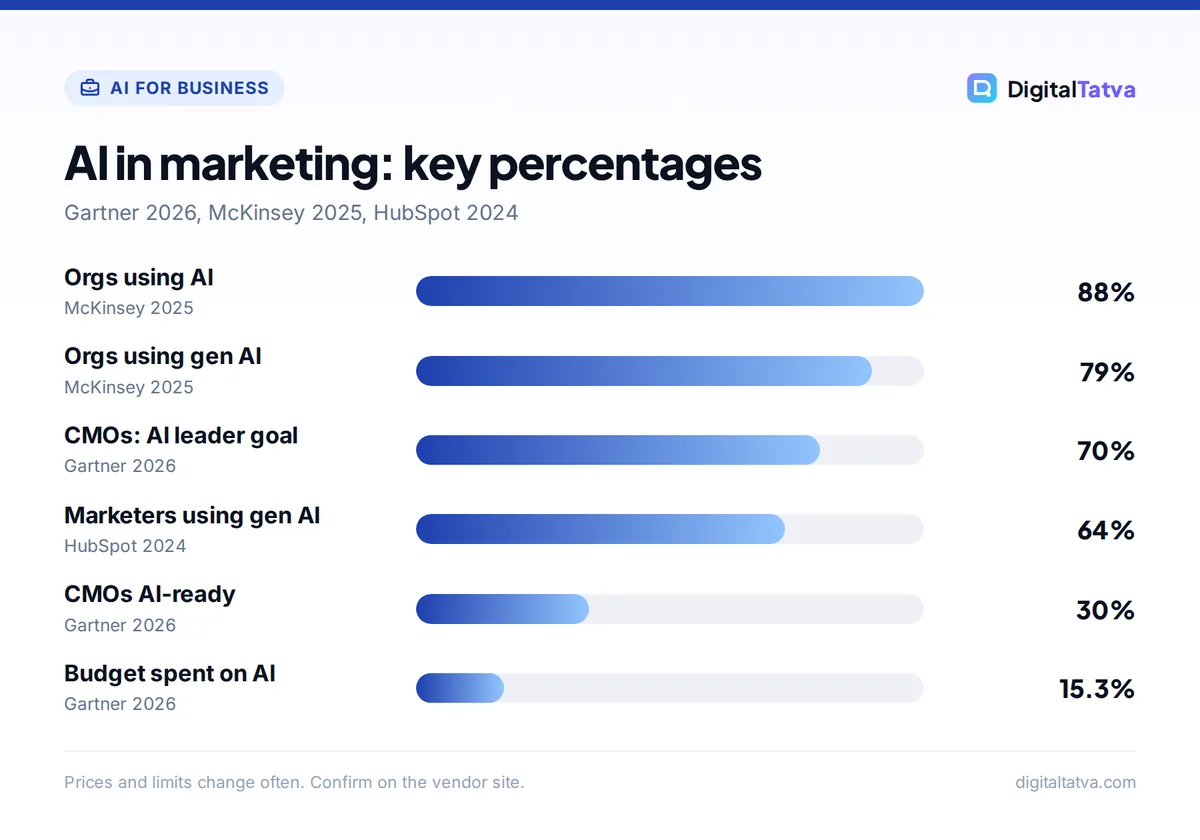
The most important AI marketing statistics for 2026 cover budgets, adoption, ad performance and AI search reach. This summary table collects the headline figures with their sources and dates.
| Statistic | Figure | Source and date |
|---|---|---|
| Share of marketing budget spent on AI | 15.3% | Gartner CMO Spend Survey, May 2026 |
| CMOs with mature AI readiness | 30% | Gartner, May 2026 |
| Organizations using AI in at least one function | 88% | McKinsey State of AI, 2025 |
| Organizations using generative AI | 79% | McKinsey, 2025 |
| Organizations with AI fully scaled | 7% | McKinsey, 2025 |
| Marketers using generative AI tools | 64% | HubSpot State of Marketing, 2024 |
| Advantage+ sales campaign ROAS lift | 22% average | Meta, January 2026 (vendor data) |
| AI Overviews monthly users | 2.5 billion+ | Google I/O, May 2026 |
| ChatGPT weekly users | 1 billion+ | OpenAI, reported August 2026 |
How much are marketers spending on AI?
Marketers spend an average of 15.3% of their marketing budgets on AI initiatives in 2026, according to Gartner’s annual CMO Spend Survey published on 11 May 2026. Organizations that Gartner classifies as AI-ready allocate 21.3%.
- Marketing budgets average 7.8% of company revenue in 2026, up from 7.7% in 2025 (Gartner).
- AI-ready organizations report marketing budgets of 8.9% of revenue (Gartner).
- 56% of CMOs say they lack the budget to deliver their 2026 strategy, and 54% report insufficient resources (Gartner).
- The survey covered 401 CMOs and marketing leaders in North America, the UK and Europe, surveyed January to March 2026, mostly at companies with over $1 billion in revenue.
Gartner’s Ewan McIntyre summarized the gap: CMOs “invest in AI tools faster than they build the data foundations.” In practice that means many teams buy tools before fixing tracking and content operations; our guide to measuring AI ROI helps avoid that trap.
How many businesses and marketers use AI?
88% of organizations use AI in at least one business function, up from 72% in 2024 and 55% in 2023, according to McKinsey’s Global Survey on the state of AI, conducted in mid-2025 with 1,993 participants. Generative AI use rose to 79%, from 71% in 2024 and 33% in 2023.
Adoption is wide but shallow: only 7% of McKinsey’s respondents said AI was fully scaled across their organizations. Gartner’s 2026 survey points the same way, with 70% of CMOs naming AI leadership as a critical goal but only 30% reporting mature AI readiness.
Among marketers specifically, HubSpot’s 2024 State of Marketing report (more than 1,400 marketers surveyed in September 2023) found that 64% already used generative AI tools and 62% considered AI important to their marketing. For the full picture beyond marketing, see our AI statistics page and AI in India statistics.
How does AI affect marketing productivity?
AI saves marketers measurable time on content: HubSpot’s 2024 report estimated that generative AI saves about 3 hours per piece of content and 2.5 hours per day, and 84% of AI-using marketers said they create content more efficiently.
| Productivity statistic | Figure |
|---|---|
| Time saved per piece of content | About 3 hours |
| Time saved per day | About 2.5 hours |
| AI users creating content more efficiently | 84% |
| Say gen AI helps personalize content | 77% |
| Worry AI content could harm brand reputation | 60% |
| Top use case | Research (33%), then content creation (31%) |
Source: HubSpot 2024 State of Marketing, as summarized by Jasper. The concern about brand reputation is why a brand voice process matters; see how to train AI in your brand voice.
Does AI improve advertising results?
AI ad automation is showing measurable gains in vendor data: Meta says its Advantage+ sales campaigns delivered an average 22% improvement in return on ad spend across 2025, and Google says AI Max for Search lifts conversions by an average of 7% when its features are combined. Both are company-reported figures.
- Meta: fourth-quarter 2025 advertising revenue of $58.1 billion (up 24%), full-year 2025 ad revenue of $196.2 billion (up 22%), and a $10 billion annual revenue run rate for its video generation tools, reported in January 2026 earnings.
- Meta ranking models: a 3.5% lift in ad clicks on Facebook and a 3% increase in conversion rates on Instagram surfaces from new AI models, reported for Q4 2025.
- Google AI Max: 14% more conversions or conversion value at similar cost at its 2025 launch; 7% for advertisers adding text customization and final URL expansion to search term matching (Google, May 2026).
- ChatGPT ads: OpenAI began testing ads in ChatGPT’s US free tier in January 2026, and ChatGPT ad revenue reached about $1 billion by August 2026, according to reports cited by Wikipedia.
Learn how to use these platforms in our guides to Meta Advantage+, Google Ads AI Max and ChatGPT ads.
How is AI changing search and brand discovery?
AI is becoming a main discovery channel: Google reported at I/O on 19 May 2026 that AI Overviews have more than 2.5 billion monthly active users, AI Mode more than 1 billion and the Gemini app more than 900 million. OpenAI’s ChatGPT crossed 1 billion weekly active users, as reported in August 2026.
For marketers this means being cited in AI answers now matters alongside ranking in blue links. ChatGPT held about 79% of chatbot market share in August 2026, according to StatCounter data cited by Wikipedia. Read what is GEO and how to rank in AI search, and track your brand with the best AI visibility tools.
AI in sales: key statistics
AI agents are spreading into sales fastest at large CRM vendors: Salesforce reported more than 29,000 Agentforce deals and about $800 million in Agentforce annual recurring revenue, up 169% year over year, at the end of its fiscal fourth quarter of 2026, according to a Zacks report in April 2026.
- Salesforce’s broader AI-related ARR, including Data 360, exceeded $2.9 billion (Zacks, April 2026).
- SDR headcount fell 22.7% while full-cycle account executive roles grew 10.8%, according to Regie.ai workforce data from June 2026 cited by Cleanlist.
- HubSpot moved its Customer Agent to outcome pricing in April 2026: $0.50 per resolved conversation.
See how these tools work in what is Salesforce Agentforce and best AI SDR tools.
What do marketers worry about with AI?
Marketers’ main AI worries are brand risk, skills and readiness. 60% of marketers using generative AI for content worried it could harm brand reputation (HubSpot 2024), and nearly two-thirds of marketers believe AI will change their jobs while 32% say they need to update their skills (Gartner findings reported in 2026).
Gartner also predicts that 50% of agencies’ proprietary AI platforms will be obsolete by 2029, a warning for agencies building their own tools; see AI for marketing agencies. To choose tools that fit your team, start with our best AI marketing tools.
Frequently asked questions
What percentage of marketers use AI?
About 64% of marketers used generative AI tools in HubSpot’s 2024 State of Marketing survey, and adoption has grown since. McKinsey’s 2025 survey found 79% of organizations use generative AI across functions. Exact percentages vary by survey, region and how “use” is defined.
How much do companies spend on AI marketing?
CMOs allocate an average of 15.3% of marketing budgets to AI initiatives, according to Gartner’s 2026 CMO Spend Survey of 401 marketing leaders. Organizations that are more AI-ready allocate 21.3%. Total marketing budgets average 7.8% of company revenue in 2026.
Does AI marketing actually work?
Often, but results vary. Meta reports a 22% average ROAS improvement for Advantage+ sales campaigns in 2025, and Google reports 7% more conversions with AI Max features combined. These are vendor figures, so test AI against your own baseline before scaling budgets.
How many people use AI search?
Google says AI Overviews had more than 2.5 billion monthly active users and AI Mode more than 1 billion as of May 2026. OpenAI’s ChatGPT crossed 1 billion weekly active users in 2026. These reach figures make AI answers a major brand discovery channel.
Where can I find reliable AI marketing statistics?
Use primary sources: Gartner and McKinsey surveys, company earnings releases from Meta, Alphabet and Salesforce, and official product announcements. Be cautious with statistics pages that do not link to an original study or that mix years without dates.
How to use these statistics
Use the budget and readiness figures to make the case for AI investment alongside data and process work, the ad performance figures to set test expectations, and the AI search reach figures to justify GEO and AI visibility work. Always cite the original source and date. Statistics and vendor figures change quickly, so check the linked reports for the latest editions before you publish them.
Sources
- Gartner 2026 CMO Spend Survey, Gartner, 11 May 2026, checked 22 October 2026
- AI at work but not at scale, McKinsey, 10 December 2025, checked 22 October 2026
- Sundar Pichai’s I/O 2026 keynote, Google, 19 May 2026, checked 22 October 2026
- Meta’s ad business hits record $58B, PPC Land, 29 January 2026, checked 22 October 2026
- Agentforce adoption rises, Nasdaq (Zacks), 24 April 2026, checked 22 October 2026
- AI insights from HubSpot’s State of Marketing report, Jasper, checked 22 October 2026
Pricing and features are checked at the time of writing and can change. Some links may be affiliate links, which never affect our verdicts.