The Real Cost per Output: What AI Images, Video and Voice Cost in 2026
Original research converting credits into real costs: what one AI image, one minute of AI video, avatar video and AI voice cost across 36 tools and models in 2026.

On this page
- Key takeaways
- Key findings at a glance
- How did we calculate cost per output?
- How much does an AI image cost?
- Why does image quality change the price so much?
- What do specialized AI image tools cost per output?
- How much does a minute of AI video cost?
- Why does the same AI video cost 40x more on one plan than another?
- Is a subscription or an API cheaper for AI video?
- How much does an AI avatar video cost per minute?
- How much does a minute of AI voice cost?
- Why do voice studios cost 5x more than voice APIs?
- How much does an AI song cost?
- Which AI tool is cheapest for each type of output?
- How much do AI images, video and voice cost in rupees?
- What are the hidden costs of AI generation?
- What do typical AI content projects cost?
- How can you lower your cost per output?
- What are the limitations of this research?
- How to cite this report
- Frequently asked questions
- Sources
Last updated: 23 October 2026
Quick answer: We converted credits, tokens and plan allowances into real cost per output for 36 AI tools and models in October 2026. A typical AI image costs about 3.5 cents, a minute of AI video about $6, and a minute of AI voice about 3 cents through an API or 16.5 cents in a voice studio. The same output can cost 30x to 40x more depending on the tool, plan and quality setting.
AI creative tools rarely tell you what one image, one video clip or one minute of voiceover actually costs. Instead they sell credits, tokens, GPU hours or “generations”, and each tool burns them at a different rate. A $15 plan and a $20 plan can deliver wildly different amounts of output, and the cheapest-looking plan is often not the cheapest per result.
To fix that, Digital Tatva converted the pricing of 36 AI image, video, avatar, voice and music tools and models into a single comparable number: the cost per output. We collected 73 price points from official pricing pages, help centers and dated third-party measurements in September and October 2026, then divided each plan’s price by the output it can produce.
This report shows what an AI image, a second and a minute of AI video, a minute of avatar video, a minute of AI voice and an AI song really cost, why prices vary so much, which hidden costs to watch for, and how to calculate the cost of your own projects.
Key takeaways
- The median AI image costs $0.034 (about 3.5 cents) across 14 general image generators and models, ranging from $0.0077 to $0.26.
- Subscription images are cheaper than API images: a median of 1.5 cents per image on plans versus 4.6 cents through APIs.
- The median AI video costs $0.10 per second, or about $6 per minute, across 23 video price points, ranging from $0.60 to $24 per minute.
- Plan choice matters more than tool choice for video: Veo 3.1 Fast costs $0.01 per second on Google AI Ultra, $0.05 on Google AI Pro and $0.12 through the API.
- AI avatar video costs $0.15 to $2.97 per minute on mainstream plans, depending mostly on the avatar model.
- AI voice costs a median 3 cents per minute through APIs and 16.5 cents per minute in voice studio subscriptions, about 5.5x more.
- Quality settings multiply cost: high-quality GPT Image 2 output costs 34x the low setting, and 1080p video often costs 4x 720p.
- An AI song costs about 2 cents to generate on Suno Pro but 50 cents per download, because downloads are capped.
- Retries are the biggest hidden cost: needing 3 attempts for one usable clip triples your real cost per output.
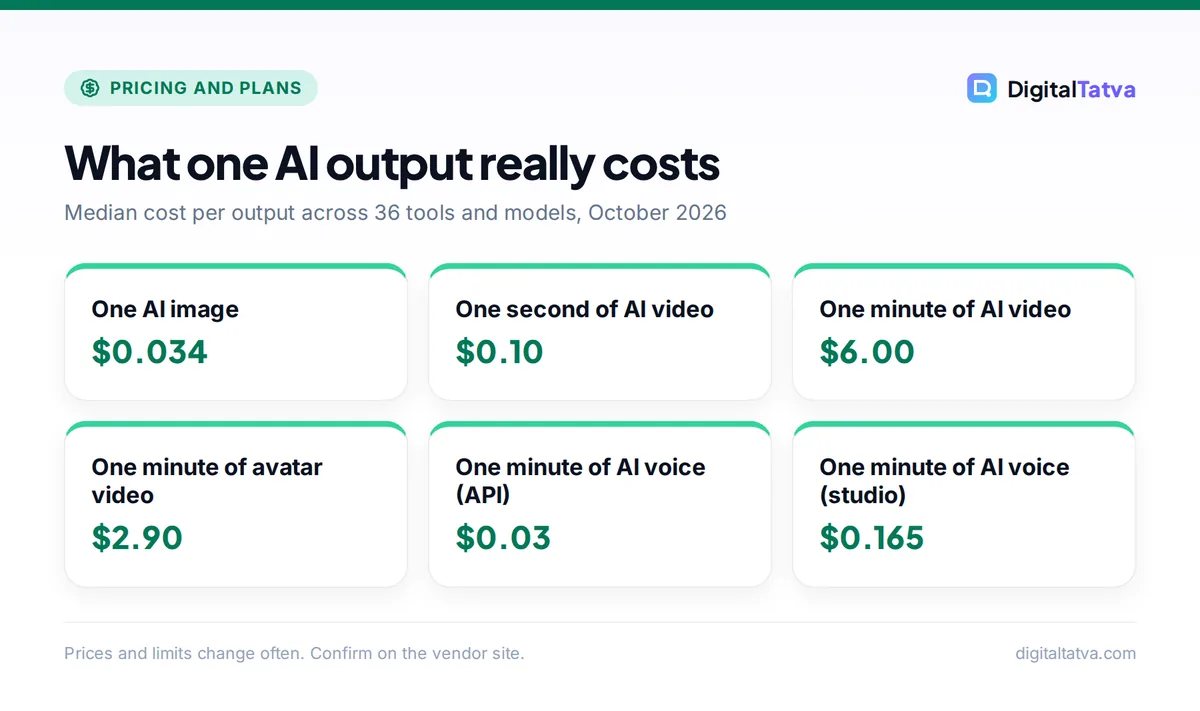
Key findings at a glance
The table below summarizes the headline results. Each figure is explained in the sections that follow, with the full price points for every tool.
| Output | Cheapest we found | Median | Most expensive (mainstream) |
|---|---|---|---|
| AI image (general generator) | $0.0077 (Recraft V4.1 Flash API) | $0.034 | $0.26 (GPT Image 2, high quality) |
| AI video, per second | $0.01 (Veo 3.1 Fast on Google AI Ultra) | $0.10 | $0.40 (Veo 3.1 API, standard) |
| AI video, per minute | $0.60 | $6.00 | $24.00 |
| Avatar video, per minute | $0.15 (HeyGen Avatar III) | $2.90 | $24.03 (Captions Mirage) |
| AI voice, per minute (API) | $0.004 (Google Cloud TTS Standard) | $0.03 | $0.16 (Google Cloud TTS Studio) |
| AI voice, per minute (studio plan) | $0.031 (Cartesia Startup) | $0.165 | $0.24 (Murf Creator, monthly) |
| AI song (Suno Pro) | $0.02 per generated song | n/a | $0.50 per downloaded song |
How did we calculate cost per output?
We calculated cost per output by dividing each plan’s monthly price by the number of outputs the plan can produce, using the vendor’s own credit costs wherever they were published. For APIs, we used the provider’s listed price per image, per second or per character directly.
The formula is simple:
Cost per output = plan price per month ÷ outputs the plan’s credits can produce
To make the results comparable, we followed these rules:
- Monthly list prices: We used monthly billing prices unless a plan is only sold yearly, in which case we used the monthly equivalent and labeled it. Promotional and first-month prices were ignored.
- Standard settings: For images we used about 1 megapixel (1024 by 1024 or “1K”). For video we used the plan’s standard model at the stated resolution. For voice we used standard text to speech.
- Voice conversion: Where a price is per character, we assumed 1,000 characters per minute of speech, the same rate ElevenLabs uses to describe its credits.
- Midjourney: Midjourney says one image prompt usually takes about one minute of fast GPU time and produces a grid of four images. For video, its table lists 8 GPU minutes for a batch of four SD videos and 26 minutes for four HD videos; we assumed 5-second clips.
- Leonardo: Leonardo does not publish a per-image token table. We estimated about 12 tokens per basic image, based on its free tier’s 150 daily tokens producing roughly 10 to 15 images, and we flag this as an estimate.
- No retries: All figures assume every generation is usable. In practice you will often generate several times, which we cover in the hidden costs section.
- Sources: 73 price points came from official pricing pages and help centers where possible. Where the vendor did not publish credit costs, we used dated third-party measurements and say so in the tables.
Note: Credit costs change often, sometimes without a change to the plan price. Every figure reflects September and October 2026. Check the credit cost shown inside each tool before you generate. For subscription prices across 155 AI tools, see our State of AI Tool Pricing 2026 report.
How much does an AI image cost?
An AI image costs a median of $0.034, or about 3.5 cents, across the 14 general-purpose image generators and models we measured. The cheapest options cost under 1 cent per image and the most expensive about 26 cents, a 34x spread.
| Tool or model | Plan or setting | Type | Cost per image | Source |
|---|---|---|---|---|
| Adobe Firefly | Standard, $9.99/month | Subscription | Unlimited standard images | Official |
| Recraft V4.1 Flash | API | API | $0.0077 | Official |
| GPT Image 2 | Low quality, 1024×1024 | API | $0.0078 | Third-party measured |
| Midjourney | Standard, $30/month | Subscription | $0.0083 (plus unlimited Relax) | Official plus estimate |
| Midjourney | Basic, $10/month | Subscription | $0.0125 | Official plus estimate |
| Leonardo.ai | Essential, $12/month | Subscription | About $0.017 | Estimate |
| Nano Banana 2.1 | 1K, Gemini API | API | $0.0336 | Official |
| Nano Banana 2 Lite | 1K, Gemini API | API | $0.0336 | Official |
| Recraft V4.1 | Raster, API | API | $0.0354 | Official |
| Seedream 5.0 | 1K | API | $0.056 | Third-party measured |
| GPT Image 2 | Medium quality, 1024×1024 | API | $0.066 | Third-party measured |
| Nano Banana 2 | 1K, Gemini API | API | $0.067 | Official |
| Recraft V4.1 Vector | SVG, API | API | $0.088 | Official |
| Runway | Standard, $15/month (Gen-4 images) | Subscription | $0.19 | Official |
| GPT Image 2 | High quality, 1024×1024 | API | $0.26 | Third-party measured |
Three findings stand out. First, subscriptions built for heavy image use are the cheapest per image. Midjourney’s Basic plan works out to just over 1 cent per image if you use all its fast time, and its Standard plan adds unlimited images in the slower Relax mode, pushing the real cost toward zero for patient users. Adobe Firefly’s paid plans include unlimited standard Firefly images, with credits only used for premium and partner models. See our Midjourney pricing guide and our comparison of Canva vs Adobe Firefly.
Second, the median subscription image costs 1.5 cents while the median API image costs 4.6 cents. APIs cost more per image but have no monthly minimum, which suits developers and occasional users.
Third, images from video-first tools are expensive. Runway’s Standard plan produces 78 Gen-4 images for $15, about 19 cents each, because its credits are priced for video. If you mainly need images, a dedicated image tool is 10x to 20x cheaper. Compare options in best AI image generators or cheaper Midjourney alternatives.
Why does image quality change the price so much?
Image quality and resolution change the price because higher settings use more compute, and providers pass that cost on per image. In our data, the same GPT Image 2 model costs $0.0078 at low quality, $0.066 at medium and $0.26 at high quality for a 1024 by 1024 image, a 34x difference.
Resolution has a similar effect. Nano Banana 2 costs $0.067 at 1K, $0.101 at 2K and $0.151 at 4K through the Gemini API. Nano Banana 2.1 is cheaper at every size, from $0.0336 at 1K to $0.113 at 4K, and batch processing halves those prices again, to $0.0168 at 1K.
The practical lesson is to generate drafts at low quality or low resolution, then re-generate or upscale only the images you will actually use. A workflow that tests 20 low-quality drafts and finalizes 2 high-quality images costs about $0.68 with GPT Image 2, compared with about $5.81 if all 22 images were generated at high quality. For prompt techniques that reduce wasted generations, see how to generate images in ChatGPT and our guide to Nano Banana image editing.
What do specialized AI image tools cost per output?
Specialized image tools cost far more per output than general generators, from about 1 cent for a product photo edit to $3.90 for an ad creative, because they bundle templates, workflows and business features into each credit. The table shows what each output costs on entry plans.
| Tool | Output | Plan | Cost per output |
|---|---|---|---|
| Photoroom | Edited product photo export | Pro, $7.50/month billed yearly | $0.0075 |
| Let’s Enhance | Image upscale | Starter, $12/month | $0.12 |
| Pikzels | YouTube thumbnail | Premium, $28/month billed yearly | $0.19 |
| Collov AI | Interior room design | Standard, $19/month | $0.32 |
| ReimagineHome | Interior visualization | Essential, $14/month | $0.47 |
| Homestyler | 2K render, pay per use | Pay per render | $0.99 |
| AdCreative.ai | Ad creative download | Starter, $39/month | $3.90 |
These tools are still cheap compared with the human work they replace. A $0.32 room design or a $3.90 ad creative is a fraction of the cost of a designer’s time. But if you can describe what you want clearly, a general generator at 3 to 7 cents per image can often produce a similar result. AdCreative.ai’s annual plan halves its cost to about $2 per download. Compare tools in best AI product photography tools, best AI interior design tools, best AI image upscalers and best AI ad generators.
How much does a minute of AI video cost?
A minute of AI-generated video costs a median of about $6, or $0.10 per second, across 23 video price points we measured. The cheapest option cost $0.60 per minute and the most expensive $24 per minute, a 40x spread for clips of similar length.
| Tool and plan | Model or setting | Cost per second | Cost per minute | Source |
|---|---|---|---|---|
| Google AI Ultra ($199.99/month) | Veo 3.1 Fast in Flow | $0.010 | $0.60 | Official credits, third-party per-clip cost |
| Midjourney Basic ($10) | SD video | $0.020 | $1.20 | Official GPU table, 5-second clip assumption |
| Pika Starter ($10) | Pika 2.5, 720p | $0.044 | $2.67 | Official credits, third-party rates |
| Google AI Pro ($19.99) | Veo 3.1 Fast in Flow | $0.050 | $3.00 | Official credits, third-party per-clip cost |
| Gemini API | Veo 3.1 Lite, 720p | $0.050 | $3.00 | Official |
| Luma Plus ($30) | Ray3.2, 720p | $0.060 | $3.60 | Third-party, checked against Luma’s page |
| Midjourney Basic ($10) | HD video | $0.065 | $3.92 | Official GPU table, 5-second clip assumption |
| Kling API | V3 Omni, standard | $0.084 | $5.04 | Third-party |
| Pika Creator ($35) | Pika 2.5, 1080p | $0.089 | $5.33 | Official credits, third-party rates |
| Kling Pro ($37) | Kling 3.0, 1080p | $0.099 | $5.92 | Third-party |
| Adobe Firefly Standard ($9.99) | Firefly Video | $0.100 | $5.99 | Official |
| Adobe Firefly Pro ($19.99) | Firefly Video | $0.100 | $6.00 | Official |
| Gemini API | Gemini Omni Flash, 720p | $0.100 | $6.00 | Official |
| Gemini API | Veo 3.1 Fast, 1080p | $0.120 | $7.20 | Official |
| Runway Max ($95) | Gen-4.5 | $0.120 | $7.21 | Official |
| Kling Standard ($10) | Kling 3.0, 1080p | $0.122 | $7.32 | Third-party |
| Runway Standard ($15) | Gen-4 Turbo | $0.144 | $8.65 | Official |
| Runway API | Gen-4.5 | $0.150 | $9.00 | Third-party reseller |
| Runway Pro ($35) | Gen-4.5 | $0.187 | $11.23 | Official |
| Luma Plus ($30) | Ray3.2, 1080p | $0.240 | $14.40 | Third-party |
| Google AI Pro ($19.99) | Veo 3.1 Quality in Flow | $0.250 | $14.99 | Official credits, third-party per-clip cost |
| Runway Standard ($15) | Gen-4.5 | $0.288 | $17.31 | Official |
| Gemini API | Veo 3.1 Standard, 1080p | $0.400 | $24.00 | Official |
Keep in mind that AI video is generated in short clips, usually 5 to 10 seconds, so a “minute” means stitching together six to twelve clips. Most clips also need several attempts. The per-minute figures are best used to compare tools, not as a quote for a finished one-minute film.
The ranking shows that cheap entry plans and budget models are now very cheap per second. Veo 3.1 Fast on Google AI Pro, Veo 3.1 Lite through the API, Pika at 720p and Luma at 720p all cost $3 to $3.60 per minute of raw footage. Premium models at full quality cost four to eight times more. Compare the main tools in best AI video generators, Runway vs Kling and our Kling AI review.
Why does the same AI video cost 40x more on one plan than another?
The same AI video can cost 40x more on one plan than another because four factors multiply together: the plan tier, the model, the resolution and the quality mode. Most buyers only look at the plan price, but the other three often matter more.
Plan tier
Bigger plans usually buy credits more cheaply. Runway’s Gen-4.5 costs $0.29 per second on the $15 Standard plan but $0.12 per second on the $95 Max plan, 2.4x less. Google’s Veo 3.1 Fast costs $0.05 per second on Google AI Pro and $0.01 on the $199.99 Ultra tier, where each clip also costs half the credits. Pika is the exception: every Pika plan prices credits at the same rate, so upgrading buys more output but not cheaper output.
Model
Inside the same plan, model choice changes the price several times over. On Runway Standard, Gen-4 Turbo costs half as much per second as Gen-4.5. On Google AI Pro, a Veo 3.1 Quality clip costs 100 credits while a Fast clip costs 20, making Quality 5x more expensive. Many platforms also resell partner models at a premium: on Luma, Veo 3.1 with audio uses 280 credits per second, compared with 20 for Luma’s own Ray3.2 at 720p.
Resolution
Resolution is the most common hidden multiplier. On Luma, 1080p video costs 4x as much as 720p. On Pika, a 1080p clip costs double a 720p clip. On the Veo 3.1 Fast API, 1080p costs 20% more than 720p, and 4K costs 2.5x the 1080p price.
Quality and audio
Native audio, HDR and longer clips add further costs. Kling’s API costs about $0.084 per second without audio and $0.14 with audio, according to a third-party listing. Luma doubles the price for HDR and triples it for HDR with EXR export.
Tip: Draft every shot at 720p with a fast or lite model, then re-render only the final takes at 1080p with the premium model. This simple workflow often cuts video costs by 60% to 80%. See how to make an AI video and how to use Google Flow and Veo.
Is a subscription or an API cheaper for AI video?
For most creators, a subscription is cheaper per second of AI video than the API for the same model, as long as you use most of your credits each month. Veo 3.1 Fast costs $0.05 per second through Google AI Pro but $0.12 per second at 1080p through the Gemini API. Runway’s Gen-4.5 costs $0.12 per second on the Max plan and about $0.15 through a reseller API.
The API wins in three situations. First, when you generate irregularly and would waste unused monthly credits, since subscription credits usually expire at the end of each month. Second, when you need automation, such as generating hundreds of product videos from a spreadsheet. Third, when you need a model the subscription restricts, such as higher resolutions or longer clips.
Across all 23 video price points, the median subscription cost was $0.10 per second and the median API cost $0.11, so the difference is smaller at the median than at the extremes. The biggest savings come from the largest subscription tiers, which are only worth it if you produce video every week. For API budgeting, see Gemini API pricing and how to estimate AI API costs.
How much does an AI avatar video cost per minute?
AI avatar video, where a digital presenter speaks your script, costs $0.15 to $2.97 per minute on mainstream plans. The avatar model you choose matters more than the platform: HeyGen’s older Avatar III costs about 15 cents per minute on its $29 Creator plan, while its newer Avatar IV costs about 97 cents per minute on the same plan.
| Tool | Plan | Minutes included | Cost per minute |
|---|---|---|---|
| HeyGen | Creator, $29, Avatar III | About 200 | $0.15 |
| HeyGen | Creator, $29, Avatar IV | About 30 | $0.97 |
| Synthesia | Starter, $29 | 10 | $2.90 |
| Synthesia | Creator, $89 | 30 | $2.97 |
| Captions (Mirage) | Max, $24.99 | About 1 | $24.03 |
HeyGen’s figures come from its published credit rates (20 credits per minute for Avatar IV and 3 for Avatar III, according to a third-party breakdown of its pricing). Synthesia sells minutes directly, which makes its pricing the most predictable. Captions’ Mirage model costs 8 credits per second, so its 500 monthly credits produce about one minute of generated avatar footage; it is designed for short social clips rather than long training videos.
Avatar video is still remarkably cheap compared with filming. A 5-minute training video costs about $4.83 with HeyGen Avatar IV or $14.50 with Synthesia, before any retakes. Compare the two leaders in Synthesia vs HeyGen or browse AI UGC video generators.
How much does a minute of AI voice cost?
A minute of AI voice costs a median of 3 cents through text-to-speech APIs and 16.5 cents through voice studio subscriptions such as ElevenLabs and Murf, based on 20 voice price points. The cheapest API voice costs 0.4 cents per minute and the most expensive studio plan about 24 cents.
| Tool and model or plan | Type | Cost per minute | Source |
|---|---|---|---|
| Google Cloud TTS Standard | API | $0.004 | Official |
| Gemini 3.8 Flash-Lite TTS | API | $0.009 | Official |
| Gemini 3.8 Flash TTS | API | $0.0135 | Official |
| OpenAI gpt-4o-mini-tts | API | About $0.015 | Third-party estimate |
| Amazon Polly Neural | API | $0.016 | Official |
| Azure AI Speech Neural | API | $0.016 | Third-party |
| OpenAI tts-1-hd | API | $0.03 | Third-party |
| Google Cloud TTS Chirp 3 HD | API | $0.03 | Official |
| Amazon Polly Generative | API | $0.03 | Official |
| Deepgram Aura-2 | API | $0.03 | Third-party |
| Cartesia Startup ($39, yearly) | Subscription | $0.031 | Third-party |
| ElevenLabs API, Flash | API | $0.05 | Third-party |
| ElevenLabs API, Multilingual | API | $0.10 | Third-party |
| Murf Business ($66, yearly) | Subscription | $0.14 | Third-party |
| Google Cloud TTS Studio | API | $0.16 | Official |
| ElevenLabs Pro ($99) | Subscription | $0.165 | Official |
| ElevenLabs Business ($990) | Subscription | $0.165 | Official |
| ElevenLabs Creator ($22) | Subscription | $0.18 | Official |
| ElevenLabs Starter ($6) | Subscription | $0.20 | Official |
| Murf Creator ($29, monthly) | Subscription | $0.24 | Third-party |
API prices assume 1,000 characters per minute of speech. Gemini TTS prices apply until 31 December 2026; Google has announced that both models will double in price from 1 January 2027.
The voice market shows the clearest gap between developer and creator pricing of any category. A 10-minute narration costs 4 cents with Google’s standard voices, 15 cents with OpenAI’s mini TTS model, $1.82 on ElevenLabs Creator and $2.42 on Murf Creator. Even the best API voices, such as Google’s Chirp 3 HD or Amazon Polly’s generative voices, cost about 30 cents for those 10 minutes.
Notice also that ElevenLabs prices barely fall with volume: its plans cost between 16.5 and 20 cents per minute from the $6 Starter plan to the $990 Business plan. Larger plans add seats, voice clones and quality options rather than much cheaper minutes. For plan details see ElevenLabs pricing and ElevenLabs vs Murf.
Why do voice studios cost 5x more than voice APIs?
Voice studios cost about 5.5x more per minute than APIs because you pay for a complete production tool, not just audio generation. The median studio minute costs 16.5 cents against 3 cents through APIs, and the extra cost buys several things an API does not include:
- An editor: studios let you adjust pronunciation, pacing, emphasis and pauses line by line, then regenerate only the parts you change.
- Voice libraries and cloning: ElevenLabs includes instant voice cloning from the $6 Starter plan and professional cloning from Creator; see how to clone a voice with ElevenLabs.
- Commercial licenses: paid studio plans include rights to use the audio commercially, while some free tiers do not.
- Quality: expressive, emotional voices still cost more than standard voices on every platform.
- No coding: APIs require a developer or an automation tool to use.
If you produce a lot of narration, such as audiobooks, course content or daily videos, the gap adds up quickly. Ten hours of audio a month costs about $99 on ElevenLabs Pro, but about $18 with Chirp 3 HD or Polly Generative, and under $10 with Gemini TTS through the API. Many teams use a studio for flagship content and an API for volume work. Compare tools in best AI voice generators.
How much does an AI song cost?
An AI song costs about 2 cents to generate on Suno’s $10 Pro plan, but about 50 cents per downloaded song, because Suno caps downloads separately from generations. One generation costs 10 credits and returns two songs, so Pro’s 2,500 monthly credits produce about 500 songs, according to a third-party pricing index. Since 3 September 2026, however, Pro allows only 20 song downloads a month and Premier ($30) allows 60.
That makes the download cap, not the credits, the real limit for most creators. If you need to publish more than 20 tracks a month, Premier costs the same 50 cents per downloaded song, and extra downloads must be bought separately. For alternatives with different limits, see Suno vs Udio and best AI music generators.
Which AI tool is cheapest for each type of output?
The cheapest AI tool depends on what you are making and how much of it you make. Based on cost per output alone, these are the lowest-cost options in our data for each common job, with a value pick that balances price, quality and ease of use.
| Job | Lowest cost per output | Value pick | Why |
|---|---|---|---|
| Everyday images, no code | Adobe Firefly (unlimited standard images) | Midjourney Standard ($30) | About 0.8 cents per fast image plus unlimited Relax mode |
| Images through an API | Recraft V4.1 Flash ($0.0077) | Nano Banana 2.1 ($0.0336 at 1K) | Strong quality at 1K, half price in batch mode |
| Vector logos and icons | Recraft V4.1 Vector ($0.088) | Recraft V4.1 Vector | Real SVG output avoids paying for vectorizing later |
| Product photo edits | Photoroom Pro ($0.0075 per export) | Photoroom Pro | 1,000 exports a month on a low yearly price |
| Short video clips | Veo 3.1 Fast on Google AI Ultra ($0.01 per second) | Veo 3.1 Fast on Google AI Pro ($0.05 per second) | Low cost without a $200 plan, plus the rest of Google AI Pro |
| Video through an API | Veo 3.1 Lite ($0.05 per second) | Veo 3.1 Fast ($0.12 per second at 1080p) | 1080p with audio at a moderate price |
| Avatar presenter video | HeyGen Avatar III ($0.15 per minute) | HeyGen Avatar IV ($0.97 per minute) | More natural avatars for under $1 a minute |
| Voiceover at volume | Google Cloud TTS Standard ($0.004 per minute) | Gemini 3.8 Flash TTS ($0.0135 per minute) | Natural voices for about 1.4 cents per minute until 2027 |
| Voiceover without code | Cartesia Startup ($0.031 per minute) | ElevenLabs Creator ($0.18 per minute) | Editor, cloning and commercial license included |
| Music tracks | Suno Pro ($0.02 per generated song) | Suno Pro | Enough downloads for most creators at 20 a month |
Lowest cost is not always best value. A tool that costs twice as much per output but needs half as many retries, or saves an hour of editing, is cheaper in practice. Use the cost per output figures to build a shortlist, then test your two or three finalists on a real project before committing to a larger plan. For free options to test first, see free AI image generators and free AI video generators.
How much do AI images, video and voice cost in rupees?
In Indian rupees, a typical AI image costs about Rs 3, a minute of AI video about Rs 567, and a minute of AI voice about Rs 2.80 through an API or Rs 15.60 in a voice studio, at 94.5 rupees per US dollar. Most AI generation tools bill in US dollars, so these costs move with the exchange rate.
| Output | Median cost (USD) | Median cost (INR) | Low-cost option (INR) |
|---|---|---|---|
| AI image | $0.034 | About Rs 3.26 | Under Rs 1 (Recraft Flash, GPT Image 2 low) |
| AI video, per second | $0.10 | About Rs 9.45 | About Rs 0.95 (Veo 3.1 Fast on Ultra) |
| AI video, per minute | $6.00 | About Rs 567 | About Rs 283 (Veo 3.1 Fast on Google AI Pro) |
| Avatar video, per minute | $2.90 | About Rs 274 | About Rs 14 (HeyGen Avatar III) |
| AI voice, per minute (API) | $0.03 | About Rs 2.84 | About Rs 0.38 (Google Cloud TTS Standard) |
| AI voice, per minute (studio) | $0.165 | About Rs 15.60 | About Rs 2.95 (Cartesia Startup) |
Indian buyers can often lower these costs further. Google sells its AI plans in rupees, and eligible students in India can get a free year of Google AI Plus, which includes Flow credits for video. Rupee prices for consumer plans usually include 18% GST, while API usage billed in dollars may attract GST separately on your invoice. See free AI pro plans in India and AI tools for Indian languages, which matters for voice work in Hindi and other Indian languages.
What are the hidden costs of AI generation?
The biggest hidden cost of AI generation is retries: if you need three attempts to get one usable result, your real cost per output is three times the list cost. Several other factors also make real costs higher than the numbers on a pricing page.
- Retries and variations. Creators commonly report needing 3 to 5 video generations for one usable clip. A $0.80 Veo clip that takes four attempts really costs $3.20.
- Failed generations still cost credits. Several platforms, including Pika and Google Flow, can deduct credits even when a generation fails or is blocked.
- Credits expire. Monthly credits on Suno, Ideogram, Pika, Google AI plans and most other tools do not roll over. Unused credits raise your effective cost per output.
- Download and export caps. Suno’s 20-download cap on Pro is the clearest example, but exports, resolution and watermark removal are also often limited by plan.
- Commercial rights. Some cheap tiers exclude commercial use. Pika’s $10 Starter plan, for example, has no commercial license, so the true entry price for business use is its $35 Creator plan. Read can you copyright AI content before publishing.
- Price changes. Credit costs change without the plan price changing. Gemini TTS doubles in price on 1 January 2027, and Gemini 3.8 Flash and other launch prices are temporary.
A simple way to estimate real costs is to multiply the list cost per output by your typical number of attempts, then divide by the share of your monthly credits you actually use. If a clip costs $0.10 per second, you need three attempts and you use 75% of your credits, your real cost is about $0.40 per usable second.
What do typical AI content projects cost?
Typical AI content projects cost from a few cents to about $26 in generation fees before you count retries, using the per-output costs in this report. The table below prices five common projects with a budget option and a premium option, assuming every generation is usable, and then with three attempts per output.
| Project | Budget option | Budget cost | Premium option | Premium cost | Premium with 3 attempts |
|---|---|---|---|---|---|
| 100 blog images | Nano Banana 2.1 API (1K) | $3.36 | GPT Image 2, high | $26.39 | $79.16 |
| 30-second product video | Veo 3.1 Fast on Google AI Pro | $1.50 | Runway Gen-4.5 on Standard | $8.65 | $25.96 |
| 10-minute voiceover | Google Cloud TTS Standard | $0.04 | ElevenLabs Creator | $1.82 | $5.45 |
| 5-minute avatar training video | HeyGen Avatar III | $0.73 | Synthesia Starter | $14.50 | $43.50 |
| 20 published songs | Suno Pro (downloads) | $10.00 | Suno Premier | $30.00 | $30.00 (60 downloads cap) |
Even the premium options are cheap compared with traditional production. A 30-second product video at $26 including retries, or a 5-minute training video at $43, would cost hundreds or thousands of dollars to film. The real budget risk is volume: teams producing content daily can quickly exhaust a plan and fall back on expensive top-ups. Planning your monthly output and choosing the right plan tier saves far more than switching between similar tools. For a YouTube workflow, see best AI tools for YouTubers.
How can you lower your cost per output?
You can lower your cost per AI output by 50% or more with a few habits: draft cheaply, finalize selectively, match the plan to your volume and use batch or relaxed modes where they exist.
- Draft at low settings. Use low quality, 720p or “fast” and “lite” models for exploration, and premium settings only for final assets.
- Use unlimited and relaxed modes. Midjourney Standard and above include unlimited Relax images, Adobe Firefly plans include unlimited standard images, and Leonardo’s Premium and Ultimate plans include unlimited relaxed generation on selected models.
- Use batch APIs. The Gemini API halves image prices in batch mode, and most providers offer about 50% off for non-urgent jobs. See how batch APIs save costs.
- Pick the right tier. Larger video plans often cut cost per second by more than half, but only if you use the credits. Track usage for a month before upgrading.
- Use the right tool for the job. Don’t make images in video tools or narration in premium studios if a cheaper dedicated tool or API will do.
- Write better prompts. Clear, specific prompts reduce retries, which is the single largest hidden cost. Our Midjourney prompts guide shows examples.
- Check yearly pricing. Yearly plans cut the cost per output on many tools by 20% to 50%, as covered in annual vs monthly AI plans.
What are the limitations of this research?
This research compares list-price cost per output in September and October 2026 and makes simplifying assumptions, so real costs will vary with your settings, success rate and region. Keep these limitations in mind:
- Credit costs are not always published. Leonardo and Ideogram do not publish full per-image credit tables, and Kling’s official pricing page did not load for us. We used estimates or third-party measurements and labeled them.
- Third-party sources: Some per-output figures come from third-party measurements and reseller pages, some published by competing vendors. We note these in every table.
- Quality is not equal: A 1-cent image and a 26-cent image are not the same product. This report compares cost, not quality.
- Assumptions: We assumed 1,000 characters per minute of speech, 5-second Midjourney clips and full use of each plan’s credits.
- No retries in base figures: Every table assumes one attempt per output unless stated.
- Prices change: Credit costs, plan allowances and model prices change frequently. Confirm inside each tool before generating.
How to cite this report
You are welcome to quote and share these findings with a link back to this page. Please cite it as: Digital Tatva, “The Real Cost per Output: What AI Images, Video and Voice Cost in 2026”, October 2026. For subscription pricing across 155 AI tools and 21 AI models, see our State of AI Tool Pricing 2026 report. We will update these figures as credit costs change.
Frequently asked questions
How much does one AI image cost?
One AI image costs a median of about 3.5 cents ($0.034) across 14 general image generators and models in October 2026. Prices range from under 1 cent with Recraft V4.1 Flash, GPT Image 2 at low quality or Midjourney’s Standard plan, to about 26 cents for GPT Image 2 at high quality.
How much does AI video cost per minute?
AI video costs a median of about $6 per minute, or $0.10 per second, across 23 price points we measured. The range is $0.60 per minute for Veo 3.1 Fast on Google AI Ultra to $24 per minute for Veo 3.1 Standard through the API. Most videos also need several attempts, which multiplies the cost.
What is the cheapest AI video generator per second?
In our data, the cheapest per second is Veo 3.1 Fast on Google AI Ultra at about $0.01 per second, followed by Midjourney’s SD video at about $0.02 and Pika’s Starter plan at 720p at about $0.044. For lower budgets, Veo 3.1 Fast on Google AI Pro costs about $0.05 per second.
How much does AI voiceover cost per minute?
AI voiceover costs a median of 3 cents per minute through text-to-speech APIs and 16.5 cents per minute through voice studios such as ElevenLabs and Murf. The cheapest option we found was Google Cloud TTS Standard at 0.4 cents per minute, and the most expensive studio plan was Murf Creator at about 24 cents.
Is a subscription or API cheaper for AI generation?
Subscriptions are usually cheaper per output for images and video if you use most of your credits, while APIs are much cheaper for voice. For example, Veo 3.1 Fast costs $0.05 per second on Google AI Pro but $0.12 at 1080p through the API, while API voices cost about one fifth of studio voices per minute.
Why do AI tools use credits instead of prices?
AI tools use credits because different models, resolutions and lengths cost very different amounts to generate, and credits let one plan cover them all. The downside for buyers is that credits hide the real price. Converting credits into cost per image, second or minute, as this report does, is the best way to compare tools.
Sources
- Digital Tatva cost-per-output dataset: 73 price points across 36 AI tools and models, compiled September to October 2026, checked 23 October 2026
- Gemini Developer API pricing, Google, checked October 2026
- Veo 3.1 API pricing, BenchLM, as of 13 October 2026
- Veo 3 pricing and real cost per video, Hooked, checked 25 September 2026
- GPU Speed (Fast, Relax, Turbo), Midjourney, checked October 2026
- Creative Cloud generative AI features, Adobe, checked October 2026
- Recraft API pricing, Recraft, checked October 2026
- AI image generation pricing compared, Segmind, 8 September 2026
- Luma AI pricing and real cost per video, Hooked, checked 25 September 2026
- Pika AI pricing, eesel AI, June 2026
- HeyGen pricing, eesel AI, June 2026
- Best TTS APIs for developers, Techsy, updated 21 October 2026
- Murf AI pricing 2026, Smallest.ai, 5 October 2026
- Suno pricing index, Flexprice, updated 30 September 2026
- Ideogram available plans, Ideogram, checked October 2026
Pricing and features are checked at the time of writing and can change. Some links may be affiliate links, which never affect our verdicts.