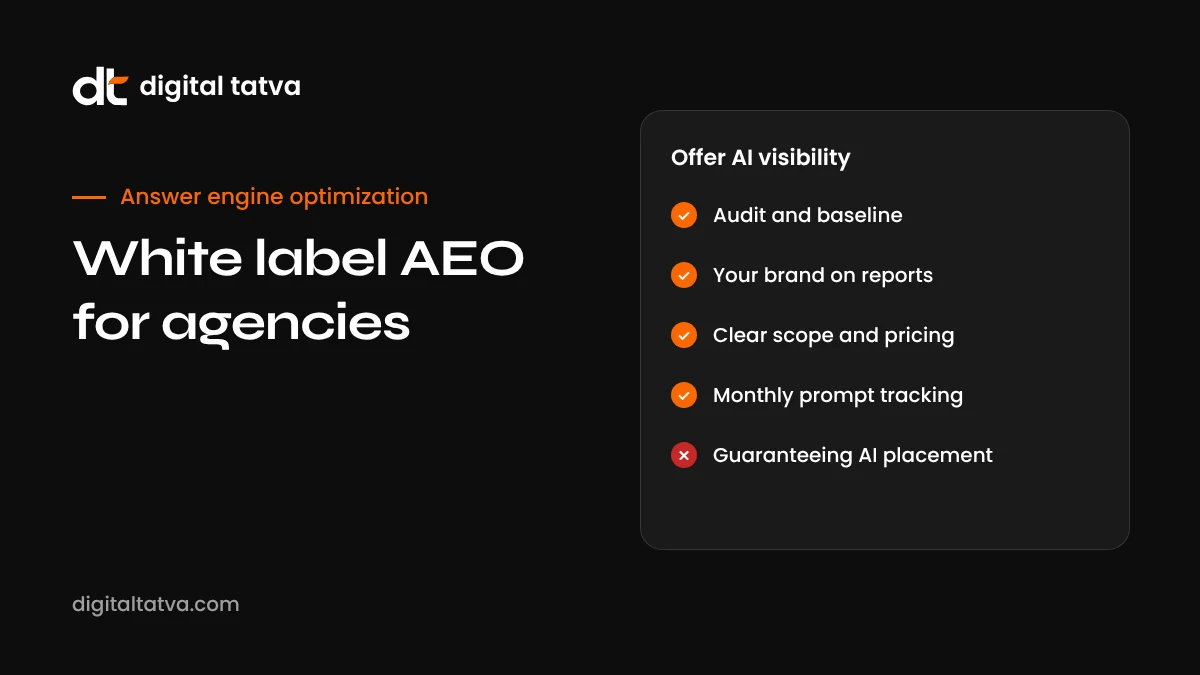
White Label AEO for Agencies: How to Offer AI Visibility
Clients are asking agencies about ChatGPT and AI search. Here is how white label AEO works, what a good partner delivers, how to package and price AI visibility services, and how to sell them honestly without promising AI placement.
On this page
- Key takeaways
- Why agencies are adding AEO now
- How white label AEO works
- What a white label AEO service should include
- Packaging AEO for your clients
- Pricing white label AEO
- Selling AEO honestly
- How to choose a white label AEO partner
- Building in-house AEO skills alongside white label
- Reporting AEO results to clients
- Common white label AEO mistakes
- Which clients benefit most from AEO
- Talking to clients about AI search: a short script
- Setting up your white label workflow
- Contracts and confidentiality
- Upselling AEO to existing SEO clients
- Tools your agency will need
- Handling difficult client questions
- How Digital Tatva can help
- White label AEO for web design agencies
- Measuring the success of your AEO offering
- Questions to ask a white-label AEO partner
- Frequently asked questions
Last updated: 13 November 2026
Quick answer: White label AEO is when an agency sells answer engine optimization services to its clients under its own brand, while a specialist partner does some or all of the work behind the scenes. It lets SEO, digital marketing and web agencies offer AI visibility services, such as AI visibility audits, prompt tracking, content restructuring and entity work, without building a full in-house team first. A good white label AEO setup includes clear deliverables, reports in your branding, a measured baseline before work begins, honest messaging that never guarantees AI placement, and a partner who explains the work well enough that your team can answer client questions confidently.
Key takeaways
- Clients are already asking agencies about ChatGPT, Gemini and Google AI Overviews. Agencies that cannot answer risk losing them.
- White label AEO lets you add AI visibility services quickly while you build internal skills.
- The core deliverables are an AI visibility audit, prompt tracking, technical fixes, content restructuring, entity work and reporting.
- Bundling AEO with existing SEO retainers is usually easier than selling it as a separate product at first.
- Honesty matters: no one can guarantee AI placement, and promising it damages trust.
- Choose partners for method, transparency and communication, not just price.
Why agencies are adding AEO now
If you run a digital marketing, SEO or web agency, you have probably heard some version of these questions from clients in the last year:
- “Why does ChatGPT recommend our competitor and not us?”
- “Our traffic dropped. Is it because of Google AI Overviews?”
- “Should we be doing something for AI search?”
- “Can you get us into Perplexity?”
These questions are not going away. AI search is now part of how buyers research, and clients expect their agency to understand it. Agencies that can answer confidently, measure AI visibility and deliver a plan are in a strong position. Agencies that cannot risk losing clients to someone who can.
Building that capability takes time: learning how different AI assistants work, developing a testing method, building reporting and training staff. White label AEO is a way to serve clients well now while you build skills in parallel. For background on the discipline, see what AEO is and AEO vs SEO.
How white label AEO works
| Stage | Your agency | White label partner |
|---|---|---|
| Sales | Owns the client relationship, scopes the need, sells the service | Provides sales materials, pricing guidance and technical support for proposals |
| Baseline | Shares client details, competitors and priorities | Runs prompt testing and audit, prepares findings |
| Delivery | Coordinates with the client, implements where agreed | Delivers audits, recommendations, content briefs or implementation as agreed |
| Reporting | Presents reports under your brand | Prepares reports and data in your branding |
| Support | Handles client communication | Answers your team’s technical questions |
Some agencies hand over everything except the client relationship. Others use a partner only for audits and tracking, and do implementation themselves. The right split depends on your team’s skills and capacity.
What a white label AEO service should include
1. AI visibility audit
A structured baseline showing how the client appears across ChatGPT, Gemini, Perplexity, Copilot, Claude and Google AI Overviews or AI Mode for a set of real buyer questions. It should cover mentions, citations, accuracy, competitors and sources, plus technical checks for AI crawler access. See AEO audits and the AI visibility audit checklist.
2. Prompt tracking
Monthly re-testing of the same prompt set across AI assistants, with trends over time. This is the backbone of ongoing reporting. See AI share of voice.
3. Technical AEO fixes
AI crawler access, rendering, schema, speed and indexing. See our technical AEO checklist.
4. Content restructuring and briefs
Rewriting key pages in an answer-first, well-structured format, plus briefs for new pages that answer gaps found in the audit. See answer-first content and content chunking for AI.
5. Entity and authority work
Aligning brand facts across the web, schema with sameAs links, review strategy and plans for third-party mentions. See entity SEO for AEO and brand mentions for AEO.
6. Reporting
Clear monthly reports in your branding showing AI mentions, citations, share of voice, AI referral traffic and actions taken. See our AEO reporting template.
Packaging AEO for your clients
Most agencies find it easiest to offer AEO in three ways:
| Package | What it includes | Best for |
|---|---|---|
| One-off AI visibility audit | Baseline across AI assistants, technical checks, prioritised recommendations | Opening the conversation; existing SEO clients |
| AEO add-on to SEO retainer | Monthly prompt tracking, AI reporting, a set number of page rewrites | Clients already paying for SEO |
| Full AEO retainer | Audit, tracking, technical work, content, entity and authority building | Clients where AI search is a major channel |
Starting with the audit works well because it gives the client something concrete, often eye-opening, and naturally leads to an ongoing engagement.
Pricing white label AEO
Pricing varies widely by market, client size and scope. Common models include:
- Fixed-fee audits, priced by the number of prompts, assistants and competitors covered.
- Monthly tracking fees, priced by prompt volume and number of assistants.
- Retainers that combine tracking with a defined amount of implementation work.
- Project fees for specific work such as site-wide schema or content restructuring.
When you resell, build in a margin that covers your account management, client communication and any implementation you do yourself. Be transparent with clients about what the work includes. Our guide to AEO pricing gives typical ranges and factors that affect cost.
Selling AEO honestly
The fastest way to damage your agency’s reputation in AEO is to overpromise. AI answers are generated by systems no agency controls. They vary between sessions, change when models update and depend on sources across the web. Promising “we will get you into ChatGPT” is not something anyone can deliver reliably.
What you can honestly promise:
- A measured baseline of current AI visibility.
- Clear identification of what is holding the client back.
- A prioritised plan to improve access, content, entity clarity and authority.
- Consistent tracking and transparent reporting.
- Expert guidance as AI search evolves.
Clients generally respond well to honesty, especially when the baseline shows them exactly where they stand. See how to choose an AEO agency, which is also a useful checklist of what clients will expect from you.
How to choose a white label AEO partner
| Question to ask | Good answer | Warning sign |
|---|---|---|
| How do you test AI visibility? | Fixed prompt sets, multiple assistants, repeated runs, documented method | “Our proprietary AI score” with no explanation |
| Which AI assistants do you cover? | ChatGPT, Gemini, Perplexity, Copilot, Claude, Google AI features | Only one assistant |
| Can I see a sample report? | Yes, with clear data and recommendations | Vague dashboards with no actions |
| Do you guarantee results? | No guarantees of AI placement; commitments on method and reporting | Guaranteed rankings or citations |
| How do you handle confidentiality? | Clear NDA and no direct client contact unless agreed | Unclear or no agreement |
| How do you support my team? | Training, documentation and responsive answers | Deliverables only, no explanation |
| What do you do yourselves vs outsource? | Clear, honest answer | Evasive answers |
Building in-house AEO skills alongside white label
White label works best as a bridge, not a permanent crutch. Use the partnership to learn:
- Shadow audits and ask the partner to explain their reasoning.
- Have your SEO team implement technical and content fixes using the partner’s guidance.
- Build your own prompt tracking for smaller clients using free AEO tools and paid platforms such as those in our list of the best AEO tools.
- Train account managers to explain AI search clearly to clients.
Over time, many agencies move from full white label to a hybrid model, using a partner for specialised work while handling routine tasks in-house. If you are hiring, see how to become an AEO specialist for the skills to look for.
Reporting AEO results to clients
AEO reporting is new to most clients, so clarity matters. A good monthly report includes:
- Headline summary: two or three sentences on what changed.
- AI mention rate: how often the client was named across tracked prompts, by assistant.
- Share of voice: compared with key competitors.
- Citations: which client pages were cited and for which questions.
- Accuracy issues: any wrong or outdated information found and actions taken.
- AI referral traffic and conversions from GA4.
- Work completed and next month’s priorities.
Explain that AI answers vary and that trends over several months matter more than single results. See AEO KPIs and tracking AI traffic in GA4.
Common white label AEO mistakes
- Reselling without understanding. If your team cannot explain the work, clients notice.
- Overpromising placement to win the deal.
- No baseline, so you cannot show progress.
- Reports full of data but no actions.
- Treating AEO as separate from SEO when the work overlaps heavily.
- Choosing partners on price alone.
Which clients benefit most from AEO
| Client type | Why AEO matters |
|---|---|
| B2B and SaaS | Buyers shortlist vendors using AI research |
| Professional services | People ask AI for recommendations of firms and experts |
| Ecommerce and D2C | Shoppers ask AI what to buy |
| Healthcare and education | High-stakes research questions where trust matters |
| Local businesses | “Best near me” questions in AI and maps |
| Publishers | AI answers affect traffic; citations matter |
See our industry guides for SaaS, ecommerce, healthcare and local businesses.
Talking to clients about AI search: a short script
Account managers often need a simple way to introduce AEO. This structure works:
- Show, do not tell. Ask two or three of the client’s buyer questions in ChatGPT and Google AI Mode during the meeting.
- Point out who appears. Note competitors named and sources cited.
- Explain the cause simply. AI recommends brands it can find, understand and verify.
- Offer a baseline. Propose an audit to measure visibility properly across assistants.
- Set expectations. No guarantees, but a clear plan and transparent tracking.
Seeing a competitor named in an AI answer is usually more persuasive than any slide.
Setting up your white label workflow
A clear workflow prevents delays and confusion once clients sign up. A simple version that works for most agencies:
- Intake form. Collect the client’s website, main products or services, target markets, top competitors, priority questions and any known AI accuracy issues.
- Kick-off with the partner. Agree the prompt set, AI assistants covered, competitors and timeline.
- Access. Share read access to Search Console, Bing Webmaster Tools and GA4 where possible, so technical and traffic analysis is accurate.
- Baseline delivery. The partner delivers the audit in your branding; your team reviews it before it goes to the client.
- Client presentation. You present findings and recommendations, with the partner available for technical questions if agreed.
- Implementation plan. Decide who implements each recommendation: your team, the partner or the client.
- Monthly cycle. Tracking, reporting, a short review call and the next set of priorities.
Contracts and confidentiality
White label relationships rely on trust. Put the basics in writing:
- Confidentiality: the partner keeps client details private and does not contact clients directly unless you agree.
- Non-solicitation: the partner does not approach your clients independently.
- Deliverables and timelines: what is delivered, in what format and when.
- Data handling: how client data and access credentials are stored and removed after the engagement.
- Quality standards: how errors are corrected and what happens if deadlines slip.
- Branding: whether the partner’s name appears anywhere in deliverables.
Upselling AEO to existing SEO clients
Your existing SEO clients are the most natural buyers for AEO, because the work builds directly on what you already do. Some approaches that feel helpful rather than pushy:
- Add an AI visibility snapshot to your next monthly report. Three or four prompts with results is enough to start a conversation.
- Connect it to their concerns. If organic clicks are flat while impressions hold, explain how AI Overviews may be affecting them.
- Offer a one-off audit at an introductory scope. A clear baseline often makes the case on its own.
- Fold some AEO into the existing retainer. For example, restructure two key pages per month for AI retrieval as part of SEO work.
See is AEO worth it for arguments clients find persuasive, and zero-click search for context on traffic changes.
Tools your agency will need
| Need | Tool type | Notes |
|---|---|---|
| Prompt tracking | AI visibility platforms or structured manual testing | Covers multiple assistants; repeated runs |
| Technical audits | SEO crawlers that report AI crawler issues | Check rendering and access |
| Schema | Validators and generators | Test before and after changes |
| Analytics | GA4 with AI referral channel groups | Standardise setup across clients |
| Reporting | Dashboards or document templates in your brand | Keep reports short and action-focused |
See our lists of the best AEO tools, AI visibility tools and the comparison of Peec AI, Otterly and Profound.
Handling difficult client questions
| Client question | Honest answer |
|---|---|
| “Why did we disappear from ChatGPT this month?” | AI answers vary and models update. We look at trends across many prompts and months, and check whether any sources changed. |
| “Can you guarantee we will be recommended?” | No one can. We can improve the factors that make recommendation more likely and track progress transparently. |
| “How long until we see results?” | Technical and content fixes can show up within weeks for search-based answers; authority takes months. |
| “Is this just SEO with a new name?” | It builds on SEO, but adds AI crawler access, prompt tracking, passage-level content and entity work that classic SEO often skips. |
How Digital Tatva can help
Digital Tatva works with agencies that want to offer AI visibility services to their clients. We can run AI visibility audits and monthly prompt tracking, prepare reports in your branding, provide technical and content recommendations, and support your team with training and answers as you build skills. We keep client relationships with you, work under confidentiality agreements and never promise AI placement. Ask us about partnership options.
Want to offer AEO to your clients? Start a conversation about white label AEO and agency partnerships, or try our free AI visibility checker to see the kind of checks we run.
White label AEO for web design agencies
Web design and development agencies are in a particularly good position to add AEO, because many of the most important fixes happen at the build stage: server rendering, clean HTML, fast performance, schema, clear page structure and crawler-friendly configuration. Adding an “AI-ready” standard to every new build, plus an optional audit and tracking service after launch, is a natural extension. Our guide to building an agent-ready website lists the technical standards worth adopting.
Measuring the success of your AEO offering
Track the health of the service itself, not just client results:
- Number of audits sold and conversion from audit to retainer.
- Client retention on AEO retainers.
- Average improvement in clients’ AI mention rates over six months.
- Time your team spends per client, to keep margins healthy.
- Client satisfaction with reports and communication.
These numbers tell you whether to expand the offering, bring more work in-house or adjust pricing.
Questions to ask a white-label AEO partner
Before signing with any white-label provider, ask questions that reveal how they really work:
- How do you measure AI visibility, and can you show a sample report with dates and prompt sets?
- What exactly is included each month, and what counts as extra work?
- Who will do the work, and what experience do they have with AI search specifically?
- How do you handle client communication: through us only, or directly under our brand?
- How do you protect our clients’ data and our client relationships?
- What happens if a client cancels mid-contract, and can deliverables be handed over?
- How do you explain to clients that AI placement cannot be guaranteed?
- Can you share a trial or a paid pilot on one client before a longer commitment?
Clear, specific answers are a good sign. Vague promises of “guaranteed rankings in ChatGPT” are a red flag, because no one controls what AI assistants say. A trustworthy partner will talk about process, measurement and realistic timelines, and will be comfortable putting service levels and confidentiality terms in writing. Ask for references from other agencies they work with, and agree on a simple monthly review call so problems surface early rather than at renewal time.
Related reading: 10 Best AI Visibility Tools for Agencies in 2026
Frequently asked questions
What is white label AEO?
It is answer engine optimization delivered by a specialist partner but sold and presented by an agency under its own brand.
Can a small agency offer AEO services?
Yes. White label partnerships let small agencies offer AI visibility audits, tracking and reporting without building a full team first.
What deliverables does white label AEO include?
Typically an AI visibility audit, monthly prompt tracking, technical recommendations, content restructuring or briefs, entity and authority plans, and branded reports.
How should agencies price AEO?
Common models are fixed-fee audits, monthly tracking fees and retainers that include implementation. Build in margin for account management and your own work.
Can agencies guarantee clients will appear in ChatGPT?
No. AI answers are generated by systems no agency controls. Honest agencies promise a clear method, measurement and improvement work, not placement.
Is AEO different from SEO for agencies?
It builds on SEO but adds AI crawler access, prompt research, passage-level content, entity work and AI visibility tracking. Many agencies offer it as an extension of SEO.
How do I choose a white label AEO partner?
Look for a documented testing method, coverage of multiple AI assistants, clear sample reports, no guarantees, strong confidentiality and good support for your team.
Does Digital Tatva offer white label AEO?
Yes. We partner with agencies to deliver AI visibility audits, tracking and recommendations under the agency’s brand.
How do agencies price white-label AEO?
Most agencies mark up the partner’s wholesale cost to cover account management, reporting and margin. Price based on the value to the client, not just the cost.
Can a white-label partner work directly with our clients?
Some can, under your brand. Agree communication rules and confidentiality in writing before any direct contact.
How long before clients see results?
Early improvements can appear within weeks for technical fixes, while broader visibility gains usually take several months.
Product details, prices and features are checked at the time of writing and can change. Sources are linked in the text so you can check them yourself.
How does your brand appear in AI answers?
We test the questions your buyers ask across the major AI assistants and search engines, then show you what to fix first.
Get an AI Visibility Audit