10 Best ChatGPT Rank Tracking Tools in 2026 (Prices and Features Compared)
The 10 best tools to track your brand in ChatGPT, compared on price, prompts, citations and best use, plus how to set up tracking and improve results.
On this page
- Key takeaways
- What is ChatGPT rank tracking?
- Why track your brand in ChatGPT?
- How ChatGPT rank tracking tools work (and their limits)
- Best ChatGPT rank tracking tools compared
- The 10 best ChatGPT rank tracking tools in detail
- Best ChatGPT tracker by need
- How to compare ChatGPT tracking tools fairly
- How to set up ChatGPT rank tracking in 7 steps
- How to improve your ChatGPT rankings after tracking
- How Digital Tatva can help
- Frequently asked questions
Last updated: 23 November 2026
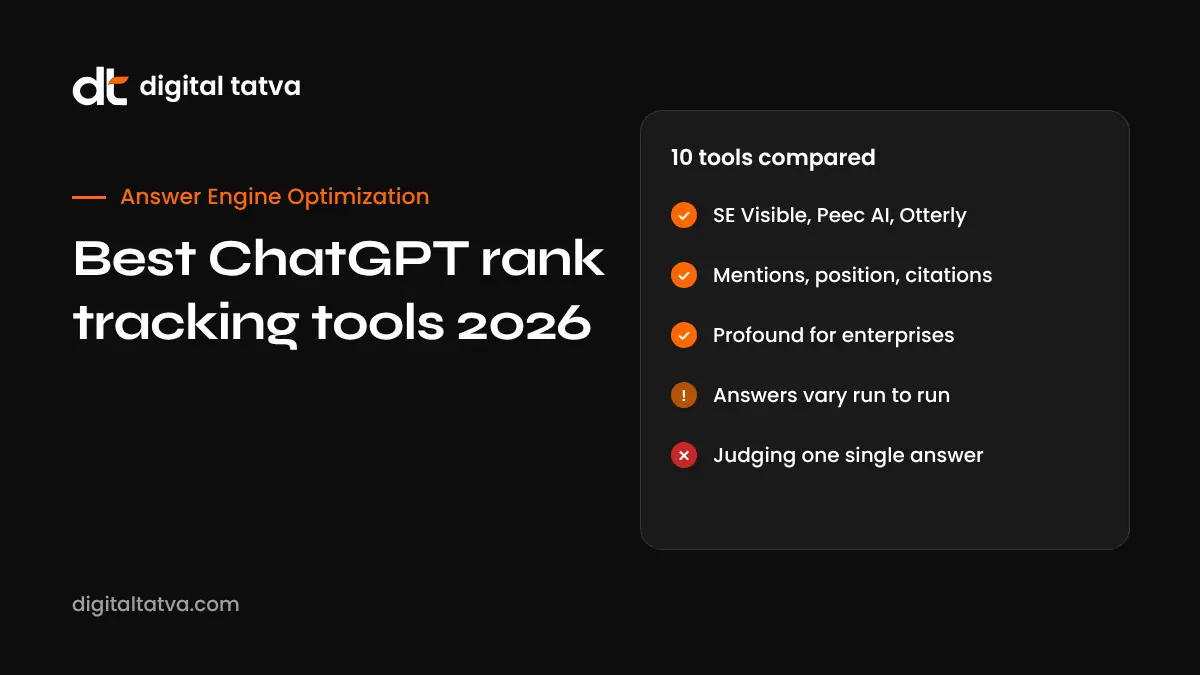
Quick answer: The best ChatGPT rank tracking tools in 2026 are SE Visible by SE Ranking (best for linking ChatGPT mentions to the sources behind them, from $89 a month), Peec AI (best for marketing teams, from $95), Otterly.AI (best budget pick, from $29), Profound (best for enterprises), Semrush AI Visibility Toolkit (best for Semrush users, $99 per domain), Ahrefs Brand Radar (best for market-wide research), Scrunch AI (best for buyer personas, from $300), Rankscale (best pay-as-you-go option), AthenaHQ (best for catching false claims, free tier) and HubSpot AEO (cheapest for HubSpot users, $50). They all run your buyer questions through ChatGPT on a schedule and report whether your brand is mentioned, where it ranks in the answer, how it is described and which pages ChatGPT cites. Prices change often, so confirm on each vendor’s page before buying.
Key takeaways
- ChatGPT is the most used AI assistant in the world, with about 5 billion web visits in October 2026, so it is usually the first engine to track.
- “Ranking” in ChatGPT means mention rate, position in the answer, sentiment and citations, not a single fixed position.
- ChatGPT answers change from run to run, so look at trends across many prompts and weeks.
- Compare tools on cost per prompt, whether ChatGPT is included on your plan and whether you get citation data.
- Tracking only pays off when you act on it: fix the pages and third-party sources ChatGPT relies on.
What is ChatGPT rank tracking?
ChatGPT rank tracking means measuring how often, where and how ChatGPT mentions your brand when people ask questions you care about, such as “best CRM for small businesses” or “top AEO agency in India”. Instead of tracking a keyword position on Google, you track a set of prompts and record four things each time ChatGPT answers:
- Mention: does your brand appear at all?
- Position: if ChatGPT lists several options, where are you in the list?
- Sentiment and accuracy: is the description positive, neutral or negative, and is it correct?
- Citations: which web pages did ChatGPT link to as sources, and is your site one of them?
Across many prompts, these become metrics such as mention rate, share of voice against competitors, average position and citation share. For a broader introduction, read what AI search visibility is.
Why track your brand in ChatGPT?
ChatGPT drew about 4.99 billion web visits in October 2026, more than four times Gemini, according to Semrush estimates published by Exploding Topics. People now ask it for product recommendations, vendor shortlists and service providers. Those conversations rarely show up in Google Search Console, and many never send a click. If ChatGPT recommends three competitors and not you, you lose demand you cannot see. See our most popular AI tools ranking for the wider picture.
Tracking also shows you what to fix. When a tool reports which pages ChatGPT cites for your category, you know which of your pages to improve and which review sites, directories or publications to get listed on.
How ChatGPT rank tracking tools work (and their limits)
Every tool on this list follows the same basic process: you add prompts, competitors and your brand name; the tool sends those prompts to ChatGPT on a schedule; and it parses the answers for mentions, positions, sentiment and links. A few limits apply to all of them:
- Answers vary every time. Asking the same question twice rarely returns the same list. Good tools run prompts repeatedly and show averages and trends. Treat a single answer as a sample, not a ranking.
- Citations change quickly. Independent testing reported by Rework found that ChatGPT search citations can turn over by roughly three quarters from week to week. Weekly or monthly trends matter more than daily swings.
- Collection method matters. Some tools query ChatGPT through the API, others simulate the consumer interface with web search. Results can differ from what a logged-in user with memory and personalisation sees. Ask vendors how they collect data.
- Location and language change answers. Track prompts in the countries and languages where your buyers are.
- Mentions without links are common. ChatGPT often names brands without citing a page. Track both mentions and citations.
None of this makes tracking pointless. It means you should track enough prompts (30 to 100 is a good range for most brands), look at trends over several weeks and use the data to guide content and PR work.
Best ChatGPT rank tracking tools compared
| # | Tool | Entry price | Entry prompts | ChatGPT on entry plan? | Best for |
|---|---|---|---|---|---|
| 1 | SE Visible by SE Ranking | $89/month | 75 | Yes | Tracing ChatGPT mentions to cited sources |
| 2 | Peec AI | $95/month | 50 (3 models) | If you pick it as one of your 3 models | Most marketing teams |
| 3 | Otterly.AI | $29/month | 15 | Yes | Small budgets and freelancers |
| 4 | Profound | Custom | 7-day trial | Yes | Enterprises |
| 5 | Semrush AI Visibility Toolkit | $99/month per domain | 25 | Yes | Semrush users |
| 6 | Ahrefs Brand Radar | From $199/month add-on | Large prompt index plus custom prompts | Yes | Market-wide research |
| 7 | Scrunch AI | $300/month ($250 yearly) | 350 custom plus industry prompts | Yes | B2B buyer personas |
| 8 | Rankscale | Pro $99/month (credits) | Credit-based | Yes, 0.25 credits per check | Flexible, pay-as-you-go tracking |
| 9 | AthenaHQ | Free tier; Starter $295/month | 300 free credits | Yes | Catching false claims about your brand |
| 10 | HubSpot AEO | $50/month ($45 yearly) | 25 prompts across 3 engines | Yes | HubSpot users on a budget |
Prices are the published entry prices from vendor pages and recent third-party comparisons checked in October and November 2026. Many tools offer yearly discounts and add-ons, and some prices vary by region.
The 10 best ChatGPT rank tracking tools in detail
1. SE Visible by SE Ranking: best for tracing ChatGPT visibility to cited sources
- Starting price: $89/month (Basic, 75 prompts)
- Free option: 10-day trial
- Engines: ChatGPT, Gemini, Google AI Mode and AI Overviews; Claude (API) on the Agency plan
- Best for: agencies and in-house teams that report AI visibility to clients or leadership
SE Visible by SE Ranking is a standalone AI visibility platform from the team behind SE Ranking. For ChatGPT, it tracks mentions, position, share of voice, sentiment and the sources ChatGPT cites. Its strongest feature is that cited sources come with SEO data such as traffic and backlinks, so you can see which pages ChatGPT trusts and why. Every metric opens into the actual answer behind it, which makes client reporting easier to explain.
Core costs $189 a month for 200 prompts and Agency $399 for 1,000 prompts, with yearly billing about 20% cheaper.
Pros: ChatGPT on every plan, source-level SEO data, clear drill-downs, good for multi-client reporting.
Cons: Claude only on the top plan; heavy users will need a higher tier.
2. Peec AI: best for most marketing teams
- Starting price: $95/month (Starter, 50 prompts)
- Free option: trial
- Engines: choose 3 of 6 models on Starter; more on higher plans
- Best for: marketing teams that want clean, regular reports
Peec AI tracks your prompts across the models you choose and reports visibility, position, sentiment and citation share. It is easy to set up and its dashboards are clear enough for non-specialists. Pro costs $245 a month for 150 prompts and Advanced $495 for 350, with about 15% off yearly.
One important detail: on the entry plan you pick three models, so make sure ChatGPT is one of them.
Pros: good balance of price and insight, citation share, fact-checking of AI claims.
Cons: model limits on lower plans; cost per prompt rises if you need many engines.
3. Otterly.AI: best budget ChatGPT tracker
- Starting price: $29/month (Lite, 15 prompts)
- Free option: trial
- Engines: ChatGPT, Google AI Overviews, Perplexity and Microsoft Copilot on every plan; Claude, AI Mode and Gemini as add-ons
- Best for: freelancers, local businesses and single brands
Otterly.AI is the cheapest serious way to start tracking ChatGPT. It records mentions and the links ChatGPT references, and builds a citation-based share of AI voice. Standard ($189, 100 prompts) adds API access and Premium ($489, 400 prompts) suits agencies.
Pros: low entry price, ChatGPT on every tier, simple interface, GEO audit features.
Cons: only 15 prompts on Lite; some engines cost extra.
4. Profound: best for enterprises
- Starting price: custom (earlier self-serve tiers started at $99 a month)
- Free option: 7-day trial
- Engines: up to nine, including ChatGPT, Perplexity, Google AI Mode, Gemini, Copilot, Claude and DeepSeek
- Best for: large brands needing many engines, seats and API access
Profound is one of the best-funded platforms in the category and is built for enterprise programmes. Beyond prompt tracking, its conversation explorer helps teams understand what people ask AI assistants in their category, and it offers detailed competitor citation analysis. Expect a sales process rather than a credit card checkout.
Pros: broad engine coverage, enterprise features, deep competitor insight.
Cons: no published self-serve pricing; overkill for small teams. See our comparison of Peec AI vs Otterly vs Profound.
5. Semrush AI Visibility Toolkit: best for Semrush users
- Starting price: $99/month per domain
- Free option: limited
- Engines: ChatGPT and Google AI surfaces
- Best for: teams already doing SEO in Semrush
Semrush’s AI Visibility Toolkit adds ChatGPT and Google AI tracking for custom prompts next to your keyword and backlink data. It includes 25 prompts, with extra prompt packs available (reported at $60 a month for 50 more). It reports mentions rather than detailed citation analysis on every view, so check whether it covers what you need.
Pros: one login with your SEO data, familiar reports, easy for existing customers.
Cons: priced per domain; fewer prompts than specialists at the same price. See Semrush vs Ahrefs.
6. Ahrefs Brand Radar: best for market-wide research
- Starting price: AI index add-on from $199/month, plus an Ahrefs plan (pricing varies by region)
- Free option: no
- Engines: ChatGPT, AI Overviews, AI Mode, Perplexity, Gemini, Copilot and Claude
- Best for: comparing brands across a whole category
Brand Radar works differently from most tools. Instead of only tracking your own prompt list, it draws on a large index of prompts and AI answers, so you can see how often each brand in your market is mentioned and which domains ChatGPT cites. That makes it excellent for pitch research, competitor analysis and finding citation opportunities. Custom prompt tracking is also available.
Pros: huge dataset, cited domain and page analysis, strong competitor research.
Cons: requires an Ahrefs subscription; total cost adds up.
7. Scrunch AI: best for B2B buyer personas
- Starting price: $300/month ($250 billed yearly)
- Free option: 7-day trial
- Engines: ChatGPT, Claude, Gemini, Perplexity, AI Mode, AI Overviews and Meta AI
- Best for: B2B brands selling to different decision makers
Scrunch lets you track how ChatGPT answers change for different personas, such as a CFO versus an IT manager. The Starter plan includes 350 custom prompts, around 1,000 industry prompts, three personas, page audits and three users, which makes it good value per prompt for larger programmes.
Pros: persona tracking, low cost per prompt at volume, citation analysis kept separate from share of voice.
Cons: high entry price for small businesses.
8. Rankscale: best pay-as-you-go option
- Starting price: Pro $99/month (Essentials $20 without included credits)
- Free option: limited
- Engines: ChatGPT, AI Mode and others on a credit system
- Best for: teams that want to control how often each prompt runs
Rankscale uses credits, with a ChatGPT check costing 0.25 credits, and lets you set refresh frequency from hourly to monthly. That flexibility helps you spend more on important prompts and less on long-tail ones. Its citation analysis panel shows which sources ChatGPT uses, and white-label dashboards are available on Growth plans for agencies.
Pros: flexible credits, adjustable frequency, white-label options.
Cons: credit maths takes some planning.
9. AthenaHQ: best for catching false claims
- Starting price: free Essential tier; Starter $295/month
- Free option: yes, 300 credits
- Engines: 5 models free, 9 on Starter
- Best for: testing before buying and monitoring brand accuracy
AthenaHQ’s free tier gives 300 credits, where one credit equals one AI response, which is enough to measure a baseline. It also flags discrepancies when ChatGPT makes claims about your brand that may be wrong, such as outdated prices or discontinued products. Starter adds 3,600 credits a month and more models.
Pros: genuine free tier, accuracy checks, broad model coverage on paid plans.
Cons: big jump from free to paid. If ChatGPT gets facts wrong, see how to fix wrong AI answers about your brand.
10. HubSpot AEO: cheapest for HubSpot users
- Starting price: $50/month ($45 billed yearly)
- Free option: free trial with 25 prompts
- Engines: ChatGPT and two other AI engines sharing 25 prompts
- Best for: small HubSpot customers who want a simple start
HubSpot’s AEO tool gives a visibility score, sentiment and citations split by domain and content type, and can build prompts from your CRM data. It is affordable and convenient if you already use HubSpot, though the 25 prompts are shared across engines and the product was still evolving in late 2026. Full details in our HubSpot AEO tool review.
Pros: low price, CRM integration, easy setup.
Cons: few prompts; fewer advanced features than specialists.
Also worth a look: Nightwatch (AI prompt tracking next to classic rank tracking), Trakkr (multi-brand plans with daily ChatGPT prompts) and Morningscore (proof-of-mention screenshots for small businesses).
Best ChatGPT tracker by need
| Your situation | Best pick | Why |
|---|---|---|
| Agency reporting to clients | SE Visible | Source-level data and clear drill-downs for reports |
| In-house marketing team | Peec AI | Clean dashboards and citation share |
| Small business or freelancer | Otterly.AI | Lowest entry price with ChatGPT included |
| Enterprise brand | Profound | Engines, seats, API and depth |
| Already on Semrush | Semrush AI Visibility Toolkit | One login with SEO data |
| Already on Ahrefs | Ahrefs Brand Radar | Market-wide mention data |
| B2B with several buyer types | Scrunch AI | Persona tracking |
| Want to test for free | AthenaHQ | 300 free credits |
| HubSpot customer on a budget | HubSpot AEO | $50 a month inside HubSpot |
How to compare ChatGPT tracking tools fairly
- Cost per prompt: Otterly Lite works out at about $1.93 per prompt ($29 for 15), Peec Starter about $1.90 ($95 for 50), SE Visible Basic about $1.19 ($89 for 75) and Scrunch Starter about $0.86 ($300 for 350).
- ChatGPT included or optional: confirm ChatGPT is on your plan, not an add-on or one of a limited set of models.
- Run frequency: daily, weekly or monthly runs affect cost and how quickly you see changes.
- Citation data: mentions tell you where you stand; citations tell you what to fix.
- Countries and languages: check that you can track the markets where your buyers are.
- Exports and API: agencies need white-label reports or data exports.
How to set up ChatGPT rank tracking in 7 steps
- List real buyer questions. Use sales calls, support tickets and search data. Include “best”, “vs”, “alternatives”, “for [industry]” and location prompts. See AEO prompt research.
- Group prompts by topic and funnel stage. Awareness, comparison and decision prompts behave differently.
- Add competitors. Track three to five direct competitors so share of voice means something.
- Set markets and languages. Track the countries where you sell.
- Run a four-week baseline. Do not react to single answers; wait for trends.
- Study citations. List the pages and domains ChatGPT cites most for your prompts.
- Review monthly. Compare mention rate, position and citation share after each round of changes.
If you are not ready to pay for a tool, follow our free method in how to check if ChatGPT recommends your brand and how to track brand mentions in ChatGPT.
How to improve your ChatGPT rankings after tracking
The tools tell you where you stand. These actions move the numbers:
- Let ChatGPT read your site. Allow OAI-SearchBot and make sure your pages render without heavy JavaScript. See how ChatGPT indexing works.
- Answer questions directly. Put a clear, factual answer at the top of key pages, with question headings and comparison tables. See answer-first content.
- Get listed where ChatGPT looks. Earn mentions on the review sites, directories, forums and publications your tracker shows in citations.
- Keep facts consistent. Prices, features, locations and company details should match across your site and profiles.
- Publish original data. Studies and benchmarks are easy for AI to cite. See original research for AEO.
- Measure AI referrals. Track visits from chatgpt.com in analytics. See track AI traffic in GA4.
Our full ChatGPT SEO guide covers each step in depth.
Illustrative example: A B2B software company tracks 60 buyer prompts in ChatGPT for a month and finds it appears in 12% of answers, while two competitors appear in more than 40%. The citation report shows ChatGPT relies heavily on two review sites and a comparison article where the company is missing. It updates its review profiles, publishes a clear comparison page and pitches the article’s author with current product details, then watches mention rate over the next two months. This is an illustrative scenario, not a client story.
Checklist: choosing and using a ChatGPT rank tracker
- ChatGPT included on the plan you are buying.
- 30 to 100 real buyer prompts listed and grouped.
- Three to five competitors added.
- Countries and languages set to match your market.
- Four-week baseline recorded before making judgements.
- Citation sources reviewed and turned into a fix list.
- Monthly review of mention rate, position, sentiment and citation share.
- AI referral traffic tracked in analytics.
Tracking other engines too? See best AI visibility tools, AI Overview tracking tools and AI Mode tracking tools.
How Digital Tatva can help
A tracker shows the problem; fixing it is the work. Digital Tatva runs ChatGPT and AI visibility audits, finds the sources ChatGPT relies on in your category, and improves your content, entity data and third-party mentions so ChatGPT is more likely to recommend you. We never guarantee AI placement, but we do show you exactly what changes and why. See our AI visibility audit and AEO services.
Does ChatGPT recommend your brand? Request an AEO audit or try the free AI visibility checker.
Related reading: 10 Best AI Visibility Tools for Agencies in 2026
Frequently asked questions
What is the best ChatGPT rank tracking tool?
SE Visible is best for tracing ChatGPT mentions back to the sources behind them, Peec AI suits most marketing teams, Otterly.AI is the best budget choice and Profound is built for enterprises. The right choice depends on prompt volume, budget and whether you need client reporting.
Can you rank in ChatGPT like in Google?
Not in the same way. ChatGPT does not have fixed positions. “Ranking” means how often you are mentioned, where you appear in lists, how you are described and whether your pages are cited, measured across many prompts.
How much do ChatGPT rank trackers cost?
Entry prices range from about $29 a month (Otterly.AI Lite) and $50 (HubSpot AEO) to $300 (Scrunch AI Starter), with enterprise tools priced on request. AthenaHQ offers a free tier with 300 credits.
Is there a free ChatGPT rank tracker?
AthenaHQ has a free tier, and several tools offer trials. You can also track manually by asking ChatGPT your buyer questions each month and logging the results in a spreadsheet.
Why do ChatGPT results change every time I check?
ChatGPT generates answers fresh each time and its web sources change often. That is why tools run prompts repeatedly and report averages and trends instead of single results.
How many prompts should I track in ChatGPT?
Most businesses do well with 30 to 100 prompts covering their main products, use cases, comparisons and locations. Local businesses can start with 15 to 30.
Do ChatGPT rank trackers show citations?
Most do. SE Visible, Peec AI, Otterly.AI, Profound, Ahrefs Brand Radar, Scrunch, Rankscale and HubSpot AEO all report sources or citations in some form. Check how detailed the data is on your plan.
Can I track ChatGPT visibility in different countries?
Yes, with most tools. Set the country and language for each prompt set, because ChatGPT answers vary by location.
How long does it take to improve ChatGPT visibility?
Some changes, such as fixing crawler access or wrong facts, can show results within weeks. Earning mentions and citations usually takes several months. See how long AEO takes.
Do I need a tool if I hire an AEO agency?
A good agency will track visibility for you and share the data. If you manage AEO in-house, a tool helps you measure progress and spot problems early.
Product details, prices and features are checked at the time of writing and can change. Sources are linked in the text so you can check them yourself.
How does your brand appear in AI answers?
We test the questions your buyers ask across the major AI assistants and search engines, then show you what to fix first.
Get an AI Visibility Audit