AEO for D2C Brands: Get Your Products Recommended by AI Assistants
How direct-to-consumer brands can get their products recommended when shoppers ask AI assistants what to buy.
On this page
- Key takeaways
- Why D2C brands need AEO
- What makes D2C different from general ecommerce
- The D2C AEO framework
- D2C AEO by category
- A 90-day plan for D2C brands
- Measuring D2C AEO
- Common D2C AEO mistakes
- Illustrative example: a D2C skincare brand
- Questions to answer on every D2C product page
- How Digital Tatva can help
- Frequently asked questions
Last updated: 17 November 2026
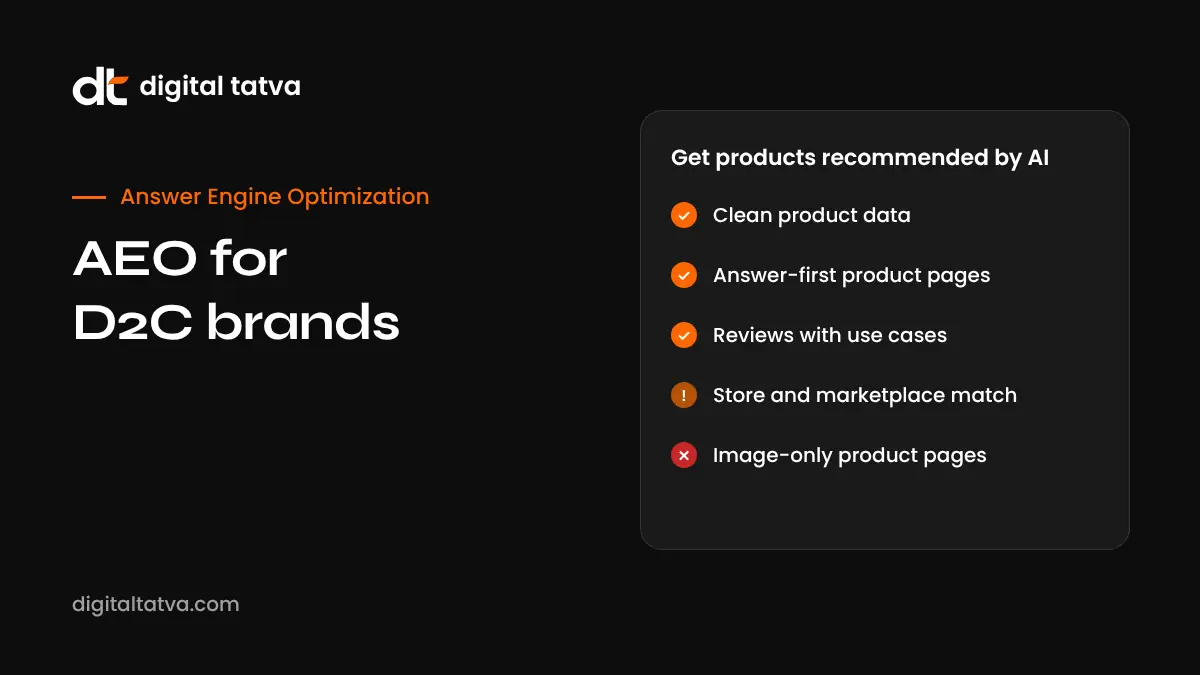
Quick answer: AEO for D2C brands means making your products the ones ChatGPT, Gemini, Google AI Mode and Perplexity recommend when shoppers ask what to buy. It rests on five things: clear product data and structured data, product pages that answer real buying questions, genuine reviews that mention use cases, independent coverage from creators and publications, and consistent brand facts across your website, marketplaces and social profiles. For Indian D2C brands, it also means covering Hindi and regional-language questions and keeping marketplace listings aligned with your own store.
Key takeaways
- Shoppers increasingly ask AI assistants for product recommendations instead of scrolling marketplaces.
- D2C brands compete with marketplace listings, reseller pages and affiliate roundups for those AI recommendations.
- Your own store should be the clearest, most complete source of truth about your products.
- Reviews, creator content and publisher roundups heavily influence AI product answers.
- Results build over months; nobody can guarantee placement in AI shopping answers.
Why D2C brands need AEO
D2C brands have built their growth on performance marketing, Instagram, influencers and marketplaces. That still works, but the research stage is shifting. A shopper planning a purchase now asks “best sunscreen for oily skin in Indian summer under 600 rupees” or “which protein bar has the least sugar” and gets a short list from an AI assistant. ChatGPT shows shopping results with product cards, and Google’s AI Mode draws on its shopping data for product questions.
The brands that appear in those lists get the consideration. The brands that do not often never know they lost the sale. For D2C brands with strong products but limited budgets, AEO is a way to win organic visibility at the decision stage. For the general ecommerce picture, see AEO for ecommerce and ChatGPT shopping optimization.
What makes D2C different from general ecommerce
| D2C reality | AEO implication |
|---|---|
| Smaller catalogue, strong brand story | Each hero product page must be excellent and specific |
| Sells on own site and marketplaces | Product facts must match everywhere |
| Heavy influencer and Instagram marketing | Creator content is valuable evidence if it is discoverable |
| Competes with established brands | Specific “best for” positioning beats generic claims |
| Ingredient, material or sustainability claims | Claims need clear evidence pages AI can cite |
| Price-sensitive Indian shoppers | Accurate prices and offers in data and on pages |
The D2C AEO framework
1. Know your shopping prompts
List the questions shoppers ask before buying in your category: needs (“for sensitive skin”), budgets (“under 1,000 rupees”), comparisons (“Brand A vs Brand B”), occasions (“gift for new parents”) and trust (“is Brand X genuine”). Pull them from customer support chats, reviews, Instagram comments, marketplace Q&A and search data. Then run them in ChatGPT, Gemini, Google AI Mode and Perplexity to see which brands appear today. See AEO prompt research.
2. Make product data complete and consistent
- Product schema with name, brand, price, currency, availability, GTIN or SKU, images and genuine aggregate ratings.
- Google Merchant Center feeds with full titles, attributes and correct categories.
- Identical core facts on your store, Amazon, Flipkart, Nykaa, Myntra or other marketplaces you use.
Mismatched prices or names across channels are one of the most common reasons AI gets D2C products wrong. See schema markup for AEO.
3. Rewrite hero product pages for buying questions
Most D2C product pages are lifestyle-led: beautiful images, short taglines. AI needs facts. Each hero product page should state clearly who it is for and not for, key ingredients or materials, sizes and variants, how to use it, results to expect and timelines, certifications or test results, delivery and return terms, and a genuine FAQ. Keep the brand voice, but answer the questions.
4. Publish buying guides and honest comparisons
AI frequently cites buying guides. Publish guides such as “How to choose a sunscreen for Indian weather” or “Plant protein vs whey: which is right for you”, and fair comparisons between your own products and category alternatives. Link naturally to your products without overselling.
5. Turn reviews into evidence
Ask customers for reviews after they have used the product, encourage them to mention their need and result, mark reviews up properly on your site, and keep marketplace reviews healthy. Never buy or fake reviews. See review sites for AEO.
6. Make creator content discoverable
Influencer content is often trapped in Instagram stories that AI cannot use. Encourage creators to publish YouTube reviews, blog posts or reels with clear captions, and feature their reviews on your site with permission. See YouTube for AEO. Paid partnerships must be disclosed.
7. Earn publisher roundups
“Best of” lists from beauty, fitness, parenting, tech or food publications often appear in AI citations. Use your AI visibility audit to find which publications AI cites for your category, then pitch genuine stories, samples and data.
8. Build a clear brand entity
Publish an about page with founders, founding year, location, manufacturing details and certifications. Align it with LinkedIn, Instagram bio, marketplace brand stores and press. Add Organization schema. When shoppers ask “is this brand genuine?”, AI should find clear, consistent answers.
9. Cover Hindi and regional-language questions
Many Indian shoppers ask in Hindi, Hinglish or regional languages, especially by voice. Translate key FAQs and product information where your audience needs it. See multilingual AEO.
10. Prepare for AI agents that shop
AI agents are starting to complete purchases. OpenAI launched ChatGPT Wallet in the US in November 2026. Keep checkout simple and make sure bot protection does not block legitimate agents. See Web Bot Auth.
D2C AEO by category
| Category | Key prompts | Priority evidence |
|---|---|---|
| Beauty and skincare | Skin type, climate, ingredients, budget | Ingredient pages, dermatologist input, detailed reviews |
| Food and nutrition | Sugar, protein, vegan, allergens, taste | Nutrition tables, lab tests, certifications |
| Fashion and footwear | Fit, size, fabric, occasion | Size guides, fabric details, fit reviews |
| Home and kitchen | Material, durability, size, care | Specs, warranty, care guides |
| Baby and parenting | Safety, age suitability, materials | Safety certifications, paediatric guidance |
| Electronics accessories | Compatibility, battery, warranty | Compatibility lists, spec tables |
A 90-day plan for D2C brands
- Weeks 1 to 3: build your shopping prompt set and baseline across AI assistants; list accuracy issues and cited sources.
- Weeks 4 to 6: fix product schema, feeds and marketplace consistency; publish a clear about and policies page.
- Weeks 7 to 9: rewrite your top five product pages and publish two buying guides.
- Weeks 10 to 12: launch a review request flow, line up creator and publisher outreach, re-test prompts.
For seasonal peaks such as Diwali and year-end sales, plan content six to eight weeks ahead. See holiday AEO.
Measuring D2C AEO
- Share of AI answers mentioning your products for your prompt set.
- Accuracy of prices and product details in AI answers.
- Referral traffic and revenue from ChatGPT, Perplexity and Gemini in GA4. See tracking AI traffic in GA4.
- Branded search growth and direct traffic.
- Review volume and quality.
Common D2C AEO mistakes
- Relying on Instagram content that AI cannot read.
- Different prices or names on store and marketplaces.
- Vague claims like “best quality” with no evidence.
- Product pages built entirely from images.
- Ignoring negative reviews instead of responding and improving.
Illustrative example: a D2C skincare brand
This is an illustrative scenario, not a client story.
A young Indian skincare brand sells sunscreens and moisturisers on its own Shopify store and two marketplaces. When shoppers ask AI assistants for “best sunscreen for oily skin in humid weather under 600 rupees”, the brand rarely appears, while two larger brands and several marketplace listings dominate.
The audit finds that the brand’s product pages are mostly images with short taglines, the SPF and ingredient details appear only inside product photos, the marketplace listings use different product names, and there are few detailed reviews. Fixes include rewriting the sunscreen page with a plain-language summary, SPF and PA ratings in text, skin type suitability, texture and white cast details, and an FAQ; aligning product names and prices across channels; adding Product schema with genuine ratings; publishing a guide on choosing sunscreen for Indian weather; and starting a post-purchase review request that asks customers about their skin type and experience. Monthly re-tests then track whether the brand appears more often and is described accurately.
Questions to answer on every D2C product page
- Who is this for, and who should not use it?
- What makes it different from the obvious alternatives?
- What exactly is in it, and in what amounts where relevant?
- How do you use it, and how long before results?
- What size options and prices are available?
- Is it tested or certified, and by whom?
- What are delivery, return and refund terms?
- What do real customers say about it?
If a shopper or AI assistant cannot find these answers in text on the page, they will rely on someone else’s description.
How Digital Tatva can help
Digital Tatva helps D2C brands in India and abroad get their products recommended by AI assistants. We audit shopping prompts, fix product data and schema, rewrite hero product pages, build buying guides, set up review flows and pursue genuine coverage. We never promise placement in AI answers. See our AEO services for ecommerce and D2C brands and AEO for Shopify.
Are AI assistants recommending your products? Try the free AI visibility checker or request an AEO audit for your D2C brand.
Related reading: Amazon Rufus optimization.
Frequently asked questions
What is AEO for D2C brands?
It is the work of making a direct-to-consumer brand’s products the ones AI assistants recommend when shoppers ask what to buy, through clear product data, strong pages, reviews, coverage and consistent brand facts.
Does AEO replace Instagram and performance marketing?
No. It adds organic visibility at the research stage, where shoppers increasingly ask AI for recommendations. It works alongside paid and social channels.
How do I get my products into ChatGPT shopping results?
No one can guarantee it. Accurate product data, clear pages, genuine reviews and independent mentions improve your chances.
Should my marketplace listings match my website?
Yes. Matching names, prices and key facts across your store and marketplaces helps AI describe your products accurately.
Do influencer posts help AEO?
They help most when they are discoverable, such as YouTube reviews, blog posts or captioned reels, and when partnerships are disclosed.
Do I need Hindi content for AEO?
If many of your customers search or ask in Hindi or regional languages, translating key product information and FAQs can help.
How long does D2C AEO take?
Data and page fixes take a few weeks. Changes in AI recommendations usually build over three to six months.
What is the most common D2C AEO mistake?
Product pages built mostly from images and taglines, with few clear facts AI can quote.
Is AEO worth it for a small D2C brand?
Often yes, because it targets high-intent research moments organically. Start with your top products and expand.
Can AEO help with marketplace sales too?
Yes. Better brand recognition and accurate product information in AI answers can lift sales across all your channels.
Product details, prices and features are checked at the time of writing and can change. Sources are linked in the text so you can check them yourself.
How does your brand appear in AI answers?
We test the questions your buyers ask across the major AI assistants and search engines, then show you what to fix first.
Get an AI Visibility Audit