AEO for Dentists and Dental Clinics: Get Recommended When Patients Ask AI
How dental clinics can get recommended when patients ask ChatGPT, Gemini and Google AI which dentist to visit.
On this page
Last updated: 17 November 2026
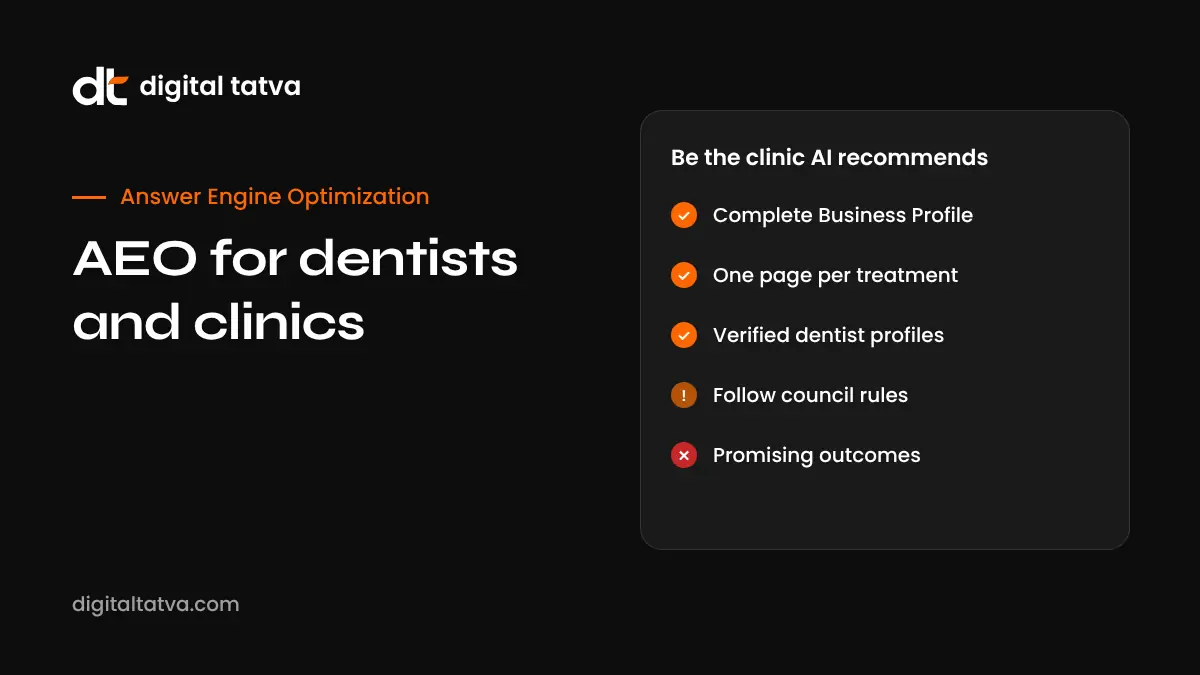
Quick answer: AEO for dentists and dental clinics means helping your practice get recommended when patients ask ChatGPT, Gemini, Google AI Mode or Siri questions like “best dentist near me for root canal” or “painless braces clinic in Ahmedabad”. The essentials are a complete Google Business Profile with the right categories and services, consistent clinic details across directories, a dedicated page for each treatment, clear dentist profiles with real qualifications, genuine patient reviews that mention treatments, and local mentions. Everything must follow your dental council’s rules on advertising and testimonials.
Key takeaways
- Patients increasingly ask AI assistants which dentist to visit, especially for higher-value treatments like implants, aligners and root canals.
- AI recommendations for clinics lean heavily on Google Business Profile, reviews, directories and clear treatment pages.
- Each treatment deserves its own page explaining suitability, process, timelines and how pricing works.
- Dentist profiles with verified qualifications build the expertise signals AI looks for.
- Professional rules on advertising and testimonials apply. Never invent outcomes or credentials.
How patients choose a dentist now
A patient with a toothache used to search “dentist near me” and call the first clinic with good ratings. Today, many ask a more detailed question: “Which dentist in Satellite, Ahmedabad is good for dental implants and open on Sunday?” or “Is clear aligner treatment painful and which clinic offers it in Pune?” AI assistants answer with two or three clinic names and a short reason for each.
For dental practices, this matters most for elective and high-value treatments, where patients research before booking: implants, aligners, cosmetic dentistry, smile makeovers, root canals and wisdom tooth removal. For broader healthcare guidance, see AEO for healthcare.
The dental prompts that matter
| Prompt type | Example |
|---|---|
| Location and treatment | “Best dentist for root canal in Vastrapur” |
| Urgency | “Emergency dentist open now near me” |
| Cost | “Dental implant cost in Ahmedabad” |
| Fear and comfort | “Painless dentist for anxious patients” |
| Comparison | “Clear aligners vs braces for adults” |
| Family | “Good paediatric dentist near me” |
| Trust | “Is [clinic name] good?” |
The dental AEO checklist
1. Perfect your Google Business Profile
- Primary category “Dentist” or the most specific option, plus relevant secondary categories such as “Cosmetic dentist”, “Orthodontist” or “Pediatric dentist” where accurate.
- Every treatment listed as a service with a short description.
- Accurate hours, including Sundays, holidays and emergency availability.
- Attributes such as wheelchair access, appointment booking and languages spoken.
- Real photos of the clinic, equipment and team.
- Regular posts and answers to common questions.
Google’s AI Mode and Gemini draw on Business Profile data for local answers. See Gemini and your Business Profile.
2. Keep clinic details consistent everywhere
Your clinic name, address, phone, hours and specialities should match on your website, Google, Practo, Justdial, Lybrate, Facebook, Instagram and any other directories you use. Old phone numbers or previous addresses confuse AI. Add Dentist or MedicalClinic schema with links to your official profiles.
3. Create one page per treatment
A single “Our services” page cannot answer specific questions. Each main treatment page should cover:
- What the treatment is and who it suits.
- Who it may not suit.
- The process, number of visits and timeline.
- Recovery and aftercare.
- How pricing works, such as price ranges or factors that affect cost, if you are comfortable sharing them.
- Which dentist performs it and their qualifications.
- A short, genuine FAQ.
Write in plain language patients understand, and have a dentist review every page for clinical accuracy.
4. Build strong dentist profiles
Create a page for each dentist with their degree, specialisation, registration details where appropriate, years of practice, areas of interest, languages spoken and a professional photo. Use Person schema. AI assistants and patients both look for real expertise. See E-E-A-T for AI search.
5. Collect genuine reviews the right way
Ask patients after treatment, when they are satisfied, to share an honest review mentioning the treatment. Respond professionally to all reviews without revealing patient information. Do not offer incentives for reviews, do not write reviews yourself, and follow your dental council’s guidance on testimonials. See review sites for AEO.
6. Answer patient questions with helpful content
Short, accurate articles on common questions help both patients and AI: “How long does a dental implant last?”, “Root canal vs extraction”, “How to care for aligners”. Keep them educational, avoid guarantees and encourage patients to consult a dentist for advice.
7. Earn local mentions
Community health camps, school dental check-ups, talks for local associations and expert comments in local media create genuine mentions that AI may cite. List your clinic in reputable healthcare directories relevant to your city.
8. Cover the languages your patients use
If many patients speak Gujarati, Hindi or another language, add key information and FAQs in those languages. See multilingual AEO.
What not to do
- Claim to be “the best” or “number one” without evidence, which may also break advertising rules.
- Promise outcomes such as “100% painless” or “guaranteed results”.
- Publish before and after photos or testimonials where your professional rules do not allow them.
- Create fake reviews or pay for reviews.
- Create many thin “dentist in [area]” pages that only swap the location name.
A simple 60-day plan for clinics
- Week 1: ask AI assistants your top 15 patient questions and note which clinics appear.
- Weeks 2 to 3: optimise Google Business Profile and fix directory listings.
- Weeks 3 to 5: create or rewrite pages for your top five treatments and each dentist.
- Weeks 5 to 6: start a review request routine and respond to all existing reviews.
- Weeks 7 to 8: publish three patient question articles and re-check AI answers.
Measuring results
- How often your clinic is named for your tracked prompts.
- Google Business Profile calls, direction requests and website clicks.
- Appointment requests by source.
- Review volume, rating and mentions of specific treatments.
- Website visits from AI assistants. See tracking AI traffic in GA4.
Illustrative example: a two-dentist clinic
This is an illustrative scenario, not a client story.
A two-dentist clinic offers general dentistry, root canals, implants and clear aligners. Patients rate it well on Google, but it rarely appears when people ask AI assistants for implant or aligner dentists nearby. The audit finds the Google Business Profile lists only “Dentist” with no services, Practo shows an old phone number, the website has one general services page, and the dentists’ qualifications are not mentioned anywhere online.
The clinic adds accurate secondary categories and services to its profile, corrects directory listings, creates separate pages for implants, aligners and root canal treatment written in plain language and reviewed by the dentists, publishes a profile for each dentist with degrees and areas of interest, and starts politely asking satisfied patients to mention their treatment in reviews. Within a few months it tracks whether it is named more often for treatment-specific prompts, alongside calls and direction requests from its profile.
Treatment page template for dental clinics
- Opening answer: one or two sentences on what the treatment is and who it helps.
- Is it right for you? Suitability and when another option is better.
- What happens: visits, steps and timeline.
- Comfort and recovery: what to expect, without promising “painless”.
- Cost: how pricing works, factors and ranges if you share them.
- Your dentist: who performs it and their qualifications.
- Aftercare: practical care tips.
- FAQ: four to six real patient questions.
- Book: clear contact and booking options.
How Digital Tatva can help
Digital Tatva helps dental clinics in Ahmedabad and across India get recommended by AI assistants and Google, while respecting professional rules. We optimise Business Profiles, align listings, create treatment and dentist pages, set up review routines and track AI visibility alongside appointment enquiries. We never promise placement in AI answers. See our local AEO services.
When patients ask AI for a dentist nearby, is your clinic named? Try the free AI visibility checker or request a local AEO audit.
Frequently asked questions
What is AEO for dentists?
It is the work of helping a dental clinic get recommended when patients ask AI assistants which dentist to visit, using strong profiles, treatment pages, dentist credentials, genuine reviews and consistent clinic details.
How do I get my dental clinic recommended by ChatGPT?
No one can guarantee it. Complete and consistent listings, clear treatment pages, verified dentist profiles and genuine reviews improve your chances.
Is Google Business Profile important for AI recommendations?
Yes. Google’s AI features and Gemini draw on Business Profile information for local answers, so accuracy and completeness matter.
Should I publish treatment prices?
It helps patients and AI if you explain how pricing works or share ranges, but it is your choice. Explain the factors that affect cost if you prefer not to list prices.
Can I use patient testimonials?
Only where your professional council’s rules allow, with consent, and without revealing private information. Genuine third-party reviews are generally safer.
Do I need a separate page for each treatment?
Yes, for your main treatments. Specific pages answer specific patient questions much better than one general services page.
Which directories matter for dentists in India?
Google Business Profile, Practo, Justdial and Lybrate are commonly used. Keep details identical everywhere you are listed.
How long does dental AEO take?
Profile and listing fixes take a few weeks. Changes in AI recommendations often appear over two to six months, depending on local competition.
Can AEO help with emergency dental searches?
Yes. Accurate hours, emergency availability and clear contact details help AI answer urgent questions correctly.
Is AEO different from local SEO for clinics?
They share most foundations. Local SEO targets maps and search rankings; AEO targets being named in AI answers. Doing both together is most effective.
Product details, prices and features are checked at the time of writing and can change. Sources are linked in the text so you can check them yourself.
How does your brand appear in AI answers?
We test the questions your buyers ask across the major AI assistants and search engines, then show you what to fix first.
Get an AI Visibility Audit