AEO for Travel and Tour Operators: Get Named When Travellers Plan With AI
How tour operators and travel agencies can get named when travellers ask AI assistants to plan their trips.
On this page
- Key takeaways
- Why travel businesses need AEO
- Travel prompts to target
- The travel AEO framework
- Seasonal content calendar
- Common travel AEO mistakes
- Measuring travel AEO
- Illustrative example: a Himalayan tour operator
- Package page template for tour operators
- How Digital Tatva can help
- Frequently asked questions
Last updated: 17 November 2026
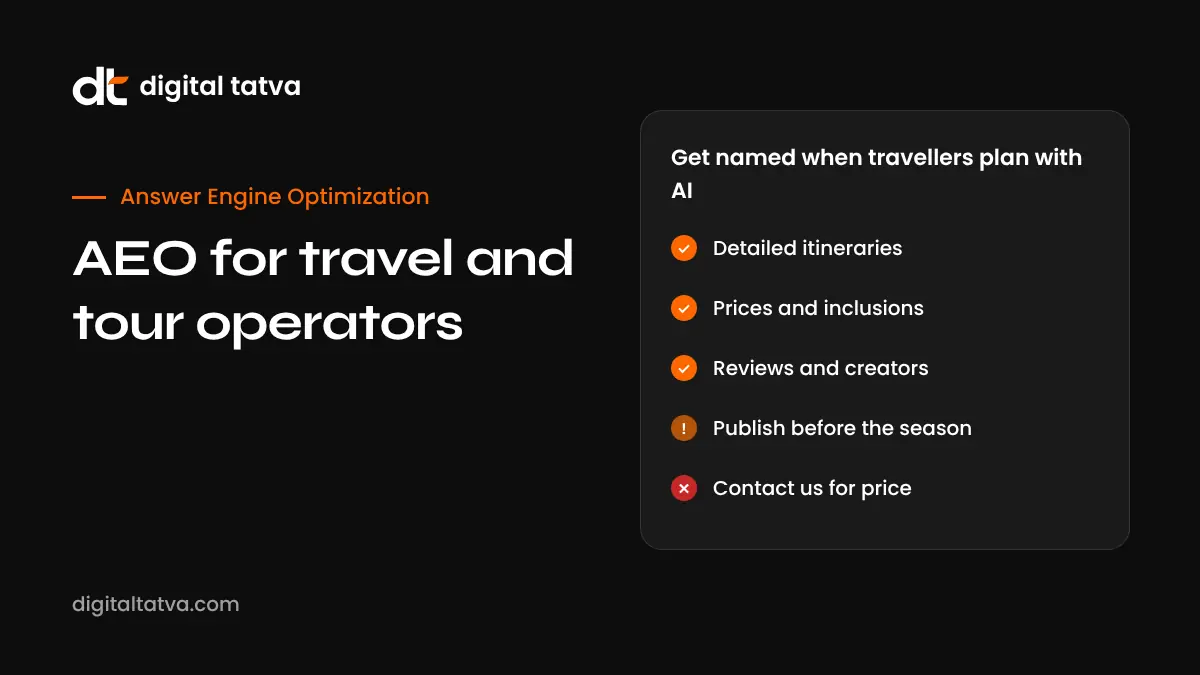
Quick answer: AEO for travel and tour operators means getting your tours, packages and destinations recommended when travellers ask ChatGPT, Gemini, Google AI Mode or Perplexity to plan a trip. Travel is one of the most common uses of AI assistants, from “7-day Kerala itinerary for a family” to “best tour operator for Ladakh bike trips”. To be included, publish specific itinerary and package pages with clear inclusions, prices and dates, build trust with reviews on platforms AI cites, keep business details consistent, earn coverage from travel publications and creators, and make booking easy for both people and AI agents.
Key takeaways
- Trip planning is a natural fit for AI assistants, so travellers increasingly start there.
- AI answers favour specific, structured information: itineraries, inclusions, prices, seasons and logistics.
- Reviews on travel platforms and coverage by travel writers and creators strongly influence recommendations.
- Clear, bookable products and simple enquiry flows matter as AI agents begin to book for users.
- Seasonality matters: publish and refresh content well before each peak season.
Why travel businesses need AEO
Planning a trip involves many questions: where to go, when, for how long, what it costs, who to book with and what to pack. AI assistants answer all of these in one conversation. A traveller might ask Gemini to “plan a 6-day Rajasthan trip in December for a couple on a mid-range budget” and then ask “which tour operators offer this as a package?” The operators named in that second answer get the enquiries.
We cover how travellers use AI in how to plan a trip with AI. For accommodation businesses, see AEO for hotels. This guide focuses on tour operators, travel agencies, DMCs and experience providers.
Travel prompts to target
| Prompt type | Example | What AI needs from you |
|---|---|---|
| Itinerary | “5-day Kashmir itinerary for families” | Day-by-day plan pages |
| Operator choice | “Best tour operator for Spiti Valley” | Reviews, coverage, clear specialisation |
| Budget | “Kerala tour package under 40,000 for two” | Prices and inclusions |
| Season | “Best time to visit Ladakh” | Seasonal guides with practical detail |
| Audience | “Senior-friendly tours in Uttarakhand” | Audience-specific pages |
| Logistics | “How to reach Tawang from Guwahati” | Practical travel guides |
| Trust | “Is [operator] reliable?” | Licences, reviews, years in business |
The travel AEO framework
1. Build detailed package and itinerary pages
Every main package should have its own page with:
- Duration, start and end points, and a day-by-day itinerary.
- Inclusions and exclusions in a clear list.
- Price, what it is per (person, couple, group) and what changes it.
- Best season and available dates.
- Who it suits: families, seniors, adventure travellers, honeymooners.
- Difficulty or fitness level for active trips.
- Accommodation type and transport.
- Cancellation and refund terms.
- A short FAQ.
Structured, factual pages are much easier for AI to use than image-heavy pages with “call for details”.
2. Publish destination guides with real expertise
Write practical guides from your on-the-ground knowledge: best time to visit, how to get there, permits, altitude advice, local food, what to pack and common mistakes. Include specifics that only an operator who runs trips there would know. This is the kind of original, experienced content AI assistants and Google value. See E-E-A-T for AI search.
3. Use structured data
Add Organization or TravelAgency schema, plus suitable markup for tours or products and FAQPage where appropriate. Keep prices and availability in markup consistent with the page. See schema markup for AEO.
4. Build reviews on the platforms AI cites
Travel AI answers often lean on Google reviews, TripAdvisor and similar platforms. Ask travellers for reviews after their trip, encourage them to mention the destination and trip type, and respond to every review professionally. Never fake or buy reviews. See review sites for AEO.
5. Work with travel creators and publications
YouTube travel vlogs, Instagram reels with good captions, travel blogs and publication roundups are common AI sources. Host creators on trips with clear disclosure, pitch stories to travel publications, and share your expertise in expert quotes. See YouTube for AEO.
6. Join community conversations
Travellers ask detailed questions on Reddit, Quora and travel forums. Helpful, transparent answers from your team, disclosed as coming from an operator, can build visibility in sources AI reads. See Reddit for AEO and Quora for AEO.
7. Show trust signals clearly
Publish your registration or licence details where relevant, years in operation, team members and guides, safety practices, insurance and emergency support. When travellers ask “is this operator reliable?”, AI should find clear answers.
8. Keep business details consistent
Align your name, address, phone, specialisations and descriptions across your website, Google Business Profile, TripAdvisor, social profiles and travel directories. See our entity SEO service.
9. Make booking and enquiry simple
Offer clear enquiry forms, WhatsApp contact and, where possible, online booking with real availability. As AI agents begin to complete bookings for users, simple, accessible booking flows will matter more. Make sure your bot protection does not block legitimate agents. See Web Bot Auth.
10. Cover multiple languages for inbound travellers
If you serve international travellers, publish key pages in their languages. For domestic audiences, Hindi content can help reach more travellers. See multilingual AEO.
Seasonal content calendar
| Season | Publish or refresh by | Examples (India) |
|---|---|---|
| Winter holidays | September to October | Rajasthan, Kerala, Goa, Andaman |
| Summer holidays | February to March | Himachal, Uttarakhand, Kashmir, Ladakh |
| Monsoon travel | April to May | Western Ghats, Meghalaya, Coorg |
| Festivals | Two months ahead | Diwali, Durga Puja, Pushkar fair, Hornbill festival |
Common travel AEO mistakes
- “Contact us for price” on every package, which leaves AI nothing to quote.
- Copying generic destination content from other sites.
- Outdated packages, prices or dates left live.
- Itineraries hidden in PDFs or images.
- Ignoring negative reviews instead of responding and fixing issues.
Measuring travel AEO
- How often you are named for your tracked destination and package prompts.
- Enquiries and bookings by source, including AI referrals.
- Review volume and ratings across platforms.
- Coverage from creators and publications.
Illustrative example: a Himalayan tour operator
This is an illustrative scenario, not a client story.
A small operator runs treks and road trips in Himachal and Ladakh. Travellers love its trips, but AI assistants rarely name it for prompts like “best tour operator for a Spiti road trip”. The audit shows its package pages are image galleries with “contact us for itinerary”, prices are only shared on WhatsApp, and most reviews sit on Instagram comments rather than Google or TripAdvisor.
The operator rebuilds its top six packages as detailed pages with day-by-day itineraries, inclusions, exclusions, price per person, fitness level, best months and acclimatisation advice. It publishes guides on reaching Spiti, permits and packing, written by its trip leaders. It starts asking travellers for Google and TripAdvisor reviews after each trip and hosts two travel YouTubers with clear disclosure. Before the next summer season, it re-tests prompts to see whether it appears more often and is described accurately.
Package page template for tour operators
- Summary: destination, duration, who it suits, price from.
- Itinerary: day-by-day with distances and highlights.
- Inclusions and exclusions.
- Dates and best season.
- Difficulty and fitness level.
- Stays and transport.
- Safety and support: guides, emergency plans, insurance.
- Cancellation and refund policy.
- FAQ and reviews from past travellers.
How Digital Tatva can help
Digital Tatva helps travel businesses get recommended when travellers plan trips with AI. We research travel prompts, structure package and itinerary pages, add schema, align listings, build reviews and coverage, and track AI visibility alongside enquiries. We never promise placement in AI answers. See our AEO services.
When travellers ask AI to plan a trip, is your company named? Try the free AI visibility checker or request an AEO audit.
Frequently asked questions
What is AEO for travel businesses?
It is the work of helping tour operators, travel agencies and experience providers get recommended when travellers ask AI assistants to plan trips, through clear packages, expert guides, reviews, coverage and consistent business details.
Do travellers really use ChatGPT to plan trips?
Yes. Trip planning is one of the most common uses of AI assistants because it involves many connected questions.
Should tour operators publish prices?
Publishing prices or clear price ranges with inclusions helps travellers and gives AI accurate information to share.
Which review platforms matter for travel?
Google reviews and TripAdvisor are commonly cited, along with niche travel platforms in your market.
Do travel influencers help AEO?
Yes, when their content is discoverable, such as YouTube vlogs and blog posts, and partnerships are disclosed.
How far ahead should I publish seasonal content?
Two to three months before the season, since travellers plan ahead and AI answers draw on content that already exists.
Is schema important for tour packages?
Yes. Structured data helps search engines and AI understand your business, packages and FAQs.
Can AI agents book my tours?
AI agents are beginning to complete bookings in some markets. Simple, accessible booking flows prepare you for that.
How is AEO for travel different from hotel AEO?
Hotels focus on property details and reviews. Tour operators focus on itineraries, packages, expertise and destination knowledge.
How long does travel AEO take?
Page and listing improvements take weeks. Changes in AI recommendations usually build over three to six months, aligned with seasonal demand.
Product details, prices and features are checked at the time of writing and can change. Sources are linked in the text so you can check them yourself.
How does your brand appear in AI answers?
We test the questions your buyers ask across the major AI assistants and search engines, then show you what to fix first.
Get an AI Visibility Audit