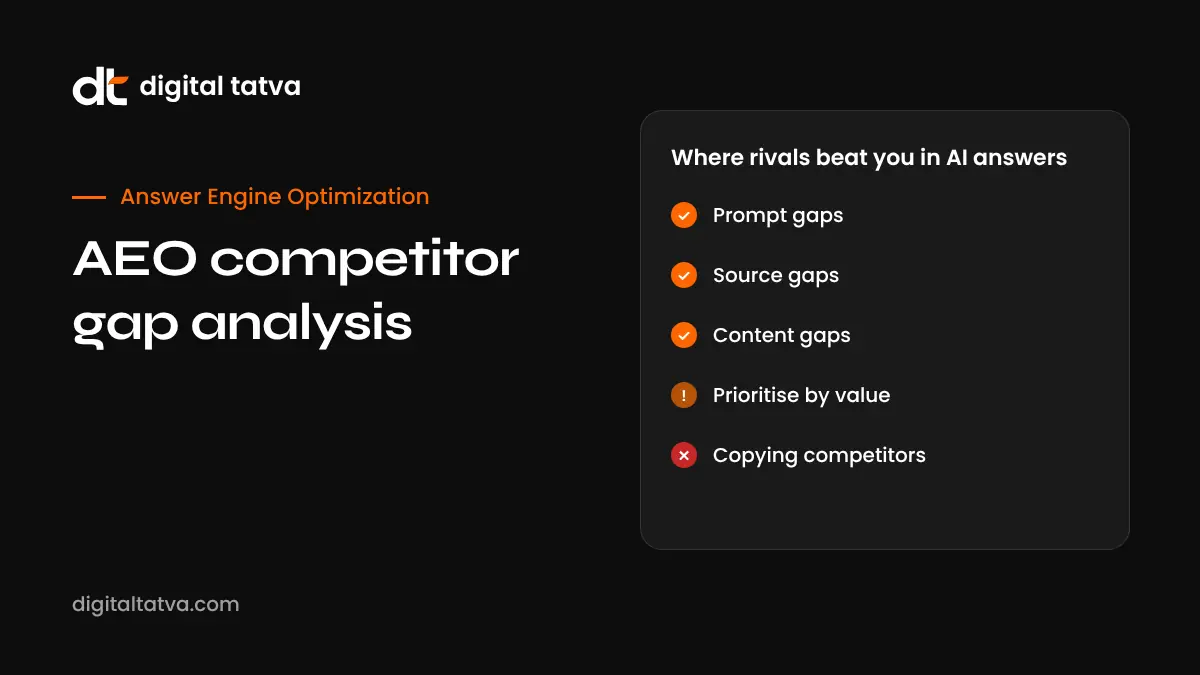
AEO Competitor Gap Analysis: Find the Prompts Where Rivals Beat You
A practical method to find where competitors beat you in AI answers, why it happens and what to fix first.
On this page
- Key takeaways
- Why competitor analysis looks different in AI search
- Step 1: Pick the right competitors
- Step 2: Build a prompt set that mirrors buying journeys
- Step 3: Run the prompts and capture everything
- Step 4: Find your prompt gaps
- Step 5: Find your source gaps
- Step 6: Find your content gaps
- Step 7: Check entity and technical gaps
- Step 8: Prioritise and plan
- Step 9: Re-test and repeat
- Common mistakes
- Illustrative example: an accounting software company
- Gap analysis worksheet
- How Digital Tatva can help
- Frequently asked questions
Last updated: 17 November 2026
Quick answer: An AEO competitor gap analysis shows the prompts where AI assistants recommend your competitors instead of you, and why. Build a prompt set of real buyer questions, run it across ChatGPT, Google AI Mode and AI Overviews, Gemini, Perplexity and Copilot, and record who is named, in what order and which sources are cited. Then compare: which prompts you lose, which sources your competitors appear on that you do not, and what their pages answer that yours do not. The output is a prioritised list of content, source and technical fixes to close the gap.
Key takeaways
- Competitor gaps in AI answers are rarely about one thing. They usually combine content, third-party sources and entity clarity.
- Prompt gaps show where you lose; source gaps show why.
- Run prompts multiple times and across several AI platforms, because answers vary.
- Prioritise gaps by business value, not by how many prompts you lose.
- Repeat the analysis quarterly; competitors and AI models change.
Why competitor analysis looks different in AI search
In classic SEO, competitor analysis compares rankings for keywords: who is position one, who has more backlinks. In AI search, there is no simple ranking. An AI assistant writes an answer that names a few brands, sometimes with reasons, sometimes citing sources. Your competitors might win because a review site they are listed on is cited, because their comparison page answers the question better, or because AI simply knows more about them as an entity.
A gap analysis finds those reasons. It turns “competitors show up in ChatGPT and we don’t” into a specific action plan. For background, see AI share of voice and AI search ranking factors.
Step 1: Pick the right competitors
Choose three to five competitors of three types:
- Direct business competitors you lose deals to.
- AI competitors, brands that AI recommends in your category even if you do not see them in sales.
- Aspirational competitors, the category leaders AI names most often.
The second group often surprises businesses. Run a few category prompts first and note who appears.
Step 2: Build a prompt set that mirrors buying journeys
| Stage | Example prompts | Business value |
|---|---|---|
| Learning | “What is [category]?”, “How does [solution] work?” | Lower |
| Considering | “Best [category] for [audience]”, “Top [category] in [city]” | High |
| Comparing | “[You] vs [Competitor]”, “Alternatives to [Competitor]” | Very high |
| Deciding | “[You] pricing”, “Is [You] worth it?”, “[You] reviews” | Very high |
Aim for 30 to 100 prompts depending on your market. Use questions from sales calls, support, search data and forums. See AEO prompt research.
Step 3: Run the prompts and capture everything
Run each prompt at least two or three times on each platform you track. For every answer, record:
- Brands named and their order.
- Which brand is recommended, if any.
- How each brand is described.
- Sources cited or linked.
- Any factual errors about you.
You can do this manually in a spreadsheet or with tools such as Ahrefs Brand Radar, Semrush’s AI visibility features, Peec AI, Otterly or Profound. See Peec AI vs Otterly vs Profound and best AEO tools.
Step 4: Find your prompt gaps
Create a simple matrix with prompts as rows and brands as columns, showing how often each brand appears.
| Prompt | You | Competitor A | Competitor B | Gap type |
|---|---|---|---|---|
| Best [category] for startups | 0 of 3 | 3 of 3 | 2 of 3 | Missing |
| [You] vs Competitor A | 3 of 3 | 3 of 3 | 0 of 3 | Framing |
| [Category] pricing in India | 1 of 3 | 2 of 3 | 1 of 3 | Weak |
Illustrative example only.
Classify each gap:
- Missing: you never appear, competitors do.
- Weak: you appear inconsistently or late in lists.
- Framing: you appear but are described less favourably or inaccurately.
Step 5: Find your source gaps
This is the most valuable part. List every source AI cited for the prompts you lose. Then check whether you are present on each.
| Source type | Typical gap | Fix |
|---|---|---|
| Review platforms | Competitors have many detailed reviews; you have few | Review request programme |
| “Best of” roundups | You are not included | Outreach with genuine information |
| Comparison pages | Only competitor-written comparisons exist | Publish fair comparisons |
| Reddit and forums | Competitors discussed, you are not | Transparent, helpful participation |
| YouTube | Competitor demos and reviews exist | Publish demos, invite reviews |
| Directories and marketplaces | Incomplete or missing profiles | Complete and align listings |
| News and publications | Competitors quoted as experts | PR and expert commentary |
See the pages AI assistants cite and brand mentions for AEO.
Step 6: Find your content gaps
Open the competitor pages AI cites and compare them with yours:
- Do they answer the question directly in the first lines?
- Do they state facts you leave vague, such as pricing, audience or timelines?
- Do they have comparison, alternatives or “best for” pages you lack?
- Do they include FAQs, tables and clear structure?
- Do they show expertise with named authors and original data?
See content chunking for AI and original research for AEO.
Step 7: Check entity and technical gaps
- Do competitors have clearer Organization schema, knowledge panels or Wikipedia entries?
- Is your brand description consistent across the web?
- Are AI crawlers able to access your important pages? See technical AEO checklist.
- Are your key pages indexed in Google and Bing?
Step 8: Prioritise and plan
Score each gap on business value (how close the prompt is to a purchase), effort and likelihood of impact. Typical high-priority wins:
- Fix factual errors about your brand.
- Publish missing comparison and alternatives pages.
- Get listed on the top three sources AI cites for your best prompts.
- Strengthen review volume on the most-cited review platform.
- Improve the pages that should answer your highest-value prompts.
Step 9: Re-test and repeat
Re-run the same prompt set monthly to track progress and quarterly to refresh competitors and prompts. AI models change too: Google switched AI Mode to Gemini 4 Hydrogen in November 2026, for example. See Gemini 4 in Google Search.
Common mistakes
- Testing a handful of prompts once and drawing big conclusions.
- Only tracking branded prompts.
- Copying competitor content instead of offering something better.
- Ignoring source gaps and only rewriting your own pages.
- Trying to manipulate sources with fake reviews or undisclosed posts.
Illustrative example: an accounting software company
This is an illustrative scenario, not a client story.
An Indian accounting software company finds that for “best accounting software for small businesses in India”, AI assistants name two larger competitors in almost every run, and the company in about one run in four. The source analysis shows three sources cited repeatedly: a popular comparison blog, a software review platform and a YouTube comparison video. Both competitors appear on all three; the company appears only on the review platform, with few reviews.
The content comparison shows that competitor pricing pages clearly state plan prices including GST, while the company’s pricing page says “custom quotes available”. The company publishes clear pricing, a fair comparison page against the two competitors, and a GST-focused feature page; it contacts the comparison blog with updated information, invites customers to review it on the platform, and records a product walkthrough video. Monthly re-tests track whether its share of mentions rises for that prompt group.
Gap analysis worksheet
| Column | What to fill in |
|---|---|
| Prompt | The exact buyer question |
| Stage | Learn, consider, compare or decide |
| Your appearance rate | For example, 1 of 3 runs |
| Top competitor rate | For example, 3 of 3 runs |
| Gap type | Missing, weak or framing |
| Main sources cited | URLs or domains |
| Your presence on those sources | Yes, partial or no |
| Content gap | What competitor pages answer that yours do not |
| Priority | High, medium or low |
| Owner and next action | Who does what, by when |
How Digital Tatva can help
A competitor gap analysis is a core part of every Digital Tatva AI visibility audit. We build your prompt set, run it across the main AI assistants, map competitor share of voice and cited sources, and give you a prioritised plan with a fixed quote. See inside a Digital Tatva AI visibility audit and our AEO services.
Want to know where competitors beat you in AI answers? Request an AEO audit or start with the free AI visibility checker.
Frequently asked questions
What is an AEO competitor gap analysis?
It is a comparison of how often AI assistants recommend you versus competitors for a set of buyer questions, plus an analysis of the content and sources behind those answers.
How many prompts should I test?
Typically 30 to 100, covering learning, considering, comparing and deciding stages.
Which AI platforms should I include?
Usually ChatGPT, Google AI Mode and AI Overviews, Gemini and Perplexity, plus Copilot or Claude if your audience uses them.
Why do competitors appear in ChatGPT and I don’t?
Common reasons are stronger presence on cited sources, clearer comparison and pricing content, more reviews and a clearer brand entity.
Can I do this without tools?
Yes. A spreadsheet and careful manual testing work well for a first analysis. Tools help with scale and tracking over time.
How often should I run a gap analysis?
Track the same prompts monthly and run a fuller refresh quarterly.
What is a source gap?
A source gap is a website AI cites for your category where competitors are present and you are not.
Should I copy competitor pages?
No. Understand what they answer well, then publish something clearer, more specific and more useful.
Does fixing gaps guarantee AI recommendations?
No. It improves the signals AI relies on, which makes recommendations more likely over time.
Is this part of an AEO audit?
Yes. At Digital Tatva, competitor and source gap analysis is included in every AI visibility audit.
Product details, prices and features are checked at the time of writing and can change. Sources are linked in the text so you can check them yourself.
How does your brand appear in AI answers?
We test the questions your buyers ask across the major AI assistants and search engines, then show you what to fix first.
Get an AI Visibility Audit