Google November Core Update: What It Changed for AI Tools Sites and What to Do Now
Google's November core update ran November 10 to 24. Who won and lost, why AI tools sites are exposed, how to check your data and what to fix.
On this page
- Key takeaways
- November core update timeline
- What is a Google core update?
- Who won and who lost
- Why AI tools sites are especially exposed
- How to check whether the update hit your site
- What to do now: a recovery checklist for AI tools sites
- What about AI Mode and AI Overviews?
- Get an expert second opinion
- Related guides
- Frequently asked questions
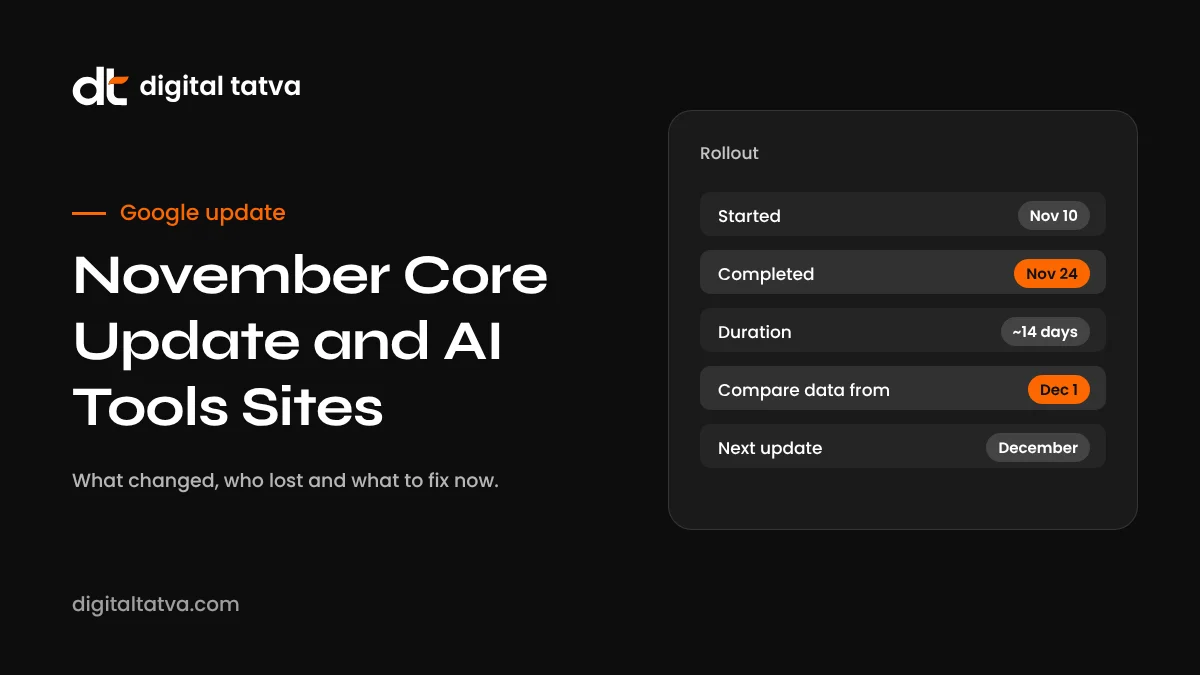
Quick answer: Google’s November core update started on November 10 and finished on November 24, after almost 14 days. It was a broad, global change to how Google ranks pages in every language, not a penalty aimed at AI tools sites. Early data shows big platforms such as YouTube, official institutions and marketplaces gaining, and reference sites and publishers losing, with AI tools and comparison sites showing mixed results. If your AI tools site lost traffic between November 13 and 24, wait until at least December 1 before judging the damage, compare like-for-like weeks in Search Console, then improve pages that are outdated, thin or hard to trust. Google has already announced a December core update, so expect more movement.
Key takeaways
- Dates: the rollout began on November 10 at 10:06 Pacific Time and completed on November 24 at 06:03 Pacific Time.
- Scope: a global update to Google’s ranking systems across all languages and regions.
- Early winners: platforms (mainly YouTube), government, universities and health institutions, and marketplaces. Early losers: dictionaries, encyclopedias and some publishers.
- AI tools sites saw mixed results: some well-known AI writing tools lost visibility while other tools gained. There was no clear penalty for the category.
- Google advises waiting at least a week after an update finishes before comparing Search Console data.
- Google announced a December core update on November 24, without a date. Do not overreact to one update.
- Pages most at risk on AI tools sites: stale pricing pages, thin “best tools” lists, pages written mainly for search engines and content published at scale with little original value.
November core update timeline
| Date | What happened |
|---|---|
| November 10 | Google started the November core update at 10:06 Pacific Time |
| November 13 to 14 | Ranking changes became visible in third-party tracking data |
| November 22 | Movements began to tail off |
| November 24 | Rollout completed at 06:03 Pacific Time, three days before Black Friday; Google also announced a December core update |
| December 1 onward | The earliest date Google suggests for fair before-and-after comparisons |
The update ran for 13 days, 19 hours and 57 minutes, and it came after the longest gap between core updates this year. Google described it as a global update to its ranking algorithms across all languages and regions.
What is a Google core update?
A core update is a broad change to the systems Google uses to rank search results. It does not target one type of site or one tactic. Instead, it changes how Google judges the overall usefulness and reliability of content, so some pages move up and others move down. A drop after a core update does not mean your site broke a rule. It usually means Google now sees other pages as a better answer for the same searches.
Core updates also affect AI features in Google Search. AI Overviews and AI Mode draw on pages Google already ranks and trusts, so a ranking drop can mean fewer AI citations too. Our guide to how AI Overviews and AI Mode pick sources explains that link, and query fan-out explains why one question can pull in many pages.
Who won and who lost
Early analysis from search visibility trackers, mainly of UK and German results, points to these patterns. Treat them as preliminary; measurement tools disagree, and reliable analysis takes until early December.
| Group | Early trend | Examples of the type of site |
|---|---|---|
| Platforms | Gained | Video platforms, especially YouTube |
| Institutions | Gained | Government, universities, charities and health services |
| Marketplaces | Gained | Large online marketplaces |
| Reference sites | Lost | Dictionaries and encyclopedias |
| Publishers | Lost | Some recipe, how-to and news publishers |
| Comparison and review sites | Mixed | Some gained strongly, others lost |
| AI tools and software sites | Mixed | Some AI writing tools lost visibility while other AI tools gained |
One SEO analyst also reported two sites that had published AI-generated content at scale dropping sharply. That is two cases, not a proven pattern, but it fits Google’s long-standing guidance that mass-produced content made mainly to rank is unlikely to do well.
Why AI tools sites are especially exposed
Sites that review, compare and explain AI tools face a particular problem: the subject changes every week. In November alone, ChatGPT moved to a shared usage allowance and launched GPT-6.2 in the Chat tab, Google replaced Gemini 4 Argon with Gemini 4 Neon on its Pro plan and announced a price rise for Gemini 4 Carbon’s API, and Perplexity launched Multiagent. A pricing page that was accurate in October can be wrong by late November.
- Stale pricing and plan pages. Wrong prices, retired models and expired offers signal low reliability to readers and search systems alike.
- Thin “best tools” lists. Pages that repeat each tool’s homepage without testing, comparison or original insight add little that searchers cannot find elsewhere.
- Overlapping pages. Several near-identical pages for the same search split your signals and confuse which page should rank.
- Pages written for search engines first. Keyword-stuffed headings, padded introductions and answers buried far down the page frustrate readers.
- Unclear authorship. Readers and search systems trust content more when it is clear who wrote it and why they are qualified.
For the latest changes to the biggest tools, see our updated ChatGPT pricing, Gemini pricing and LLM API pricing guides.
How to check whether the update hit your site
- Wait until at least December 1. Google recommends waiting a week after an update completes before comparing data.
- Pick fair comparison windows. Compare a full week before the update (for example November 3 to 9) with a full week after it settles (for example December 1 to 7 or December 2 to 8). Avoid windows that include the rollout itself.
- Use the Pages report in Search Console. Open Performance, set the comparison dates, switch to Pages and sort by the change in clicks.
- Check impressions and position together. If impressions fell but average position held steady, demand dropped, not your rankings. If position fell, the update likely affected you.
- Look at query and page pairs. Filter one page and review its main queries. A page can lose one query and gain another.
- Rule out other causes. Check for seasonal demand, site migrations, broken pages, indexing problems or tracking changes in the same period.
- Group the losers. If most of your losses are pricing pages or tool lists, the fix is content quality and freshness for that page type, not a site-wide change.
Illustrative scenario, not a client story: an AI tools blog sees its “AI subscription prices” page drop from position 6 to position 14 between mid and late November. Impressions for its main query are flat, so demand has not changed; its ranking has. A review shows the page still lists two retired models and an expired student offer. The owner updates the facts, adds a short “what changed this month” box, removes an overlapping older article and rechecks the comparison in mid-December.
What to do now: a recovery checklist for AI tools sites
- Do not rush. Google advises against quick fixes for small drops. Pages that are still performing well should be left alone.
- Refresh the facts first. Update prices, plan names, models, limits and offers on your highest-traffic pages, and show when the page was last reviewed.
- Add what only you can add. Real testing notes, screenshots of your own use, side-by-side comparisons and clear recommendations for specific readers.
- Put the answer first. Answer the main question in the first paragraph, then support it with detail, tables and FAQs.
- Merge overlapping pages. Combine near-duplicates into one stronger guide and redirect the old URL.
- Show who is behind the content. Use real author names, short bios and a clear editorial policy.
- Cut or improve thin pages. Pages that exist only to target a keyword should be improved substantially or removed.
- Fix technical basics. Fast loading, clean internal links, structured data and no accidental blocks for Googlebot or AI search crawlers.
- Track AI citations as well as rankings. A core update can change which pages AI Overviews and AI Mode cite. Our list of AI visibility tools covers trackers for this.
- Measure again after the December update. Make final judgments in mid to late December, once both updates have settled.
What about AI Mode and AI Overviews?
The core update changed regular rankings, but it overlapped with changes to Google’s AI features. Google is bringing Gemini 4 Carbon into AI Mode for Google AI Ultra subscribers, which affects how some AI Mode answers are generated. Because AI Overviews and AI Mode rely on pages Google already trusts, the same quality signals that help you rank also help you get cited. If your page lost both rankings and AI citations, the fix is the same: make it the clearest, most accurate and most useful answer to the question.
For a deeper view of how AI systems pick sources, read how to get cited by AI and where LLMs get their data.
Get an expert second opinion
Not sure whether the November core update hit your site, or how it changed your visibility in AI Overviews, AI Mode and ChatGPT? Digital Tatva’s AI visibility audit reviews your rankings and AI citations together and gives you a ranked list of fixes. We never promise rankings or placement in AI answers. Request an audit or start with our free AI visibility checker.
Related guides
- How AI Overviews and AI Mode pick sources
- Query fan-out explained
- How to get cited by AI
- Technical AEO
- Best AI visibility tools
Frequently asked questions
When did the Google November core update start and finish?
It started on November 10 at 10:06 Pacific Time and completed on November 24 at 06:03 Pacific Time, a rollout of almost 14 days.
What did the November core update change?
It was a broad, global update to Google’s ranking systems across all languages and regions. It changed how Google judges the usefulness and reliability of pages rather than targeting one type of site.
Was the November core update aimed at AI tools sites?
No. There is no evidence it targeted AI tools sites. Early data shows mixed results for the category, with some AI tools sites losing and others gaining.
Which sites gained in the November core update?
Early tracking shows platforms such as YouTube, official institutions like government, universities and health services, and large marketplaces gaining visibility.
Which sites lost in the November core update?
Early data shows reference sites such as dictionaries and encyclopedias and some publishers losing the most visibility. Comparison and AI tools sites were mixed.
How long should I wait before checking my traffic?
Google recommends waiting at least a week after an update completes, so compare data from December 1 onward against a full week before November 10.
How do I know if the core update hit my site?
In Search Console, compare a week before the update with a week after it settled. If average position fell for your main queries while impressions held steady, the update likely affected you.
My clicks dropped but my rankings did not. Was it the update?
Probably not. If position held steady but impressions fell, the drop is more likely lower search demand, seasonality or more clicks going to AI features.
Can I recover from a Google core update?
Yes. Improve the usefulness, accuracy and trustworthiness of affected pages. Recovery often shows up at a later core update rather than immediately.
Is there another Google core update coming?
Yes. On November 24 Google announced a December core update, without giving a date.
Did the November core update affect AI Overviews?
Indirectly. AI Overviews and AI Mode rely on pages Google already ranks and trusts, so ranking changes can also change which pages are cited.
Does AI-generated content get penalised in core updates?
Google does not penalise content just for being AI-assisted, but content mass-produced mainly to rank tends to do poorly. One analyst reported two sites with scaled AI content dropping sharply in this update.
Why do pricing pages lose rankings?
AI tool prices and plans change often. Pages with outdated prices, retired models or expired offers become less useful and less trustworthy, which can hurt rankings after a core update.
Should I delete pages that lost traffic?
Not straight away. First check whether the loss is real and lasting. Improve pages that are useful but outdated, and merge or remove pages that are thin or duplicate.
Should I make big changes to pages that still rank well?
No. Google advises against quick fixes for small drops, and pages that still perform well should be left alone.
What should AI tools sites update first?
Start with your highest-traffic pricing, plan and comparison pages. Update facts, add original testing and clear recommendations, and show when each page was last reviewed.
Does Google AI Mode now use Gemini 4 Carbon?
Google is bringing Gemini 4 Carbon into AI Mode for Google AI Ultra subscribers, which affects how some AI Mode answers are generated.
Do core updates affect Bing and ChatGPT search?
No. Core updates are Google changes. Bing, which ChatGPT search draws on, has its own ranking systems, but the same content quality improvements usually help everywhere.
How do I track AI citations after a core update?
Use an AI visibility tool that tracks citations in AI Overviews, AI Mode, ChatGPT and Perplexity, alongside rankings in Search Console.
Can an agency guarantee recovery after a core update?
No honest agency can guarantee rankings or AI placement. A good audit identifies the pages and issues most likely holding you back and prioritises fixes.
Product details, prices and features are checked at the time of writing and can change. Sources are linked in the text so you can check them yourself.
How does your brand appear in AI answers?
We test the questions your buyers ask across the major AI assistants and search engines, then show you what to fix first.
Get an AI Visibility Audit