Where Do LLMs Get Their Data? How ChatGPT, Gemini and Perplexity Learn and Find Information
How LLMs like ChatGPT, Gemini and Perplexity get data: training sets, Common Crawl, licensed data, live search, crawlers and what it means for your brand.
On this page
- Key takeaways
- The short version: how an LLM “knows” things
- Path 1: training data, what the model learned
- Path 2: live retrieval, what the model looks up
- The crawlers behind each path
- Licensed data and why Reddit shows up everywhere
- Why AI sometimes gets your brand wrong
- What you can and cannot control
- How to make your brand visible in both paths
- Related guides
- Frequently asked questions
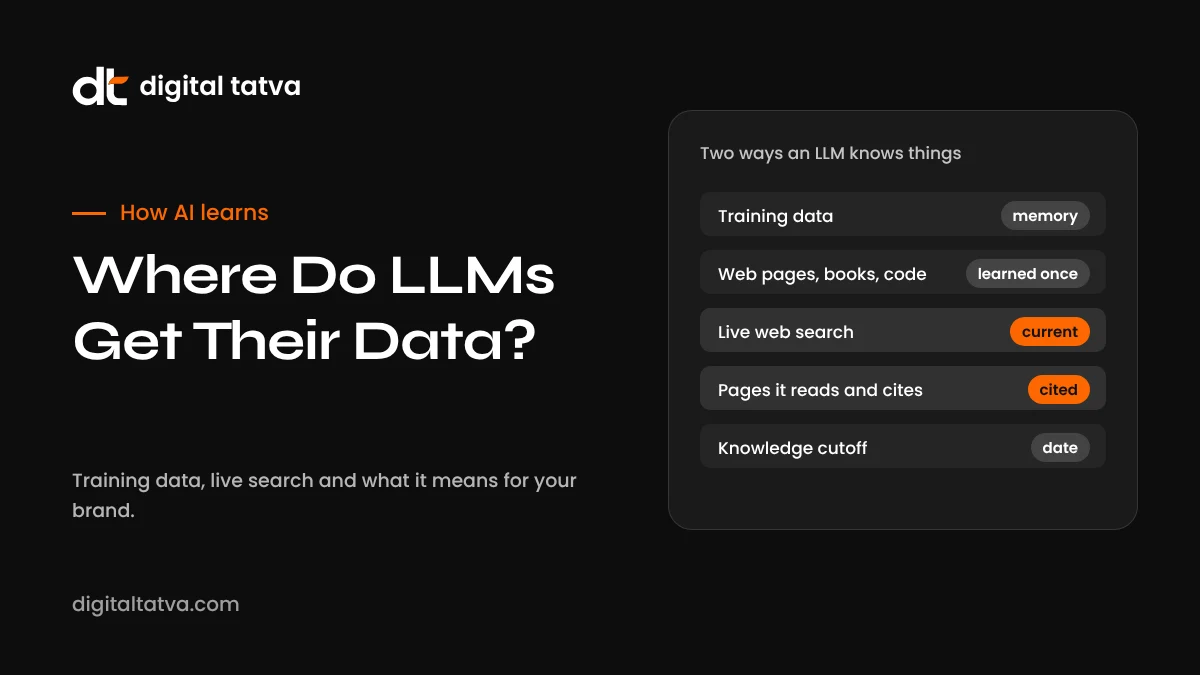
Quick answer: Large language models (LLMs) such as ChatGPT, Gemini, Claude and Perplexity get information in two ways. First, training data: a huge snapshot of public web pages, books, code, licensed data and human feedback that the model learns from once, up to a knowledge cutoff date. Second, live retrieval: when you ask a question, many assistants search the web or a search index in real time, read the pages they find and cite them. Training shapes what an AI “already knows” about your brand; live retrieval decides which pages it reads and links to today. To be visible in AI answers you need to be present in both.
Key takeaways
- LLMs learn from training data once, then answer from memory. That memory stops at a knowledge cutoff date, which is why AI can repeat outdated facts.
- Most modern AI assistants also search the web live. ChatGPT search, Perplexity, Google AI Overviews, AI Mode, Gemini and Claude can all read current pages and cite them.
- Different crawlers do different jobs. GPTBot and ClaudeBot collect training data, while OAI-SearchBot, Claude-SearchBot and PerplexityBot index pages for AI search. Blocking the wrong one can remove you from AI answers.
- The public web is the biggest single source of training text. Common Crawl alone published 2.14 billion pages in a single monthly crawl in August.
- Licensed data now matters too. Google and OpenAI both struck deals with Reddit, which is one reason forum discussions show up so often in AI answers.
- You can influence both paths: keep accurate, consistent facts about your brand across the web, and make your pages easy for AI search crawlers to read and quote.
The short version: how an LLM “knows” things
When you ask ChatGPT about your industry, the answer comes from one of two places, and often from both at once:
| Training data (memory) | Live retrieval (search) | |
|---|---|---|
| What it is | Text the model learned from before it was released | Pages the assistant fetches while answering your question |
| When it happens | Once, during training, months before launch | Every time a question needs current or specific facts |
| How fresh | Stops at the knowledge cutoff date | As fresh as the search index and the pages it reads |
| Does it cite sources? | No. The model cannot point to where it learned something | Usually yes, with links or numbered sources |
| Main crawlers | GPTBot, ClaudeBot, CCBot, Google-Extended (a control token) | OAI-SearchBot, Claude-SearchBot, PerplexityBot, Googlebot, Bingbot |
| What you control | Whether future models may train on your pages | Whether AI search can find, read and cite your pages |
If you want the background on what an LLM is in the first place, start with our plain-English guide to what a large language model is.
Path 1: training data, what the model learned
An LLM is trained by reading enormous amounts of text and learning to predict the next word. Everything it “remembers” without searching comes from this phase. The main sources are:
| Source | What it includes | Why it matters for your brand |
|---|---|---|
| Public web crawls | Web pages collected by crawlers such as Common Crawl and the AI companies’ own bots | If accurate pages about your brand exist widely on the open web, future models are more likely to describe you correctly |
| Reference sites | Wikipedia, Wikidata, dictionaries, documentation | Heavily weighted because they are well structured and reliable |
| Books and academic papers | Published books, research papers, open-access journals | Shape general knowledge and writing style |
| Code | Public code repositories | Why AI can write and explain code |
| Licensed data | Paid agreements with publishers and platforms such as Reddit, news groups and stock libraries | Gives some sources extra reach inside AI products |
| Human feedback | People rating and writing answers to fine-tune behaviour | Shapes tone, safety and how the model answers, not facts about your brand |
How big is the web data?
The best public example is Common Crawl, a nonprofit that has been archiving the web since 2007. Its August crawl alone contained 2.14 billion web pages from 40.2 million hosts and 33.1 million registered domains, about 360 TiB of uncompressed data, and 0.7 billion of those URLs had never appeared in an earlier crawl. When OpenAI described GPT-3 in 2020, filtered Common Crawl made up about 60% of its training mix. AI companies clean and filter this data heavily, removing spam, duplicates and low-quality pages, so being crawled is not the same as being used. Our guide to what Common Crawl is and whether your site is in it explains this in detail.
The knowledge cutoff
Training stops at a fixed date, called the knowledge cutoff. Anything that happened after it, such as a new product, a price change or a rebrand, is unknown to the model unless it searches the web. Cutoffs differ widely: OpenAI lists February 16 for GPT-5.6 Sol’s knowledge, while Anthropic lists June for its current Claude models. See our list of LLM knowledge cutoff dates.
Path 2: live retrieval, what the model looks up
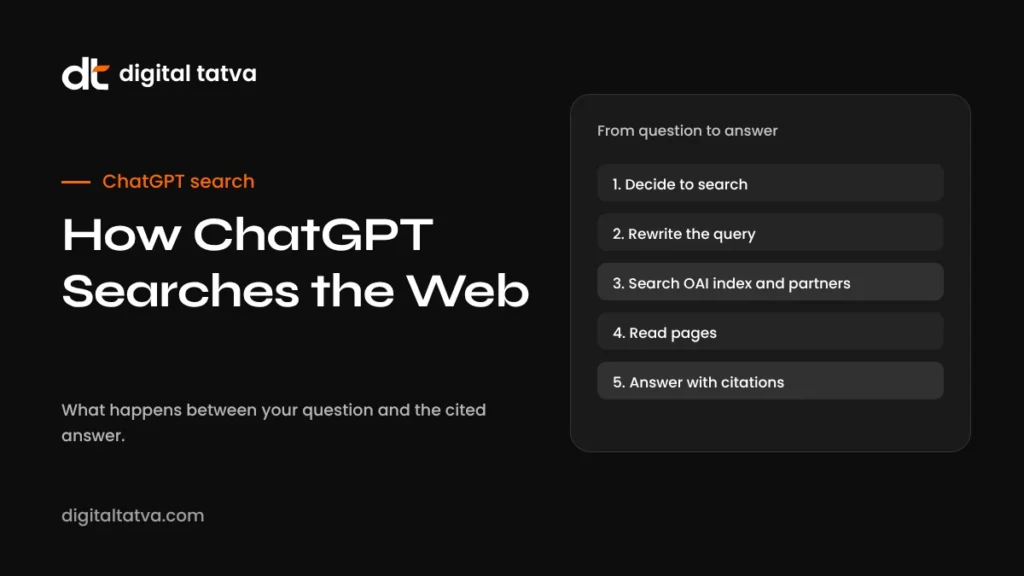
Because training data goes out of date, AI assistants now search the web for many questions. This is called retrieval, and the technique behind it is known as retrieval-augmented generation, or RAG. The assistant turns your question into one or more search queries, fetches the best results, reads the relevant passages and writes an answer that cites them.
| AI assistant | How it retrieves information | Crawler or index involved |
|---|---|---|
| ChatGPT search | Rewrites your question into targeted queries, sometimes sent to partner search providers, then reads and cites results | OAI-SearchBot (search index), ChatGPT-User (pages fetched on request) |
| Perplexity | Searches the web for almost every question and shows numbered sources | PerplexityBot (index), Perplexity-User (fetches on request) |
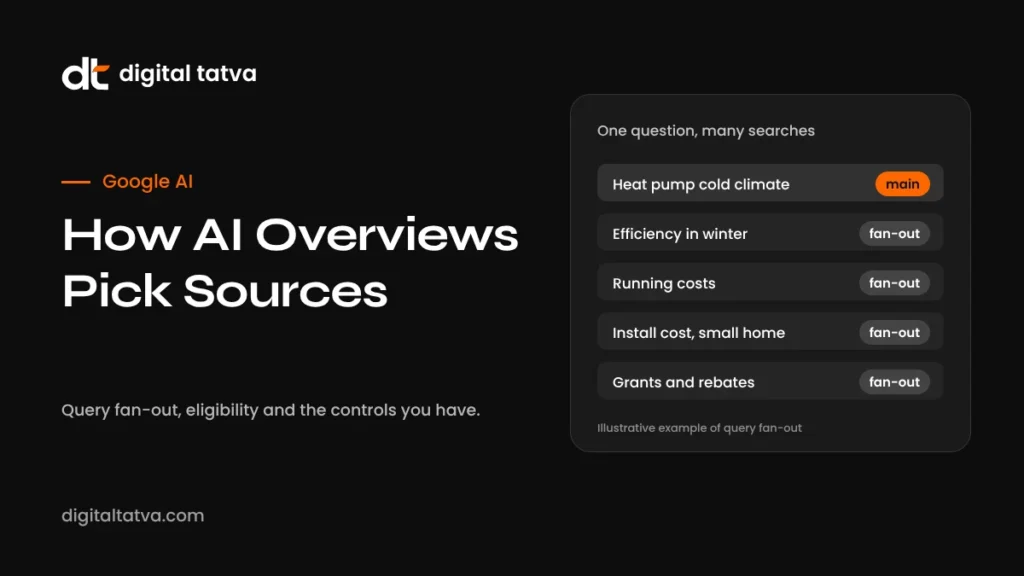
| Google AI Overviews and AI Mode | Run several related searches across subtopics (query fan-out) on Google’s own index | Googlebot |
| Gemini app | Grounds answers in Google Search results when it needs current information | Google’s index, with Google-Extended controlling some uses |
| Claude | Searches the web when needed and cites sources | Claude-SearchBot (index), Claude-User (fetches on request) |
| Microsoft Copilot | Grounds answers in Bing search results | Bingbot |
Each assistant has its own process. We explain them one by one in how ChatGPT searches the web, how Perplexity chooses its sources and how Google AI Overviews and AI Mode pick sources. For a marketer’s view of retrieval itself, read RAG for marketers.
Retrieval is unstable
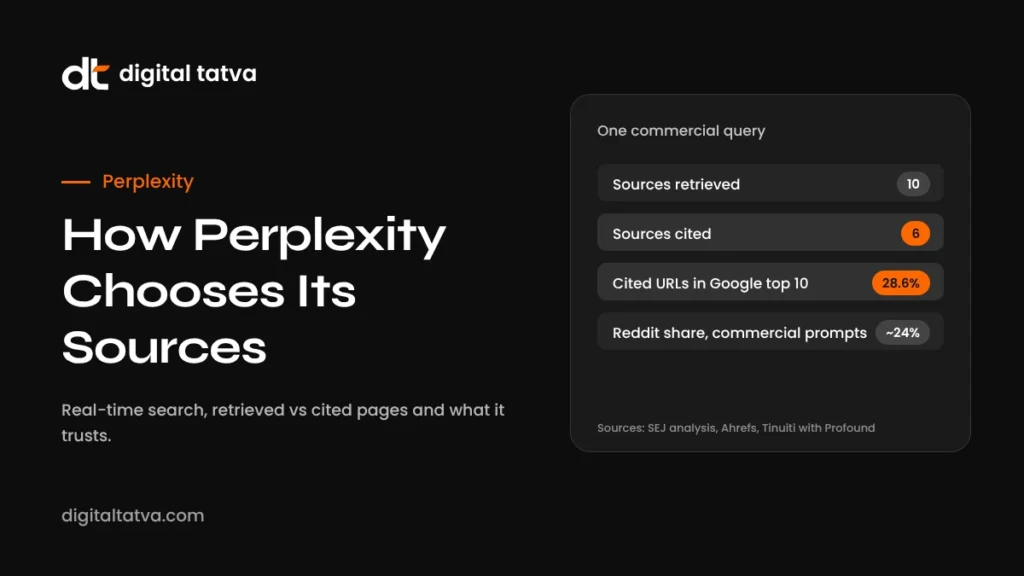
Live answers change constantly. In an Ahrefs study that tracked about 37,500 citations for 20 days, 59% of the sources ChatGPT cited were gone the next day, and 81% of Gemini’s. Engines also differ: Ahrefs found that 28.6% of the URLs Perplexity cited ranked in Google’s top 10, compared with only 6 to 8% for ChatGPT. So there is no single “AI ranking” to win; there are many retrieval systems to be present in.
The crawlers behind each path
Most AI companies now run separate bots for training and for search, and each one can be allowed or blocked in robots.txt. This matters because blocking a training bot does not remove you from AI search, but blocking a search bot does.
| Company | Training | AI search index | Fetches on a user’s request |
|---|---|---|---|
| OpenAI | GPTBot | OAI-SearchBot | ChatGPT-User |
| Anthropic | ClaudeBot | Claude-SearchBot | Claude-User |
| Perplexity | None (says it does not train foundation models with its crawlers) | PerplexityBot | Perplexity-User |
| Google-Extended (a robots.txt control token, not a separate bot) | Googlebot | Google user-triggered fetchers | |
| Common Crawl | CCBot (public dataset used by many AI labs) | Not applicable | Not applicable |
OpenAI says sites that opt out of OAI-SearchBot “will not be shown in ChatGPT search answers”, and that robots.txt changes take about 24 hours to apply. Read what blocking each AI crawler really does before you change your robots.txt, and see our full AI crawlers list.
Licensed data and why Reddit shows up everywhere
Not all data is crawled. AI companies increasingly pay for access. In February 2024 Reuters reported that Google agreed to pay Reddit about $60 million a year for access to its data, and in May 2024 Reddit announced a partnership with OpenAI. Reddit content now appears heavily in some AI answers: research by Tinuiti with Profound found Reddit made up about 24% of Perplexity’s citations for commercial prompts, compared with 0.1% of Gemini’s. We cover this in do LLMs use Reddit?
Why AI sometimes gets your brand wrong
When an AI describes your business incorrectly, the cause is usually one of five things:
- Old training data. The model learned about you before a change and answers from memory without searching.
- Inconsistent facts online. Directories, review sites and old articles disagree, so the model picks one version.
- Your site is hard to read. Key facts sit in images, scripts or PDFs, or AI search crawlers are blocked.
- Third-party sources dominate. The assistant retrieves a comparison page or forum thread instead of your own pages.
- Errors in retrieval. The Tow Center at Columbia found eight AI search tools answered more than 60% of source queries incorrectly in its 2025 test, so mistakes also happen in the citation step.
Our guide to why ChatGPT gives outdated answers about your brand shows how to diagnose and fix each one.
What you can and cannot control
| You can control | You cannot control |
|---|---|
| Whether AI search crawlers can read your pages | What older models already learned |
| Whether future models may train on your content | Exactly which pages an AI chooses to cite |
| How clearly your pages state facts, prices and answers | How often answers change from day to day |
| How consistent your brand facts are across the web | Licensing deals between AI companies and platforms |
| Your presence on review sites, directories and forums AI trusts | Whether an assistant decides to search at all |
How to make your brand visible in both paths
- Allow AI search crawlers. Keep OAI-SearchBot, Claude-SearchBot, PerplexityBot, Googlebot and Bingbot allowed. Decide separately whether to allow training bots such as GPTBot and ClaudeBot.
- Put key facts in plain HTML text. Company name, what you do, prices, locations and contact details should be readable without scripts.
- Answer questions directly. Start pages with a clear answer and use headings that match real questions.
- Keep facts consistent everywhere. Update your Google Business Profile, LinkedIn, directories and review profiles so they match your website.
- Earn mentions on trusted third-party sites. Review sites, industry publications, comparison lists and genuine forum discussions feed both training data and live retrieval.
- Keep content fresh. Retrieval favours current, dated information. See our guide to refreshing content for AEO.
- Measure. Track mentions and citations over time with the tools in our free AI visibility tools guide.
Not sure what AI says about your brand, or why? Digital Tatva’s AEO audit checks how ChatGPT, Gemini, Perplexity and Google AI describe and cite you, which crawlers can reach your site and what to fix first. Request an AEO audit or explore our AEO services.
Related guides
- What is Common Crawl?
- What blocking each AI crawler really does
- RAG for marketers
- LLM knowledge cutoff dates
- Do LLMs use Reddit?
Frequently asked questions
Where do LLMs get their data?
From two places. Training data, a large snapshot of web pages, books, code, licensed content and human feedback learned once before release, and live retrieval, where assistants such as ChatGPT search and Perplexity search the web in real time and cite what they find.
Does ChatGPT search the internet?
Yes. ChatGPT can search the web automatically when a question needs current information, or when you choose web search. It rewrites your question into search queries, reads results and shows citations.
Is my website used to train AI?
Possibly. If training crawlers such as GPTBot, ClaudeBot or CCBot can access your site, your public pages may be collected for future model training. You can block these bots in robots.txt.
What is the difference between training data and live search?
Training data is what a model learned once, up to its knowledge cutoff, and it cannot cite it. Live search is what the assistant looks up while answering, which can be current and is usually cited.
What is a knowledge cutoff?
The date after which a model has no training data. For example, OpenAI lists February 16 for GPT-5.6 Sol, and Anthropic lists June for its current Claude models. Events after the cutoff are unknown unless the AI searches.
How does AI know about my company?
From pages about your company that were in its training data, and from pages it retrieves live when someone asks. Your website, directories, reviews, news coverage and forum discussions all contribute.
Why does AI give wrong information about my business?
Usually because of outdated training data, inconsistent facts across the web, a site AI crawlers cannot read, or third-party pages that are wrong. Retrieval can also make mistakes.
What is Common Crawl?
A nonprofit that has archived the public web since 2007 and releases its data for free. Its August crawl held 2.14 billion pages, and many AI labs use filtered versions of its data for training.
Do AI companies pay for data?
Some do. Google reportedly pays Reddit about $60 million a year for data access, and OpenAI partners with Reddit and several news publishers. Most web data is still crawled rather than licensed.
Does blocking GPTBot remove me from ChatGPT?
No. GPTBot is OpenAI’s training crawler. ChatGPT search uses OAI-SearchBot. Blocking GPTBot stops future training use but does not remove you from ChatGPT search answers.
Which crawlers should I allow for AI visibility?
Allow the search crawlers: OAI-SearchBot, Claude-SearchBot, PerplexityBot, Googlebot and Bingbot. Whether you allow training crawlers such as GPTBot, ClaudeBot and CCBot is a separate business decision.
Does Google use my content for Gemini?
Google uses its Search index for AI Overviews and AI Mode. The Google-Extended control lets you decide whether your content is used to train Gemini models and to ground answers in Gemini apps, without affecting Google Search.
What is RAG?
Retrieval-augmented generation. The AI retrieves relevant documents or web pages first, adds them to its prompt, and then writes an answer based on them. It is how AI search tools give current, cited answers.
Does Perplexity train on my website?
Perplexity says PerplexityBot is used to surface and link websites in search results and is not used to crawl content for AI foundation models.
How often do AI answers change?
Very often. Ahrefs found 59% of the sources ChatGPT cited were gone the next day, though many returned within a few days.
Can I remove my brand from AI training data?
You cannot remove data from models already trained. You can block training crawlers so future collection stops, and correct the public sources AI learns from.
Does llms.txt control what AI learns?
No. llms.txt is a proposed file that summarises your site for AI tools. It does not control training or crawling; robots.txt does that.
How long does it take for AI to learn new information about my brand?
For live search, as soon as your updated page is crawled and indexed, often days. For training data, only when a new model is trained with a later cutoff, which can take many months.
Do LLMs use social media data?
Some do, through public pages, licensed deals such as Reddit’s, or each company’s own platforms. Coverage varies by company and is not fully disclosed.
How can I make AI describe my brand correctly?
Publish clear, consistent facts on your site in plain text, keep profiles and directories up to date, earn mentions on trusted sites, allow AI search crawlers and refresh key pages regularly.
Product details, prices and features are checked at the time of writing and can change. Sources are linked in the text so you can check them yourself.
How does your brand appear in AI answers?
We test the questions your buyers ask across the major AI assistants and search engines, then show you what to fix first.
Get an AI Visibility Audit