Should You Block AI Crawlers? What Blocking GPTBot, OAI-SearchBot, Google-Extended and PerplexityBot Really Does
What blocking GPTBot, OAI-SearchBot, ClaudeBot, Google-Extended, PerplexityBot and CCBot really does to your AI visibility, and a safe default to use.
On this page
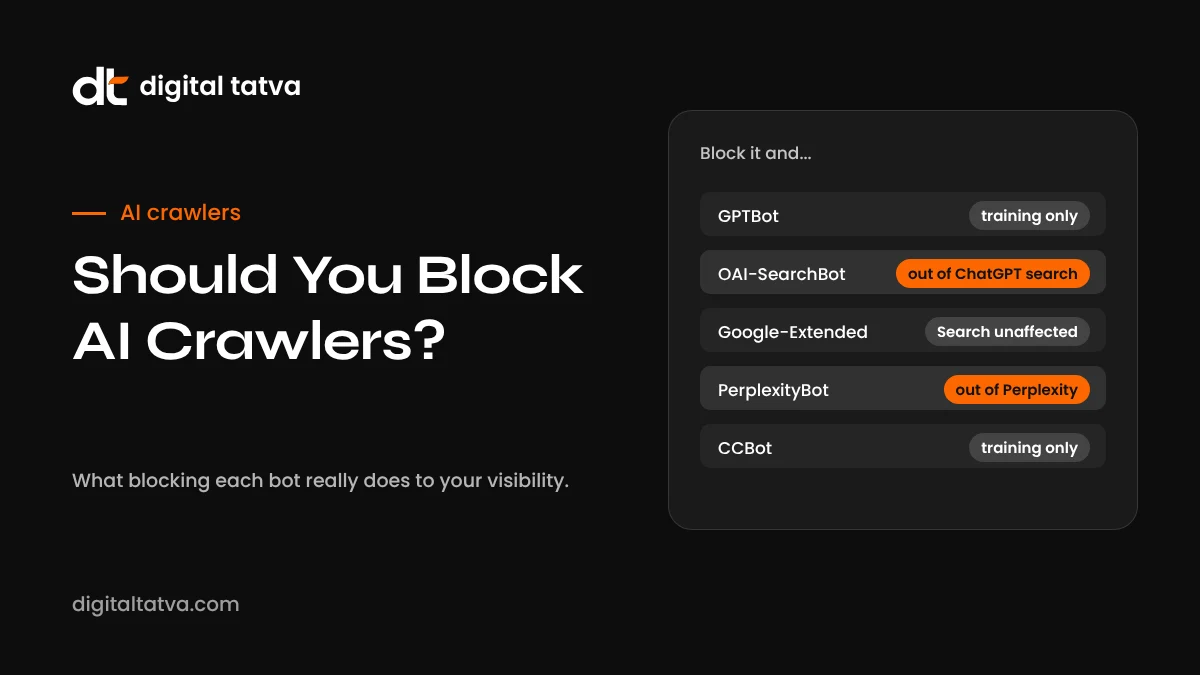
Quick answer: Blocking an AI crawler has very different effects depending on its job. Blocking a training crawler (GPTBot, ClaudeBot, CCBot or the Google-Extended token) stops future model training on your pages but does not remove you from AI search. Blocking a search crawler (OAI-SearchBot, Claude-SearchBot, PerplexityBot, Googlebot or Bingbot) can remove you from that AI’s answers entirely. User-triggered fetchers such as ChatGPT-User and Perplexity-User may not follow robots.txt at all. For most businesses that want AI visibility, the safe choice is to allow every search crawler and make a separate decision about training.
Key takeaways
- There are three kinds of AI bot: training crawlers, search crawlers and user-triggered fetchers. Each needs a separate decision.
- OpenAI says sites that block OAI-SearchBot “will not be shown in ChatGPT search answers”. Blocking GPTBot only affects training.
- Anthropic says blocking Claude-SearchBot “may reduce your site’s visibility and accuracy in user search results”.
- Google-Extended controls Gemini training and grounding in Gemini apps; it does not affect Google Search or AI Overviews.
- Perplexity says PerplexityBot is not used for training, so blocking it only costs you Perplexity visibility.
- Robots.txt changes take about 24 hours for OpenAI and up to 24 hours for Perplexity.
The three kinds of AI bot
| Type | What it does | Examples | Main effect of blocking |
|---|---|---|---|
| Training crawler | Collects pages that may be used to train future models | GPTBot, ClaudeBot, CCBot, Google-Extended (token) | Your new content is not used to train future models |
| Search crawler | Builds the index an AI searches when answering | OAI-SearchBot, Claude-SearchBot, PerplexityBot, Googlebot, Bingbot | You can disappear from that AI’s answers and citations |
| User-triggered fetcher | Opens a page when a person asks the AI to | ChatGPT-User, Claude-User, Perplexity-User | Varies; some ignore robots.txt because a user started the request |
For the complete list of bots, see our AI crawlers list. For exact robots.txt syntax and templates, see our guide to AI crawler robots.txt rules. This article answers one question: what happens if you block each one?
What blocking each crawler really does
| Crawler | Owner | If you block it | Recommendation for AI visibility |
|---|---|---|---|
| GPTBot | OpenAI | Your content should not be used to train OpenAI’s foundation models. ChatGPT search is unaffected. | Business choice |
| OAI-SearchBot | OpenAI | “Sites that are opted out of OAI-SearchBot will not be shown in ChatGPT search answers.” | Allow |
| ChatGPT-User | OpenAI | OpenAI says robots.txt rules “may not apply” to user-initiated actions. | Allow |
| ClaudeBot | Anthropic | Stops training data collection for Claude models. | Business choice |
| Claude-SearchBot | Anthropic | Prevents indexing for Claude’s search; “may reduce your site’s visibility and accuracy in user search results”. | Allow |
| Claude-User | Anthropic | Prevents Claude retrieving your page when a user asks; may reduce visibility in user-directed search. Anthropic says it honours robots.txt. | Allow |
| PerplexityBot | Perplexity | Removes you from Perplexity’s search results. Perplexity says the bot is not used for training. | Allow |
| Perplexity-User | Perplexity | Perplexity says this fetcher “generally ignores robots.txt rules”. | Allow |
| Google-Extended | Stops use for Gemini model training and grounding in Gemini apps and Vertex AI. No effect on Google Search or AI Overviews. | Business choice | |
| Googlebot | Removes you from Google Search, including AI Overviews and AI Mode. | Allow | |
| Bingbot | Microsoft | Removes you from Bing and Copilot answers that rely on Bing. | Allow |
| CCBot | Common Crawl | Keeps new pages out of Common Crawl, a public dataset many AI labs train on. | Business choice |
The trade-off with training crawlers
Blocking training crawlers is a reasonable choice for publishers whose content is the product, such as news, research or paid courses. For most businesses, though, being in training data helps future models describe you accurately. If a model never saw your current pages, it will rely on older or third-party sources. Weigh:
| Allow training crawlers if… | Consider blocking if… |
|---|---|
| You want AI to know your brand, products and expertise | Your content is what you sell |
| Your pages are mostly marketing, service and help content | You have licensing or legal concerns |
| You rely on brand awareness and recommendations | You are negotiating data licensing deals |
Common mistakes
- Blocking every bot with “AI” in the name. This often removes search crawlers and costs you AI visibility.
- Blocking at the firewall or CDN by accident. Some security tools block AI crawlers by default. Check your Cloudflare or hosting settings, not just robots.txt.
- Assuming Google-Extended blocks AI Overviews. It does not. AI Overviews use Googlebot’s index.
- Expecting robots.txt to stop user-triggered fetches. Some fetchers may not follow it.
- Forgetting old models. Blocking now does not remove content from models already trained.
A sensible default for most businesses
- Allow all search crawlers: OAI-SearchBot, Claude-SearchBot, PerplexityBot, Googlebot and Bingbot.
- Allow user-triggered fetchers so AI can read pages people ask about.
- Decide on training crawlers (GPTBot, ClaudeBot, CCBot, Google-Extended) as a business decision, and document it.
- Check that your CDN, firewall and security plugins match your robots.txt.
- Re-check your rules every few months, as AI companies add and rename bots.
Not sure what your robots.txt and firewall are blocking? Our free AI visibility checker tests whether AI crawlers can read your site, and our AEO audit reviews every bot rule for you.
Related guides
- AI crawlers list
- AI crawler robots.txt guide
- Where do LLMs get their data?
- AI training opt-out token
- What is Common Crawl?
Frequently asked questions
Should I block AI crawlers?
Most businesses should allow AI search crawlers so they can appear in AI answers, and make a separate decision about training crawlers.
Does blocking GPTBot remove my site from ChatGPT?
No. GPTBot is for training. ChatGPT search uses OAI-SearchBot. Blocking GPTBot does not remove you from ChatGPT search answers.
What happens if I block OAI-SearchBot?
OpenAI says sites that opt out of OAI-SearchBot will not be shown in ChatGPT search answers.
Does blocking Google-Extended affect my Google rankings?
No. Google-Extended controls Gemini training and grounding in Gemini apps and Vertex AI. It does not affect Google Search.
Does blocking Google-Extended remove me from AI Overviews?
No. AI Overviews use Google’s search index, controlled by Googlebot.
What happens if I block ClaudeBot?
It stops Anthropic collecting your pages for training. Claude’s search and user fetches use separate bots.
What is Claude-SearchBot?
Anthropic’s bot that indexes content for Claude’s search features. Anthropic says blocking it may reduce your visibility and accuracy in search results.
Does PerplexityBot train AI models?
Perplexity says PerplexityBot is not used to crawl content for AI foundation models.
Do user-triggered fetchers obey robots.txt?
Not always. OpenAI says rules may not apply to ChatGPT-User, and Perplexity says Perplexity-User generally ignores them. Anthropic says Claude-User honours robots.txt.
What is CCBot?
Common Crawl’s crawler. It builds a free public web archive that many AI labs use for training. It obeys robots.txt.
Can I block training but allow AI search?
Yes. Block training crawlers such as GPTBot and ClaudeBot while allowing OAI-SearchBot, Claude-SearchBot and PerplexityBot.
Will blocking AI crawlers remove my content from existing models?
No. Blocking only affects future crawling. Models already trained keep what they learned.
How long do robots.txt changes take to apply?
OpenAI says about 24 hours, and Perplexity says up to 24 hours. Others vary.
Can my CDN block AI crawlers without me knowing?
Yes. Some CDN and security settings block AI bots by default. Check them alongside robots.txt.
Should news publishers block AI crawlers?
Many block training crawlers to protect their content, while allowing search crawlers to keep visibility and referral traffic.
Does blocking Bingbot affect Copilot?
Yes. Copilot grounds answers in Bing, so blocking Bingbot can remove you from those answers.
Is blocking AI crawlers legally binding?
Robots.txt is a widely respected standard, not a law. Major AI companies say they follow it for their crawlers.
What is the safest robots.txt setting for AI visibility?
Allow all search crawlers and user fetchers, decide on training crawlers separately and keep your firewall consistent with robots.txt.
How often do AI companies add new bots?
Regularly. OpenAI, for example, added OAI-AdsBot for ChatGPT ads. Review your rules every few months.
How can I check which AI bots visit my site?
Look at your server logs or CDN bot analytics for the user agents listed above, and verify them against each company’s published IP ranges.
Product details, prices and features are checked at the time of writing and can change. Sources are linked in the text so you can check them yourself.
How does your brand appear in AI answers?
We test the questions your buyers ask across the major AI assistants and search engines, then show you what to fix first.
Get an AI Visibility Audit