What Is Common Crawl and Is Your Website in It?
What Common Crawl is, how big it is, how AI companies use it for training, how to check if your site is in it and whether to block CCBot.
On this page
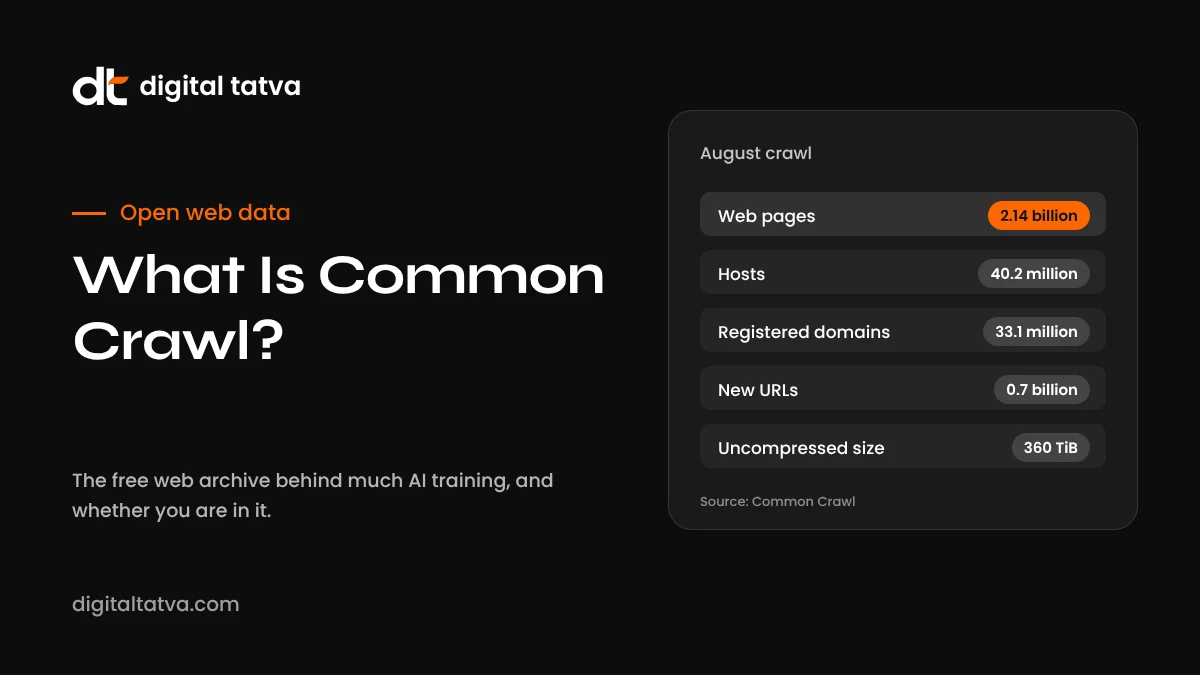
Quick answer: Common Crawl is a nonprofit that has crawled and archived the public web since 2007 and gives the data away for free. It publishes a new crawl roughly every month; its August crawl contained 2.14 billion web pages from 40.2 million hosts. Many AI companies and researchers use filtered versions of this data to train large language models. Your site is probably in it if it is public and does not block Common Crawl’s crawler, CCBot. You can check with Common Crawl’s free URL index, and you can opt out of future crawls by blocking CCBot in robots.txt.
Key takeaways
- Common Crawl is a 501(c)(3) nonprofit founded in 2007 by Gil Elbaz. Its archive holds more than 10 petabytes of web data.
- Each monthly crawl typically contains more than two billion pages. The August crawl had 2.14 billion pages and 0.7 billion URLs never seen before.
- Common Crawl data has been cited in more than 12,000 research papers and is a common starting point for AI training data.
- OpenAI’s GPT-3 paper said filtered Common Crawl made up about 60% of GPT-3’s training mix.
- CCBot obeys robots.txt, so you can block it. Blocking it does not remove pages already archived or used in trained models.
- Being in Common Crawl does not guarantee AI will use or remember your pages; AI labs filter heavily for quality.
What is Common Crawl?
Common Crawl is an open archive of the web. Its crawler, CCBot, visits billions of public pages, saves their content and publishes the results as free downloads for anyone, from university researchers to AI companies. It describes itself as a nonprofit 501(c)(3) organisation and was founded by Gil Elbaz in 2007. The total archive is now more than 10 petabytes.
How big is a Common Crawl crawl?
| Measure (August crawl) | Figure |
|---|---|
| Web pages | 2.14 billion |
| Uncompressed size | 360 TiB |
| Hosts | 40.2 million |
| Registered domains | 33.1 million |
| URLs never crawled before | 0.7 billion |
| Crawl window | 7 to 20 August |
Crawls are released roughly monthly, so the data is constantly refreshed with new and updated pages.
How AI companies use Common Crawl
Common Crawl is not itself an AI tool, but it is one of the most important sources of AI training data:
- GPT-3: OpenAI’s 2020 paper said filtered Common Crawl made up about 60% of the training mix, alongside books, Wikipedia and curated web text.
- Open datasets: Popular open training sets such as Hugging Face’s FineWeb are built by filtering many Common Crawl snapshots.
- Research: Common Crawl says its data has been cited in more than 12,000 research papers.
AI labs rarely use the raw data. They remove spam, duplicates, adult content and low-quality text, and many also run their own crawlers such as GPTBot and ClaudeBot. So Common Crawl is one important source among several. Read the full picture in where do LLMs get their data?
Is your website in Common Crawl?
If your site is public, linked from other sites and does not block CCBot, it is very likely included. To check:
- Open Common Crawl’s free URL index search (search for “Common Crawl index” to find it).
- Choose a recent crawl.
- Search for your domain using a wildcard, for example yourdomain.com/*.
- Review the list of captured URLs and dates.
- Repeat for older crawls to see how long you have been included.
If important pages are missing, check that they are linked internally, not blocked in robots.txt and not hidden behind logins or heavy scripts.
Should you allow or block CCBot?
| Allow CCBot if… | Block CCBot if… |
|---|---|
| You want future AI models to know your brand, products and expertise | Your content is your product, such as paid research or news |
| Your pages are mainly marketing, services and help content | You have legal or licensing concerns about AI training |
| You want researchers and tools to find your public content | You are negotiating paid data licensing |
Blocking CCBot only affects future crawls. Pages already archived stay in past crawls, and models already trained keep what they learned. Common Crawl also maintains an opt-out ledger. For how CCBot fits with other bots, see what blocking each AI crawler really does.
What this means for your AI visibility
- Being in Common Crawl helps future models learn about you, but only if your pages are clear, factual and high quality enough to survive filtering.
- Training data is only half the story. Live AI search uses separate crawlers such as OAI-SearchBot and PerplexityBot.
- Consistent facts across many sites matter more than one page, because models learn from patterns across the web.
Want AI to learn the right things about your brand? Digital Tatva’s AEO services make your site readable for every AI crawler and build consistent brand signals across the web. Request an AEO audit.
Related guides
- Where do LLMs get their data?
- What blocking each AI crawler really does
- AI crawlers list
- AI training opt-out token
- What is an LLM?
Frequently asked questions
What is Common Crawl?
A nonprofit that has archived the public web since 2007 and publishes the data free of charge for research and other uses, including AI training.
Who owns Common Crawl?
It is a nonprofit 501(c)(3) organisation founded by Gil Elbaz in 2007.
How big is Common Crawl?
The archive is more than 10 petabytes. A single monthly crawl typically has more than two billion pages; the August crawl had 2.14 billion.
How often does Common Crawl crawl the web?
It publishes a new crawl roughly every month.
Is Common Crawl used to train ChatGPT?
OpenAI’s GPT-3 paper said filtered Common Crawl made up about 60% of its training mix. OpenAI does not publish the full data mix for its latest models.
What is CCBot?
Common Crawl’s web crawler. It identifies itself as CCBot, obeys robots.txt and limits how fast it requests pages from each server.
How do I check if my site is in Common Crawl?
Use Common Crawl’s free URL index search, choose a crawl and search for your domain with a wildcard such as yourdomain.com/*.
How do I block Common Crawl?
Add a rule for User-agent: CCBot with Disallow: / to your robots.txt file.
Does blocking CCBot remove my data from AI models?
No. It only stops future crawls. Past crawls and models already trained are not changed.
Should I block Common Crawl?
Most businesses benefit from being included so future AI models learn about them. Publishers whose content is their product may choose to block it.
Is Common Crawl data free?
Yes. It is free to access and download, though processing it requires significant computing resources.
Does being in Common Crawl mean AI will mention my brand?
Not necessarily. AI labs filter the data heavily and models learn patterns across many sources. Clear, consistent, high-quality pages help.
Does Common Crawl include every website?
No. It covers a very large sample of the public web, not every page, and skips sites that block CCBot.
Does Common Crawl capture pages behind logins?
No. It only crawls publicly accessible pages.
What is the difference between CCBot and GPTBot?
CCBot builds a free public archive used by many organisations. GPTBot collects content that OpenAI may use to train its own models.
How many research papers use Common Crawl?
Common Crawl says its data has been cited in more than 12,000 research papers.
Can I remove my pages from Common Crawl?
You can block future crawls. Common Crawl also keeps an opt-out ledger. Already published crawl archives are not usually edited.
Does Common Crawl affect my Google rankings?
No. It is unrelated to Google Search.
What open AI datasets are built from Common Crawl?
Many, including Hugging Face’s FineWeb, which is built by filtering many Common Crawl snapshots.
Is Common Crawl the only source of AI training data?
No. AI labs also use their own crawlers, licensed data, books, code and human feedback.
Product details, prices and features are checked at the time of writing and can change. Sources are linked in the text so you can check them yourself.
How does your brand appear in AI answers?
We test the questions your buyers ask across the major AI assistants and search engines, then show you what to fix first.
Get an AI Visibility Audit