Keywords vs Prompts: How to Choose What to Track for AI Visibility
Prompt lists measure the questions a team chose to ask. Keywords measure real demand. How to choose what to track for AI visibility, step by step.
On this page
- Key takeaways
- What tracking prompts and tracking keywords actually mean
- The problem with prompt lists
- AI answers change from run to run
- Why the keyword works as the unit of intent
- What to measure on each keyword: mentions first, citations second
- Keywords vs prompts at a glance
- How to build a keyword set for AI visibility tracking
- Common mistakes
- Frequently asked questions
Quick answer: Track keywords, not a hand-written list of prompts. A keyword states an intent and comes with search volume, so AI visibility can be weighted by real demand and read next to Google data. A prompt list has no demand data, reflects whoever wrote it, and can be inflated by editing the list. Keep prompts for diagnosing specific questions, not for the KPI.
Key takeaways
- People rarely phrase a question the same way. In a SparkToro and Gumshoe study, prompts written by volunteers for the same need barely overlapped, so guessing “the” buyer prompt rarely works.
- AI answers change from run to run. One answer is noise. Visibility measured across many queries, over time, is the signal.
- A prompt has no search volume. A keyword does. That lets you weight AI visibility by demand instead of counting every question the same.
- Measure mentions first, citations second. A mention is the buyer seeing the brand. A citation is the model trusting a page as a source.
- Start from the keywords already tracked in Google, so SEO and AI search are reported on the same base.
What tracking prompts and tracking keywords actually mean
Prompt tracking starts with a list of questions written by a team or made up by an AI, such as “What is the best CRM for a small agency?”. A tool sends them to ChatGPT, Gemini or Perplexity, for example, on a schedule and records whether the brand is mentioned or cited. The list is the measurement.
Keyword tracking starts with search terms that have measured demand, such as “crm for small agency”. Each keyword can be turned into a natural question that keeps the same intent, sent to the AI platforms, and the results are rolled up and weighted by search volume. The keyword is the unit. The question is how it gets asked.
In a dashboard, both end up as the same kind of number: the share of answers that mention the brand. The difference is what sits underneath it.
The problem with prompt lists
There is no demand data behind a prompt
Google search volume tells you, roughly, how many people search a term each month. There is no equivalent for prompts. AI platforms do not publish how often a question is asked, and the “prompt volume” figures on the market are modeled estimates that you cannot check against a first-party source.
Without demand data, every prompt may count the same. A question almost nobody asks can weigh as much as one asked thousands of times a month, and the visibility score cannot tell the two apart.
The list measures whoever wrote it
Prompt lists are usually written by people who know the brand well, so they might ask the questions the brand already answers well. Worse, the KPI moves with the list. Add five prompts in a topic where the brand is already mentioned and visibility goes up, with nothing changed in the market. Drop the prompts where it is missing and visibility goes up again.
For an agency reporting to a client, that is a number that can be steered by editing a spreadsheet, on purpose or not. A client who asks “what did we measure?” deserves a better answer than “the questions we picked.”
Buyers do not ask the way you expect
In the SparkToro and Gumshoe research, published in January 2026, volunteers wrote their own prompts for the same need. Across 142 prompts, barely two looked alike, and their average semantic similarity was 0.081. A short list of prompts written in a meeting room covers a thin slice of how people actually ask.
AI answers change from run to run
The same study had 600 volunteers run 12 prompts through ChatGPT, Claude and Google’s AI Overviews (or AI Mode when no overview appeared), 2,961 times in total. The finding: there is less than a 1 in 100 chance that ChatGPT or Google’s AI gives the same list of brands in any two responses, and less than a 1 in 1,000 chance of the same list in the same order. Claude was slightly more likely to repeat the same list, but even less likely to repeat the order.
The authors did not conclude that AI visibility cannot be measured. They concluded that visibility percentage across many prompts, run many times, is a reasonable metric, while ranking position inside an answer is not. One hospital in their data appeared in 97% of ChatGPT answers but was the first one named in only 25 of 71.
That has two practical consequences:
- Do not judge a brand on a single answer. One screenshot proves very little.
- Size matters. Fifty prompts checked once a month is a small sample of an unstable system. A keyword set is usually built from the hundreds or thousands of terms a team already tracks for SEO, so the sample is wider, and every result carries a demand weight.
Why the keyword works as the unit of intent
Language models read intent. “seo forecasting tools” and “what are the best tools for SEO forecasting?” are worded differently, but both ask for the same thing: a shortlist of tools. A keyword is simply the shortest way to state an intent.
Keywords also separate intents that do differ. “best seo forecasting tools” and “best free seo forecasting tools” look close, but the second one has a budget limit, and the answer will recommend different products. Keyword research already separates them by modifier: “free”, “for agencies”, “vs”.
One caveat: a broad head term can mix intents. “crm” can mean “what is a CRM” or “which CRM should I buy”. Check the actual question each keyword turns into, and split or drop the terms that are ambiguous.
Why demand weighting changes the picture
Take a brand tracked on three keywords (illustrative volumes):
| Keyword | Monthly searches | Brand mentioned in AI answer? |
|---|---|---|
| project management software | 5,000 | No |
| project management software for agencies | 300 | Yes |
| free project management software for freelancers | 200 | Yes |
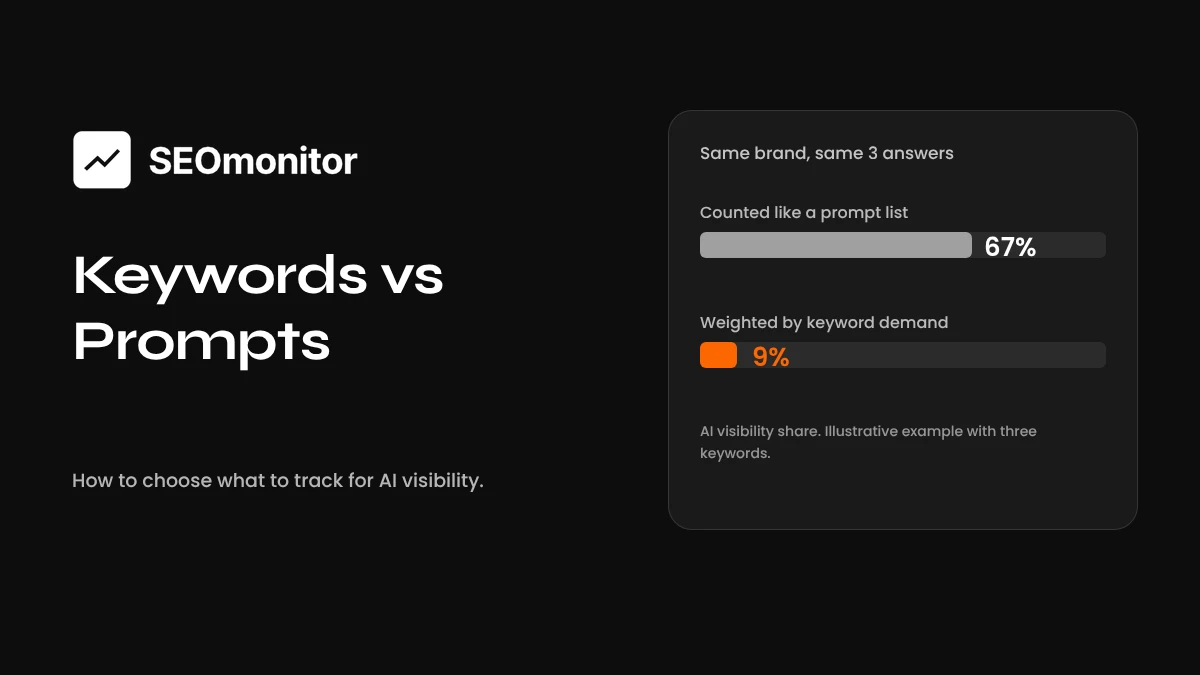
Counted like a prompt list, the brand is mentioned in 2 of 3 questions: 67% visibility. Weighted by demand, it is mentioned on 500 of 5,500 monthly searches: about 9%. The first number says the brand is doing well. The second says it is missing from the question most buyers ask.
What to measure on each keyword: mentions first, citations second
A mention is the model naming the brand in the answer the user reads. That is the touchpoint with the buyer: they see the brand whether or not they click anything.
A citation is the model using a page as a source and linking to it. It is a trust signal, and it is a lever: being a source is how a site gets to shape what the answer says over time. But many readers never open the sources, so a citation without a mention is credit the buyer may never notice.
So report the mention rate as the headline, with citations underneath, both weighted by search volume and compared against competitors on the same keywords. Two patterns are worth a closer look:
- Cited but not mentioned: the model trusts the site’s content but recommends someone else. Read the cited page. If it explains the topic but never presents the brand as an option for that need, the model has facts to quote and no reason to recommend the brand. Say clearly on the page who the product is for and which problem it solves.
- Mentioned but not cited: the model knows the brand but describes it using other sites. Check what those pages say.
Keywords vs prompts at a glance
| Prompt list | Keyword set | |
|---|---|---|
| Where the questions come from | Written by the team or made up by an AI | Search terms with measured demand |
| Demand data | None you can verify | Google search volume |
| Weighting | Every prompt counts the same | Weighted by search volume |
| Can editing the list move the KPI? | Easily | Much less: the set follows demand, not preference |
| Comparable with SEO data | No, different units | Yes, same keywords as rank tracking |
| Cost of covering one intent | Grows with every phrasing added | One keyword per intent |
| Best use | Diagnosing specific questions | The KPI and trend reporting |
How to build a keyword set for AI visibility tracking
- Start from the keywords already tracked in Google. Using the same base means a drop in AI visibility can be read next to rankings, and the reverse.
- Separate branded keywords. When someone asks about a brand by name, the answer will mention it. Branded terms inflate the score, so report them apart from non-branded ones.
- Prioritize keywords where an answer recommends something. “best”, “vs”, “alternatives”, “how to choose” and problem-led searches are where brands get named or skipped.
- Group by topic and intent, and check the questions. Split head terms that mix intents, as with “crm” above, and make sure the question behind each keyword reads like something a person would type.
- Weight by search volume and read the trend over several weeks. Week-to-week or day-by-day movement on a wide set tells you more than any single answer.
- Benchmark competitors on the same set. A 20% mention rate means little until you see who gets the other 80%.
Some tools are built around this approach. SEOmonitor’s AI search tracking, for example, turns each tracked keyword into a search-intent question, checks it every week or every day in ChatGPT, Claude, Gemini or Perplexity, and reports mentions and citations next to daily Google rankings and AI Overviews for the same keywords, with share of voice weighted by search volume. Whatever tool you use, the steps above still apply.
Common mistakes
- Reporting a single run as the result. Answers vary too much from run to run.
- Counting every question the same. Without demand weighting, rare questions can hide the gaps that matter.
- Mixing branded and non-branded terms. Branded questions push the score up without saying anything about category visibility.
- Leading with citations or position. The buyer sees the mention, and the order of brands changes almost every time.
- Running SEO and AI search on separate lists. Neither report can then explain the other.
Frequently asked questions
Do AI assistants search using keywords?
The case for keywords does not depend on how a model builds its web searches. It rests on intent and demand: a keyword states an intent, and it comes with search volume that a prompt does not have.
How many keywords do you need?
Enough to cover the topics that matter commercially. For most sites, that is the set already tracked for SEO, often several hundred to a few thousand keywords. Very small sets amplify the run-to-run noise described above.
Can you check AI visibility for free?
Yes. SEOmonitor’s free AI Visibility Index shows how often ChatGPT and Google AI Overviews mention and cite a brand on searches with real Google demand, with every result weighted by search volume. The first report needs no account. It covers the UK and Romania at the time of writing and is updated quarterly.
Which AI platforms should you track?
Start with the ones the audience uses, usually Google AI Overviews and ChatGPT, then add Claude, Gemini and Perplexity where that audience is.
Product details, prices and features are checked at the time of writing and can change. Sources are linked in the text so you can check them yourself.
How does your brand appear in AI answers?
We test the questions your buyers ask across the major AI assistants and search engines, then show you what to fix first.
Get an AI Visibility Audit