ChatGPT vs Gemini vs Perplexity Citation Study 2026: Who Cites What and Why
Our 2026 citation study compares how ChatGPT, Gemini and Perplexity choose and cite sources: citations per answer, Reddit, YouTube, Google overlap, accuracy and how to get cited.
On this page
- Key takeaways
- About this study
- The comparison at a glance
- 1. Audience: how many people see each engine’s citations
- 2. How each engine finds its sources
- 3. How many sources each engine cites
- 4. Which sources each engine prefers
- 5. How closely each engine follows Google rankings
- 6. Citation accuracy: can you trust what they cite?
- 7. Which citation positions get clicked
- 8. What kind of content gets cited
- 9. Crawler access: the first thing to check
- 10. Platform playbooks
- 11. One strategy that works across all three
- 12. How to run your own citation study
- 13. Limits of the data
- Frequently asked questions
Last updated: 26 November 2026
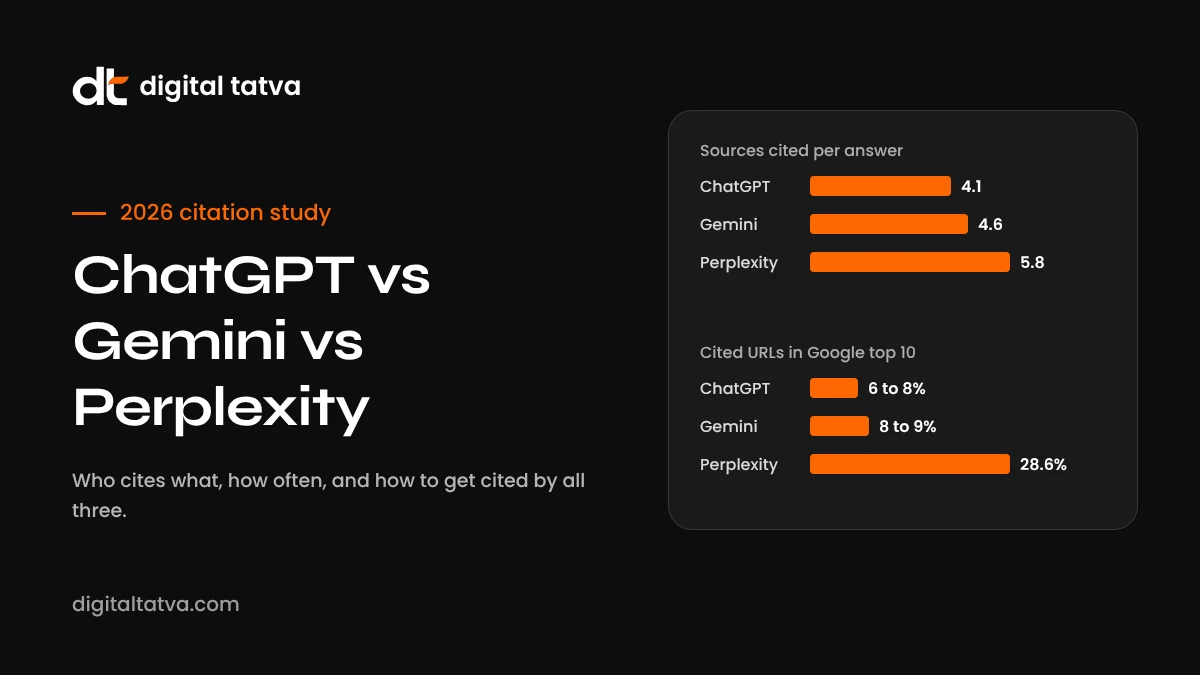
Quick answer: ChatGPT, Gemini and Perplexity cite the web in very different ways. Perplexity cites the most sources per answer, leans hardest on Reddit and has the closest overlap with Google’s top 10 (about 29% of cited URLs). ChatGPT cites fewer sources, favours Wikipedia, major publishers and retailers, and its citations rarely match Google’s top 10 (about 6 to 8%). Gemini is grounded in Google Search, favours YouTube, publishers and brand sites, cites Reddit very little, and in 2026 started showing citations on fewer answers. All three make citation mistakes. To be cited across all three, a brand needs crawlable, answer-first pages, strong Google rankings for Gemini, and real mentions on the third-party sites each engine trusts.
Key takeaways
- Reach is now huge on two of the three: ChatGPT and the Gemini app each reported passing a billion users in mid 2026. Perplexity is much smaller but popular with researchers and professionals.
- Perplexity cites roughly 5 to 6 sources per answer in vendor data, ChatGPT about 4 and the Gemini app about 4 to 5.
- In an Ahrefs test of 15,000 queries, 28.6% of Perplexity’s cited URLs ranked in Google’s top 10, against 6 to 8% for ChatGPT and around 8 to 9% for Gemini and Copilot.
- Reddit was 24% of Perplexity’s citations in January 2026 but just 0.1% of Gemini’s, according to Tinuiti and Profound.
- Gemini’s share of answers with citations fell from 99% to 76% in a few weeks in early 2026 in one 82,000-response dataset.
- Independent audits found frequent citation errors on every platform, so brands must check how they are quoted, not just whether.
- Studies disagree on how often brand websites are cited, from about 11% to over 50%, because they use very different prompts. Test your own category.
About this study
This citation study compares how ChatGPT, Google Gemini and Perplexity choose, show and attribute sources. Instead of relying on one dataset, we brought together the largest and most credible public research published between March 2025 and November 2026 and put the findings side by side. Every number below names its source and date.
| Dataset | Published | Size | Platforms covered |
|---|---|---|---|
| Ahrefs: AI citations vs Google rankings | August 2025 | 15,000 long-tail queries | ChatGPT, Gemini, Perplexity, Copilot |
| Profound: AI platform citation patterns | June 2025 | 30 million citations | ChatGPT, Perplexity, Google AI Overviews |
| Profound analysis reported by WARC | September 2026 | 11.8 billion data points | ChatGPT, Gemini and others |
| Tinuiti with Profound: AI Citation Trends Q1 2026 | Early 2026 | Commercial prompts in 9 industries, 4 months | ChatGPT, Gemini, Perplexity and 4 others |
| Seer Interactive: Gemini citation drop | April 2026 | 82,000 Gemini responses, 20 brands | Gemini |
| Presenc AI citation reports | April to June 2026 | Thousands of monitored answers | ChatGPT, Gemini app, Perplexity |
| The Attribution Crisis in LLM Search Results (academic paper) | 2025 | About 14,000 conversations | OpenAI GPT-4o search, Gemini, Perplexity Sonar |
| Tow Center, Columbia Journalism Review | March 2025 | 1,600 queries | 8 AI search tools |
| EBU and BBC: News Integrity in AI Assistants | October 2025 | 3,000+ answers, 18 countries, 14 languages | ChatGPT, Gemini, Perplexity, Copilot |
| Cloudflare crawler investigation | August 2025 | Tens of thousands of domains | Perplexity, ChatGPT |
Some of these come from companies that sell AI visibility tools or services, which we point out where relevant. Most citation data covers US English queries. AI products change every few weeks, so treat any single percentage as a snapshot and look for the patterns that repeat across studies. Digital Tatva did not run its own panel for this article and presents no figure as its own data.
The comparison at a glance
| ChatGPT | Gemini | Perplexity | |
|---|---|---|---|
| Users (2026) | OpenAI: more than 1 billion active users (July 2026) | 1 billion+ monthly app users (August 2026) | About 45 million monthly users (2025 estimate) |
| Where sources come from | Live web search with OpenAI’s own crawler and search partners, plus model memory | Grounding in Google Search, plus Google’s own properties | Live search on every query with Perplexity’s own crawler and index |
| Sources per answer (vendor data) | About 4.1 | About 4.6 | About 5.8 |
| Cited URLs in Google top 10 (Ahrefs) | 6 to 8% | About 8 to 9% | 28.6% |
| Favourite source types | Wikipedia, news, retailers, reviews | YouTube, publishers, brand sites, Google properties | Reddit, YouTube, publishers, niche sites |
| Reddit share (Jan 2026, Tinuiti) | Above 5% | 0.1% | 24% |
| Citation display | Inline source pills and a sources list when it searches | Links and source chips, not on every answer | Numbered citations on almost every answer |
| Search crawler to allow | OAI-SearchBot and ChatGPT-User | Googlebot | PerplexityBot and Perplexity-User |
1. Audience: how many people see each engine’s citations
Reach decides how much a citation is worth. Note that the companies report different measures, weekly users for ChatGPT and monthly users for Gemini, so the numbers are not directly comparable.
- ChatGPT: passed 900 million weekly active users in February 2026. On 31 July 2026 OpenAI said its models reach more than one billion active users across ChatGPT and its other products.
- Gemini: the Gemini app grew from 650 million monthly users in October 2025 to 750 million in February 2026, 900 million at Google I/O in June 2026, and passed 1 billion in August 2026. According to Google, 63% of users talk to it by voice.
- Perplexity: much smaller, at about 45 million monthly users according to Business of Apps estimates, roughly double the year before. Its audience skews towards researchers, students and professionals who click sources more often.
For most brands, ChatGPT and Gemini drive the most exposure, while Perplexity punches above its weight in clicks and B2B research. Gemini also shares its foundations with Google’s AI Overviews and AI Mode, so work that helps in Gemini usually helps in Google Search too. See our Gemini vs Perplexity and Perplexity vs ChatGPT comparisons for the user side of these tools.
2. How each engine finds its sources
ChatGPT
ChatGPT answers many questions from model memory with no sources at all. When it searches, it uses OpenAI’s search crawler, OAI-SearchBot, and third-party search partners, then shows the pages it used. OpenAI says sites that block OAI-SearchBot will not appear in ChatGPT search answers except as navigational links. A separate agent, ChatGPT-User, visits pages when a user asks, and GPTBot collects training data. See our guide to ChatGPT indexing.
Gemini
Gemini grounds its answers in Google Search. Google’s developer documentation describes “grounding with Google Search”, in which the model runs searches and returns the web sources it used. In practice, Gemini sees the web through Google’s index, so normal Google indexing and rankings matter most. Gemini also draws on Google’s own properties such as YouTube, Maps and Shopping. Read our Gemini SEO guide for the details.
Perplexity
Perplexity was built as an answer engine and searches the live web on nearly every query, using its own crawler (PerplexityBot) and a user-triggered agent (Perplexity-User). In August 2025, Cloudflare reported that Perplexity also used undeclared crawlers that changed their identity and ignored robots.txt after being blocked, and it removed Perplexity from its verified bots list. Perplexity disputed the claims. For site owners, the lesson is to set crawler rules deliberately and check server logs. Our Perplexity SEO guide covers the practical steps.
3. How many sources each engine cites
Perplexity is the most generous with citations. The exact count depends on how a study defines a citation.
| Measure | ChatGPT | Gemini | Perplexity | Source |
|---|---|---|---|---|
| Average sources per answer | 4.1 (ChatGPT Search) | 4.6 (Gemini app) | 5.8 | Presenc AI, 2026, vendor data |
| Median sites visited per answer | 2 | 4 | 10 | Attribution Crisis paper, 2025 API models |
| Median citations shown per answer | 2 | 0 | 5 | Same paper |
| Answers with no citations | About 25% | About 92% | About 11% | Same paper |
The academic paper, based on about 14,000 conversations from the LMArena search arena in early 2025, found that Gemini read several pages but often cited none of them, while Perplexity read many pages and cited about half. The authors call the difference between pages read and pages cited the “attribution gap”. The models tested were early 2025 API versions, so treat the exact figures as historical, but the pattern still shows up in 2026 data.
Perplexity’s citation count has also grown over time. Presenc AI reports an average of 4.2 sources per answer in 2024 and 5.8 in 2026, with more for research questions (about 7.3) and current events (about 6.8) than for simple factual questions (about 4.2).
Gemini’s 2026 citation drop
Seer Interactive tracked 82,000 Gemini responses for 20 brands from November 2025. Between mid February and early March 2026, the share of Gemini answers that included citations fell from 99% to 76%. For 11 of the 20 brands, visibility in cited sources shifted by more than 5 percentage points, and one e-commerce brand went from being cited in 96% of answers to 3.7% in a week. YouTube citations fell from 18% to 3% of responses and “best of” listicle sites dropped about 40%, while Reddit (44%) and Wikipedia (33%) held steady in that dataset. “How to” questions kept citations on every answer, while “best” and “top” recommendation questions lost the most. At the same time, Gemini’s answers became more structured, with headings in 99.5% of responses and tables in 52%.
4. Which sources each engine prefers
This is where the three engines differ most, and it is the most useful finding for brands deciding where to invest.
The 2025 baseline: Wikipedia for ChatGPT, Reddit for Perplexity
Profound’s analysis of 30 million citations from August 2024 to June 2025 found that Wikipedia made up 47.9% of ChatGPT’s top 10 cited sources, while Reddit made up 46.7% of Perplexity’s top 10. In Google AI Overviews, Reddit led with 21%. Those shares fell later in 2025 as the engines spread their citations more widely, but the different “personalities” remained.
Early 2026: Reddit splits the engines
Tinuiti’s Q1 2026 report, built with Profound data on commercial prompts across nine industries, found Reddit’s citation share grew at least 73% between October 2025 and January 2026 across platforms. But the split by engine was stark:
| Platform | Reddit share of citations, January 2026 |
|---|---|
| Perplexity | 24% |
| ChatGPT | Above 5% |
| Gemini | 0.1% |
Among social and community citations in January 2026, YouTube made up 29% of Gemini’s and Medium 28%. In Google AI Overviews, Reddit made up 44% of social citations against just 5% in Gemini. Profound also found that 99% of ChatGPT’s Reddit citations point to individual discussion threads rather than subreddit pages, so it is specific conversations that get cited.
Source mix by type
| Source type | ChatGPT Search | Gemini app |
|---|---|---|
| Major news and publishers | 22% | 21% |
| Industry publications and blogs | 17% | Included in other web (22%) |
| Wikipedia | 14% | 13% |
| Brand and product sites | 11% | 14% |
| YouTube | 5% | 18% |
| Google properties | None | 12% |
| Reddit and Quora | 9% | Low |
| Review aggregators | 8% | Included in other web |
Figures are from Presenc AI’s 2026 reports (vendor data, sample sizes partly undisclosed). Presenc does not publish a matching breakdown for Perplexity, but describes it as giving no special weight to Google properties, a low weight to YouTube and a strong weight to recent content.
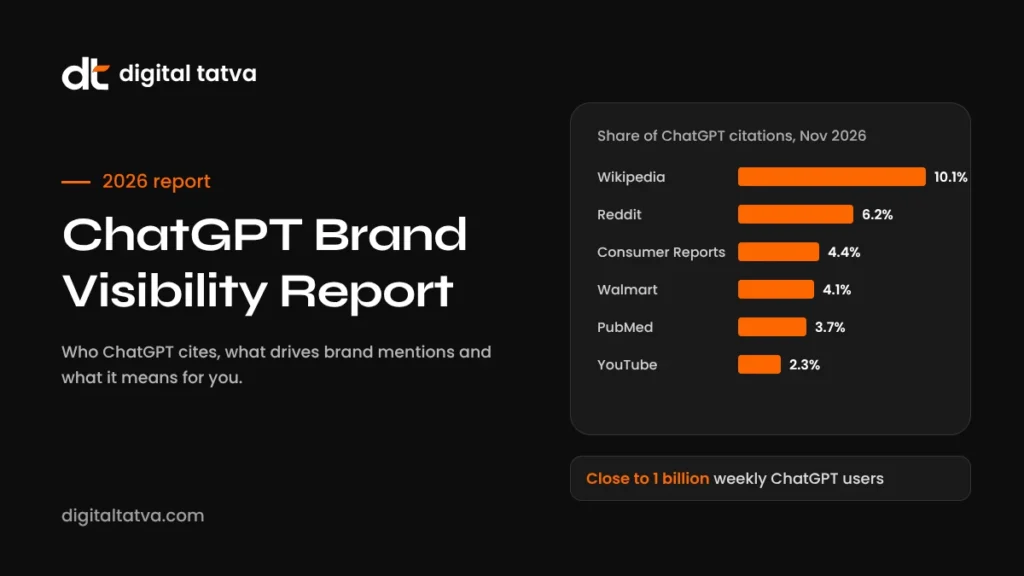
For ChatGPT, larger datasets agree that Wikipedia and Reddit remain the top two domains, followed by review sites, retailers such as Walmart and Home Depot, and medical and government sources. Our ChatGPT Brand Visibility Report 2026 covers those rankings in detail.
How often brand websites get cited
The studies disagree sharply here. Presenc AI found brand and product sites made up about 11% of ChatGPT Search citations and 14% of the Gemini app’s. A much larger Profound analysis of 11.8 billion data points, reported by WARC in September 2026, found brand websites made up 57% of AI citations overall, 47% in ChatGPT and 69% in Gemini.
The gap mostly comes from the prompts. Questions that name a brand or product (“what does X cost”, “does X integrate with Y”) send engines straight to the official site. Open category questions (“best CRM for small teams”) send them to reviews, publishers and forums. Both matter. Your own site wins the factual questions about you. Third-party sources win the shortlist questions where new customers discover you. Gemini, with its Google roots, appears to lean on official sites the most.
5. How closely each engine follows Google rankings
Ahrefs ran 15,000 long-tail queries through Google, Bing and AI assistants in mid 2025 and checked whether the cited URLs ranked for the same query.
| Platform | Cited URLs ranking in Google top 10 |
|---|---|
| Perplexity | 28.6% |
| ChatGPT (citations in the text) | 8.0% |
| ChatGPT (reference list) | 6.1% |
| Gemini and Copilot | About 8 to 9% |
| Average across assistants | About 12% |
Overall, about 80% of AI citations did not rank anywhere in Google for the original query. That sounds surprising for Gemini, which is grounded in Google Search, but AI assistants rewrite a question into several narrower searches (often called query fan-out) and cite the pages that answer those. A page can be cited without ranking for the head term, as long as it ranks for, or clearly answers, a specific sub-question.
For Google’s own AI Overviews, overlap is far higher. Ahrefs’ earlier research found about 76% of AI Overview citations came from the top 10, while BrightEdge, quoted by Tinuiti, put the overlap with page one at about 17% by early 2026, again because of fan-out searches.
The practical point: classic SEO helps most with Perplexity and Google’s AI features, while ChatGPT and the Gemini app need you to cover the specific sub-questions buyers ask and to be present on the sources they favour.
6. Citation accuracy: can you trust what they cite?
Being cited is only half the story. Independent audits show all three engines get citations wrong.
Tow Center at Columbia Journalism Review (March 2025)
- Eight AI search tools were given exact quotes from news articles and asked to identify the headline, publisher, date and URL, in 1,600 queries.
- Together they answered more than 60% of queries incorrectly.
- Perplexity had the lowest error rate at 37%. ChatGPT Search identified 134 of 200 articles incorrectly, about 67%, and rarely signalled any doubt.
- More than half of Gemini’s responses cited fabricated or broken URLs.
- Some tools still answered correctly about publishers that had blocked their crawlers, suggesting the content reached them another way.
EBU and BBC News Integrity study (October 2025)
- 22 public broadcasters in 18 countries reviewed more than 3,000 answers in 14 languages from ChatGPT, Copilot, Gemini and Perplexity.
- 45% of answers had at least one significant issue and 31% had serious sourcing problems.
- Gemini performed worst, with significant issues in 76% of answers, more than double the others, mostly because of weak sourcing.
These tests focused on news and used 2025 versions of the products, which have since improved. But the message for brands has not changed: an engine can cite your page and still misquote your price, mix you up with a competitor or link to an outdated article. Check what is said about you, not only whether you are mentioned. Our guide on fixing wrong AI answers about your brand explains what to do.
7. Which citation positions get clicked
Presenc AI measured relative click-through by citation position (first citation set to 100). Being listed first matters on both platforms, but Perplexity users click deeper into the list.
| Citation position | ChatGPT Search | Perplexity |
|---|---|---|
| 1st | 100 | 100 |
| 2nd | 68 | 72 |
| 3rd | 44 | 51 |
| 4th | 27 | 33 |
| 5th and later | 13 | 21 (5th), 12 (6th and later) |
No comparable public figure exists for Gemini. For actual traffic, ChatGPT sends by far the most AI referrals in most analytics data, simply because of its size, while Perplexity visitors are often highly engaged. Set up AI traffic tracking in GA4 to see the split for your own site.
8. What kind of content gets cited
Across studies, the same content traits come up again and again:
- Direct answers. Presenc AI found pages cited by Perplexity were 2.6 times more likely to use a direct answer format, 2.2 times more likely to be dense with facts, 1.9 times more likely to have headings that match the question and 1.7 times more likely to have passages that make sense on their own.
- Deep, specific pages. Similarweb found most ChatGPT citations point to blog posts, FAQs, guides and product pages rather than homepages.
- How-to content. In Seer’s Gemini data, “how to” questions kept citations on every answer even when recommendation questions lost them.
- Freshness. Perplexity and Gemini both weight recent content strongly for time-sensitive topics. Keep key pages updated and dated.
- Video. YouTube is a major source for Gemini and Google’s AI features, and YouTube mentions showed the strongest correlation with AI visibility in Ahrefs’ study of 75,000 brands.
- Community proof. Specific Reddit threads matter for Perplexity and ChatGPT, but barely for Gemini.
Schema markup alone did not move ChatGPT citations in an Ahrefs test of 1,885 pages, so treat structured data as hygiene rather than a ranking lever. Our guide to getting cited by AI turns these traits into a checklist.
9. Crawler access: the first thing to check
| Engine | Crawler for search and citations | Crawler for user-triggered visits | Training control |
|---|---|---|---|
| ChatGPT | OAI-SearchBot | ChatGPT-User | GPTBot |
| Gemini | Googlebot (Google Search index) | Google’s own fetchers | Google-Extended |
| Perplexity | PerplexityBot | Perplexity-User | No separate training crawler listed |
Many sites block AI crawlers by accident through security plugins, CDN bot rules or old robots.txt entries. Allow the search crawlers you want to be cited by, decide separately about training crawlers, and check your server logs to confirm the bots actually reach your pages. Our technical AEO checklist walks through each step.
10. Platform playbooks
To get cited by ChatGPT
- Allow OAI-SearchBot and ChatGPT-User.
- Earn mentions in the publishers, review sites and retailers ChatGPT cites in your category.
- Keep your Wikipedia presence (if you qualify) and other reference listings accurate.
- Publish pages that answer specific sub-questions, not only broad head terms.
- Track your visibility share with one of the ChatGPT tracking tools.
To get cited by Gemini
- Rank well in Google Search for the questions and sub-questions buyers ask.
- Invest in YouTube: helpful videos with clear titles, chapters and descriptions.
- Keep your official site complete and accurate, because Gemini leans on brand sites.
- Keep your Google Business Profile, Merchant Center and other Google listings up to date.
- Monitor with Gemini visibility tracking tools, since citation behaviour can change suddenly.
To get cited by Perplexity
- Allow PerplexityBot and Perplexity-User.
- Rank in Google’s top 10 where you can, since Perplexity has the highest overlap with it.
- Write fact-dense, answer-first pages with headings that mirror real questions, and update them often.
- Take part honestly in Reddit and community discussions where your buyers ask questions.
- Track mentions and citations with Perplexity rank tracking tools.
11. One strategy that works across all three
Despite the differences, the brands each engine recommends overlap a lot. Ahrefs’ study of about 75,000 brands found a correlation of 0.769 between the brands mentioned in Google AI Mode and ChatGPT, and 0.749 between AI Overviews and ChatGPT. Brands that are widely and consistently discussed tend to appear everywhere. So the core strategy is shared:
- Make your site easy to crawl for every engine you want to appear in.
- Publish clear, specific, up-to-date answers to the questions your buyers ask.
- Earn mentions on the third-party sources each engine trusts: publishers and reviews for ChatGPT, YouTube and Google properties for Gemini, communities and ranking pages for Perplexity.
- Keep your facts identical everywhere, from your website to listings and profiles.
- Measure each engine separately, because the same brand can be strong in one and invisible in another.
Digital PR is often the fastest way to build those third-party mentions. See our list of digital PR tools for earning AI citations.
12. How to run your own citation study
Public data shows the patterns, but your category may behave differently. Here is a simple way to run your own comparison:
- Write 30 to 50 prompts that real buyers ask, mixing discovery questions (“best X for Y”), comparison questions (“X vs Y”) and brand questions (“is X good for Y”).
- Run each prompt in ChatGPT with search on, the Gemini app and Perplexity, ideally three times each on different days, in each market and language you sell in.
- Record whether your brand is mentioned, whether your site is cited, which other domains are cited, and whether the facts about you are correct.
- Calculate visibility share per engine (the percentage of answers that mention you) and list the top cited domains for each.
- Compare the cited domains with your current PR, content and listings to find the gaps.
- Repeat monthly, or use an AI visibility tool to automate it.
This is an illustrative scenario, not a client story. A project management software company runs 40 prompts across the three engines. It finds that Perplexity cites two Reddit threads and a comparison article it is missing from, Gemini cites YouTube reviews and its competitors’ official comparison pages, and ChatGPT cites two software review sites and a well-known publisher’s roundup. The resulting plan has three tracks: join the relevant community discussions openly, produce a short YouTube comparison and a clear comparison page, and get reviewed on the two review sites before pitching the publisher’s next roundup. Nothing guarantees a citation, but each action targets a source the engines are already using.
13. Limits of the data
- Snapshots, not laws. Gemini’s citation rate fell 23 points in weeks, and ChatGPT’s Reddit and Wikipedia citations dropped sharply in late 2025. Re-check every quarter.
- Prompt mix changes everything. Commercial prompts, brand prompts and news prompts produce very different source mixes, which is why studies disagree.
- Vendor bias. Several datasets come from companies that sell AI visibility tools or services.
- US and English focus. Results in other languages and countries can differ, particularly for local sources.
- Personalisation. Signed-in users with memory and location may see different sources than a tracking tool does.
Want to know where each engine cites you? Digital Tatva runs AI visibility audits that compare your citations and mentions across ChatGPT, Gemini and Perplexity, identify the sources each engine trusts in your category and set out what to fix first. No one can guarantee placement in AI answers, but we can show you where the gaps are.
For a ChatGPT-specific action plan, read our guide on how to get your brand in ChatGPT.
Frequently asked questions
Which AI cites the most sources: ChatGPT, Gemini or Perplexity?
Perplexity. Vendor data puts it at about 5.8 sources per answer in 2026, against about 4.1 for ChatGPT Search and 4.6 for the Gemini app. Perplexity also shows numbered citations on almost every answer.
Does Gemini use Google Search to choose its sources?
Yes. Gemini grounds many answers in Google Search and also uses Google properties such as YouTube. Even so, Ahrefs found only about 8 to 9% of Gemini’s cited URLs ranked in Google’s top 10 for the original query, because Gemini runs several narrower searches behind the scenes.
Why does Perplexity cite Reddit so much?
Perplexity searches the live web on almost every query and favours detailed first-hand discussion. Reddit made up 24% of its citations in January 2026, according to Tinuiti and Profound, compared with 0.1% for Gemini.
Which AI search engine is most accurate with citations?
None is fully reliable. In the Tow Center test, Perplexity had the lowest error rate at 37%, ChatGPT Search got about 67% wrong, and over half of Gemini’s answers cited broken or made-up links. The EBU and BBC study found significant issues in 76% of Gemini’s news answers. Products have improved since, but brands should still check how they are quoted.
Do I need different strategies for ChatGPT, Gemini and Perplexity?
Partly. The foundations are the same: crawl access, clear answers, consistent facts and third-party mentions. The emphasis differs: publishers and reviews for ChatGPT, Google rankings, YouTube and your official site for Gemini, and Google top 10 rankings plus community discussions for Perplexity.
Does ranking on Google help me get cited by AI?
It helps most with Perplexity (28.6% of its citations ranked in Google’s top 10 in Ahrefs’ test) and with Google’s own AI Overviews. For ChatGPT and the Gemini app, ranking for the specific sub-questions behind a prompt matters more than ranking for the main keyword.
Why did my brand stop being cited in Gemini?
Gemini changed how often it shows citations in early 2026, dropping from 99% to 76% of answers in one large dataset, with recommendation questions affected most. Check whether your brand is still mentioned in the answer text, not only in the sources, and keep your Google presence and YouTube content strong.
How do I allow ChatGPT, Gemini and Perplexity to crawl my site?
Allow OAI-SearchBot and ChatGPT-User for ChatGPT, Googlebot for Gemini, and PerplexityBot and Perplexity-User for Perplexity in your robots.txt, firewall and CDN settings. Training crawlers such as GPTBot and Google-Extended can be controlled separately.
How often should I check my AI citations?
At least monthly, and after any major model update. Citation behaviour can change within weeks, as Gemini’s 2026 drop and ChatGPT’s late 2025 shift away from Reddit and Wikipedia showed.
Product details, prices and features are checked at the time of writing and can change. Sources are linked in the text so you can check them yourself.
How does your brand appear in AI answers?
We test the questions your buyers ask across the major AI assistants and search engines, then show you what to fix first.
Get an AI Visibility Audit