10 Best Perplexity Rank Tracking Tools in 2026 (Mentions and Citations)
Ten tools to track your brand and citations in Perplexity, plus how Perplexity picks sources and how to improve visibility.
On this page
- Key takeaways
- Why track your brand in Perplexity?
- How Perplexity chooses sources
- Best Perplexity rank tracking tools compared
- The 10 best Perplexity tracking tools in detail
- What to track in Perplexity
- How to set up Perplexity tracking
- How to improve your Perplexity visibility
- Perplexity vs ChatGPT tracking: what is different
- Common mistakes with Perplexity tracking
- Which Perplexity tracking tool fits your team?
- How to report Perplexity visibility
- Questions to ask before you buy
- How Digital Tatva can help
- Frequently asked questions
Last updated: 25 November 2026
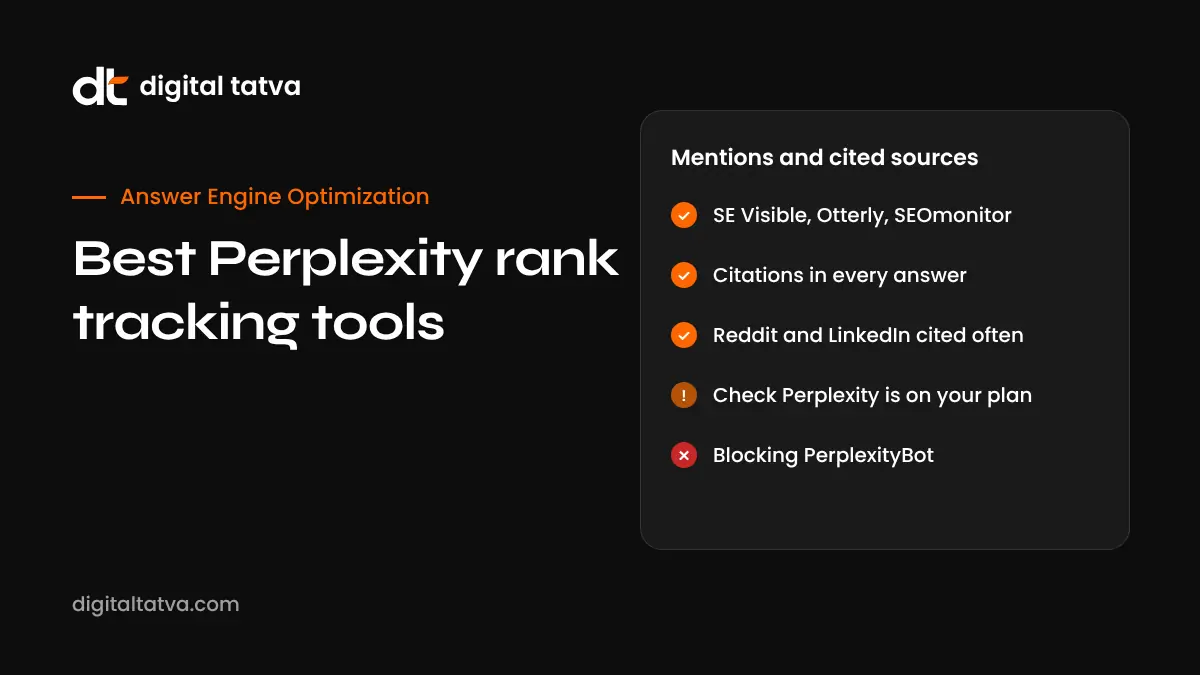
Quick answer: The best Perplexity rank tracking tools in 2026 are SE Visible by SE Ranking (best for linking Perplexity citations to SEO data), Otterly.AI (best budget pick, with Perplexity on every plan from $29), SEOmonitor (best for tracking Perplexity on real search demand), Peec AI (best for marketing teams, with Perplexity as an add-on), Scrunch AI (best for B2B personas), Trakkr (best flat pricing), Rankscale (best flexible credits), Semrush AI Visibility Toolkit (best for Semrush users), HubSpot AEO (cheapest simple option) and AthenaHQ (best free start). Perplexity shows its sources in every answer, so the most useful tools track both brand mentions and which of your URLs Perplexity cites.
Key takeaways
- Perplexity cites sources in nearly every answer, which makes citation tracking especially valuable.
- Perplexity relies more on Reddit and LinkedIn than ChatGPT does, according to 2026 citation data.
- Not every tool includes Perplexity on its entry plan, so check before buying.
- Perplexity’s API can cite a different mix of sites than the app people use.
- Allowing PerplexityBot and being present on the platforms it cites are the first fixes.
Why track your brand in Perplexity?
Perplexity is an AI answer engine that searches the web and shows numbered sources with every answer. It had about 98 million web visits in October 2026, according to Semrush estimates published by Exploding Topics. That is smaller than ChatGPT or Gemini, and its traffic fell about 15% between June and October, but Perplexity users skew towards researchers, professionals and B2B buyers who click sources and compare options carefully.
Because Perplexity always shows its sources, it is the clearest place to see which pages AI trusts in your category. Tracking it tells you whether your brand is mentioned, which of your pages are cited and which competitor or third-party pages win the citation instead. For the bigger picture, see our Perplexity review and Perplexity SEO guide.
How Perplexity chooses sources
Perplexity combines its own crawler (PerplexityBot), live web search and its models’ training. Relevance, freshness, authority and clear structure all influence which pages it cites. Citation data published by Searchable for September 2026 showed some clear differences from ChatGPT:
| Source | Share of Perplexity answers citing it | Share of ChatGPT answers citing it |
|---|---|---|
| 10.8% | 5.2% | |
| 8.3% | 2.3% | |
| Wikipedia | 1.3% | 3.8% |
| YouTube | 0.6% | 1.5% |
The same data showed YouTube citations in Perplexity falling sharply in August 2026, from about 13.8% of answers to under 1%, which is a reminder that source patterns can change quickly. It also noted that Perplexity’s API sources a different mix of sites than the consumer app, so ask tools which they measure. Useful related guides: Reddit for AEO and LinkedIn for AEO.
Best Perplexity rank tracking tools compared
| # | Tool | Entry price | Perplexity on entry plan? | Citation tracking | Best for |
|---|---|---|---|---|---|
| 1 | SE Visible by SE Ranking | $89/month | Check plan; listed on higher tiers | Yes, with SEO data | Citation analysis for SEO teams |
| 2 | Otterly.AI | $29/month | Yes | Yes | Small budgets |
| 3 | SEOmonitor | $86/month | If chosen as your LLM | Yes | Perplexity on real search demand |
| 4 | Peec AI | $95/month | Add-on | Yes | Marketing teams |
| 5 | Scrunch AI | $300/month | Yes | Yes | B2B personas |
| 6 | Trakkr | $100/month | Yes | Yes | Flat pricing |
| 7 | Rankscale | $99/month | Yes (credits) | Yes | Flexible frequency |
| 8 | Semrush AI Visibility Toolkit | $99/month per domain | Yes | Mentions focus | Semrush users |
| 9 | HubSpot AEO | $50/month | Yes | Yes | Simple, low-cost tracking |
| 10 | AthenaHQ | Free; $295/month | Yes | Yes | Free baseline |
Engine coverage and prices come from vendor pages and recent third-party comparisons checked in October and November 2026. Confirm Perplexity is included on the exact plan you choose.
The 10 best Perplexity tracking tools in detail
1. SE Visible by SE Ranking: best for Perplexity citation analysis
- Starting price: $89/month (Basic, 75 prompts)
- Free option: 10-day trial
- Best for: SEO teams and agencies that want to know why pages get cited
SE Visible tracks mentions, position, share of voice, sentiment and cited sources across the main AI engines, and third-party comparisons list Perplexity among its engines on higher tiers. Its strength for Perplexity work is that cited sources come with SEO data such as traffic and backlinks, which helps explain why Perplexity chose a page and what it would take to replace it.
Benefits:
- Cited sources enriched with SEO metrics
- Every metric opens into the answer behind it
- Strong prompt volume on Core and Agency plans
- About 20% off yearly
- Free trial to confirm Perplexity coverage on your plan
2. Otterly.AI: best budget Perplexity tracker
- Starting price: $29/month (Lite, 15 prompts)
- Free option: trial
- Best for: small businesses and freelancers
Otterly includes Perplexity on every plan alongside ChatGPT, Google AI Overviews and Copilot. It records mentions and the links each answer references, and builds a citation-based share of voice.
Benefits:
- Perplexity included from the cheapest plan
- Citation-based share of AI voice
- Four engines on every plan
- Unlimited workspaces from Standard
- Quick setup
3. SEOmonitor: best for Perplexity on real search demand
- Starting price: $86/month (Starter, 500 keywords, one LLM of choice)
- Free option: 14-day trial, no card
- Best for: SEO teams that already track keywords
SEOmonitor turns Google keywords into questions and checks them in your chosen LLMs, including Perplexity, weighting results by search volume. Choose Perplexity as your Starter LLM, or mix it with ChatGPT, Claude and Gemini on Pro from $327.
Benefits:
- Perplexity visibility weighted by real demand
- Google rankings and AI Overviews on the same keywords
- Mentions and citations for competitors
- Unlimited users
- Looker Studio and MCP integrations
4. Peec AI: best for marketing teams
- Starting price: $95/month (Starter, 50 prompts)
- Free option: trial
- Best for: teams that want clean reports across several engines
Peec AI reports visibility, position, sentiment and sources. Perplexity is available as an add-on rather than in the default model picks, so include it in your budget.
Benefits:
- Clear dashboards for non-specialists
- Sentiment insight on Perplexity answers
- Unlimited users
- Scales to 350 prompts
- About 15% off yearly
5. Scrunch AI: best for B2B personas
- Starting price: $300/month ($250 yearly)
- Free option: 7-day trial
- Best for: B2B and SaaS brands
Perplexity’s research-heavy audience overlaps with B2B buyers, which makes Scrunch’s persona tracking useful. It covers Perplexity with ChatGPT, Claude, Gemini, AI Mode, AI Overviews and Meta AI.
Benefits:
- Persona-based answers for different buyers
- 350 custom prompts plus industry prompts
- Low cost per prompt at volume
- Citation analysis separate from share of voice
- Content recommendations
6. Trakkr: best flat pricing
- Starting price: $100/month (one brand)
- Free option: limited
- Best for: teams that want predictable costs
Trakkr includes Perplexity among a wide set of engines and tracks cited URLs, mentions and sentiment as separate fields, without credit metering.
Benefits:
- Flat price per brand
- Broad engine coverage
- Separate citation, mention and sentiment data
- White-label portal on Scale
- API on Scale
7. Rankscale: best flexible credits
- Starting price: Pro $99/month
- Free option: limited
- Best for: teams that want to control frequency
Rankscale’s credit system covers Perplexity on every tier and lets you choose how often each prompt runs, so you can track key Perplexity prompts daily and the rest weekly.
Benefits:
- Perplexity on every tier with no add-on fee
- Adjustable frequency per prompt
- Citation analysis panel
- Unlimited seats from Pro
- White-label dashboards from Growth
8. Semrush AI Visibility Toolkit: best for Semrush users
- Starting price: $99/month per domain
- Free option: limited
- Best for: teams running SEO in Semrush
Semrush covers Perplexity with ChatGPT, Google AI and Gemini, reporting mentions next to your keyword data.
Benefits:
- AI and SEO data in one login
- Familiar reports
- Extra prompt packs available
- Easy for existing Semrush customers
- Combined stakeholder reporting
9. HubSpot AEO: cheapest simple option
- Starting price: $50/month ($45 yearly)
- Free option: free trial, 25 prompts
- Best for: small teams
HubSpot’s AEO tool tracks Perplexity, ChatGPT and Gemini with a visibility score, sentiment and citations split by domain and content type. See our HubSpot AEO tool review.
Benefits:
- Low price
- Free trial without a card
- Citations by domain and content type
- CRM-based prompts
- Easy setup
10. AthenaHQ: best free start
- Starting price: free; Starter $295/month
- Free option: 300 credits
- Best for: measuring a Perplexity baseline before paying
AthenaHQ’s free tier gives 300 credits across five engines, enough to measure how Perplexity treats your brand on key questions. Starter adds 3,600 credits a month and more engines.
Benefits:
- Free tier with no time limit
- One credit equals one answer
- Flags false claims about your brand
- Wide engine coverage on Starter
- Partner discounts for agencies
What to track in Perplexity
| Metric | What it tells you |
|---|---|
| Mention rate | How often Perplexity names your brand for your prompts |
| Citation rate | How often your own URLs appear in the numbered sources |
| Cited competitors and third parties | Which pages win the citation instead of yours |
| Position in lists | Whether you are named first or further down |
| Sentiment and accuracy | Whether Perplexity describes you correctly |
| Referral traffic | Visits from perplexity.ai in analytics |
Track Perplexity referrals in GA4 with our guide to tracking AI traffic in GA4.
How to set up Perplexity tracking
- Check crawler access. Make sure PerplexityBot is not blocked in robots.txt or by your firewall. See robots.txt for AI crawlers.
- List research-style prompts. Perplexity users ask detailed comparison and “how to choose” questions.
- Add competitors. Three to five direct competitors.
- Pick a tool that includes Perplexity on your plan, not as a surprise add-on.
- Run a four-week baseline. Citations shift, so look for trends.
- Map cited sources. Note how often Reddit, LinkedIn, review sites and publications appear.
- Turn gaps into actions. Improve pages, earn mentions on cited platforms and fix wrong facts.
How to improve your Perplexity visibility
- Make pages easy to cite: clear answers at the top, question headings, tables and sourced facts.
- Keep content fresh: Perplexity favours up-to-date information; show updated dates.
- Be present where Perplexity looks: helpful Reddit discussions, LinkedIn articles and industry publications.
- Publish original data: unique statistics are natural citation targets.
- Fix technical access: fast, crawlable pages without heavy JavaScript.
Our full Perplexity SEO guide covers each step.
Illustrative example: A cybersecurity software company finds it is cited in only a few Perplexity answers for its main buying questions, while two Reddit threads and a LinkedIn article by an analyst are cited often. It publishes a detailed comparison page with sourced benchmarks, contributes helpful answers in the relevant communities and shares research on LinkedIn, then tracks citation rate monthly. This is an illustrative scenario, not a client story.
Checklist: Perplexity tracking
- PerplexityBot allowed in robots.txt and firewall.
- Research-style prompts listed.
- Perplexity included on your tool’s plan.
- Competitors added.
- Baseline recorded for four weeks.
- Cited sources mapped and prioritised.
- Perplexity referrals tracked in analytics.
Tracking other engines? See ChatGPT rank tracking tools, Gemini visibility tracking tools and the best AI visibility tools.
Perplexity vs ChatGPT tracking: what is different
| Factor | Perplexity | ChatGPT |
|---|---|---|
| Sources shown | Numbered sources in almost every answer | Sources shown mainly when search is used |
| Audience | Researchers and professionals | Very broad, consumer and business |
| Cited platforms | Reddit and LinkedIn cited more often in 2026 data | Wikipedia and YouTube cited more often than in Perplexity |
| Crawler | PerplexityBot | OAI-SearchBot and others |
| Best metric | Citation rate of your URLs | Mention rate and citation share |
Because the two engines prefer different sources, a brand can do well in one and poorly in the other. Track both if your buyers use both. See Perplexity vs ChatGPT.
Common mistakes with Perplexity tracking
- Blocking PerplexityBot by accident. Firewalls and CDNs sometimes block AI crawlers without anyone noticing.
- Tracking only mentions. In Perplexity the citation is often the most valuable signal.
- Ignoring Reddit and LinkedIn. These platforms appear frequently in Perplexity sources.
- Using API data as if it were the app. Ask your tool which version it measures.
- Reacting to weekly swings. Source patterns can shift quickly; look at monthly trends.
- Letting content go stale. Perplexity favours fresh information, so update key pages and show dates.
Which Perplexity tracking tool fits your team?
| Your situation | Good fit |
|---|---|
| Small business on a budget | Otterly.AI or HubSpot AEO |
| SEO team tracking keywords | SEOmonitor |
| Agency needing citation analysis | SE Visible or Rankscale |
| B2B with research-heavy buyers | Scrunch AI |
| Team wanting predictable cost | Trakkr |
| Team testing first | AthenaHQ free tier |
How to report Perplexity visibility
A good monthly report turns tracking data into decisions. Keep it short and focused on what changed and what you will do next.
- Headline numbers. Mention rate, citation rate and share of voice against the same competitors as last month.
- What moved. Prompts where you gained or lost visibility, with the answer text as evidence.
- Top cited sources. The pages and platforms Perplexity relied on most, and whether any of them are yours.
- Accuracy issues. Any wrong facts, prices or descriptions found in answers.
- Traffic and conversions. Visits and leads or orders from perplexity.ai in analytics.
- Actions for next month. Three to five specific fixes, each with an owner.
Our AEO reporting template gives you a ready-made structure, and AEO KPIs explains each metric.
Questions to ask before you buy
- Which engines are included on this exact plan? Some engines are add-ons or limited to higher tiers.
- How do you collect answers? API and app answers can differ, so ask which one you measure.
- How often does each prompt run? Daily, weekly or custom frequency changes both cost and data quality.
- Do you repeat prompts to smooth out variation? AI answers change from run to run.
- Can I set country and language? Answers vary by location.
- Do you show cited URLs, not just domains? Page-level citations make fix lists far more useful.
- Can I export data or connect Looker Studio or an API? Important for reporting.
- What happens to my data if I cancel? Make sure you can export your history.
How Digital Tatva can help
Digital Tatva helps brands get cited in Perplexity and other AI answer engines by improving content, technical access, entity data and third-party mentions. We never guarantee AI placement; we measure, explain and improve. See our AEO services.
Is Perplexity citing you or your competitors? Request an AEO audit or try the free AI visibility checker.
Frequently asked questions
What is the best Perplexity rank tracking tool?
SE Visible is strong for citation analysis with SEO data, Otterly.AI is the best budget option with Perplexity on every plan, and SEOmonitor suits SEO teams tracking keywords.
Can you rank in Perplexity?
Not in fixed positions. Perplexity generates answers fresh each time, so “ranking” means how often you are mentioned and cited across many prompts.
How does Perplexity choose its sources?
It combines its crawler, live web search and model knowledge, favouring relevant, fresh, authoritative and well-structured pages. In 2026 data it cited Reddit and LinkedIn more often than ChatGPT did.
Is there a free Perplexity rank tracker?
AthenaHQ’s free tier covers Perplexity, and several tools offer trials. You can also test prompts manually each month and log the sources cited.
Does every AI visibility tool track Perplexity?
No. Some include it on every plan, others charge an add-on or include it only on higher tiers. Always check.
How do I allow Perplexity to crawl my site?
Make sure PerplexityBot is not blocked in robots.txt or by your firewall or CDN. See our AI crawlers list.
Why do Perplexity citations change so often?
Perplexity searches the live web and adjusts which sources it uses. In 2026, YouTube citations dropped sharply within weeks, so track trends over time.
Do Perplexity’s API and app cite the same sources?
Not always. Third-party data found the API sources a different mix of sites than the consumer app, so ask your tool which it measures.
How do I track traffic from Perplexity?
Look for referrals from perplexity.ai in your analytics and group them in an AI channel. See our GA4 guide.
How long does it take to get cited by Perplexity?
Fixes such as crawler access can help within weeks, while earning citations through content and mentions usually takes a few months.
Product details, prices and features are checked at the time of writing and can change. Sources are linked in the text so you can check them yourself.
How does your brand appear in AI answers?
We test the questions your buyers ask across the major AI assistants and search engines, then show you what to fix first.
Get an AI Visibility Audit