10 Best AI Visibility Tools for Ecommerce in 2026 (Track Products in AI Shopping)
Ten tools that show which of your products AI assistants recommend, with shopping coverage, prices and how to improve.
On this page
- Key takeaways
- Why ecommerce brands need AI visibility tracking
- What ecommerce teams need from an AI visibility tool
- Best AI visibility tools for ecommerce compared
- The 10 best AI visibility tools for ecommerce in detail
- Which tool fits your store?
- Prompts ecommerce brands should track
- How to improve AI shopping visibility
- Ecommerce AI visibility metrics
- An AI visibility calendar for online stores
- Common ecommerce mistakes
- How to report AI shopping visibility
- Questions to ask before you buy
- How Digital Tatva can help
- Frequently asked questions
Last updated: 25 November 2026
Quick answer: The best AI visibility tools for ecommerce in 2026 are Peec AI (product-level ChatGPT shopping tracking on every tier, from $95 a month), Rankscale (ChatGPT and Google AI Mode shopping tracking from $99), Goodie (the widest shopping coverage, including Amazon’s shopping assistant and Walmart’s Sparky, on its Pro plan), Profound (enterprise SKU tracking), Semrush Enterprise AIO (ChatGPT and AI Mode shopping for large retailers), Scrunch AI (ChatGPT and Copilot shopping), Writesonic GEO (AI shopping tracker on enterprise plans), LLM Pulse (shopping tracking with an Amazon assistant add-on), SE Visible by SE Ranking (brand and category visibility with cited sources) and Otterly.AI (low-cost brand-level tracking). Ecommerce brands need product-level tracking, not just brand mentions, because AI shopping answers recommend specific products, prices and stores.
Key takeaways
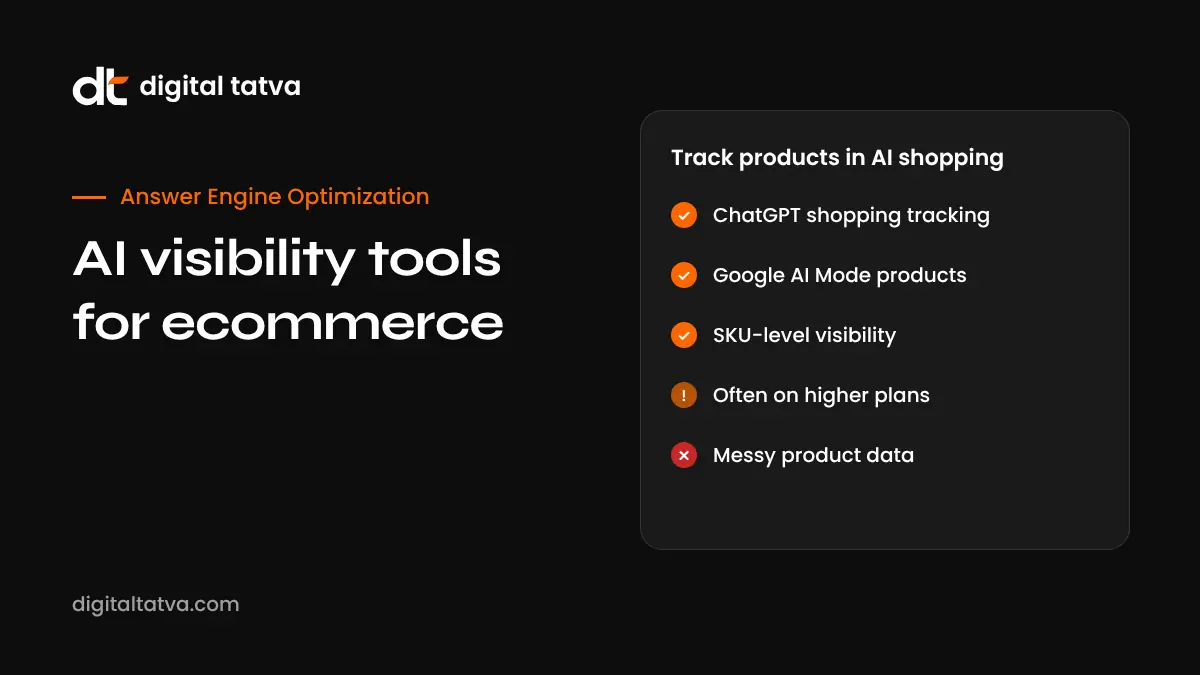
- AI assistants now recommend specific products, show prices and in some cases complete checkout.
- Most AI visibility tools track brand mentions; fewer track products or SKUs inside shopping answers.
- ChatGPT shopping is the most widely tracked surface; Google AI Mode and Amazon’s assistant are tracked by fewer tools.
- Many product-level features sit on higher or enterprise plans, so check carefully.
- Clean product data, reviews and policies drive AI shopping visibility as much as content does.
Why ecommerce brands need AI visibility tracking
Shopping research is moving into AI assistants. ChatGPT offers shopping research and product cards, Google AI Mode shows products with prices and, through Google’s Universal Commerce Protocol, can support checkout, and Amazon’s shopping assistant answers product questions inside Amazon. When a shopper asks “best running shoes for flat feet under $150”, the assistant picks a handful of products. If yours are missing, you lose the sale before the shopper ever reaches a search results page.
For ecommerce, brand-level tracking is not enough. You need to know which products appear, at what price, from which store and with what description. See our guides to ChatGPT shopping optimization, Google UCP and agentic checkout and Amazon Rufus optimization.
What ecommerce teams need from an AI visibility tool
| Feature | Why it matters |
|---|---|
| Product or SKU-level tracking | Shows which products AI recommends, not just whether your brand is named |
| ChatGPT shopping coverage | The most widely used AI shopping surface |
| Google AI Mode shopping coverage | Product results inside Google’s AI search |
| Amazon and retailer assistants | Marketplace sellers need visibility where purchases happen |
| Price and retailer data | Shows whether AI shows your price and store or a reseller’s |
| Competitor products | Reveals which rival products win recommendations |
| Category prompts | “Best X for Y” prompts drive most AI shopping journeys |
| Cited sources | Review sites and listicles that influence product picks |
Best AI visibility tools for ecommerce compared
| # | Tool | ChatGPT shopping | Google AI Mode shopping | Amazon assistant | Product-level tracking | Price |
|---|---|---|---|---|---|---|
| 1 | Peec AI | Yes | No | No | Yes, all tiers | From $95/month |
| 2 | Rankscale | Yes | Yes | No | Yes (Product Cockpit) | Pro $99/month |
| 3 | Goodie | Yes | Yes (Pro) | Yes, plus Walmart Sparky | Yes, Pro and up | Pro $999/month yearly |
| 4 | Profound | Yes | Not named | No | Yes (Enterprise) | Custom |
| 5 | Semrush Enterprise AIO | Yes | Yes | No | Yes | Custom |
| 6 | Scrunch AI | Yes (and Copilot) | Not confirmed | No | Yes (Enterprise) | From $300/month |
| 7 | Writesonic GEO | Yes | Not named | No | Partial (Enterprise) | From $79/month yearly |
| 8 | LLM Pulse | Yes | No | Yes, paid add-on | Yes (Scale) | Scale €299/month |
| 9 | SE Visible by SE Ranking | Brand-level | Brand-level | No | Category and brand | From $89/month |
| 10 | Otterly.AI | Brand-level | Add-on | No | Brand-level | From $29/month |
Shopping coverage is based on a product-level comparison published by Rework in October 2026 and vendor pages checked in November 2026. Many vendors gate shopping data behind higher plans, so confirm features in a trial or demo. Amazon’s shopping assistant has been referred to as Rufus and, by some vendors, as Alexa for Shopping; ask which name and surface a tool actually tracks.
The 10 best AI visibility tools for ecommerce in detail
1. Peec AI: best for product-level ChatGPT shopping tracking
- Starting price: $95/month (Starter)
- Shopping coverage: ChatGPT shopping
- Best for: DTC brands and online stores of any size
Peec AI tracks which products ChatGPT shows in shopping answers on every tier, not only enterprise plans. That makes it one of the most accessible ways for online stores to see product-level AI visibility alongside brand mentions, sentiment and sources.
Benefits:
- Product-level tracking on all tiers
- Brand visibility, sentiment and sources in the same dashboard
- Unlimited users
- Published pricing from $95
- About 15% off yearly
2. Rankscale: best for ChatGPT and AI Mode shopping on a budget
- Starting price: Pro $99/month (shopping not in Essentials)
- Shopping coverage: ChatGPT and Google AI Mode
- Best for: stores that sell through Google and want AI Mode product data
Rankscale’s Product Cockpit tracks products in both ChatGPT and Google AI Mode shopping answers, which is rare at this price. Its credit system lets you run high-value category prompts more often than long-tail ones.
Benefits:
- ChatGPT and Google AI Mode shopping from $99
- Product Cockpit for SKU-level views
- Adjustable tracking frequency
- All engines on every tier
- White-label dashboards from Growth for agencies
3. Goodie: best for marketplace and retailer assistants
- Starting price: Core $399/month yearly; shopping on Pro $999/month yearly
- Shopping coverage: ChatGPT, Google AI Mode, Amazon’s assistant and Walmart Sparky
- Best for: large brands selling across marketplaces
Goodie offers the widest shopping coverage in this list, including retailer assistants where purchases happen. It also adds an action layer and revenue attribution on higher plans.
Benefits:
- Tracks Amazon’s and Walmart’s shopping assistants
- ChatGPT and AI Mode shopping on Pro
- SKU-level views on Pro and above
- Action recommendations alongside tracking
- Revenue attribution features
4. Profound: best for enterprise retailers
- Starting price: custom after demo
- Shopping coverage: ChatGPT shopping
- Best for: large retailers and brands with many SKUs
Profound supports ChatGPT shopping and SKU-level tracking on enterprise plans, alongside broad engine coverage and conversation research. Note that the free trial excludes ChatGPT shopping.
Benefits:
- SKU-level tracking for large catalogues
- Up to nine AI engines
- Enterprise seats and API
- Conversation research for product questions
- Dedicated enterprise support
5. Semrush Enterprise AIO: best for retailers already on Semrush
- Starting price: custom (the $99 toolkit is brand-level only)
- Shopping coverage: ChatGPT and Google AI Mode
- Best for: large ecommerce teams in Semrush
Semrush’s Enterprise AIO adds product-level tracking in ChatGPT and AI Mode shopping. The standard $99 AI Visibility Toolkit tracks brands rather than products, so ecommerce teams need the enterprise product for SKU data.
Benefits:
- ChatGPT and AI Mode shopping data
- SKU-level tracking
- Sits alongside Semrush SEO and PPC data
- Familiar reporting for existing teams
- Enterprise project structure
6. Scrunch AI: best for ChatGPT and Copilot shopping
- Starting price: $300/month ($250 yearly)
- Shopping coverage: ChatGPT and Copilot
- Best for: brands with several customer types
Scrunch tracks ChatGPT and Copilot shopping answers, with SKU-level views on enterprise plans. Persona tracking helps brands see how product recommendations change for different shoppers.
Benefits:
- ChatGPT and Copilot shopping coverage
- Persona-based product recommendations
- Broad engine coverage
- Low cost per prompt at volume
- Content recommendations
7. Writesonic GEO: best for content-led ecommerce teams
- Starting price: Starter $79/month yearly; shopping on Enterprise
- Shopping coverage: ChatGPT shopping tracker
- Best for: teams that want tracking and content creation together
Writesonic combines AI visibility tracking with content tools, and its AI shopping tracker shows top products in ChatGPT answers on enterprise plans.
Benefits:
- Tracking and content creation in one platform
- AI shopping tracker for top products
- Lower entry price for brand tracking
- Fact-check and sentiment features
- Useful for refreshing product and category content
8. LLM Pulse: best for Amazon assistant tracking at mid-market prices
- Starting price: Scale €299/month (weekly)
- Shopping coverage: ChatGPT shopping; Amazon assistant as a paid add-on
- Best for: Amazon sellers and marketplace brands
LLM Pulse tracks ChatGPT shopping and offers Amazon’s shopping assistant as a paid add-on, with SKU-level tracking on its Scale plan.
Benefits:
- Amazon assistant tracking add-on
- SKU-level tracking on Scale
- ChatGPT shopping coverage
- Weekly tracking keeps costs predictable
- Mid-market pricing
9. SE Visible by SE Ranking: best for category and brand visibility
- Starting price: $89/month (75 prompts)
- Shopping coverage: brand and category prompts across ChatGPT, Gemini, AI Mode and AI Overviews
- Best for: stores that want to know which review and comparison pages AI trusts
SE Visible focuses on brand mentions and cited sources rather than product cards. For ecommerce, that is valuable for category questions such as “best mattress for back pain”, where AI often cites review sites and buying guides. Cited sources come with SEO data, so you can see which pages to target for coverage.
Benefits:
- Cited sources with traffic and backlink data
- Covers ChatGPT, Gemini, AI Mode and AI Overviews
- Strong for category and buying-guide prompts
- High prompt volume on higher tiers
- 10-day free trial
10. Otterly.AI: best low-cost brand tracking for small stores
- Starting price: $29/month (15 prompts)
- Shopping coverage: brand-level
- Best for: small Shopify and WooCommerce stores
Otterly does not track product cards, but it is an affordable way for small stores to see whether ChatGPT, Google AI Overviews, Perplexity and Copilot mention their brand for key category questions, and which sources they cite.
Benefits:
- Lowest entry price
- Four engines on every plan
- Citation-based share of voice
- Simple setup for small teams
- Upgrade path as you grow
Which tool fits your store?
| Store type | Good fit |
|---|---|
| Small Shopify or WooCommerce store | Otterly.AI, then Peec AI |
| Growing DTC brand | Peec AI or Rankscale |
| Store relying on Google traffic | Rankscale (AI Mode shopping) |
| Amazon or marketplace seller | Goodie or LLM Pulse |
| Enterprise retailer | Profound, Semrush Enterprise AIO or Goodie |
| Content-led brand with buying guides | SE Visible or Writesonic GEO |
Prompts ecommerce brands should track
- Category: “best [product] for [use case]”, “top [product] brands”
- Budget: “best [product] under [price]”
- Comparison: “[your brand] vs [competitor]”, “[product] alternatives”
- Problem: “what [product] helps with [problem]”
- Location and delivery: “where to buy [product] in [country]”
- Gift and seasonal: “best [product] gift for [person]”
How to improve AI shopping visibility
- Fix product data. Complete titles, attributes, prices, stock and images in your feeds and on product pages.
- Add product schema. Structured data helps AI read prices, availability and reviews.
- Grow reviews. Ratings and detailed reviews strongly influence product picks.
- Publish buying guides. Honest comparisons and “best for” pages are easy for AI to cite.
- Earn coverage on review sites. Target the publications AI cites for your category.
- Keep policies clear. Shipping, returns and warranty details help agents choose stores.
- Prepare for agentic checkout. See Google UCP and AEO for Shopify.
Illustrative example: A skincare brand tracks 40 category prompts and finds ChatGPT recommends its moisturiser, but shows a reseller’s price and an old product name. It updates its product feed, adds product schema, corrects the name on major retailer listings and publishes a buying guide for sensitive skin, then tracks product appearances weekly through the holiday season. This is an illustrative scenario, not a client story.
Checklist: AI visibility for ecommerce
- Product-level tracking on the plan you choose.
- Shopping surfaces that matter to you covered (ChatGPT, AI Mode, Amazon).
- Category, budget and comparison prompts listed.
- Product feeds and schema complete.
- Review volume and quality monitored.
- Shipping and returns policies clear.
- Weekly tracking during peak seasons.
Related: AEO for ecommerce, AEO for the holiday season and AI visibility tools pricing compared.
Ecommerce AI visibility metrics
| Metric | What it shows |
|---|---|
| Product appearance rate | How often your products appear in shopping answers for tracked prompts |
| Product position | Whether your product is shown first or further down |
| Price and store accuracy | Whether AI shows your correct price and your own store |
| Competitor products | Which rival products win recommendations |
| Cited review sources | Which review sites and guides influence product picks |
| Brand mention rate | How often your brand is named in category answers |
| AI referral revenue | Orders from visitors who came from AI assistants |
An AI visibility calendar for online stores
| When | What to do |
|---|---|
| 8 to 10 weeks before peak season | Baseline product prompts, fix product data and schema |
| 4 to 6 weeks before | Publish gift guides and buying guides, update reviews and policies |
| Peak season | Track key prompts more often, watch prices and stock shown by AI |
| After peak | Review which products appeared, fix gaps for the next season |
| Product launches | Add launch prompts, check that AI picks up the new product name and price |
Common ecommerce mistakes
- Tracking only the brand name. Shoppers ask about products and problems, not your company.
- Inconsistent product names. Different names across your site, feeds and marketplaces confuse AI.
- Missing prices or stock data. AI may show a reseller or an old price instead.
- Ignoring reviews. Ratings and detailed reviews strongly influence AI picks.
- Thin category pages. AI prefers pages that clearly explain who each product is for.
- No AI referral tracking. Measure orders from AI visitors in analytics. See track AI traffic in GA4.
How to report AI shopping visibility
A good monthly report turns tracking data into decisions. Keep it short and focused on what changed and what you will do next.
- Headline numbers. Mention rate, citation rate and share of voice against the same competitors as last month.
- What moved. Prompts where you gained or lost visibility, with the answer text as evidence.
- Top cited sources. The pages and platforms AI shopping relied on most, and whether any of them are yours.
- Accuracy issues. Any wrong facts, prices or descriptions found in answers.
- Traffic and conversions. Visits and leads or orders from chatgpt.com, gemini.google.com and perplexity.ai in analytics.
- Actions for next month. Three to five specific fixes, each with an owner.
Our AEO reporting template gives you a ready-made structure, and AEO KPIs explains each metric.
Questions to ask before you buy
- Which engines are included on this exact plan? Some engines are add-ons or limited to higher tiers.
- How do you collect answers? API and app answers can differ, so ask which one you measure.
- How often does each prompt run? Daily, weekly or custom frequency changes both cost and data quality.
- Do you repeat prompts to smooth out variation? AI answers change from run to run.
- Can I set country and language? Answers vary by location.
- Do you show cited URLs, not just domains? Page-level citations make fix lists far more useful.
- Can I export data or connect Looker Studio or an API? Important for reporting.
- What happens to my data if I cancel? Make sure you can export your history.
How Digital Tatva can help
Digital Tatva helps online stores get their products recommended in ChatGPT, Google AI Mode and other AI shopping surfaces by improving product data, content, reviews and citations. We never guarantee AI placement; we measure, explain and improve. See our ecommerce AEO service.
Are AI assistants recommending your products? Request an AEO audit or try the free AI visibility checker.
Frequently asked questions
What is the best AI visibility tool for ecommerce?
Peec AI offers product-level ChatGPT shopping tracking on every tier, Rankscale adds Google AI Mode shopping from $99 and Goodie covers the widest range of shopping assistants for larger brands.
Can I track my products in ChatGPT shopping?
Yes. Peec AI, Rankscale, Goodie, Profound, Semrush Enterprise AIO, Scrunch AI, Writesonic GEO and LLM Pulse track ChatGPT shopping in some form, often on higher plans.
Which tools track Google AI Mode shopping?
Rankscale, Goodie (Pro) and Semrush Enterprise AIO track Google AI Mode shopping according to 2026 comparisons.
Can I track Amazon’s AI shopping assistant?
A few tools can. Goodie and LLM Pulse (as an add-on) track Amazon’s assistant. Ask which name and surface they track, as vendors refer to it differently.
What is the difference between brand and product tracking?
Brand tracking shows whether AI names your company. Product tracking shows which specific products appear, with prices and stores, in shopping answers.
How much does ecommerce AI visibility tracking cost?
Product-level tracking starts at about $95 to $99 a month with Peec AI and Rankscale, while broader marketplace coverage costs several hundred dollars or more.
Do small stores need AI visibility tools?
Small stores can start with low-cost brand tracking or manual checks of their top category prompts, then upgrade to product tracking as revenue grows.
How do I get my products recommended by ChatGPT?
Complete product data, structured data, strong reviews, clear policies and presence on the review sites ChatGPT cites. See our ChatGPT shopping optimization guide.
How often should ecommerce brands track AI visibility?
Weekly for most stores, and more often around launches, sales and the holiday season.
Can AI visibility tools track prices shown by AI?
Product-level tools show which products and stores appear, which helps you spot wrong prices or resellers. Check how detailed price data is on each plan.
Product details, prices and features are checked at the time of writing and can change. Sources are linked in the text so you can check them yourself.
How does your brand appear in AI answers?
We test the questions your buyers ask across the major AI assistants and search engines, then show you what to fix first.
Get an AI Visibility Audit