10 Best AI Search Engines to Use Instead of Google
The 10 best AI search engines in 2026, from Perplexity and Google AI Mode to private options like Brave, DuckDuckGo and Kagi, with free plans, prices and accuracy tips.

On this page
The best AI search engines in 2026 are Perplexity for cited answers, Google AI Mode for everyday searches with Google’s index, ChatGPT search for conversational research, and privacy-focused options like Brave Search, DuckDuckGo and Kagi. Instead of ten blue links, an AI search engine reads the web for you and gives a direct answer with sources you can click to check.
Below are the 10 best AI search engines to use instead of (or alongside) classic Google, with what each is best for, free plans, prices, privacy notes and tips for getting accurate answers.
Key takeaways
- Perplexity is the best dedicated AI search engine for sourced answers and research.
- Google AI Mode has passed 1 billion monthly users and is free in India in English and Hindi.
- ChatGPT search and Gemini are best when you want to keep chatting about the results.
- Brave Search, DuckDuckGo and Kagi are the picks for privacy and fewer ads.
- Always open the sources for important facts: AI answers can still be wrong or outdated.
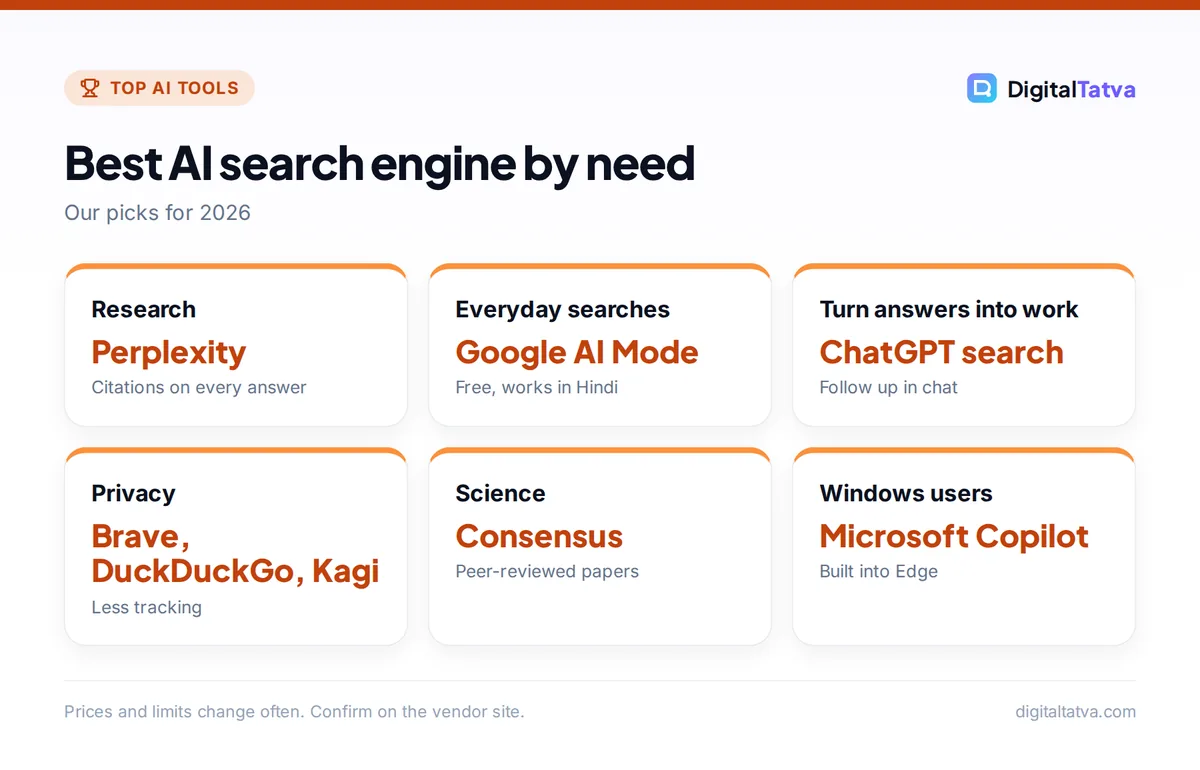
Quick picks: best AI search engines compared
| Search engine | Best for | Free plan | Paid option |
|---|---|---|---|
| Perplexity | Cited answers and research | Yes | Pro $20/month |
| Google AI Mode | Everyday searches, shopping, local | Yes | Pro models with Google AI plans |
| ChatGPT search | Conversational research and follow-ups | Yes | Plus $20/month |
| Gemini | Google ecosystem and deep research | Yes | Google AI Pro $19.99/month |
| Microsoft Copilot | Bing-powered answers on Windows and Edge | Yes | Microsoft 365 plans |
| Brave Search | Private search with AI answers | Yes | Leo Premium $14.99/month |
| DuckDuckGo | Anonymous AI answers and chat | Yes | Optional subscription |
| Kagi | Ad-free, customizable search | Trial | Paid plans only |
| Consensus | Answers from scientific papers | Yes, limited | Pro about $20/month |
| Claude with web search | Careful synthesis of search results | Yes | Pro $20/month |
The 10 best AI search engines
1. Perplexity: Best overall AI search engine
- Starting price: Free; Pro $20/month
- Free plan: Yes
- Best for: Sourced answers, research, students
Perplexity was built as an answer engine from day one. Every answer shows numbered citations, you can pick a focus such as academic or social sources, and Research mode runs deeper multi-source reports. Pro adds a model picker, more research, premium data sources such as PitchBook and Statista, and its Comet browser brings the same search into a full browser. It is the best Google alternative for most people who want answers with receipts. See our Perplexity review and how to use Perplexity.
2. Google AI Mode: Best for everyday searches
- Starting price: Free
- Free plan: Yes
- Best for: Daily questions, shopping, travel, local results
Google AI Mode turns Google Search into a conversation: open google.com/ai or pick AI Mode in the search bar, ask a complex question and follow up. It uses Google’s index, Maps, shopping and flight data, works in about 100 languages including Hindi, and passed 1 billion monthly users in 2026. Subscribers to Google AI Pro and Ultra can pick stronger models, including Gemini 4 Argon rolling out from October 13, 2026. Our guide to Google AI Mode covers every feature.
3. ChatGPT search: Best for conversational research
- Starting price: Free; Plus $20/month
- Free plan: Yes
- Best for: Asking follow-ups and turning results into documents
ChatGPT searches the web automatically when your question needs fresh information, shows sources and lets you keep refining the answer, then turn it into an email, table or plan in the same chat. With GPT-6 now on every plan, its summaries are strong. Free users may see ads below answers in some markets. Compare it with Google in ChatGPT vs Google Search.
4. Gemini: Best for Google users and deep research
- Starting price: Free; Google AI Pro $19.99/month (Rs 1,950 in India)
- Free plan: Yes
- Best for: Research that ends up in Docs, Gmail and Sheets
Gemini answers with Google Search grounding and adds Deep Research, which reads many sources and exports a report to Google Docs. It is the natural pick if your work lives in Google Workspace. Read how to use deep research for the step-by-step method.
5. Microsoft Copilot: Best on Windows and Edge
- Starting price: Free
- Free plan: Yes
- Best for: Quick sourced answers inside Windows and Edge
Copilot uses Bing results and shows sources, and it is built into Windows and the Edge browser, so it is one click away for many PC users. It is good for quick factual questions and summaries of pages you are reading. For a full comparison, see Copilot vs ChatGPT.
6. Brave Search: Best private search with AI answers
- Starting price: Free; Leo Premium $14.99/month
- Free plan: Yes
- Best for: Privacy-conscious users
Brave Search runs on its own independent index and adds AI-generated answers at the top of results. The Brave browser’s Leo assistant summarizes pages and answers questions, and Brave says Leo does not retain or share chats or use them for model training. No account is needed for the free version.
7. DuckDuckGo: Best for anonymous AI chat
- Starting price: Free
- Free plan: Yes
- Best for: Quick private answers without an account
DuckDuckGo adds AI-assisted answers to its private search results and offers Duck.ai, a free chat that lets you talk to several popular AI models anonymously, without creating an account. It is a simple way to use AI search without building a profile of your searches. Check DuckDuckGo’s site for its current model list and limits.
8. Kagi: Best ad-free paid search
- Starting price: Paid plans after a free trial
- Free plan: Trial only
- Best for: Professionals who want no ads and full control
Kagi is a subscription search engine with no ads and no tracking. You can boost or block websites, and its Assistant feature adds AI answers and chat with a choice of models on higher plans. It suits researchers and developers who search all day and are tired of ads and low-quality sites. Check Kagi’s pricing page for current plans.
9. Consensus: Best for scientific research
- Starting price: Free; Pro about $20/month ($12 on annual billing, third-party figure)
- Free plan: Yes, limited
- Best for: Students, doctors and researchers
Consensus searches peer-reviewed papers and summarizes what the research says, showing which studies support or contradict a claim. It is far better than general AI search for questions like “Does intermittent fasting improve sleep?” where you want evidence, not blog opinions. See our list of AI research tools for more academic options.
10. Claude with web search: Best for careful synthesis
- Starting price: Free; Pro $20/month
- Free plan: Yes
- Best for: Long, balanced summaries of many sources
Claude can search the web and is especially good at turning many results into a balanced, clearly written summary that separates facts from opinions. It is not a search engine in the classic sense, but for “explain this complex topic with sources” questions it is excellent. Our Claude guide shows how to turn on web search.
How AI search engines work
An AI search engine combines a search index with a large language model. When you ask a question, it searches the web or its index, pulls the most relevant pages, and the model reads them and writes an answer with citations. Better engines rank sources for quality, cite claims precisely and show when information conflicts. This approach is called retrieval-augmented generation, explained in what RAG is.
How to choose the right AI search engine
- For research and studies: Perplexity or Consensus.
- For everyday searches and shopping: Google AI Mode.
- For turning answers into work: ChatGPT search or Gemini.
- For privacy: Brave Search, DuckDuckGo or Kagi.
- For Windows users: Microsoft Copilot.
Tip: ask AI search engines full questions with context, such as “best budget phone under Rs 20,000 for photos, released in 2026”, rather than keywords. Then ask follow-ups instead of starting over.
Are AI search engines accurate?
They are often accurate on well-covered topics but can misread sources, mix up dates or confidently repeat errors from low-quality pages. Treat answers as a starting point. For money, health, legal or safety decisions, open the cited sources and confirm with official pages. If you publish content, remember that AI search engines increasingly decide which sites get visibility; our guide on how to rank in AI search explains how to earn citations.
Frequently asked questions
What is the best AI search engine?
Perplexity is the best dedicated AI search engine for most people because every answer comes with clear citations and it offers deeper research modes. Google AI Mode is best for everyday searches, and ChatGPT search is best if you want to keep working on results in a chat.
Is there a free AI search engine?
Yes. Perplexity, Google AI Mode, ChatGPT search, Gemini, Microsoft Copilot, Brave Search and DuckDuckGo all have free versions. Paid plans add stronger models, more research runs or ad-free experiences, but free versions are enough for most daily searches.
Can AI search engines replace Google?
For many questions, yes, especially research and how-to questions. Google itself now offers AI Mode. Classic search is still better for finding a specific website, local businesses, very recent news and navigational searches, so many people use both.
Which AI search engine is most private?
DuckDuckGo, Brave Search and Kagi are the most privacy-focused. DuckDuckGo’s Duck.ai works without an account, Brave says its Leo assistant does not retain chats or use them for training, and Kagi is a paid, ad-free search engine with no tracking.
Is Perplexity better than Google?
Perplexity is better for research-style questions where you want a direct, sourced answer. Google is better for local results, shopping, maps, very fresh news and finding specific sites. Google AI Mode narrows the gap by adding conversational answers to Google Search.
Our recommendation
Start with Perplexity for research, Google AI Mode for everyday questions and one privacy option such as Brave Search or DuckDuckGo for sensitive searches. Try each on the same five questions you search often and keep the ones that save you time. Plans and limits change, so confirm current details on Perplexity’s pricing page and Google’s AI Mode help page.
Pricing and features are checked at the time of writing and can change. Some links may be affiliate links, which never affect our verdicts.